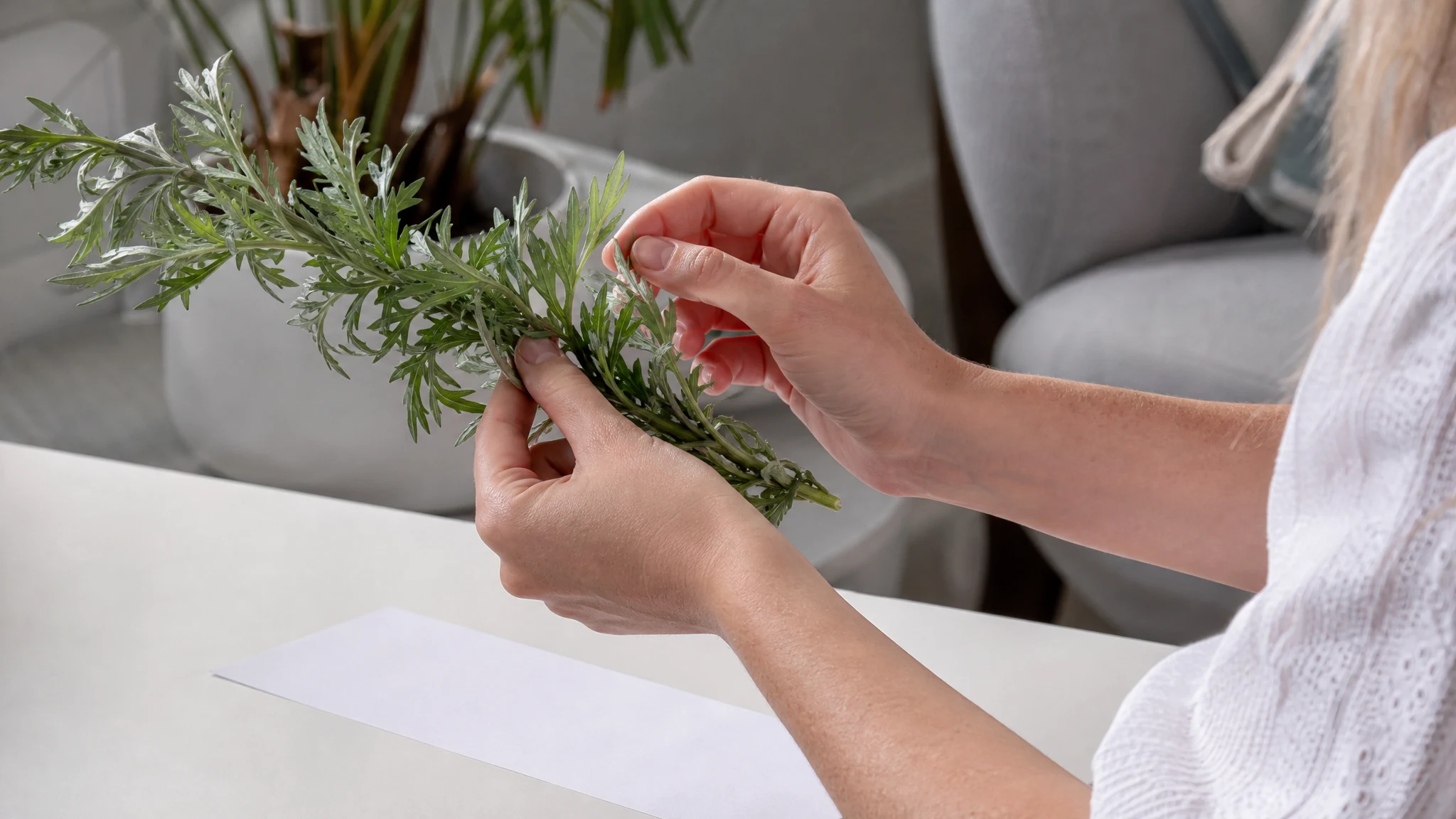
Armoise Oil in Perfumery: Which Artemisia Is on the Label?
Armoise is a French plant name, not a species and not a grade, and in a perfume raw-material catalogue it can mean a different Artemisia from the one an English-speaking buyer expects under "mugwort". If you are a perfumer reading a quote for "armoise oil", the single useful instruction is to get the Latin name and the product form in writing before you evaluate anything else. The rest of this page is laid out as the questions a buyer asks, with the sources that answer them.
Mugwort Essential Oil
Our own Mugwort Essential Oil, in sizes from 0.5 oz to bulk.
From $16.99
Shop Now →Does armoise mean mugwort?
Sometimes. The GBIF taxonomic backbone lists the French names "armoise commune" and "armoise vulgaire" against Artemisia vulgaris L., whose English names there are mugwort and common mugwort (GBIF, accessed October 2026). In the same database, French names for Artemisia herba-alba Asso are "armoise herbe blanche" and "armoise herba-alba", with English names white wormwood and Pyrenean wormwood. Both species are accepted names in the family Asteraceae. So "armoise" is the French root for both a mugwort and a white wormwood, and a fragrance catalogue that drops the qualifier leaves the buyer guessing.
The perfumery listings read for this article show the split in practice:
- A US essential-oil retailer headlines its page "Armoise (Mugwort) - Wild EO" yet lists the botanical name as Artemisia herba-alba Asso, Morocco, leaves, steam distilled, wild harvested (Eden Botanicals, product page, read October 2026).
- A raw-material producer's armoise page gives Artemisia herba-alba Asso, aerial part, harvested in the High Atlas region of southeastern Morocco under government concessions, and says these species are used primarily for their thujone content (Biolandes, product page).
- A third supplier's page titled "Armoise Oil, Morocco" gives Artemisia herba alba Asso with CAS 8022-37-5 and describes a "bitter-sweet thujonic heart" (Frater Works, product page).
- The Good Scents Company, a data aggregator and not an authority, indexes "artemisia vulgaris herb oil" (CAS 68991-20-8) as common mugwort, lists "armoise oil" and "armoise marocco EO" among its synonyms, and in a second entry for a similar material the notes section says wormwood (Artemisia absinthium) (Good Scents, entries 1024711 and 1024712).
Those pages do not agree with each other on what armoise is. That is the point of the first rule: the word does not identify the plant.
Is it an essential oil, an absolute or a concrete?
Form changes both the aroma and the paperwork, because an absolute or concrete is a solvent extract and a steam-distilled oil is not. The three armoise supplier pages above all describe an essential oil (steam distillation is stated on two of them; the third does not state the method). The search for this article found no armoise absolute or concrete listed in any of them, so we cannot tell you that one exists. If a quote says absolute or concrete, treat it as a different product from the pages above and ask which solvent was used and for the specification sheet; that is reasoning, not a sourced rule.
The EU cosmetic ingredient inventory, CosIng, supports the same caution about names. As mirrored by CosIng Checker, it carries separate entries for "Artemisia vulgaris oil" (CAS 84775-45-1, functions perfuming and skin conditioning, defined as the volatile oil from the whole herb of common mugwort), "Artemisia herba-alba herb oil" (CAS 84775-75-7, perfuming) and "Artemisia argyi leaf oil" (fragrance, defined as the volatile oil from the leaves). Three INCI names, three plants, three parts: the label on a finished product would name one of them, and the Latin name on your raw material should match.
What does IFRA say about armoise?
A text search of IFRA's complete Standards compilation (51st Amendment, January 2024) found no standard that names armoise, mugwort or any Artemisia oil. What it does contain is a standard on the compound thujone, Amendment 49 (2020), a restriction driven by neurotoxicity. Its maximum thujone in the finished product is 1.4% for fine fragrance (Category 4) and 0.095% for body creams, oils and lotions (Category 5A) (IFRA, 2024). IFRA's guidance says a restricted substance that arrives inside a natural complex substance has to be counted in the calculation, using an indicative level from IFRA's annex only if the company has no analysis of its own (IFRA, 2023). The Good Scents entry reproduces what appears to be that indicative reference, "alpha-thujone, max found 50.00%, neurotoxicity", while stating it is a non-analysis reference.
One supplier turns this into a per-oil figure. Its Moroccan armoise page lists "IFRA 51: 2.641%" as the permitted amount in finished product (Category 4) and states that these are derived from calculated concentrations that do not replace chromatographic quantification on individual lots (Frater Works). Dividing the IFRA Category 4 thujone cap by that figure, 1.4 / 2.641, gives about 0.53, which implies the supplier assumed roughly 53% thujone. That is our back-calculation, not a number the supplier states. Apply the same 53% to Category 5A and the oil would be capped near 0.18% (0.095 / 0.53) in a body oil; our composition article tabulates the same arithmetic for other thujone shares. Neither is a limit for any oil you hold: only the thujone value on that lot's own analysis decides it.
The retailer above also publishes a use caution for its armoise: no more than 0.25 percent for short-term or occasional topical use, avoid with children, the elderly, epilepsy, pregnancy and nursing, and not for ingestion (Eden Botanicals). That is a retailer's statement about a herba-alba oil, not an IFRA or regulator figure, and it is lower than the 0.5% to 2% in our own skin copy. We flag it because buyers move between the two names; we do not read it across to any other oil.
What does a perfumer do with the answer?
The odour descriptions are supplier language and vary: "fresh cedarleaf minty camphor sage herbal bitter-sweet" at 1% in dipropylene glycol on Good Scents; "sweet, fresh, slightly mentholated top notes" with chamomile-like base on the Biolandes page; an "intensely fresh, camphoraceous blast" on the Frater Works page. A fragrance house's listing quoted on Good Scents is titled "Armoise Oil 70 PCT Thuyone", which is a standardised-thujone product name, a useful reminder that some armoise on the market is sold by thujone content. Our own shop page calls our oil green, bitter and camphoraceous with sage-like facets and lists it as a middle note; it does not tell you what the other oils above smell like.
- Ask for the Latin binomial and authority (for example "Asso" or "L."), the plant part, the form and the process, in writing, tied to a lot number.
- Ask for a GC-MS report for that lot with alpha-thujone and beta-thujone as separate lines, then do your own IFRA arithmetic by category.
- If the quote says only "armoise", do not compare it with a "mugwort" quote on price or aroma: they may be different species.
- Check that the name on the label, the INCI name on your finished product and the report all refer to the same plant.
Our COA gives a relative density of 0.895 and a refractive index of 1.4750 for its batch, nothing about composition; a buyer who needs a thujone figure from us should ask for it in writing and get it in writing before ordering. Our copy says to avoid use during pregnancy, keep the oil from children and pets, and not for internal use. For more on the blend side, see perfumery with mugwort, reading a mugwort oil label and mugwort versus wormwood. A wearable formula with a skin-contact claim should go past a qualified safety assessor.
Mugwort Essential Oil
Mugwort Essential Oil from our own shop, in sizes from 0.5 oz to bulk.
From $16.99
Shop Now →Sources & Further Reading
- GBIF Secretariat, accessed 2026. Artemisia vulgaris L. (usage key 3120946), Artemisia herba-alba Asso (usage key 3120848): accepted names, Asteraceae, vernacular names. api.gbif.org/v1/species/3120946 and api.gbif.org/v1/species/3120848
- Biolandes. Armoise product page. biolandes.com/en/product/armoise
- Eden Botanicals. Armoise (Mugwort), wild essential oil, product page. edenbotanicals.com/armoise-mugwort.html
- Frater Works. Armoise Oil, Morocco, product page. fraterworks.com/products/armoise-oil
- The Good Scents Company. Armoise oil entries (artemisia vulgaris herb oil). thegoodscentscompany.com/data/es1024711.html and es1024712.html
- CosIng Checker (mirror of the EU CosIng inventory). Artemisia vulgaris oil, ref. 83056; Artemisia herba-alba herb oil, ref. 39200; Artemisia argyi leaf oil, ref. 97702. cosingchecker.com/ingredients/83056
- IFRA, 2024. Standards, 51st Amendment compilation, Standard "Thujone", pp. 309-311. ifrafragrance.org 51st Amendment standards
- IFRA, 2023. Guidance for the use of IFRA Standards, 51st Amendment. IFRA guidance PDF