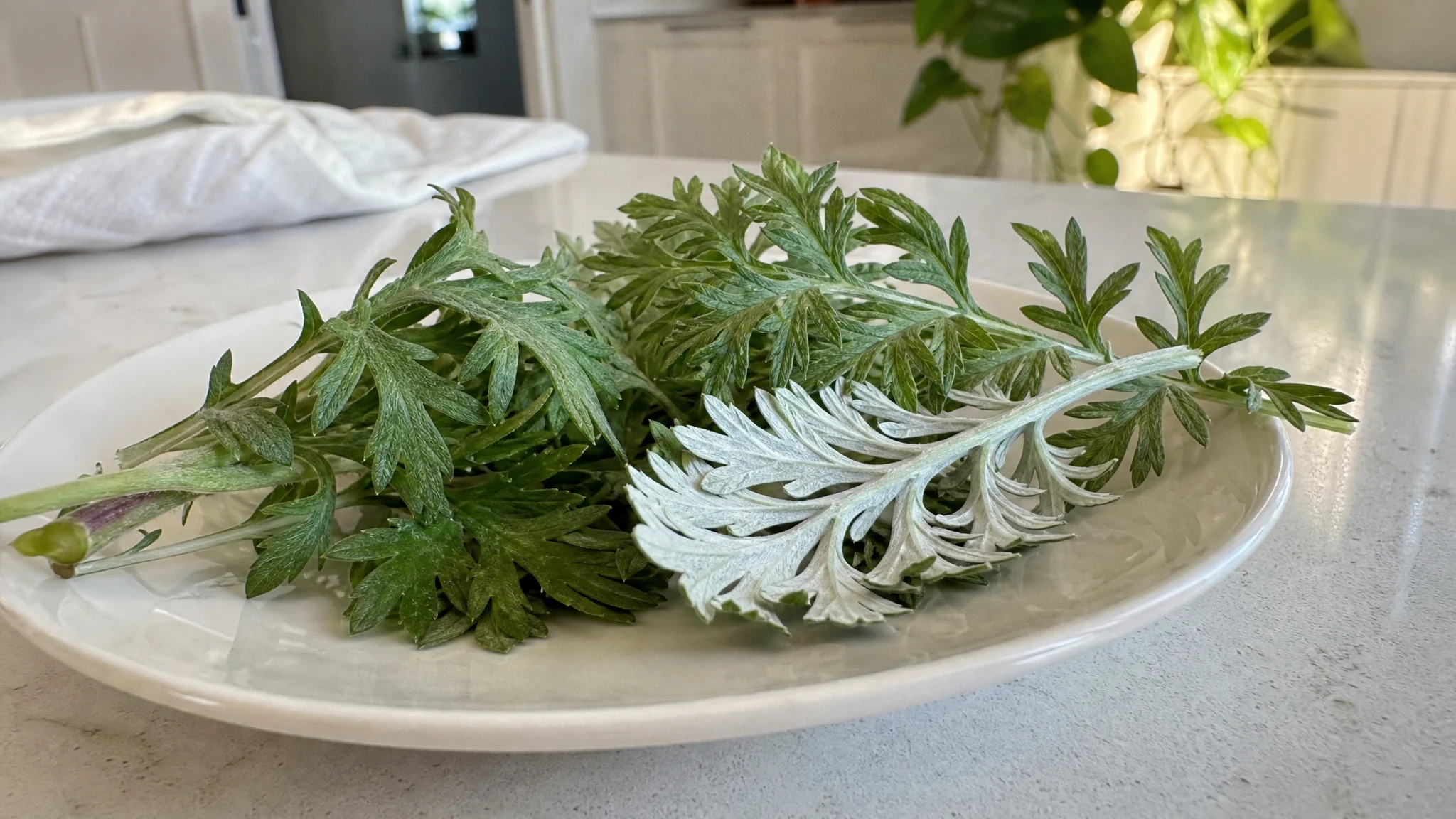
Mugwort Oil Composition: What Published Analyses Show
There is no such thing as a typical mugwort oil composition, and any page that gives you one number for thujone, camphor or 1,8-cineole is averaging materials that are not the same. The published analyses below range from oils with no reported thujone and no camphor at all to oils where trans-thujone is the lead compound. This article shows what those papers measured, explains the one constituent with a regulatory standard attached, works out what that standard does to a dilution, and says what to demand in writing before you buy.

Mugwort Essential Oil
Our own Mugwort Essential Oil, in sizes from 0.5 oz to bulk.
From $16.99
Shop Now →What the published analyses actually show
Every row below is from a paper (or a review summarising a paper), reported as relative peak area from gas chromatography with mass spectrometry. None of it describes our oil. The batch on the published COA gives a relative density of 0.895 and a refractive index of 1.4750, and nothing about composition, so these tables cannot be laid over it.
| Species, material, origin | Method | Leading compounds reported (% of oil) | Source |
|---|---|---|---|
| Artemisia vulgaris, cultivated, dried aerial parts cut before flowering, Maranhao, Brazil (August 2016) | Hydrodistillation, 3 h | caryophyllene 37.45; germacrene D 16.17; humulene 13.66; borneol 6.80. Thujone, camphor and 1,8-cineole not reported (18 compounds identified) | Malik et al., 2019 |
| A. vulgaris, aerial parts, Lithuania (study from 2016, as summarised in a review) | Not stated in the review | davanones 13.8 to 45.5 (six oils); germacrene D 9.1 to 30.5 (four oils); 1,8-cineole 16.4 (one oil); camphor 18.9 (one oil); trans-thujone 8.9 and 10.9 (two oils) | Pandey and Singh, 2017 |
| A. vulgaris, Erie, Pennsylvania, USA (2012 study, as summarised) | Not stated in the review | Leaves: germacrene D 25, caryophyllene 20, alpha-zingiberene 15, borneol 11. Buds: 1,8-cineole 32, camphor 16, borneol 9, caryophyllene 5 | Pandey and Singh, 2017 |
| A. argyi, aerial parts, China (2014 study, as summarised) | Not stated in the review | eucalyptol (1,8-cineole) 22.03; beta-pinene 14.53; beta-caryophyllene 9.24; camphor 5.45 | Pandey and Singh, 2017 |
| A. argyi, leaves, Qichun, China | Hydrodistillation | neointermedeol 9.65; caryophyllene oxide 8.71; alpha-thujone 7.99; beta-caryophyllene 7.50; borneol 6.48; camphor ((+)-2-bornanone) 3.90 | Guan et al., 2019 |
| A. argyi, same leaves, same paper | Subcritical butane extraction | beta-caryophyllene 20.02; alpha-thujone 11.31; borneol 8.27; camphor 7.25 | Guan et al., 2019 |
| A. argyi, leaves and stems, Anhui plantation, China | Steam distillation, 8 h | eucalyptol 13.76; terpinen-4-ol 6.77 (thujone and borneol not reported) | Li et al., 2023 |
Four things stand out. First, the Brazilian oil is led by sesquiterpenes and its authors state that monoterpene hydrocarbons were absent, while the same paper's survey of earlier work reports European mugwort oils dominated by monoterpenes (Malik et al., 2019). Second, within one species the lead compound moves from germacrene D to davanones to 1,8-cineole to trans-thujone depending on the country and the plant part: in the Pennsylvania study the leaves and the buds of the plants have different leaders (germacrene D against 1,8-cineole). Third, the method matters as much as the plant: Guan and colleagues distilled and extracted the same ground leaves three ways and got caryophyllene oxide at 8.71% by hydrodistillation but 0.13% by subcritical extraction. Fourth, thujone appears in both species' literature, so its presence is not a species fingerprint, and it does not follow from a Latin name.
The one constituent with rules attached: thujone
Thujone occurs as a variable mixture of alpha-thujone and beta-thujone. The European Medicines Agency's herbal committee (2012) describes alpha-thujone as a rapid modulator of the GABA-gated chloride channel, about two to three times more potent than the beta form in a receptor binding assay, with epileptiform convulsions as the most prominent sign of acute poisoning in animals. It also states that no studies allow a reliable assessment for sensitive groups such as pregnant women and children, and that use of thujone-containing herbal medicinal products in those groups should be minimised. That is a statement about oral herbal medicines, not about fragrance use. Our own copy says to avoid use during pregnancy and to keep the oil away from children and pets; the safety article covers the practical side.
Three regulatory texts show how seriously the compound is handled, each for a different use:
- US food rules: 21 CFR 172.510 lists "Artemisia (wormwood), Artemisia spp" among natural flavoring substances with the limitation "finished food thujone free" (US Code of Federal Regulations, Cornell LII text). It sets a test method, not a number.
- European herbal medicines: the HMPC statement (22 May 2012) records a maximum of 3 mg of thujone per person per day for wormwood herb preparations and 5 mg for sage leaf, each for at most two weeks, and a Council of Europe tolerable daily intake of 10 micrograms per kg of body weight per day.
- European food flavourings: the same statement cites Regulation (EC) 1334/2008 limits of 35 mg/kg thujone in alcoholic beverages produced from Artemisia species and 0.5 mg/kg in non-alcoholic ones.
None of these governs a fragrance oil on the skin. For that, the relevant document is the standard from the International Fragrance Association.
What the IFRA thujone standard does to a dilution
A text search of IFRA's complete Standards compilation (51st Amendment, January 2024) found no standard naming mugwort or any Artemisia oil. There is a standard on the compound itself, "Thujone", Amendment 49 (2020), a restriction driven by neurotoxicity, which applies to the thujone contributed by natural oils as well (IFRA, 2024). IFRA's guidance adds that restricted substances arriving through a natural complex substance must be counted, and that an analytically determined level replaces the indicative one (IFRA, 2023). Maximum thujone in the finished product, per category: fine fragrance (Cat 4) 1.4%; body creams, oils and lotions (Cat 5A) 0.095%; face (5B) 0.032%; hand cream (5C) 0.016%; candles (Cat 12) 9.5%.
The arithmetic is simple: maximum oil percentage equals the thujone cap divided by the oil's thujone share. We hold no thujone figure for our oil, so the table uses stand-in shares to show the shape of the problem, not a limit for any oil.
| Assumed thujone share of the oil | Cat 4 (cap 1.4%) | Cat 5A (cap 0.095%) | Cat 5C (cap 0.016%) |
|---|---|---|---|
| 1% | no limit below 100% | 9.5% oil | 1.6% oil |
| 5% | 28% oil | 1.9% oil | 0.32% oil |
| 10% | 14% oil | 0.95% oil | 0.16% oil |
| 20% | 7% oil | 0.475% oil | 0.08% oil |
Our copy says to dilute to 0.5% to 2% in a carrier for skin use and to patch test first. Against body-oil limits, the top of that range (2%) is above the Cat 5A cap whenever the oil is more than 4.75% thujone, and the bottom (0.5%) is above it once thujone passes 19%. For a hand cream (5C) the top of our range is exceeded above 0.8% thujone. Two of the oils in the table above, at 8.9% and 10.9% trans-thujone, sit inside that zone for 2% in a body oil. This is a conditional conflict, and we state it plainly: if your supplier's GC-MS shows thujone in the range of the Lithuanian oils, a body-oil dilution near 2% exceeds IFRA's thujone figure, and the lower end of our range is the more defensible place to stay. For scale, 0.95% of one ounce of carrier is about 5.6 drops at roughly 20 drops per ml (weigh instead of counting). The Tisserand Institute states that maximums for internal toxicities such as neurotoxicity are flexible and depend on how much oil is absorbed, with the figures in Essential Oil Safety assuming 30 ml of oil applied to the whole body (Tisserand Institute, undated); we could not read the book and report no mugwort-specific figure from it.
What to ask for before you buy, and what a buyer can and cannot infer
- A GC-MS report for the lot you will receive, naming the species, plant part and distillation method, with alpha-thujone and beta-thujone as separate lines, the laboratory and the date. Percentages with no named laboratory are an assertion.
- The same Latin name on the bottle, the invoice and the report. The label-reading guide goes through mismatches.
- A statement of what the figures are: relative peak area is not mass percent, and two laboratories can rank the same oil differently.
Our COA does not contain composition data. A buyer who needs a GC-MS or thujone figure should ask for it in writing before ordering and get it in writing; the quality-check article explains what physical constants like density and refractive index can and cannot show. For the contrast with a thujone-dominant relative, see the wormwood comparison.
A formulator with a regulatory question about finished products should take the GC-MS to a qualified regulatory or safety professional; this article describes published figures and is not a safety assessment.
Mugwort Essential Oil
Mugwort Essential Oil from our own shop, in sizes from 0.5 oz to bulk.
From $16.99
Shop Now →Sources & Further Reading
- Malik et al., 2019. Chemical profile and biological activities of essential oil from Artemisia vulgaris L. cultivated in Brazil. Pharmaceuticals 12(2):49. pmc.ncbi.nlm.nih.gov/articles/PMC6631396
- Pandey and Singh, 2017. The genus Artemisia: a 2012 to 2017 literature review on chemical composition, antimicrobial, insecticidal and antioxidant activities of essential oils. Medicines 4(3):68. pmc.ncbi.nlm.nih.gov/articles/PMC5622403
- Guan et al., 2019. Chemical composition and antimicrobial activities of Artemisia argyi essential oils extracted by simultaneous distillation-extraction, subcritical extraction and hydrodistillation. Molecules 24(3):483. pmc.ncbi.nlm.nih.gov/articles/PMC6384757
- Li et al., 2023. The antimicrobial effect and mechanism of the Artemisia argyi essential oil against bacteria and fungus. Brazilian Journal of Microbiology 55(1):727-735. pmc.ncbi.nlm.nih.gov/articles/PMC10920523
- European Medicines Agency HMPC, 2012. Public statement on the use of herbal medicinal products containing thujone, EMA/HMPC/732886/2010 Rev. 1. ema.europa.eu thujone statement
- US Code of Federal Regulations, 21 CFR 172.510, natural flavoring substances. law.cornell.edu/cfr/text/21/172.510
- IFRA, 2024. Standards, 51st Amendment compilation, Standard "Thujone" (Amendment 49, 2020), pp. 309-311. ifrafragrance.org 51st Amendment standards
- IFRA, 2023. Guidance for the use of IFRA Standards, 51st Amendment. IFRA guidance PDF
- Tisserand Institute. Q&A: safety maximums for dermal application. tisserandinstitute.org/learn-more/safety-maximum-dermal