
Mugwort Oil Safety: Thujone, Dilution, and Why Caution Matters During Pregnancy
Mugwort essential oil carries a quiet mystique. It has been distilled from the silver-leafed Artemisia vulgaris plant for centuries, prized in folk traditions across Europe, East Asia, and the Americas. But its aromatic appeal comes with a chemistry profile that demands genuine respect. If you are asking whether mugwort oil is safe, the honest answer is: it can be, in the right hands, at the right concentration, for the right person.
This guide walks through the key safety considerations in plain language. We will look closely at thujone, the compound responsible for most of mugwort oil's safety concerns, explain dilution ratios with step-by-step instructions, and be direct about why pregnancy is a firm contraindication. Whether you use essential oils casually or follow botanical traditions closely, this information matters before you open the bottle.
Understanding Mugwort Oil: A Quick Starting Point
Before diving into safety specifics, a brief grounding in what mugwort oil actually is helps set the context. For a fuller picture of the plant and its extraction, the complete guide to mugwort essential oil covers the botany, distillation process, and aromatic character in depth.
In short: mugwort essential oil is steam-distilled from the leaves, stems, and flowering tops of Artemisia vulgaris. The resulting oil is typically thin, pale yellow to olive in color, and carries a sharp, herbaceous scent with earthy and slightly woody undertones. Its chemical composition varies depending on the plant's geographic origin, the part of the plant used, and the time of harvest.
That variability is one reason mugwort oil safety conversations are not simple. Two bottles labeled "mugwort essential oil" can have meaningfully different thujone concentrations. Sourcing quality, tested oil from a reputable supplier is not a luxury. It is a baseline requirement.
What Is Thujone and Why Does It Matter?
Thujone is a naturally occurring ketone found in several plants in the Artemisia family, including mugwort, wormwood, and sage. It exists in two forms: alpha-thujone and beta-thujone. Both appear in mugwort oil, though the ratio and total concentration vary considerably between samples.
Mugwort oil thujone levels are the primary focus of safety discussions because thujone acts as a neurotoxin at sufficient doses. Research has shown that high exposure can overstimulate the nervous system. This is not a theoretical concern limited to laboratory extremes. It is the practical reason why regulatory bodies in the European Union have set limits on thujone in food and beverages, and why professional aromatherapy organizations consistently flag mugwort as a high-caution oil.
Some mugwort oils are relatively low in thujone, while others can contain concentrations above 50 percent of total composition. Without a gas chromatography and mass spectrometry (GC/MS) report from your supplier, you cannot know which you have. This single fact should shape every decision you make about how, and whether, to use the oil.
What GC/MS Testing Tells You
A GC/MS report is a chemical analysis document that breaks down an essential oil into its constituent compounds and their percentages. Reputable suppliers provide these reports, often batch-by-batch, either on their website or upon request. When evaluating a mugwort oil, look specifically for:
- Total thujone percentage (alpha plus beta combined)
- Camphor percentage (another ketone that also warrants caution)
- Country and region of origin for the plant material
- Part of plant distilled (leaf, aerial parts, flowering tops)
- Distillation date or batch number for traceability
If a supplier cannot or will not provide this information, that is a clear signal to shop elsewhere.
Is Mugwort Oil Safe? The Honest Framework
Mugwort oil is not classified as safe for all uses by aromatherapy safety authorities. Robert Tisserand and Rodney Young, whose textbook Essential Oil Safety is the field's most cited reference, categorize mugwort as one of the oils with the most significant safety concerns due to its thujone and camphor content. Their guidance recommends avoiding dermal use entirely for some mugwort chemotypes, and reserving any application for very specific, informed contexts.
That said, mugwort oil is not uniquely dangerous when compared proportionally to other high-ketone oils like pennyroyal, tansy, or wormwood. The key is understanding what you are working with and applying a conservative, informed approach.
Here is the practical framework:
- Know your chemotype. Not all mugwort oils are the same. Oils distilled from plants grown in China, Europe, and North Africa can differ dramatically in composition.
- Always dilute. Undiluted (neat) application of mugwort oil to skin is not appropriate practice for any adult user.
- Use conservative dilution ratios. More on this below.
- Limit frequency. This is not an oil intended for daily, long-term topical use.
- Avoid inhalation in enclosed spaces at high concentrations. Diffusing mugwort in a small, poorly ventilated room at high output is not a recommended approach.
- Certain populations should avoid it entirely. Pregnancy is the most critical exclusion, discussed at length below.
Step-by-Step: Safe Dilution for Topical Use

If you have confirmed your mugwort oil has a documented, lower thujone content from a reputable supplier, and you have consulted a qualified healthcare provider, the following dilution guidance reflects conservative aromatherapy best practice.
Materials You Will Need
- Mugwort essential oil (with GC/MS report on file)
- A carrier oil appropriate for your skin type (options include fractionated coconut oil, sweet almond oil, or jojoba oil)
- Small glass mixing vessel or roller bottle
- A pipette or dropper for accurate measurement
- Labels and a marker to record your blend details
- Measuring tool: knowing that 1 ml of carrier oil typically holds approximately 20 drops helps with ratio calculations
Recommended Dilution Rate
Standard aromatherapy dilution for most adults runs between 2 and 3 percent for body application. For high-thujone oils like mugwort, a more cautious maximum of 0.5 to 1 percent is the conservative professional recommendation. Some practitioners suggest staying at 0.5 percent until you have confirmed your individual tolerance.
At a 1 percent dilution: 1 drop of essential oil per 5 ml of carrier oil. At 0.5 percent: 1 drop per 10 ml of carrier oil.
Step 1: Gather and Label Everything Before You Start
Set out all your materials. Label your container now, before mixing, so there is no risk of forgetting what is inside. Note the mugwort oil batch number, the carrier oil used, the dilution percentage, and the date. This is a habit worth forming with all essential oil blends.
Step 2: Measure Your Carrier Oil First
Add your carrier oil to the vessel before the essential oil. This order matters. It prevents you from accidentally adding too many drops of essential oil before the carrier is in place. Start with 10 ml of carrier if you are making a 0.5 percent dilution, or 5 ml for a 1 percent dilution.
Step 3: Add the Essential Oil One Drop at a Time
For a 0.5 percent dilution in 10 ml of carrier: add exactly 1 drop of mugwort essential oil. For a 1 percent dilution in 5 ml of carrier: add exactly 1 drop. Do not estimate. Drops vary in size by bottle tip, so a calibrated dropper is preferable to a standard orifice reducer when precision matters.
Step 4: Mix Gently and Cap Immediately
Swirl or roll the vessel gently to combine. Do not shake vigorously. Cap immediately to prevent oxidation. Mugwort oil, like all high-ketone oils, can oxidize over time. An oxidized oil may increase the likelihood of skin sensitivity.
Step 5: Patch Test Before Any Full Application
Apply a small amount of your diluted blend (about the size of a pea) to the inside of your forearm. Leave it uncovered and unwashed for 24 hours. Observe for any redness, itching, or change in the skin. If any reaction appears, do not continue use. Even at conservative dilutions, individual sensitivity varies.
Step 6: Limit Application Area and Frequency
If the patch test is clear, apply the diluted blend to small, targeted skin areas rather than large body surfaces. Avoid mucous membranes, eyes, and broken skin entirely. For aromatic enjoyment rather than skin contact, consider adding a drop or two to a diffuser with water, in a well-ventilated room, for short sessions of 30 to 60 minutes.
Common Mistakes to Avoid
Even experienced oil users make avoidable errors with high-caution botanicals. The following patterns appear frequently and are worth naming directly.
- Using undiluted oil. There is no context in which applying undiluted mugwort oil directly to skin is appropriate practice.
- Assuming "natural" means low-risk. Thujone is entirely natural. So is the risk it poses at high concentrations.
- Buying without a GC/MS report. Price and attractive packaging tell you nothing about chemical composition.
- Prolonged daily diffusion. Extended, repeated inhalation of high-thujone oil in enclosed spaces is not a safe habit, regardless of how pleasant the scent may be.
- Skipping the patch test. First-time users of any new essential oil blend should always patch test, and mugwort warrants particular attention here.
- Storing oil incorrectly. Keep mugwort oil in a dark glass bottle, away from heat and light, capped tightly. Degraded oil is more likely to cause skin sensitivity than fresh, well-stored oil.
Why Pregnancy Is a Firm Contraindication
This section requires directness. Mugwort oil is not appropriate for use during pregnancy. This is not a precautionary footnote. It is a primary safety consideration that aromatherapy authorities, midwifery organizations, and botanical safety researchers consistently uphold.
The plant Artemisia vulgaris has been used historically in various cultural traditions in ways that are specifically tied to uterine stimulation. Mugwort's long role in folklore is deeply connected to this property. The centuries of tradition behind mugwort include explicit references to its use in contexts that would be contraindicated in pregnancy, which is exactly why those traditional applications are informative from a safety standpoint.
The essential oil is a concentrated extract of the plant's volatile compounds. The constituents responsible for the plant's traditional properties are present in the oil at much higher concentrations than in the whole herb. Using mugwort oil during pregnancy, whether through skin application or inhalation, is not a calculated risk worth taking. It is an avoidable one.
This contraindication extends to people who are actively trying to conceive and those who may be in very early pregnancy without yet knowing it. If there is any possibility of pregnancy, mugwort oil should be set aside entirely.
Breastfeeding is another context where caution applies. Because the safety profile for nursing infants has not been established, the conservative position is to avoid mugwort oil during that period as well.
Young children should not be exposed to high-ketone essential oils. The same applies to people with certain neurological conditions. A qualified healthcare provider is the right person to consult if you have specific questions about whether mugwort oil is appropriate for your individual circumstances.
Aromatic Use: Lower Risk, Still Mindful
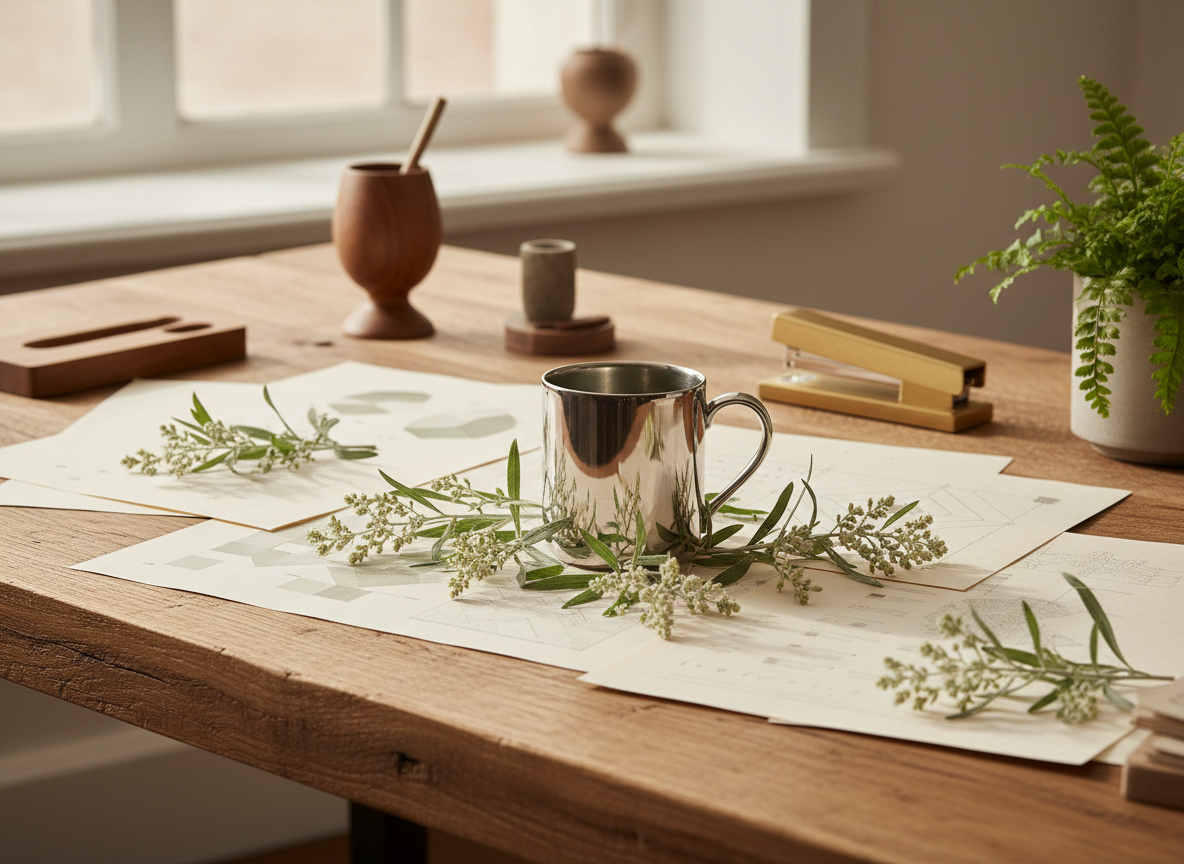
Diffusing mugwort oil in a well-ventilated space at low concentrations is a different risk category than topical application. Many people are drawn to mugwort's complex, camphoraceous, and slightly sweet herbal scent for aromatic rituals, creative spaces, and evening wind-down routines.
If you choose to diffuse mugwort oil:
- Use 2 to 3 drops maximum in a standard diffuser with the manufacturer's recommended water volume.
- Diffuse for no more than 30 to 60 minutes at a time in a well-ventilated room.
- Do not diffuse around pregnant people, young children, or pets.
- Take breaks between sessions. Continuous diffusion of any essential oil is not a best practice.
- If the scent feels overwhelming or you notice any head pressure or discomfort, turn the diffuser off and open a window.
Aromatic use allows you to engage with mugwort's distinctive botanical character without the concerns that come with skin contact. For many people curious about this plant, the scent itself is the draw, and diffusion at modest concentrations is the most accessible way to explore it.
What to Expect: Honest, Hedged Observations
People who use mugwort oil aromatically as part of an evening routine often report that its herbaceous, grounding scent contributes to a sense of atmosphere well-suited to winding down. Some describe the scent as anchoring, earthy, and slightly green with soft woody notes beneath. Others find it sharp or medicinal and prefer blending it in very small proportions with softer botanicals like lavender or cedarwood to round out the profile.
From a skin application standpoint, when properly diluted, some users report that mugwort oil blends absorb well into carrier oils without leaving a heavy residue. Its scent dissipates relatively quickly on skin compared to heavier resins or roots.
It is worth noting: results in personal care and aromatic contexts vary widely between individuals. What one person finds deeply pleasant in scent and sensation, another may find too assertive. This is common across the entire essential oil category and particularly relevant with bold botanicals like mugwort.
Additional Safety Populations to Keep in Mind
Beyond pregnancy, a few other groups warrant a careful, conservative approach to mugwort oil:
- People with ragweed or Asteraceae plant sensitivities. Mugwort is in the same botanical family. Cross-sensitivity is possible, and patch testing is especially important.
- People taking certain medications. Essential oils with high ketone content may interact with some medications. A pharmacist or healthcare provider can offer guidance specific to your situation.
- Older adults and people with sensitive skin. Skin barrier function varies with age, and more conservative dilutions are appropriate for greater skin sensitivity.
- People new to essential oils entirely. Starting with well-established, lower-risk oils before working with high-caution botanicals like mugwort is a sensible sequence.
Sourcing Quality Mugwort Oil: The Foundation of Safe Use
Safe use of mugwort oil begins at the point of purchase. No dilution technique or safety protocol can compensate for a poorly sourced, adulterated, or mislabeled product. When evaluating suppliers, look for:
- Botanical name clearly stated (Artemisia vulgaris) with plant part specified.
- Country of origin listed for the plant material (not just where the company is located).
- GC/MS reports available, ideally batch-specific and from a third-party laboratory.
- Clear storage and shelf-life guidance provided.
- A supplier willing to answer sourcing questions directly and transparently.
If you are new to mugwort and want a broader foundation before purchasing, the 15 common questions answered about mugwort essential oil is a good place to fill in gaps before committing to a bottle.
Keeping Perspective
Mugwort oil is a genuinely interesting botanical, with a rich cultural history and a distinctive aromatic character that earns its place in a thoughtfully curated collection. The safety considerations outlined here are not reasons to fear it. They are reasons to approach it with the kind of informed respect that makes working with complex botanicals a satisfying and responsible practice.
Thujone is real. The pregnancy contraindication is firm. Dilution is non-negotiable. And with all of that clearly understood, mugwort oil can be enjoyed as part of an aromatic ritual by adults who have done their homework, sourced carefully, and consulted a healthcare provider when their personal circumstances called for it.
For those drawn to mugwort's long story as much as its scent, that combination of knowledge and caution is exactly the spirit in which this plant has always asked to be engaged.