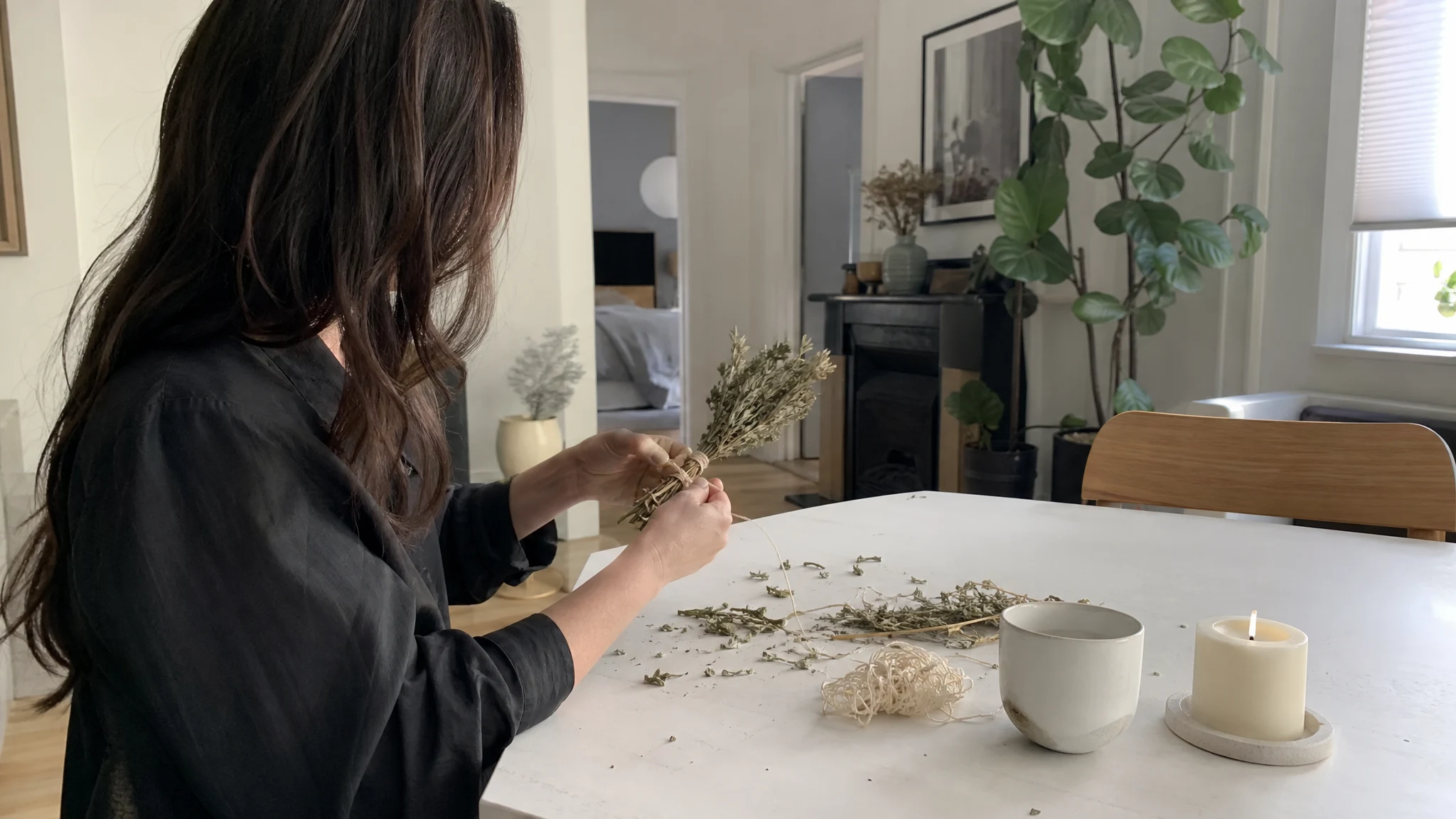
Mugwort in Folk Magic and Witchcraft: A Source History
In the texts read for this article, mugwort shows up far more often as a herb used against witches, ghosts and bad luck than as a herb used by witches. The record runs from a Roman natural history, through Anglo-Saxon medical books, to a sixteenth-century English herbal that refuses to repeat the lore, to nineteenth-century village collections. Everything below is a reported belief, set beside its date, and none of it says mugwort or mugwort oil achieves anything.
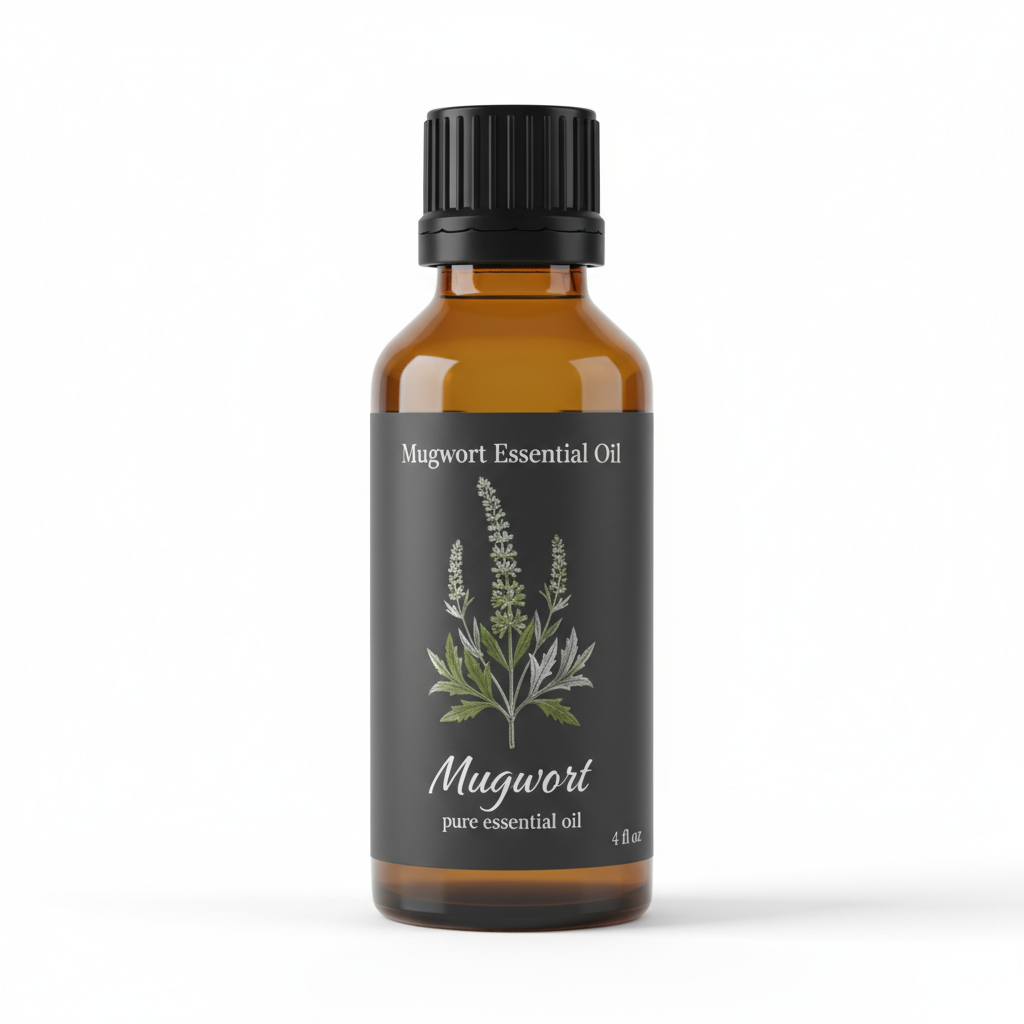
Mugwort Essential Oil
Our own Mugwort Essential Oil, in sizes from 0.5 oz to bulk.
From $16.99
Shop Now →Tier one: a hearsay line in Pliny
The Roman author Pliny the Elder, in his Natural History, Book 26, chapter 89, writes in the Bostock and Riley translation (Perseus Digital Library, London, 1855): "The traveller who carries artemisia attached to his person, or elelisphacus, will never be sensible of lassitude, it is said." The qualifier "it is said" is Pliny's own: he is relaying, not vouching. His separate chapter on artemisia (25.36) says the plant took the name of Artemisia, wife of King Mausolus, or else of the goddess Artemis Ilithyia because it was used "for the cure of female complaints more particularly." The translators' footnotes say the broader-leaved variety is "probably" Artemisia chamaemelifolia and name other Artemisias for the other varieties. So even at the earliest stage, "artemisia" is a name that need not mean the plant now called common mugwort.
Tier two: Anglo-Saxon books, where belief and medicine are one text
Oswald Cockayne's Leechdoms, Wortcunning, and Starcraft of Early England (Rolls Series, 1864 to 1866, on the Internet Archive) prints three passages worth setting side by side.
- The Old English Herbarium (vol. 1, 1864), in its first artemisia entry: "if any propose a journey, then let him take to him in hand this wort artemisia ... then he will not feel much toil in his journey. And it also puts to flight devil sickness (demoniac possession)," and kept in the house it "turneth away the evil eyes of evil men." The running title of the volume calls this the Herbarium of Apuleius, and the entry sits beside remedies for "sore of inwards" and "sore of feet."
- Bald's Leechbook, Book I, chapter lxxxvi (vol. 2, 1865, p. 155): "For mickle travelling over land, lest he tire, let him take mugwort to him in hand, or put it into his shoe ... and when he will pluck it, before the upgoing of the sun, let him say first these words, 'I will take thee, artemisia, lest I be weary on the way,' etc. Sign it with the sign of the cross, when thou pullest it up." The charm is Christian in form: a spoken formula, a time of day and a cross.
- The Nine Herbs Charm in the Lacnunga (vol. 3, 1866), which addresses mugwort first: "Have a mind, mugwort, / What thou mentionedst / What thou preparedst / At the prime telling. / Una thou hightest / Eldest of worts." The manuscript is British Library Harley MS 585, dated to the late tenth or early eleventh century by the Gneuss Handlist, as summarised by DigiPal.
Two features matter for the "ancient pagan herb" claim. The charm mixes registers: the same short poem has Woden striking an adder into nine pieces and, a few lines on, "Christ stood over sickness of a cruel kind" (Benjamin Slade's 2002 facing-text translation). It is a Christian-era manuscript preserving older-looking material, and nothing in the text dates the older layer. And translations disagree: Cockayne's "at the prime telling" is Slade's "at the mighty proclamation" for the same line. The charm's stated job is against "poison and contagion," and it ends with a salve of nine herbs and instructions to sing over them; that is a medical-magical recipe of its era, reported here as history, not as guidance.
Tier three: an English herbalist who left it out
John Gerard's Herball (London, 1597; scan, p. 946) repeats, "Pliny saith," the traveller line and then writes: "Many other fantasticall deuises inuented by Poets are to be seene in the workes of the auncient writers, tending to witchcraft and sorcerie, and the great dishonor of God: wherefore I do of purpose omit them as things vnwoorthie of my recording or your reuiewing." He also reports, citing Dioscorides, that mugwort "bringeth downe the termes, the birth and the afterbirth." That last sentence is a reason, by reasoning and not by any source's statement, why the pregnancy question belongs with an obstetric clinician: the historical herbals describe it as acting on pregnancy, and our own safety copy says to avoid use during pregnancy.
Tier four: village collections, 1845 to 1892
In The Golden Bough (Frazer, third edition, 1913, vol. 11), the mugwort customs are overwhelmingly counter-magic. Bohemian girdles are "believed to protect the wearer for the whole year against ghosts, magic, misfortune, and sickness." In Bohemia, a bewitched cow that gives no milk could be washed with a St John's Day mugwort decoction "and the spell will be broken." Stalks "hinder witches from laying their spells on the butter" (Normandy, de Nore 1846 and Lecoeur 1883-86 as cited), and on the Isle of Man mugwort was gathered at Midsummer Eve "as a preventive against the influence of witchcraft" (Train, 1845). The Midsummer details are in the St John's Eve article. Frazer also reports from 1910 and 1901 sources mugwort used in China and by the Ainu to expel "poisonous airs" and "demons of disease." These are reports from compilers outside the cultures described, and the sources are mostly a century or more younger than the Anglo-Saxon texts.
Tier five: modern pagan witchcraft, and what could not be checked
The scholarly standard history is Ronald Hutton's The Triumph of the Moon (Oxford University Press, 1999). Only a chapter abstract was retrievable: it describes Gerald Gardner as "the person most prominently associated with the appearance of modern pagan witchcraft" (OUP chapter page), and it does not mention mugwort. The book's argument about continuity with older practice was behind a paywall and is not reported here. The honest position is narrow: the pre-modern texts above are charms, amulets and herbal remedies, and nothing in them presents itself as a witch's own rite; whether and how modern witchcraft adopted mugwort is a question for that scholarship, not for a seller of oil.
A claims table
| Common claim | What the sources read here show |
|---|---|
| "Mugwort has been a witches' herb since antiquity" | Antiquity: Pliny relays travel lore "it is said." Witches: the records read name mugwort against witches (Frazer's collections) or against "witchcraft" as something Gerard wished to omit |
| "The Anglo-Saxons called it the oldest herb" | The Lacnunga charm says "Una ... oldest of herbs" (Cockayne 1866: "Eldest of worts"), in a Christian-era manuscript |
| "It was always a Midsummer plant" | The Anglo-Saxon passages quoted here do not mention a feast day; the earliest dated midsummer source in Frazer is 1541 |
| "It brings dreams" | No passage quoted here mentions dreams |
Where this leaves a maker
If you want to work with this tradition as a craft, treat it as a craft: name your source, label the practice as belief, and keep outcome words out of your product copy. The FDA's aromatherapy page (content current as of 2023-09-08) says a product's intended use, judged from its claims, decides whether it is a cosmetic or a drug, and that a plant origin does not change that. Nothing here shows our oil does anything. Our shop copy lists ritual and seasonal candles as an intended use; the ritual candle post covers that as a craft, and the folklore overview covers the wider tradition.
Mugwort Essential Oil
Mugwort Essential Oil from our own shop, in sizes from 0.5 oz to bulk.
From $16.99
Shop Now →Sources & Further Reading
- Pliny the Elder. The Natural History, Books 25 (ch. 36) and 26 (ch. 89), trans. J. Bostock and H. T. Riley, London: Taylor and Francis, 1855. Perseus Digital Library. perseus.tufts.edu (26.89), (25.36)
- Cockayne, O. (ed. and trans.), 1864 to 1866. Leechdoms, Wortcunning, and Starcraft of Early England, vols. 1 to 3, Rolls Series 35. archive.org/details/leechdomswortcun02cock
- DigiPal, citing Gneuss, Handlist of Anglo-Saxon Manuscripts (G. 421). BL Harley 585. digipal.eu/digipal/manuscripts/996
- Slade, B., 2002. Woden's Nine Herbs Charm, from Lacnunga LXXIX-LXXXII. heorot.dk
- Gerard, J., 1597. The Herball, or Generall Historie of Plantes, London: John Norton, p. 946. archive.org/details/mobot31753000817749
- Frazer, J. G., 1913. The Golden Bough, third edition, Part VII, Balder the Beautiful, vol. 2 (vol. 11 of 12), Macmillan. gutenberg.org/ebooks/43433
- Hutton, R., 1999. The Triumph of the Moon: A History of Modern Pagan Witchcraft, Oxford University Press, chapter "Gerald Gardner" (abstract only). academic.oup.com/book/7115
- U.S. FDA, 2023. Aromatherapy (content current as of 09/08/2023). fda.gov/aromatherapy