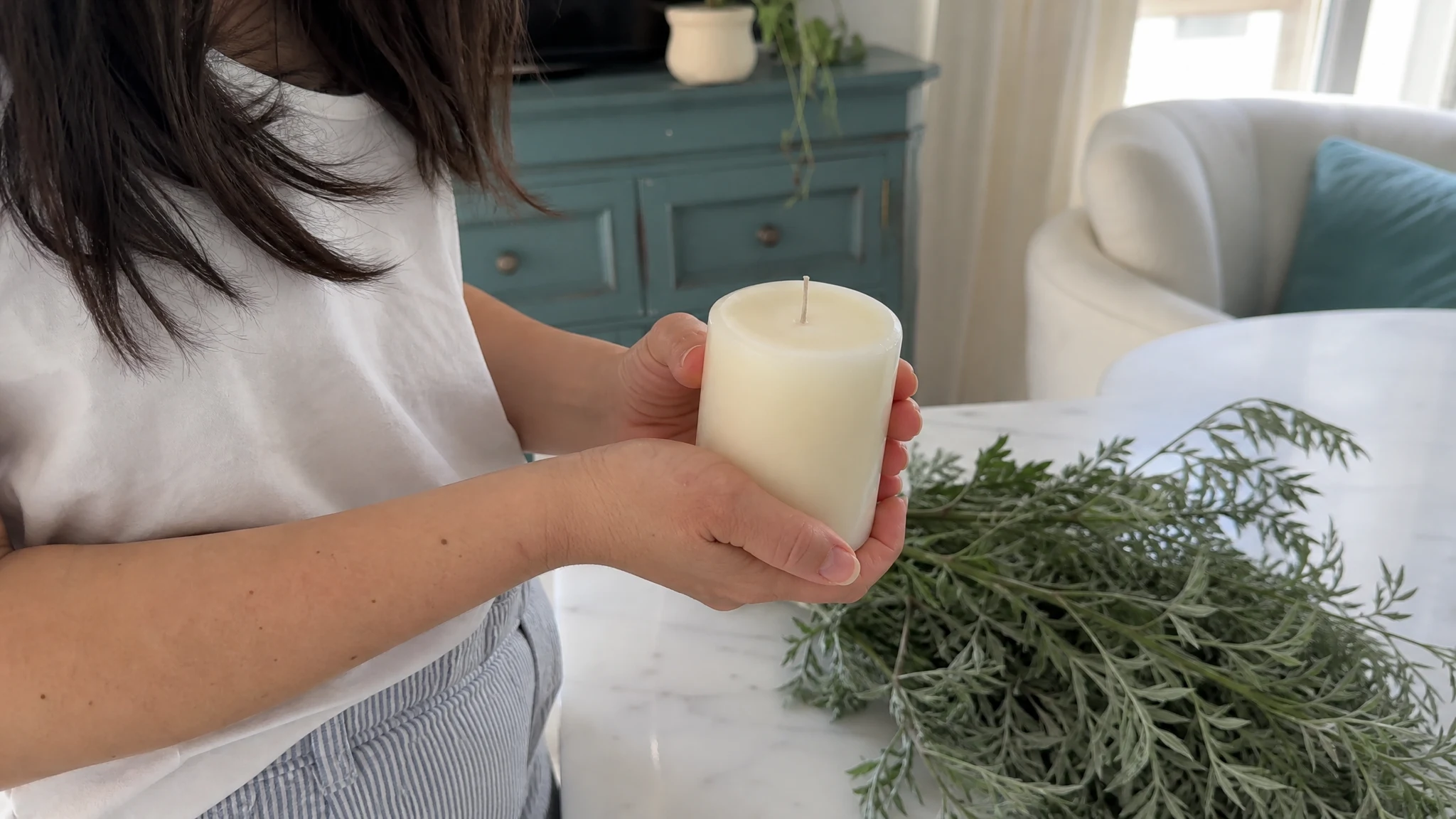
Dressing a Candle with Mugwort Oil: Custom, Skin and Fire
Dressing a candle means rubbing oil onto its outside before it is lit, and it is a custom, not a technique with a measured result. Our position is short: put mugwort oil in the wax if you want the scent, and if you still want to dress the candle as part of a practice, use a heavily diluted oil, keep it off the wick end, wear gloves, and never leave the candle unattended. The reasons are fire and skin contact, and both come with numbers below.

Mugwort Essential Oil
Our own Mugwort Essential Oil, in sizes from 0.5 oz to bulk.
From $16.99
Shop Now →What "dressing" is, according to the one source we could read
The clearest published description the search found is commercial, not scholarly. On the Lucky Mojo Curio Company's "Love Me" page, copyright catherine yronwode, the instructions for a prayer-light candle read: carve your full name on a pink or red offertory candle, "dress the candle with Love Me Oil", and "as you dress the candle, speak aloud your petition". The page never defines dressing; it treats it as understood (Lucky Mojo Curio Co., Love Me spiritual supplies, undated). The wider Lucky Mojo candle page mentions dressing only in passing inside product descriptions and says nothing about fire safety (Lucky Mojo Curio Co., candles, copyright 1994 to 2019).
That is one vendor's account of one tradition, American hoodoo and conjure practice, and we did not read sources on any other tradition's practice, so nothing here describes dressing in general. We report it as a custom. We do not say that mugwort oil, or any oil, charges, protects, cleanses or banishes anything, and the shop does not sell it for that. For the plant's own history see mugwort in folklore and the folk magic post.
Problem one: oil on a candle is something extra that can burn
No source we fetched tests essential oil on the outside of a candle, so what follows is reasoning from fire-safety guidance, labeled as such. A candle is a controlled fuel supply: the wick draws melted wax up to a small flame. Oil smeared on the surface, and especially oil on the upper edge, the wick end or the rim of a container, is fuel that was not part of the design. The more oil, the nearer the flame, the worse the case, which is why our advice is a thin film on the body of the candle and none near the top.
The published rules for ordinary candle use show how little margin there is. The National Candle Association advises trimming the wick to a quarter inch before each use, keeping candles at least 12 inches from curtains, bedding, books and other flammable items, never burning one for more than about four hours at a time, and stopping at about half an inch of wax (National Candle Association, undated). The Illinois Office of the State Fire Marshal, quoting National Fire Protection Association data for 2015 to 2019, reports about 20 home candle fires a day, and that three in five (60%) began when something combustible was left or came too close to the candle; 37% started in a bedroom, and falling asleep was a factor in 10% (Illinois OSFM, citing NFPA, undated page). Candle fire-safety labeling under ASTM F2058 asks for three things in pictures: burn within sight, keep away from combustibles, keep away from children and pets (National Candle Association, 18 January 2019).
A candle burned as part of a personal practice may be lit in a bedroom, left to burn down, or lit while the person is absorbed in something else, which are the circumstances those numbers describe. A candle dressed in oil does not change that arithmetic in a good direction. Our recommendations, all reasoning:
- Dress the lower two thirds of the body of the candle only, and leave the top inch and the wick untouched.
- Use a thin film, wiped, not a coating you can see running.
- Do not dress a candle in a container at all; the oil collects at the rim and the walls.
- Burn it in sight, on a heat-proof base, 12 inches from anything flammable, and out before sleep.
The alternative is plainer: add the oil to the wax when you make the candle. Wax makers publish loads for that, and the IFRA ceiling for candles is not the limit (see how to make mugwort candles and the wax guide). It puts the scent in the room without a layer of oil on the outside, which is the point of this section.
Problem two: your hands are the applicator
Dressing is done with the fingers, usually repeatedly and often with a daily top-up. That is skin contact with the oil, and our own copy for skin use is to dilute to 0.5% to 2% in a carrier oil, patch test first, keep the oil away from the eyes, children and pets, and avoid use during pregnancy. The shop's standards page adds that dilutions "should be very low indeed", and says it is unsuitable for anyone pregnant or nursing, for children, and for anyone with a history of seizures.
Published limits point the same way. IFRA has no standard named for mugwort oil in the compilation we read (up to the 51st Amendment, January 2024), but it restricts thujone, a neurotoxic constituent of some Artemisia oils: 0.095% thujone in the finished product for body oils and lotions (Category 5A) and 0.016% for hand cream (Category 5C) (IFRA Standards, 51st Amendment compilation, Thujone, Amendment 49, 2020). IFRA has no category for a candle-dressing oil, so these are the nearest guideposts, not rules for you. The thujone share of mugwort oils in the literature runs from none to about 20%, depending on species and origin (Ekiert et al., Molecules, 2020; Luo et al., Scientific Reports, 2022). The COA we publish reports no constituent, so the share for our oil is not on paper. Here is what each end of our copy delivers, at three assumed shares:
| Mugwort oil in carrier | Thujone at 1% share | At 5% share | At 17% share |
|---|---|---|---|
| 0.25% | 0.0025% | 0.0125% | 0.0425% |
| 0.5% | 0.005% | 0.025% | 0.085% |
| 2% | 0.02% | 0.1% | 0.34% |
Set against the body-oil figure of 0.095%: the top of our copy (2%) exceeds it at a 5% share and is 3.6 times it at 17%; 0.5% stays under it up to a share of about 19%. Against the hand-cream figure of 0.016%, even 0.25% exceeds it at a 17% share. This is a flag against our own copy: if the thujone content of the batch in your hands is high, the upper half of 0.5% to 2% is above a published IFRA thujone figure for leave-on skin products, and nothing in the middle of the range is a confirmed margin. A retailer page for a different species, Artemisia herba-alba, recommends no more than 0.25% for occasional topical use and cites Tisserand and Young's Essential Oil Safety (Eden Botanicals, undated); we could not read the book, so we cannot say what it gives for mugwort oil, and that figure is not about our oil.
The Tisserand Institute explains why such limits are not a simple dial: skin-reaction maximums are fixed concentrations, while limits for internal toxicity such as neurotoxicity assume maximum whole-body application and fall as the amount and area rise (Tisserand Institute, undated). A fingertip on a candle is a small area, but it is repeated.
A dressing oil worked out by weight
This is a formulation, not a tested recipe. We have not made it or dressed a candle with it. Use a carrier oil from a craft or soap supply shop (we do not sell carriers) and ask that supplier for its safety data sheet. Our recommendation is no more than 0.5% mugwort oil, and 0.25% if the thujone share of your batch is unknown to you. One ounce of carrier is 29.57 ml. At 0.5%, that is 0.148 ml of mugwort oil, about 3 drops at 20 drops to the milliliter; at 0.25%, about 1.5 drops. One drop in an ounce is 0.17%. Droppers vary, so a small scale is better than counting. Make a very small amount, label it, wear nitrile gloves when you apply it, patch test first as our copy says, and wash your hands afterward.
If anyone in the home is pregnant or nursing, the answer from our copy is to avoid use, and the right person to ask is an obstetric clinician. Keep the bottle, the dressing oil and the dressed candle away from children and pets, and call a veterinarian or poison help line (1-800-222-1222 in the US) after any exposure.
What we cannot say
We have no burn tests of dressed candles, no flash point for our oil (a buyer who needs the safety data sheet should ask for it in writing), and no data on how oil on a candle's surface changes the flame. Anyone selling dressed candles faces labeling and product-liability questions that are outside this page; start with labeling essential oil candles in the US and then a product-safety attorney.
The wick, the wax and the room do the work of a candle. A dressing is a small custom laid on top of them, and it earns its place only if it adds no fire and no avoidable skin exposure.
Mugwort Essential Oil
Mugwort Essential Oil from our own shop, in sizes from 0.5 oz to bulk.
From $16.99
Shop Now →Sources & Further Reading
- Lucky Mojo Curio Co. (yronwode C.), undated. Love Me spiritual supplies. luckymojo.com/loveme.html
- Lucky Mojo Curio Co. (yronwode C.), 1994 to 2019. Candles. luckymojo.com/candles.html
- National Candle Association, undated. Candle safety. candles.org/candle-safety
- National Candle Association, 2019. Candle Labels 101: understanding product claims and safety instructions. candles.org
- Illinois Office of the State Fire Marshal, undated. Candle safety (NFPA statistics 2015 to 2019). sfm.illinois.gov
- IFRA, 2024. The complete IFRA Standards up to and including the 51st Amendment (Thujone). ifra-standards-51st-amendment.pdf
- Ekiert H. et al., 2020. Significance of Artemisia vulgaris L. (common mugwort) in the history of medicine and its possible contemporary applications substantiated by phytochemical and pharmacological studies. Molecules 25(19):4415. PMC7583039
- Luo D.-Y. et al., 2022. Repellency and insecticidal activity of seven mugwort (Artemisia argyi) essential oils. Scientific Reports 12:5337. PMC8964668
- Tisserand Institute, undated. Q&A safety maximums for dermal application. tisserandinstitute.org
- Eden Botanicals, undated. Armoise (mugwort), Artemisia herba-alba. edenbotanicals.com