Best Wax for Mugwort Candles: What the Data Sheets Say
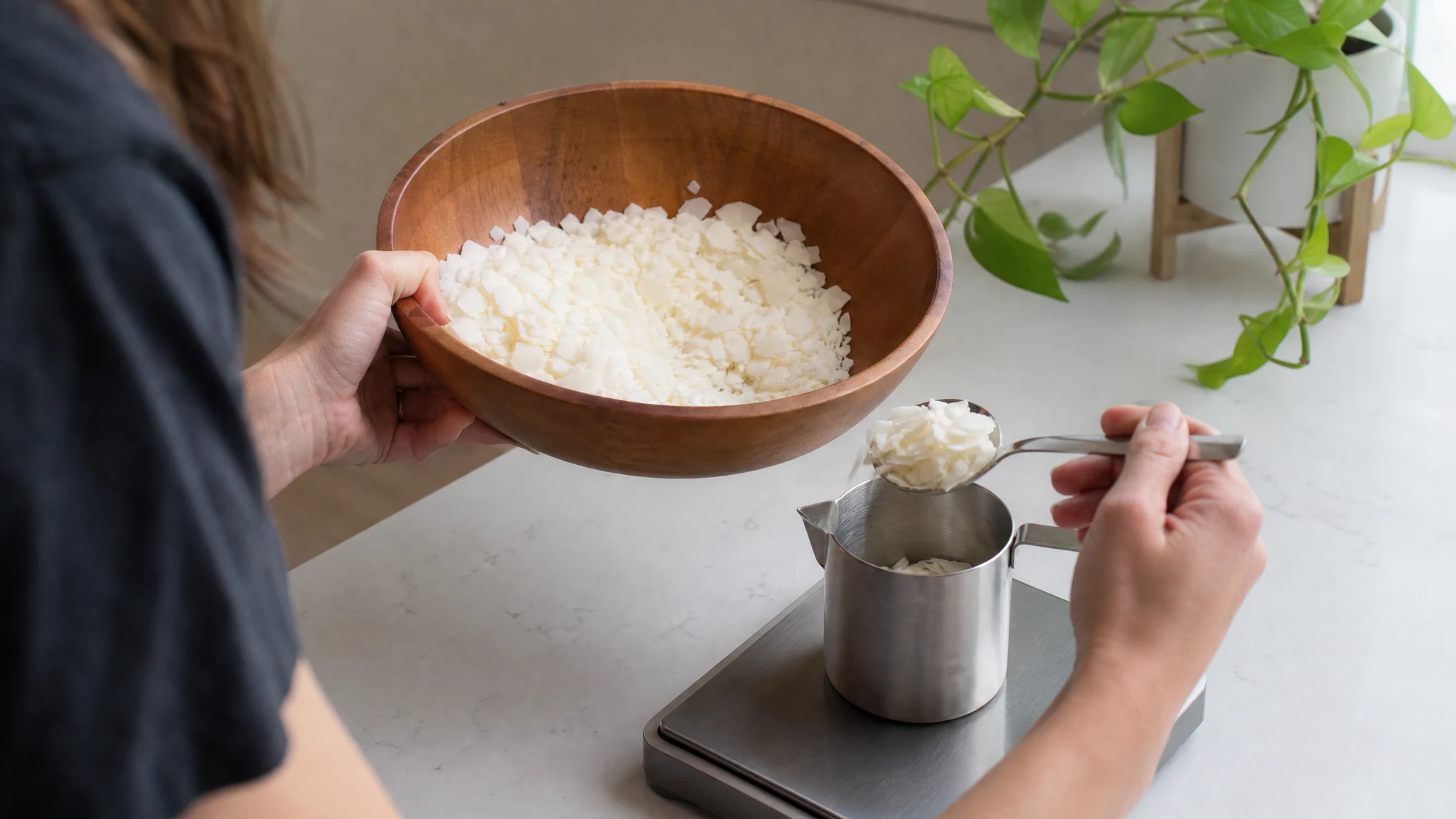
There is no best wax for a mugwort candle, and the published data sheets do not support picking one by the word on the bag. What a wax does give you is a ceiling on how much oil it will hold, a pour window and a wick family, and those three figures are what a first batch varies. Choose the wax whose sheet states all three, then let a small pilot decide the rest. Every figure below comes from a data sheet or supplier page; we have not poured or burned any wax with mugwort oil.
Mugwort Essential Oil
Our own Mugwort Essential Oil, in sizes from 0.5 oz to bulk.
From $16.99
Shop Now →What the sheets state, and what they leave out
Congealing point is the temperature at which molten wax starts to set; the sheets list it by ASTM D938. It matters because one sheet advises pouring close to it for better adhesion to the glass. Read the table with the right-hand column in mind: a blank is information too.
| Wax family and product (as named) | Congealing point | Fragrance level stated | Wick notes stated |
|---|---|---|---|
| Soy container wax (sheet v5.0, 2020, maker not named in the document) | 34 to 42 C (typical 39) | Up to 10 to 12% | Natural waxes need larger wicks; too large causes sooting, too small tunnels |
| Soy, EcoSoya CB-Advanced (v3.0, 2020) | 38 C typical | None stated | Test burn after 48 hours; try different wicks |
| Coconut-predominant, EcoCoco ContainerBlend (v2.0, 2020) | 40 C typical (melt point 55 C) | Designed for 5 to 12% | Larger wicks than paraffin |
| Rapeseed blend, Kerawax 4170 (v4.0, 2020) | 40 to 46 C (typical 42) | Up to 10% | Natural waxes typically need larger wicks |
| Container blend, Kerawax 4105 (v5.0, 2020) | 43 to 49 C (typical 45) | 5 to 10% | Wick size left to the candle maker |
| Paraffin container wax, WAX003 (Supplies for Candles Ltd, 2022) | 49 to 54 C | None stated on the sheet; the same supplier's product page for Kerawax 4140 says it holds up to 12% | Page names LX and Stabilo wick series |
Three things stand out. First, the natural container blends publish ceilings of 10 to 12%, and the paraffin supplier page says 12%, so the idea that natural waxes simply hold less (or more) oil than paraffin is not what these documents say. Second, one widely used soy container sheet (EcoSoya CB-Advanced) states no fragrance ceiling at all, so a buyer who picks it needs a ceiling from the supplier in writing. Third, none of the sheets is about essential oils.
Where the sources disagree
Paraffin and load. One fragrance supplier says paraffin takes lower loads, soy moderate to higher and coconut blends higher, without numbers (AFI, undated). A candle supplier's essential-oil guide says the reverse for the top of the range: soy and coconut at 6 to 10%, beeswax at 3 to 6%, paraffin up to 12% (Village Craft and Candle, 2026), which matches the 12% on the Kerawax 4140 supplier page (Supplies For Candles). Another page from that retailer says most waxes hold no more than 12% and recommends 10% for good throw (Supplies For Candles, undated). Because the sources split, the sheet for the exact wax in your hand decides, not the wax family.
Flash points of essential oils. A fragrance supplier says essential oils have flash points of around 40 to 60 C, against 80 C and above for fragrance oils (NI Candle Supplies, undated), while the Village Craft guide says many common essential oils fall between 50 and 75 C. Both are generalisations by suppliers, neither names mugwort, and we publish no flash point for our oil. A buyer should request the safety data sheet in writing and read the number there.
What the wax means for a plant oil
The sheets recommend fragrance made for natural waxes, and the EcoCoco and soy sheets add that fragrances designed for paraffin candles exaggerate bleeding, poor surfaces and poor flame quality. None says what a single steam-distilled plant oil does. Reasoning from the stated ceilings, the practical consequence is that a ceiling of 10 to 12% tells you where problems begin for fragrance, not where an essential oil performs. The oil also sets its own handling limit: addition temperature relative to flash point is the open question described above.
Wick demand is the one consistent signal. Four sheets say natural waxes tend to need larger wicks than paraffin, and a wick supplier says more additives mean a larger wick (Candlewic, 2025). So switching from paraffin to soy or coconut moves the wick size up even before the oil is added, and each oil load moves it again. This is why the pilot ladder in the how-to guide holds wax, jar and wick constant and varies only the load.
The arithmetic of a ceiling you will not use
At a 200 g candle (our assumption), a 10% ceiling is 20 g of oil and a 4% pilot is 8 g. The batch on our published COA has a relative density of 0.895, so a 1 oz bottle holds about 26.5 g. The 4% candle uses 8 g, so one 1 oz bottle makes about 3.3 candles; the 10% candle uses 20 g, so the same bottle makes 1.3. A 5 lb container (2,268 g) makes about 283 candles at 4% and 113 at 10%. For a reseller, then, the wax ceiling is a limit on the formula, not a figure to buy against. Do not size an order on the ceiling. See the buying guide for sizes and the comparison with fragrance oil for why a plant oil is not a drop-in replacement.
Our recommendation, in the order we would apply it
- Reject any wax with no published fragrance ceiling, pour temperature and wick guidance, and ask the supplier for them in writing, together with the safety data sheet. Hot wax and heated equipment carry their own hazards, which the SDS covers and this article does not.
- Prefer a single-pour container blend whose sheet states a pour temperature in the 60 to 65 C range, since our oil should be added late and cool (the open question under "Where the sources disagree").
- Avoid beeswax for a first batch unless you accept a 3 to 6% ceiling, from one supplier's guide, and a larger wick.
- Make the pilot, not the table, the decision. Wax melts use different waxes and have their own guide: mugwort wax melts.
This article makes no claim about which wax burns cleaner or lasts longer: the sheets do not address it, and we have burned none. Wax, wicks and containers are not sold by us; a candle supply shop is where to buy them.
Mugwort Essential Oil
Mugwort Essential Oil from our own shop, in sizes from 0.5 oz to bulk.
From $16.99
Shop Now →Sources & Further Reading
- Soy wax container technical data sheet, v5.0, revised 2020 (maker not named in the document). cdn.shopify.com/Soy_Wax_Container_Technical_Data_Sheetv5.0.pdf
- Kerax Ltd, 2020. Technical data sheet, EcoSoya CB-Advanced, v3.0. candle.gr/EcoSoya_CB-Advanced_-TDS_v3.0.pdf
- EcoCoco, 2020. Technical data sheet, ContainerBlend, v2.0. candle.gr/EcoCoco-ContainerBlend-TDS.pdf
- Kerax Ltd, 2020. Technical data sheet, Kerawax 4170, v4.0. smellingood.com/KW-4170v4.0-TDS.pdf
- Kerax Ltd, 2020. Technical data sheet, Kerawax 4105, v5.0. candle.gr/KW-4105-TDS-v05.pdf
- Supplies for Candles Ltd, 2022. Technical data sheet, WAX003 Paraffin Container Wax. suppliesforcandles.co.uk/WAX003 TDS
- Supplies For Candles. Paraffin Container Wax (Kerawax 4140), product page. suppliesforcandles.co.uk/product/paraffin-container-wax
- Supplies For Candles. How much fragrance to add to candles. suppliesforcandles.co.uk/?p=9995
- Village Craft and Candle, 2026. Candle making essential oil guide. villagecraftandcandle.com/candle-making-essential-oil
- NI Candle Supplies. Fragrance oils vs essential oils: the ultimate maker's guide. nicandlesupplies.com/fragrance-oils-vs-essential-oils
- AFI (Aromatic Fragrances International). Hot throw: the scientific method to stronger smelling candles. afi-usa.com/hot-throw
- Candlewic, 2025. Wicks for candles: how to choose the right one. candlewic.com/wicks-for-candles