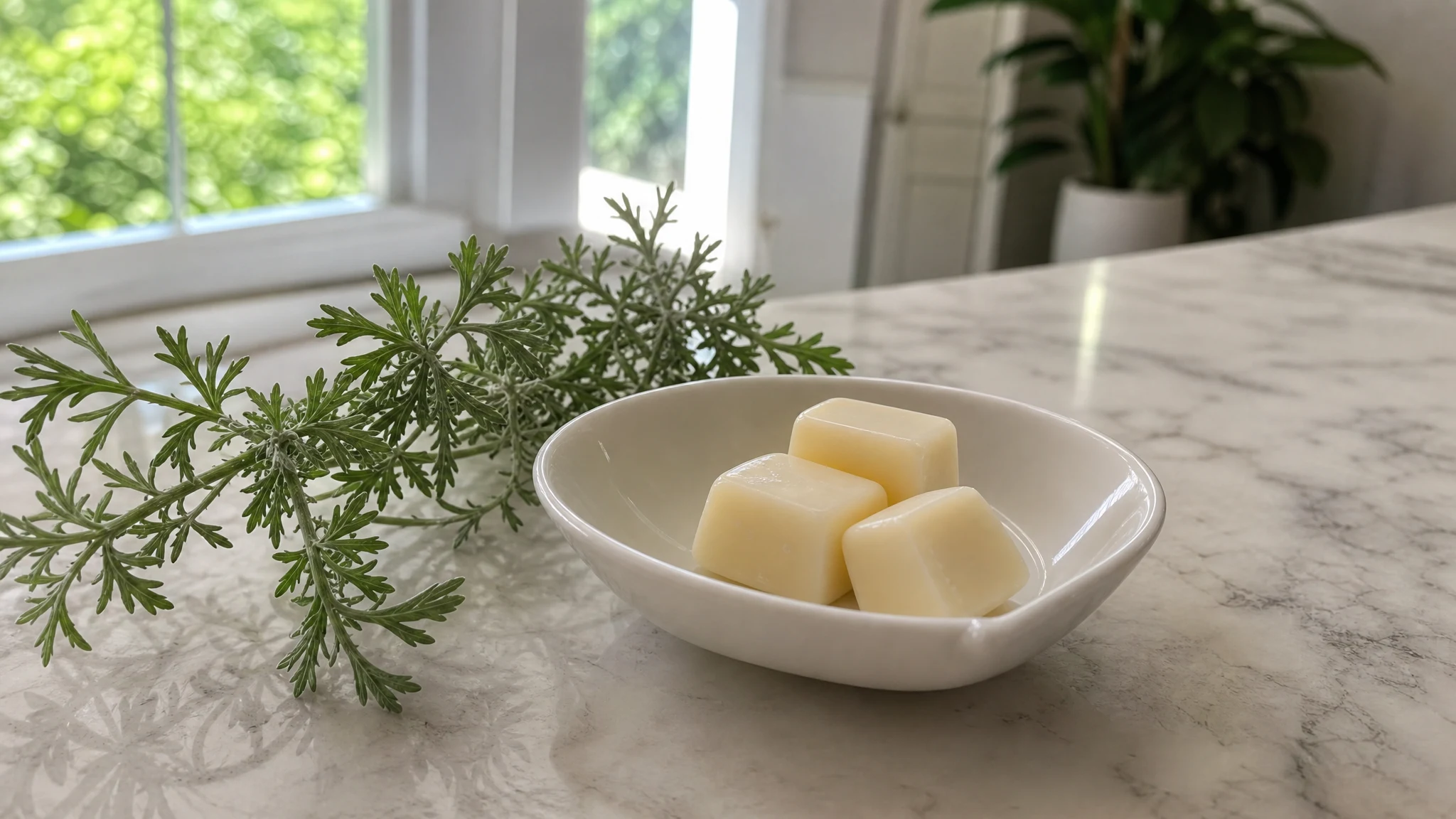
Mugwort Wax Melts: A 200 g Batch Worked Out by Weight
A wax melt has no wick, no flame and no second chance: whatever oil you stir into it is released by warmth alone, for hours at a time, in the room where the warmer sits. That changes the questions worth asking about mugwort oil. This post works one 200 g batch out by weight from published wax-maker figures, flags where those figures stop applying to an essential oil, and says plainly that we have not poured it.

Mugwort Essential Oil
Our own Mugwort Essential Oil, in sizes from 0.5 oz to bulk.
From $16.99
Shop Now →The verdict first: start low, and ask whether a melt is the right format
Our own copy calls mugwort oil "a restrained perfumery and ritual material", describes the aroma as green, bitter and camphoraceous, advises avoiding use during pregnancy, and keeps it away from children and pets. A warmer is an all-day diffusion device, and the same page copy says to diffuse the oil lightly if at all. So our position is a narrow one: if you make melts, make a small batch at a modest load, use the warmer for short sessions, and decide per household whether a continuous room scent fits. If anyone in the home is pregnant or nursing, has a seizure history, or if small children or pets share the room, ask the relevant professional (an obstetric clinician, a physician, a veterinarian) before the warmer goes on, not after.
If what you want is a mugwort candle rather than a melt, the wick changes the load, the temperatures and the labeling; see how to make mugwort candles and the wax guide.
Where the load numbers come from, and what they do not cover
Wax makers publish the highest fragrance load a given wax holds before oil weeps out. These are the figures the search found on pages we read this session. All are written for fragrance oils or for waxes in general; none is a rule for mugwort essential oil.
| Wax or source | Stated figure for melts | Date and scope |
|---|---|---|
| CandleScience melt recipe | 10% fragrance in its worked example | Undated page, copyright 2026; CocoSol wax |
| CandleScience, maximums listed for melts | CocoSol 25%, EcoSoya PB 12%, IGI 6028 9%, IGI 4625 6% | Same page |
| Blended Waxes Inc., BW 923 tart/melt blend | "Up to 15% Maximum" scent load | Manufacturer's product page, undated |
Read the spread: the same job has a ceiling of 6% in one wax and 25% in another. The wax's own data sheet is the only number that matters, and it is a ceiling, not a target. CandleScience's own advice for essential oils is to check the usage percentage on the product page and start with low percentages (CandleScience, melt guide, undated; Blended Waxes Inc., BW 923, via Voyageur Soap and Candle).
The 200 g batch, in grams and drops
The batch below is a formulation we worked out from those figures and from arithmetic. We have not made it, poured it or smelled it from a warmer. The conversion uses the relative density of the batch on our published COA, 0.895, so 1 ml is about 0.895 g, and about 20 drops to the milliliter (droppers vary, so weigh the oil on a scale: that removes the drop error entirely).
| Load (by weight of wax) | Oil in 200 g wax | Volume | Drops, about |
|---|---|---|---|
| 2% | 4 g | 4.5 ml | 89 |
| 4% | 8 g | 8.9 ml | 179 |
| 6% | 12 g | 13.4 ml | 268 |
| 10% | 20 g | 22.3 ml | 447 |
Our recommendation is to pour three small test batches at 2%, 4% and 6%, label them, and let the warmer tell you. Ten percent is listed only because it is the load in a wax maker's worked example for fragrance oil; at 20 g it is about 0.75 oz of oil in a single 200 g batch, and a bitter, camphoraceous oil is more likely to be too much than too little. Never exceed the ceiling on your wax's own sheet. See the shop page for the current price per size if you are budgeting a test series.
Pouring: temperatures from the wax makers, one gap from us
The two makers read agree on the sequence and differ slightly on the numbers. CandleScience says to add fragrance at 185 F (85 C), remove from heat, stir gently for about 2 minutes, then cool to 170 F (76.7 C) before pouring into a silicone mold, and to let the melts cure for 1 to 2 weeks before use. Blended Waxes gives a pour window of 160 to 180 F with a suggested start at 160 to 170 F, melts the wax to about 180 F, adds fragrance off the heat and stirs about 2 minutes, and asks that melts sit undisturbed for 48 hours before first test melting.
The gap: those temperatures are written for fragrance oils whose flash points the supplier knows. We state no flash point for our oil, and the COA we publish does not include one. The practical step is to request the safety data sheet in writing before you heat the oil in wax; US rules require a manufacturer or importer to provide a safety data sheet to distributors and employers with the first shipment (29 CFR 1910.1200(g)(6) and (g)(7)), and the sheet's section 9 is where physical properties are reported. Until you hold the figure, reasoning from the makers' ranges, the lower end of the stated window is the conservative place to add the oil, and a thermometer, not a guess, should set it.
The warmer is the riskier object than the wax
Essex County Fire and Rescue Service in the UK is blunt: use a wax melter designed for wax melts, not a candle warmer or a hot plate, because those devices "can get too hot and cause the wax to catch fire"; never leave an electric melter unattended; and do not melt wax melts for more than 4 hours at a time (Essex County Fire and Rescue Service, undated). Appliances themselves also get recalled: a 2020 joint action by Health Canada, the US Consumer Product Safety Commission and Scentsy covered two warmer models whose electrical components could corrode and pose a fire hazard, with 5,424 of one model sold in the United States (Health Canada, 10 December 2020). Check the warmer you own or plan to buy against the CPSC recall list, and follow its manual over this page.
One more difference from a candle, again our reasoning and not a measured result: a lit candle burns off part of its fragrance in the flame, while a melt releases all of it by evaporation, and the lighter components of an essential oil will tend to leave a warm wax pool before the heavier ones. What you smell in the first hour may not be what is left at hour four. That is one more reason to test in small steps and to keep sessions short.
Where the IFRA numbers sit
The IFRA Standards contain no entry named for mugwort or Artemisia oil in the compilation read (up to the 51st Amendment, January 2024). They do contain a standard for thujone, a constituent of some Artemisia oils, restricted for neurotoxicity: the cap in Category 12 (candles of all types, and electrical and solid-substrate air fresheners) is 9.5% thujone in the finished product, against 0.22% for manual air-freshener sprays and 0.095% for body oils and lotions (IFRA Standards, 51st Amendment compilation, Thujone, Amendment 49, 2020; IFRA Guidance, 30 June 2023). Wax melts are not named in the guidance tables we read, so the Category 12 placement is an inference from the nearest entries; confirm it with your fragrance supplier.
Published thujone shares vary enormously: 0 to about 3% alpha-thujone in one review of common mugwort oils, up to 20.2% trans-thujone in one Lithuanian set, and 1.31% to 16.66% in the three of seven Chinese Artemisia argyi oils where it was reported (Ekiert et al., Molecules, 2020; Luo et al., Scientific Reports, 2022). Those are literature ranges, not a figure for our oil, and our COA reports no constituent. Worked through anyway: at a 17% thujone share, a 10% load gives 1.7% thujone in the wax, far under 9.5%. The cap is not what limits a melt; the wax's ceiling and your nose are. The caveat is that the Category 12 rationale in the IFRA guidance speaks of negligible skin exposure; the pages we read do not say whether the number contemplates breathing vapor in a closed room for hours. That question belongs to a toxicologist, not to this page.
What we cannot tell you
- How strong a mugwort melt smells at 2%, 4% or 6%, or how long it lasts. We have no test data; the table above is arithmetic.
- Whether your wax will hold the oil without sweating. The wax maker's sheet and a 48-hour rest are the tests.
- Whether the batch is suitable for sale. Selling melts brings labeling and product-liability questions; see labeling essential oil candles for sale in the US and talk to a product-safety attorney.
Wax, molds, warmers and thermometers come from a craft or candle supply shop; we sell the oil only. For household questions about a warmer and pets or children, see mugwort oil and pets and call a veterinarian or the poison help line (1-800-222-1222 in the United States) if anyone has been exposed.
A mugwort melt is a small experiment, not a recipe with a known answer: three labeled batches, the wax maker's ceiling as the hard stop, the safety data sheet in hand, and a short session on a warmer built for melts.
Mugwort Essential Oil
Mugwort Essential Oil from our own shop, in sizes from 0.5 oz to bulk.
From $16.99
Shop Now →Sources & Further Reading
- CandleScience, undated (copyright 2026). How to make soy wax melts. candlescience.com
- Blended Waxes Inc., undated. BW 923 Natural Tart/Melt Wax Blend (product page). voyageursoapandcandle.com
- Essex County Fire and Rescue Service, undated. Candles. essex-fire.gov.uk/candles
- Health Canada, 2020. Scentsy Luminary Jack and Bless This Home warmers recalled due to fire hazard. recalls-rappels.canada.ca
- IFRA, 2024. The complete IFRA Standards up to and including the 51st Amendment (Thujone). ifra-standards-51st-amendment.pdf
- IFRA, 2023. Guidance for the use of IFRA Standards. ifra-51st-amendment-guidance.pdf
- Ekiert H. et al., 2020. Significance of Artemisia vulgaris L. (common mugwort) in the history of medicine and its possible contemporary applications substantiated by phytochemical and pharmacological studies. Molecules 25(19):4415. PMC7583039
- Luo D.-Y. et al., 2022. Repellency and insecticidal activity of seven mugwort (Artemisia argyi) essential oils. Scientific Reports 12:5337. PMC8964668
- OSHA, undated. 29 CFR 1910.1200 Hazard communication. law.cornell.edu/cfr/text/29/1910.1200