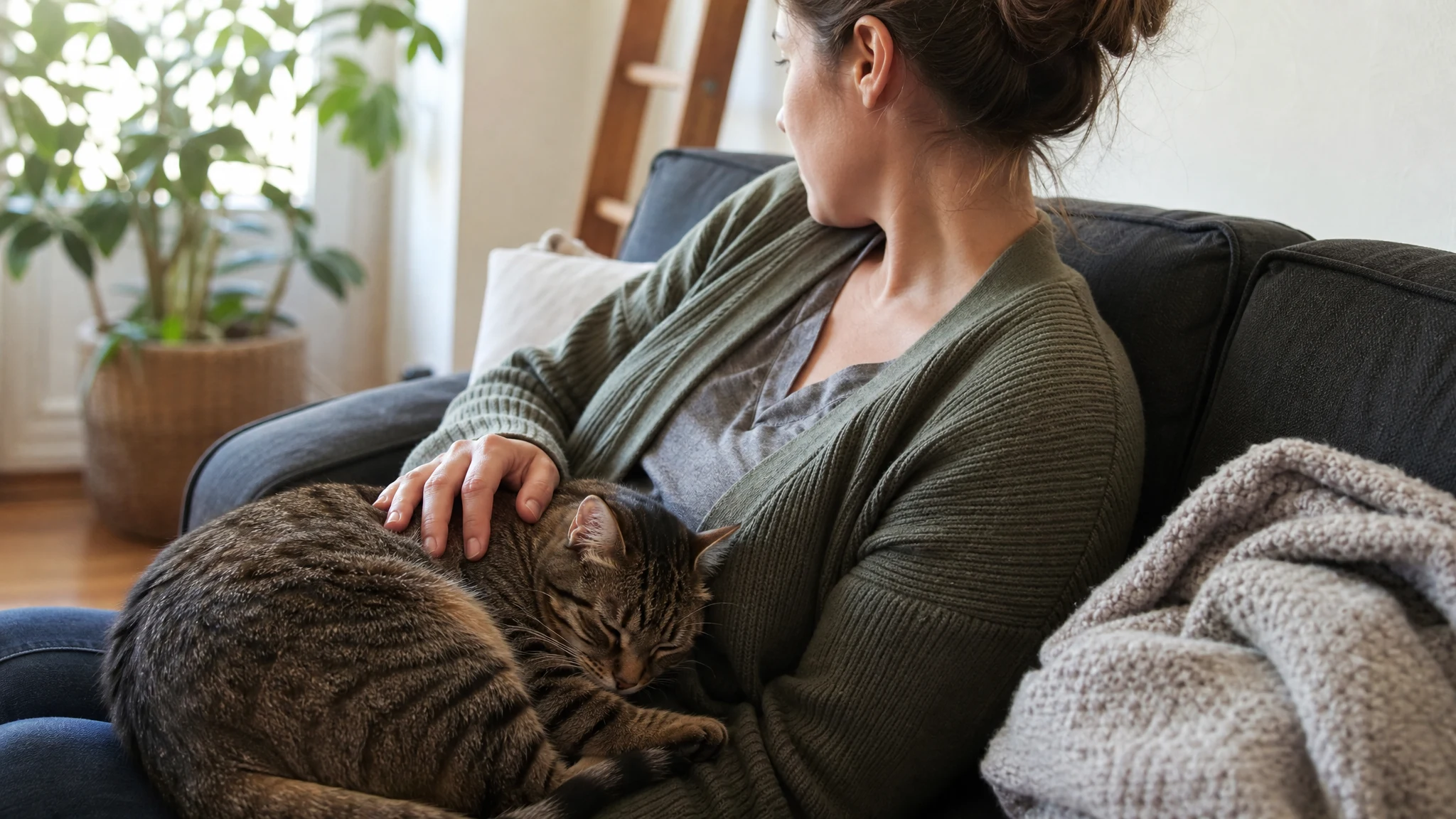
Mugwort Oil Around Cats, Dogs and Birds: What Vets Report
Our answer is short: keep mugwort oil away from pets, as our own copy says, and do not diffuse it in a home with a cat or a bird. No veterinary source read for this article gives a dose or a safe use level for mugwort oil in any animal, so there is no number to hand you. What follows is what veterinary toxicology sources say about essential oils as a group, what that does and does not tell us about this oil, and what to do if an exposure happens.

Mugwort Essential Oil
Our own Mugwort Essential Oil, in sizes from 0.5 oz to bulk.
From $16.99
Shop Now →What the mugwort-specific record contains
Very little. The search for this article looked for veterinary toxicology data on mugwort oil, an ASPCA toxic-plant entry for mugwort, and a published dose for cats or dogs. None turned up. The nearest items are two plant-level and poison-centre statements. The ASPCA tarragon entry (Artemisia dracunculus, a different species) lists the plant as toxic to dogs and cats, names "essential oils" as the toxic principle and lists mild vomiting and diarrhea. That is a plant entry for another Artemisia, so it shows the genus is not unknown to veterinary toxicologists, not what mugwort oil does. The Missouri Poison Center says mugwort essential oil "contains irregular amounts of toxic compounds such as Thujone, Camphor, and Eucalyptol" and does not mention pets.
The thujone point matters because of what it is. In mouse and rat tissue work, Hold and colleagues (2000) reported that alpha-thujone is toxic to mice and suppresses GABA-activated currents in rat neurons. That study used mice, rats and fruit flies, not cats or dogs, and it does not say how much thujone any mugwort oil contains. Composition varies by species and origin: in Pandey and Singh's 2017 literature review, two Lithuanian Artemisia vulgaris oils held trans-thujone at 8.9% and 10.9%, other A. vulgaris rows list none, and an Ethiopian wormwood sample reached 42.3 to 66.4% beta-thujone. The COA we publish contains no thujone figure, so none of those ranges can be assigned to our oil.
Why cats come first in every source
The ASPCA (2020) says "Cats are especially sensitive to essential oils" and recommends against using any essential oils "in areas where your pets have access" unless pets are supervised or a veterinarian approves. The Merck Veterinary Manual (page updated March 2025; the page credits a veterinarian at Pet Poison Helpline as author and a veterinary toxicologist as peer reviewer) puts dogs, cats and birds in the at-risk group, says cats are deficient in the enzyme glucuronyl transferase and so are very sensitive to phenols, and notes that grooming adds skin and oral exposure.
The underlying genetics is documented. Shrestha and colleagues (2011, PLoS One) found that the UGT1A6 gene, the main phenol-detoxifying enzyme, is a pseudogene in every living member of the cat family, and in two other carnivores out of 22 sampled (brown hyena and northern elephant seal), all hypercarnivores. Their examples are drugs (acetaminophen, aspirin) and similar diet and environmental toxicants, not essential oils.
A limit on that reasoning, stated as inference: the cat defect concerns phenols. Thujone, camphor and 1,8-cineole are ketones and an ether, not phenols, and none of the sources read says how cats handle them. So the cat mechanism is a documented reason for caution about essential oils generally, not an explanation of what a mugwort oil would do. Dogs are not exempt: the Merck manual names them alongside cats and birds, and lists tea tree oil as the most commonly reported essential-oil intoxicant in pets.
Routes of exposure in a workshop home
| Route | What the sources say | Our reasoning for a mugwort oil household |
|---|---|---|
| Diffuser | Merck: passive diffusers mainly irritate the airways; active diffusers add droplets that settle on fur or feathers and are absorbed or swallowed in grooming. | We do not list diffusing as a use. See can you diffuse mugwort oil. |
| Skin | Merck: concentrated oils should never be applied directly to pets; absorption through skin is a major route. | Oil on your hands or forearms reaches a cat that sleeps on you or on a bench. A diluted skin product is still oil on a surface the animal grooms. |
| Swallowing | Merck: vomiting, lethargy, drooling, ataxia and anorexia are the most common signs; seizures and liver or kidney failure are reported. | A dripping dropper or an open sample bottle is the realistic route. Our copy says to keep it from pets and not for internal use. |
| Smoke | Particle exposure from burning is covered in burning mugwort indoors. | No pet-specific smoke data were found for mugwort or incense. |
Scale is worth seeing in numbers. One drop of the batch on our COA is about 0.05 ml, and at a relative density of 0.895 that is roughly 45 mg. On a 4 kg cat that is about 11 mg per kilogram; on an 80 g bird, about 560 mg per kilogram. These are arithmetic only: no toxic threshold for mugwort oil in either animal was found. The nearest real case concerns a different oil. In a 2020 BMC Veterinary Research case report, three drops (0.15 ml) of tea tree oil applied to the skin of an 80 g cockatiel were followed within about 30 minutes by convulsions, vomiting and coma, with severe liver damage on bloodwork. The bird recovered with supportive care. One case, one oil, one species: it shows how small a skin exposure can be on a small animal, not what mugwort oil does.
If an exposure happens
Call a veterinarian or a pet poison line first, and have the container and its label in your hand. The ASPCA Animal Poison Control Center number is (888) 426-4435; Pet Poison Helpline lists (855) 764-7661 and says it is available 24 hours. Both are published numbers; confirm any fee with the service. The Merck manual advises against inducing vomiting because of the aspiration risk, and says decontamination is by bathing or fresh air; the ASPCA says not to induce vomiting unless a veterinarian directs it. Follow the veterinarian on both. Breathing difficulty in a cat needs emergency care if it does not clear quickly in fresh air, according to Pet Poison Helpline.
For a person exposed to the same spill, the number is Poison Control at 1-800-222-1222.
What this article does not say
Nothing here suggests mugwort oil treats, calms or protects an animal. FDA's aromatherapy page (current as of 9 September 2023) says a product's regulatory category turns on its intended use, judged from labeling, websites and advertising, and that a plant origin does not stop a product being regulated as a drug. We sell the oil as a perfumery and ritual material for people who make things, not as an animal product, and a question about a pet's behavior, skin or health belongs with a veterinarian.
Our own copy says to keep the oil from children and pets and not to use it internally. The thujone and dilution basics for people are in our mugwort oil safety article, and the storage habits that keep a bottle out of reach are in how to store mugwort oil.
If you share a home with a cat, a dog or a bird, the plain verdict is to keep bottles capped and out of reach, skip the diffuser, and ask your veterinarian before any mugwort product is used where the animal lives.
Mugwort Essential Oil
Mugwort Essential Oil from our own shop, in sizes from 0.5 oz to bulk.
From $16.99
Shop Now →Sources & Further Reading
- ASPCA, 2020. Pet Poisons: Be Mindful of these Household Products and Cleaning Agents. aspca.org/news
- ASPCA. Toxic and Non-toxic Plants: Tarragon. aspca.org/tarragon
- Merck Veterinary Manual, 2025. Toxicoses from Essential Oils in Animals. merckvetmanual.com
- Pet Poison Helpline. Essential Oils and Cats. petpoisonhelpline.com
- Shrestha et al., 2011. Evolution of a major drug metabolizing enzyme defect in the domestic cat and other Felidae. PLoS One 6(3):e18046. PMC3065456
- Vetere et al., 2020. Acute tea tree oil intoxication in a pet cockatiel. BMC Veterinary Research 16:29. PMC6995176
- Hold et al., 2000. Alpha-thujone: GABA type A receptor modulation and metabolic detoxification. PNAS 97(8):3826-3831. PMC18101
- Pandey and Singh, 2017. The genus Artemisia: a 2012-2017 literature review. Medicines 4(3):68. PMC5622403
- Missouri Poison Center. Mugwort. missouripoisoncenter.org
- FDA, 2023. Aromatherapy. fda.gov/cosmetics