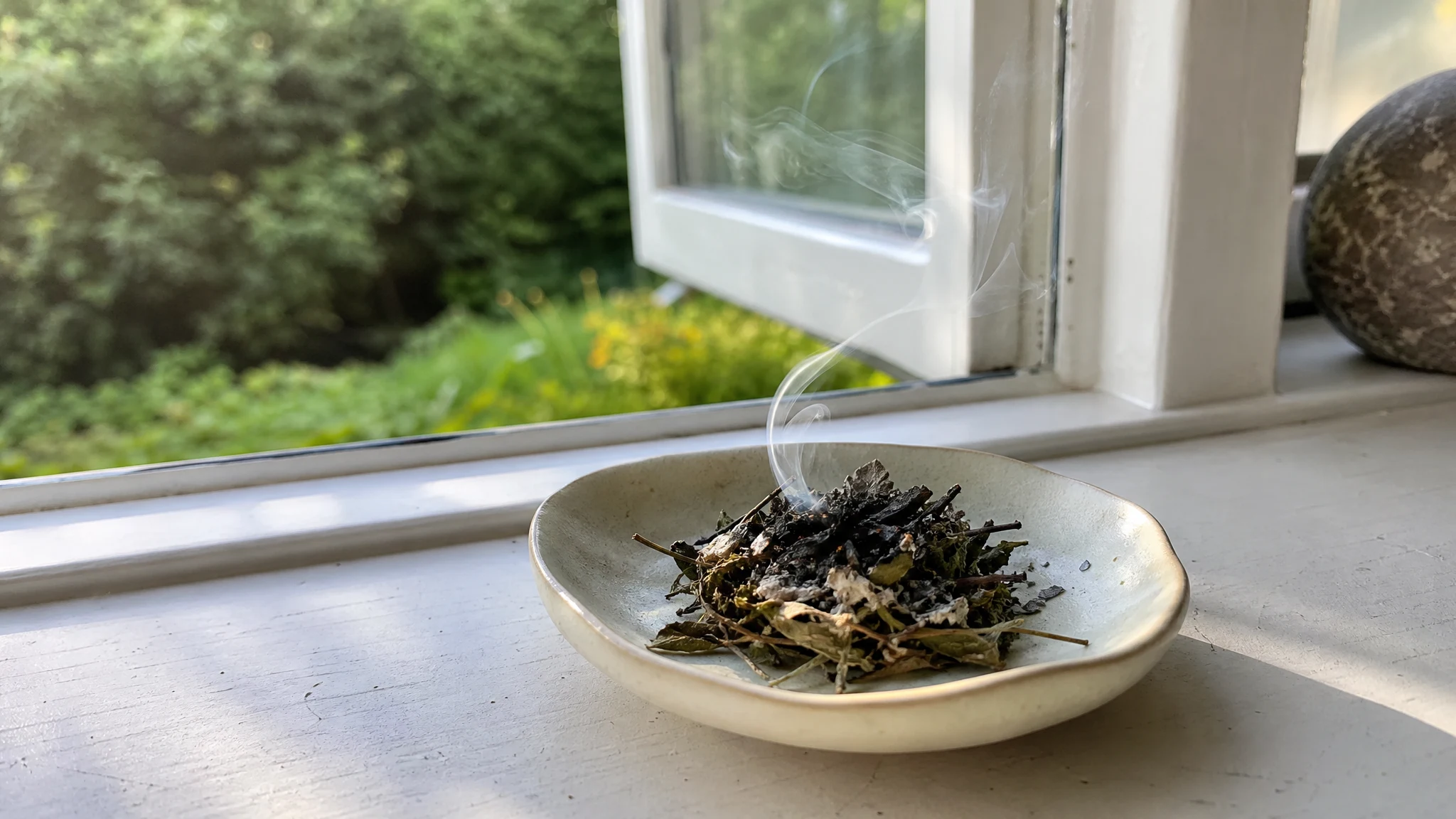
Burning Mugwort Indoors: What Smoke Studies Measured
Smoke from burning mugwort is smoke: it carries fine particles and carbon monoxide whatever plant it comes from, and the published measurements located are large next to the standards that exist for outdoor air. In one hospital room, burning one roll of mugwort moxa wool for 15 minutes took the fine-particle reading from 26 to 296 micrograms per cubic meter. This article walks through that study, the incense studies, what the EPA says particles do, and what the sources do not tell us about mugwort oil in a burner.

Mugwort Essential Oil
Our own Mugwort Essential Oil, in sizes from 0.5 oz to bulk.
From $16.99
Shop Now →The one measurement made on burning mugwort
Moxibustion burns processed Artemisia leaf, described in the paper as "moxa produced from dried Artemisia (mugwort) herb species." Lu and colleagues (2016, International Journal of Environmental Research and Public Health) measured a 92.40 cubic meter acupuncture and moxibustion room in a Taipei hospital with the HVAC off: 10 minutes of background, 15 minutes of burning one moxa wool (18 mm by 200 mm), then 20 minutes of decay.
| Measure | Background | During burning |
|---|---|---|
| PM2.5 (ug/m3) | 26 | 296 |
| PM10 (ug/m3) | 147 | 409 |
| Carbon monoxide (ppm) | below 0.1 | 2.8 (maximum 4.0) |
| Total VOC (ppm) | 0.03 | 0.27 |
The authors compared the room to Taiwan's indoor air standards of 35 and 75 ug/m3 (8-hour averages) for PM2.5 and PM10 and reported both exceeded. The US EPA's primary outdoor standards are 35 ug/m3 over 24 hours and 9.0 ug/m3 per year for PM2.5, and 150 ug/m3 over 24 hours for PM10. Those are outdoor air standards, not indoor limits and not exposure rules for a 15-minute event, so the comparison is a scale (296 is about 8.5 times 35), not a violation. The study was one room, one burn, and the authors note that clinics treating 20 or more patients a day may be exposed more.
Three results from the same paper bear on what people try. Aged moxa wool cut carbon monoxide by 57% and total VOC by 83% but raised PM2.5 by 75%. A cyclone dust collector drawing 0.19 cubic meters a minute, placed 25 cm from the burning wool, cut the PM2.5 increase by 96%. A 50 W carbon, HEPA, photocatalyst and ion-generator air cleaner cut it by 71% and, in the authors' words, was "inefficient" for gases. Local exhaust beat a room air cleaner; nothing in the paper tests an open window.
Incense: the larger numbers
In a 1 cubic meter chamber, Ongwandee and Pipithakul (Applied Environmental Research) found incense emitted PM2.5 at 154 to 255 mg per hour (65.6 to 252 mg per gram burned) and carbon monoxide at 378 to 790 mg per hour, against 8.80 to 9.97 mg per hour of PM2.5 for candles. The authors attribute the one-to-two order of magnitude gap to smoldering, incomplete burning by design.
A worked upper bound shows why chamber numbers alarm. Assume a 30 cubic meter room (3 by 4 by 2.5 meters, an assumption). With no ventilation and no particle loss to surfaces, which no real room achieves, 154 to 255 mg per hour of PM2.5 becomes 5,100 to 8,500 ug/m3 added per hour. A candle at 9 mg per hour gives about 300 ug/m3 per hour on the same assumptions. Real rooms lose particles to ventilation and deposition, so these are ceilings, and they come from commercial products, not mugwort. They show the order of magnitude, nothing more.
A review by Lin, Krishnaswamy and Chi (2008, Clinical and Molecular Allergy) gives particulate emissions "greater than 45 mg/g burned" for incense against 10 mg/g for cigarettes, and mean indoor total suspended particulates of about 1,316 ug/m3 in one Taiwanese temple against 73 ug/m3 outdoors. The same review records the disagreement: some studies found no harm, and a Taiwanese study of 35,036 children reported a negative association between home incense burning and asthma, which the authors attribute possibly to confounding. The authors conclude that more controlled studies are needed. Report both: the particle numbers are large and consistent, and the health-outcome evidence is mixed.
What the EPA says particles do
The EPA's indoor particulate matter page (updated 3 August 2026) lists candles, fireplaces and other combustion among indoor sources and says particles under 10 micrometers "can get deep into your lungs," with eye, nose and throat irritation and worsened heart and lung disease among the effects. It names people with heart or lung disease, children and older adults as the more affected. It does not mention incense by name. Its ventilation advice concerns fuel-burning appliances vented outdoors and exhaust fans; none of it is specific to herb smoke.
What is not known about mugwort
The search for this article found no measurement of what burning mugwort oil, or the dried herb in a bowl, releases beyond the moxa study above: no constituent breakdown of the smoke, and no thujone measurement in smoke. Nothing in the sources says the smoke from a plant is milder or harsher than other combustion smoke; the particle figures are for moxa, incense and candles. We therefore make no claim about what the smoke does to air or to bacteria, and nothing in this article says burning mugwort cleanses, protects or purifies a room. FDA's aromatherapy page (current as of 9 September 2023) says a product's intended use, judged from labeling and advertising, decides whether it is a drug.
Where our oil fits
Our shop lists incense and smudge-style blends and ritual or seasonal candles among the uses of the oil, as a restrained perfumery and ritual material. The oil is an ingredient, not the thing that burns cleanly. How much of it survives a burn, and what it turns into, are not documented in anything we have read. IFRA's guidance (30 June 2023) places candles of all types and incense in Category 12, "non-skin contact products," and notes that for candles the dermal sensitization risk is negligible. IFRA's thujone standard still sets a Category 12 cap of 9.5% thujone in the finished product (the 51st Amendment compilation, pp. 309-311); the sources do not say whether that figure assumed burning. We hold no thujone figure for our oil, so we cannot calculate against it. The chemistry of thujone in oils is in our safety article.
A buyer who makes burning products should get the supplier's SDS and thujone figure in writing; see the workshop checklist. For the dried plant as incense, see the incense and herb bundle article; our shop does not sell dried herb.
Who to ask before you burn anything
Our copy says to avoid use during pregnancy, keep the oil from children and pets, and, in our standards page, to diffuse lightly if at all (see can you diffuse mugwort oil). The cases the EPA names, heart or lung disease, children and older adults, should ask a physician; anyone who is pregnant or has asthma, an obstetric clinician or pulmonologist; a household with a cat, dog or bird, a veterinarian (see mugwort oil and pets). Fire is a separate risk that this article's sources did not measure: smoke detectors, a non-flammable surface and attention while anything burns are choices for your fire marshal's guidance, not numbers we can supply.
The measured fact to take away is that burning plant material indoors adds fine particles and carbon monoxide to the air, and that local exhaust did far more than a room air cleaner in the one study that compared them.
Mugwort Essential Oil
Mugwort Essential Oil from our own shop, in sizes from 0.5 oz to bulk.
From $16.99
Shop Now →Sources & Further Reading
- Lu et al., 2016. Controlling indoor air pollution from moxibustion. Int J Environ Res Public Health 13(6):612. PMC4924069
- Ongwandee and Pipithakul. Air pollutant emissions from the burning of incense, mosquito coils, and candles in a small experimental chamber. Applied Environmental Research 32(1):69-79. tci-thaijo.org/aer/9702
- Lin, Krishnaswamy and Chi, 2008. Incense smoke: clinical, structural and molecular effects on airway disease. Clin Mol Allergy 6:3. PMC2377255
- US EPA, 2026. Indoor particulate matter. epa.gov/indoor-air-quality-iaq
- US EPA, 2026. NAAQS table. epa.gov/criteria-air-pollutants
- IFRA, 2023. Guidance for the use of IFRA Standards (51st Amendment, 30 June 2023). ifra guidance pdf
- IFRA, 2024. The complete IFRA Standards, 51st Amendment (Thujone, pp. 309-311). ifrafragrance.org
- FDA, 2023. Aromatherapy. fda.gov/cosmetics