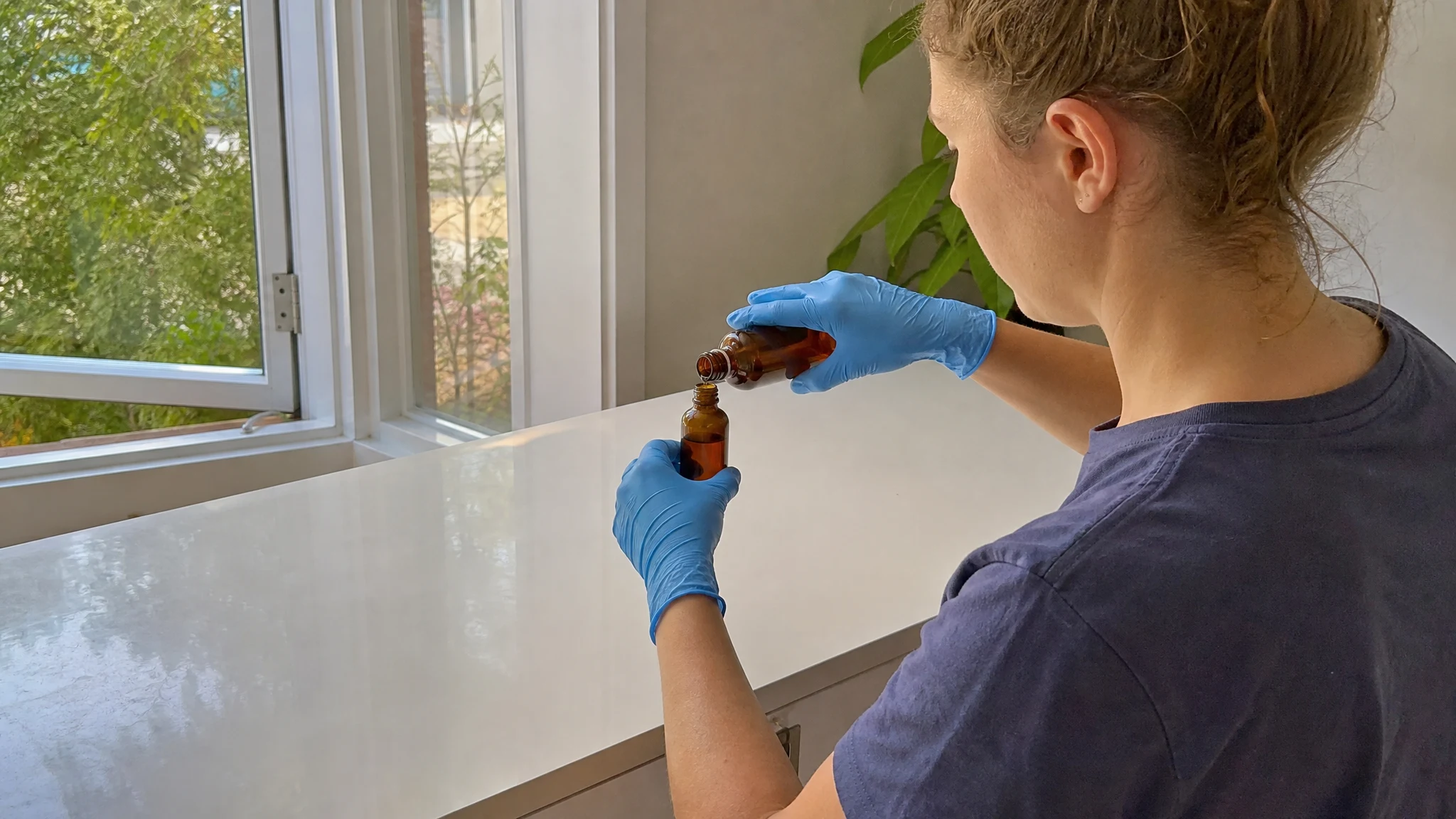
Mugwort Oil in the Workshop: A Handling Checklist
Treat mugwort oil in the workshop as a combustible liquid and a skin, eye and swallowing hazard until the supplier's safety data sheet says otherwise in writing. We publish no safety data sheet and no flash point for our oil, so the first item on any handling checklist, the document, is one you have to request before the first order ships. The rest of this checklist follows the order a small production shop meets the hazards: paperwork, fire, storage, decanting, skin and eyes, spills, first aid, and who to call.

Mugwort Essential Oil
Our own Mugwort Essential Oil, in sizes from 0.5 oz to bulk.
From $16.99
Shop Now →1. The document, before the drum
OSHA's Hazard Communication Standard, 29 CFR 1910.1200, sets 16 sections for a safety data sheet (SDS), in this order: identification; hazard identification; composition; first aid; fire-fighting; accidental release; handling and storage; exposure controls and personal protection; physical and chemical properties; stability and reactivity; toxicology; ecological information; disposal; transport; regulatory information; other. Manufacturers and importers must provide an SDS on request under paragraph (g)(6)(iv), and retail distributors with commercial accounts must on request under (g)(7)(iii). Employers must keep the sheets readily accessible during each shift, paragraph (g)(8). The duty sits on employers; a sole maker with no employees should ask an EHS professional or the state OSHA office whether it applies, and should still read the sheet.
What to ask for, in writing, before ordering: the SDS for the exact material and size, with Section 9 (flash point and the test method) and Section 8 (the glove material and ventilation it names). Our published COA covers relative density (0.895 on the batch shown), refractive index, steam distillation and best-by date, nothing on flash point or constituents. We make no promise of a particular document; get whatever you rely on in writing.
2. Fire: assume combustible
OSHA's flammable-liquid rule, 29 CFR 1910.106(a)(19), defines a flammable liquid as one with a flashpoint at or below 199.4 F (93 C) and splits it into categories: Category 3 is 73.4 F (23 C) to 140 F (60 C); Category 4 is above 140 F to 199.4 F. A liquid in Category 3 or 4 is a fire hazard in the regulation's sense even though it does not feel like gasoline. For scale only, an aggregator listing (The Good Scents Company) gives 131 F (55 C) by closed-cup test for an Artemisia vulgaris herb oil. That is a secondary listing, for someone else's oil, not an SDS figure and not a figure for ours, but it shows that a mugwort oil can sit in Category 3.
The practical check is a comparison of two numbers you must get from the SDS: the flash point, and the highest temperature the oil reaches in your process (a warmed decanting station, a melter, a wax pot, a heat gun nearby). Reasoning from the regulation's categories: where the process temperature approaches the flash point, vapor can reach ignitable concentration, so keep ignition sources, hot plates and open flames out of the area, and read the SDS's Section 5 for the extinguishing media it names.
3. Storage and the arithmetic of volume
Our own copy says to store tightly capped in a cool, dark place away from heat and light, and our bulk page says to keep containers sealed and decant working amounts into a smaller airtight bottle (see how to store mugwort oil). To see how much liquid that is, use the COA batch density of 0.895 g/ml:
| Size | Mass | Volume |
|---|---|---|
| 1 oz | about 26.5 g | 29.57 ml |
| 16 fl oz | about 423 g | 473 ml |
| 25 lb | 11.34 kg | about 12.7 L (3.3 US gal) |
| 100 lb | 45.4 kg | about 50.7 L (13.4 US gal) |
| 400 lb | 181.4 kg | about 203 L (53.6 US gal) |
At the 400 lb size, one failed container is roughly 200 liters of oil on a floor. Where the container sits, and what is under it, are decisions to make before delivery. A fire marshal or insurer is the person to ask about quantity limits and storage cabinets in your building; we cite no figure for them here.
4. Decanting from a large container
OSHA's grounding paragraph, 1910.106(e)(6)(ii), requires the nozzle and container to be electrically interconnected when dispensing Category 1 or 2 liquids and Category 3 liquids with a flashpoint below 100 F (37.8 C). It is written for industrial plants. If the SDS flash point for your oil is above 100 F that paragraph does not reach it, and if the SDS shows a lower number it does; the sheet decides, and an EHS professional should confirm for your premises. Work with ventilation as the SDS Section 8 describes, over a tray, with the cap and funnel ready.
Label what you decant. Paragraph (f)(6) of the same standard requires each container of hazardous chemicals in the workplace to carry either the full shipped-container label information or a product identifier plus words, pictures or symbols giving at least general hazard information; (f)(8) exempts a portable container only if it is for the immediate use of the person who filled it. A working bottle left on a shelf overnight is not immediate use.
5. Skin, eyes and the swallowing risk
Our copy says to keep the oil from eyes, children and pets, not for internal use, and, for skin products, to dilute to 0.5% to 2% and patch test first. Neat oil is a different exposure from a dilution: handling it by the ounce means skin contact on hands and forearms. Choose gloves by the material the SDS names, not by habit. A poison centre statement on mugwort oil, from the Missouri Poison Center (undated), says the oil "contains irregular amounts of toxic compounds such as Thujone, Camphor, and Eucalyptol" and that swallowing it "could cause vomiting, confusion, respiratory distress, coma, and seizures." The National Capital Poison Center adds that aspirating an essential oil can cause pneumonia. So no tasting, no mouth pipetting, no food or drink at the bench, and nothing stored in a food or drink container.
Limits on skin-product concentration are a separate topic from handling. Our copy's 0.5% to 2% for skin sits next to a published IFRA thujone restriction that can be lower, depending on thujone content we cannot state; the comparison is set out in the allergy article and the basics in our safety article.
6. Spills and who else is in the building
SDS Section 6 names the absorbent, containment and disposal route; read it before the first delivery, not during the first spill. Pets and children are the cases in our copy: a cat on a bench, a dog licking a floor, a child in a shared studio. The veterinary side is in mugwort oil and pets. If someone with a history of seizures or someone who is pregnant works in the room, our copy's pregnancy and seizure lines apply, and that person's physician is the one to ask.
7. First aid, as published
MedlinePlus advises for chemical burns that skin be flushed with cool running water for 15 minutes or more after contaminated clothing is removed, and that eyes be flushed with running water for at least 15 minutes with medical help sought right away. It says to seek urgent help for trouble breathing, seizures or unconsciousness. Poison Control is 1-800-222-1222. The SDS Section 4 is the supplier's own first-aid instruction and takes precedence for that material. Post the number and the sheet where people work.
What this checklist is not
It is not a substitute for an EHS professional, an industrial hygienist or your fire marshal, and none of these sources address mugwort oil in a workshop specifically. Nothing here suggests the oil treats, cleanses or protects anything. For ordering at drum scale, see the bulk buyer's guide.
The plain order of work is: request the SDS in writing, compare its flash point to your process, label and cap every container, and keep the poison number where people can see it.
Mugwort Essential Oil
Mugwort Essential Oil from our own shop, in sizes from 0.5 oz to bulk.
From $16.99
Shop Now →Sources & Further Reading
- OSHA, 29 CFR 1910.1200, Hazard Communication (paragraphs (f)(6), (f)(8), (g)(2), (g)(6), (g)(7), (g)(8)). law.cornell.edu/cfr/29/1910.1200
- OSHA, 29 CFR 1910.106, Flammable liquids ((a)(19), (e)(6)(ii)). law.cornell.edu/cfr/29/1910.106
- The Good Scents Company. Artemisia vulgaris herb oil listing (aggregator, secondary). thegoodscentscompany.com
- Missouri Poison Center. Mugwort. missouripoisoncenter.org
- National Capital Poison Center. Essential oils. poison.org
- MedlinePlus. Chemical burns. medlineplus.gov/ency/000059