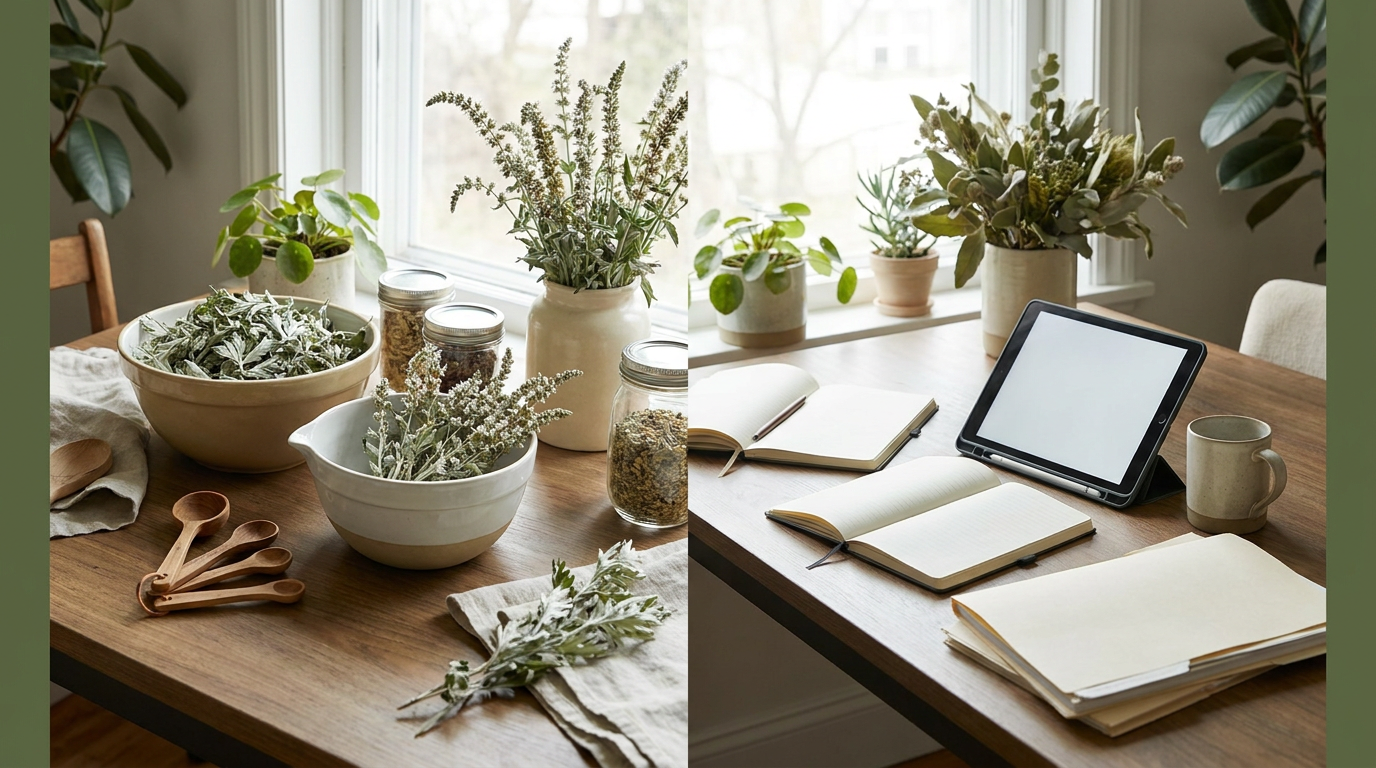
DIY Mugwort Incense and Herb Bundles: Working with the Dried Plant
Mugwort has been tied to smoke and ritual for a very long time. Across European, East Asian, and Indigenous American traditions, bundles of dried Artemisia vulgaris were burned to scent a space, mark a season, or simply make an evening feel more intentional. Today, crafting your own mugwort bundles and loose herbal incense at home is one of the most satisfying ways to work with this plant. The process is slow, tactile, and genuinely aromatic.
This guide covers two related projects: a bound mugwort smudge-style bundle for slow smoldering, and a loose herbal incense blend you can use on a charcoal disc or an incense burner plate. You can make just one, or use the same batch of dried plant material for both.
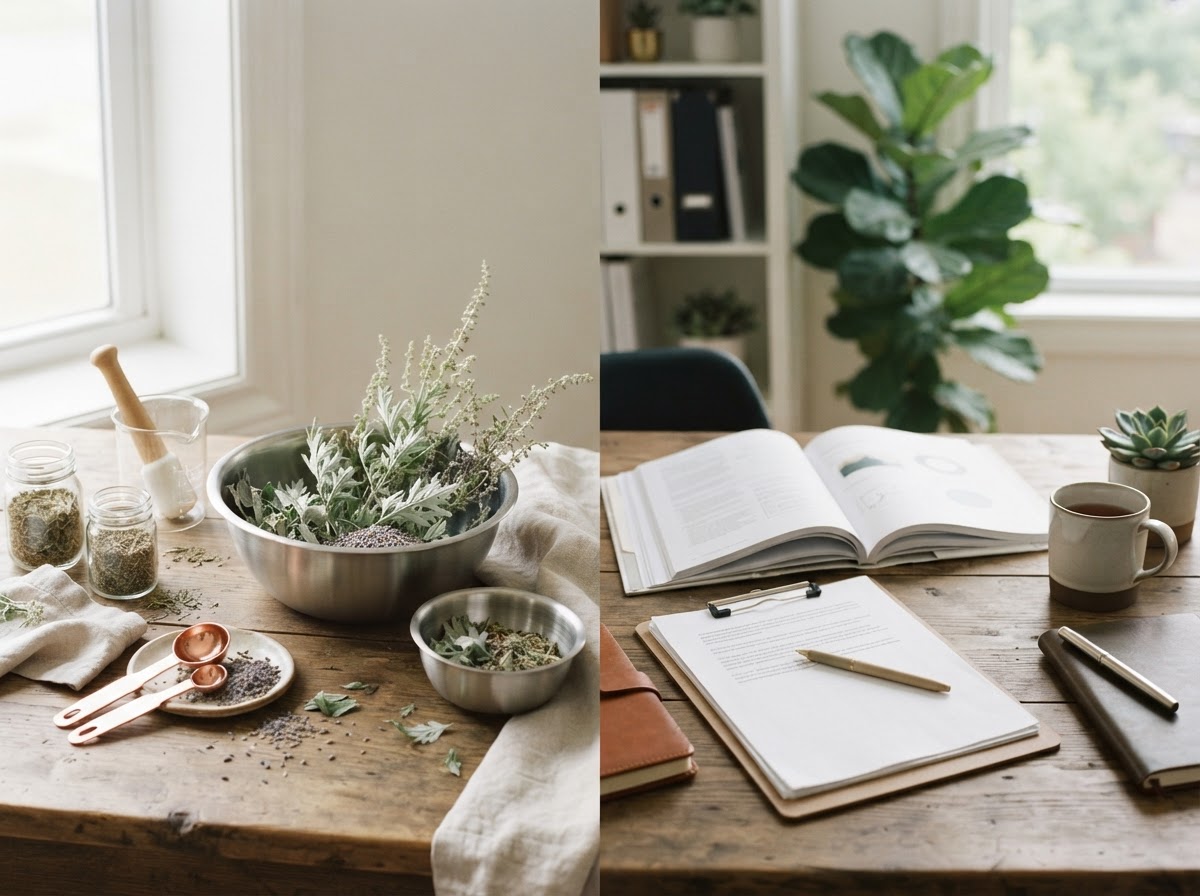
Before you begin: Mugwort smoke is potent. Always burn in a well-ventilated space. Mugwort is a member of the Artemisia family and contains compounds that may cause reactions in people sensitive to ragweed, chrysanthemums, or related plants. Anyone who is pregnant or nursing should avoid burning mugwort or handling large quantities of the dried herb. Keep away from children and pets. If you have respiratory sensitivities, burn outdoors or near an open window.
What You Will Need
For the Bound Bundle (makes 2 medium bundles)
- 40 to 60 grams of dried mugwort stems and leaves (cut to roughly 20 to 25 cm lengths)
- Natural cotton twine or undyed hemp string, approximately 3 meters per bundle
- Small scissors or floral snips
- Optional accent botanicals: dried lavender stems, cedar sprigs, or rosemary sprigs (see Variations below)
For the Loose Herbal Incense Blend (makes approximately 30 grams)
- 15 grams dried mugwort leaf (crumbled, stems removed)
- 8 grams dried lavender buds
- 5 grams dried rosemary leaf
- 2 grams dried orris root powder (acts as a natural fixative)
- Optional: 3 to 5 drops of mugwort essential oil, to deepen the aromatic character (see notes on sourcing below)
- Small glass jar with a lid for storage
- Charcoal discs or a mesh incense burner plate for burning
General Supplies
- Kitchen scale (grams, not volume, for accuracy)
- Mixing bowl made from glass or ceramic
- Gloves if you have known plant sensitivities
- A clean, dry work surface
Sourcing Your Mugwort
Quality matters here. Mugwort that has been stored too long, exposed to humidity, or sourced from unclear suppliers loses much of its aromatic complexity before you even light it. Look for dried mugwort from reputable herb suppliers who list the plant part (leaf, stem, or whole herb), the country of origin, and ideally the harvest year. UK-grown and Eastern European mugwort both have good reputations for aromatic quality in craft use.
If you grow your own, harvest just before the plant flowers in midsummer. This is when the leaf is most fragrant. Cut stems in the morning after dew has dried, bundle them loosely, and hang upside down in a warm, dark, well-ventilated space for two to three weeks before using them in these projects.
If you want to layer in the aromatic depth of mugwort essential oil alongside the dried plant, a few drops added to the loose blend just before sealing the jar makes a noticeable difference.
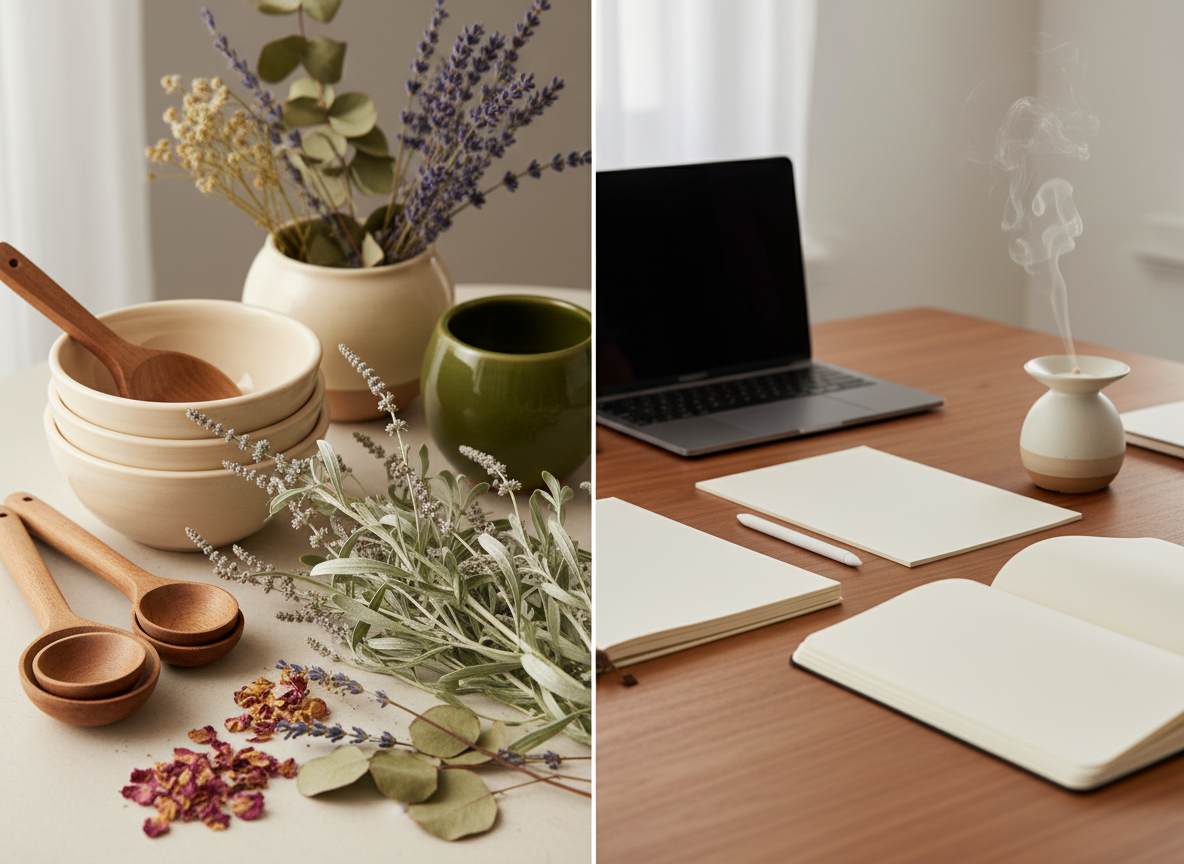
Step-by-Step: Bound Mugwort Bundle
Difficulty: Beginner
Active prep time: 20 to 30 minutes per bundle
Drying time after binding: 2 to 4 weeks
- Sort and align your stems. Gather a generous handful of dried mugwort, roughly 20 to 30 grams per bundle. Line the stems up so the cut ends are even. If you are adding accent botanicals, tuck them along the outside edges of the bundle now, keeping the mugwort as the core mass.
- Form the shape. Hold the bundle firmly at the base with your non-dominant hand. The bundle should be dense enough that it does not fall apart when held, but not so thick that airflow through it is blocked. A finished diameter of about 3 to 4 cm is practical.
- Anchor the twine. Leave a 10 cm tail of twine at the base. Wrap this tail in with your first few loops to secure it. Wind the twine tightly around the base two or three times.
- Wind upward. Begin spiraling the twine up the bundle toward the tip, spacing your wraps about 1.5 to 2 cm apart. Apply firm, consistent tension as you go. The bundle should feel solid, not floppy.
- Return to the base. Once you reach the top, loop the twine back down toward the base in the opposite diagonal direction, creating a criss-cross pattern. This adds structural stability.
- Tie off. At the base, tie the working end of the twine to the original tail using a simple knot. Trim any excess.
- Hang to dry. Even if your mugwort was already dried before bundling, the bundle needs additional time to compress and dry further after binding. Hang it upside down in a warm, ventilated space away from direct light for at least two weeks. A bundle that has not fully dried will smolder poorly and may not stay lit.
Step-by-Step: Loose Herbal Incense Blend
Difficulty: Beginner
Active prep time: 15 minutes
Recommended resting time: 48 hours before burning
- Crumble the dried mugwort leaf. Remove any thick woody stems. You want leaf material and thin stems only. Crumble by hand into rough pieces, not a fine powder. Some texture helps with even burning.
- Combine the dry botanicals. Add the crumbled mugwort, lavender buds, rosemary leaf, and orris root powder to your mixing bowl. Stir gently with a spoon to distribute evenly. Do not crush or grind further at this stage.
- Add essential oil (optional). If using mugwort essential oil, add 3 to 5 drops to the blend now. Stir thoroughly. Adding essential oil to a dry botanical blend this way is low-risk compared to skin application, but work in a ventilated space and avoid direct inhalation over the bowl while mixing.
- Transfer to a glass jar. Seal tightly. Label with the blend name and date. Let it rest for 48 hours before burning. This resting period allows the orris root to begin fixing the aromatic compounds so the scent develops more cohesion.
- To burn: Light a charcoal disc and place it in a heat-safe incense burner. Wait until the disc is glowing and ashed over (usually 2 to 3 minutes). Place a small pinch of the loose blend on the disc. A little goes a long way. Mugwort smoke is distinctive and earthy; start with a small amount and see how the scent fills your space before adding more.
Safety Warnings and Contraindications
- Pregnancy and nursing: Do not use mugwort in any form, including dried herb smoke and essential oil, during pregnancy or nursing. This applies to both projects in this guide.
- Ragweed and related plant sensitivities: If you react to ragweed, chrysanthemums, marigolds, or related plants in the Asteraceae family, approach mugwort with caution. Consider a small patch test by holding a piece of dried leaf near (not on) your skin before working with larger quantities.
- Respiratory considerations: Herbal smoke of any kind should be used in well-ventilated spaces. Those with respiratory sensitivities should consult a qualified healthcare provider before burning botanical incense regularly.
- Essential oil handling: When working with mugwort essential oil as an additive to the loose blend, avoid skin contact with undiluted oil. If any undiluted oil contacts skin, wash with mild soap and water. If you plan to use mugwort oil in skin-contact applications, a dilution ratio of 0.5% to 1% in a carrier oil is the recommended starting point, and patch testing is essential before broader application.
- Fire safety: Never leave burning bundles or charcoal discs unattended. Use a proper heat-safe holder. Keep away from flammable materials, drafts, and fabrics.
Storage and Shelf Life
Bound Bundles
Store finished, fully dried bundles in a cool, dry place away from direct light. A paper bag or open basket works well. Avoid airtight containers, which can trap residual moisture and cause mold. Well-made bundles stored correctly will hold their aromatic character for 12 to 18 months. After that, the scent fades noticeably, though the bundle will still burn.
Loose Blend
Store in a sealed glass jar in a cool, dark location. Properly dried botanicals and a small amount of essential oil will keep well for 12 months. If the blend starts to smell flat or faintly musty, discard it and start fresh. Always use a clean, dry spoon to remove the blend from the jar to avoid introducing moisture.
Variations and Substitutions
| Variation | What to Add or Swap | Notes |
|---|---|---|
| Forest-leaning bundle | Add cedar sprigs or juniper to the outside of the bundle | Cedar burns slowly and adds a warm, resinous character |
| Floral loose blend | Replace rosemary with dried rose petals | Softens the earthy quality of the mugwort |
| Citrus-edged blend | Add dried lemon verbena or lemon peel (2 to 3 grams) | Brings brightness to what can otherwise be a heavy smoke profile |
| Resin-enriched blend | Add a small amount of frankincense resin granules (2 grams) | Requires charcoal disc; adds depth and slightly extends burn time |
| Clary sage pairing | Swap half the lavender for dried clary sage leaf | A classic pairing explored further in our Hedgerow Dusk signature blend |
A Few Honest Notes on Scent Expectations
Mugwort incense does not smell like commercial incense sticks. It is greener, more complex, and at times a little medicinal-smelling in a herbal sense. Some people find the smoke dry and pleasantly bitter. Others take time to warm to it. That is completely normal with botanicals that have not been sweetened or adulterated.
Burning quality also varies by how well-dried your material is, the density of the bundle, and environmental humidity. If a bundle struggles to stay lit, try drying it further or loosening the twine slightly on your next attempt.
If you want to deepen your understanding of how the dried plant's aromatic character compares to the distilled oil, the guide to using mugwort oil in fragrance and craft covers this in detail. Working with both forms of the plant gives you a much richer picture of what mugwort actually is.