What Blends Well with Mugwort Oil: A Complete Pairing Guide
Mugwort essential oil has a scent that stops people mid-sniff. It is green and camphorous, faintly bitter, with a quiet smokiness underneath that most people cannot immediately place. That complexity is exactly what makes essential oil pairing with mugwort so rewarding. Once you understand how its aromatic profile behaves alongside other oils, a whole range of fragrant and cosmetic possibilities opens up.
This guide walks you through the logic of mugwort oil blends, the materials you will need, and specific step-by-step instructions for crafting pairings that work. Whether your goal is a diffuser blend for a moody evening atmosphere, a grounding room spray, or a botanical skincare serum base, the same pairing principles apply.
Understanding Mugwort's Aromatic Profile First
Before you can pair well, you need to understand what you are working with. Mugwort essential oil (Artemisia vulgaris or Artemisia argyi, depending on origin) sits in the herbal-camphorous family. Its dominant notes are:
- Top notes: Sharp, fresh greenness with a slight camphor lift
- Middle notes: Dry, herbaceous bitterness, similar to wormwood but softer
- Base notes: Earthy, faintly woody, with a smoky or resinous undertone in some distillations
Because mugwort is a middle-to-base note oil with strong top-note presence, it behaves somewhat like a bridge ingredient. It anchors lighter florals and brightens heavier resins. That dual role is why using mugwort oil in fragrance and craft work has become increasingly popular among indie perfumers and cosmetic formulators alike.
One practical note on quality: the pairing behavior of mugwort oil shifts considerably depending on the source plant, distillation method, and thujone content. Higher-thujone distillations tend to be sharper and more camphor-forward. Lower-thujone or steam-distilled versions from Korean Artemisia argyi read greener and softer. Know your oil before you blend.
Safety Baseline Before You Begin
Mugwort essential oil is potent. It contains thujone, a ketone compound that requires careful handling. Before any blending session, review these baseline safety points:
- Dilute to a maximum of 0.5% to 1% in finished cosmetic products (follow current IFRA and industry guidelines for your specific use case).
- Do not use mugwort oil undiluted on skin.
- Avoid use during pregnancy or while nursing.
- Always perform a patch test on the inner forearm before applying any new blend to larger skin areas. Wait 24 hours and check for any reaction before proceeding.
- Consult a qualified healthcare provider if you have any concerns about personal sensitivities.
- For diffuser and room fragrance use, ensure good ventilation and limit session length to 30 to 60 minutes.
Materials You Will Need
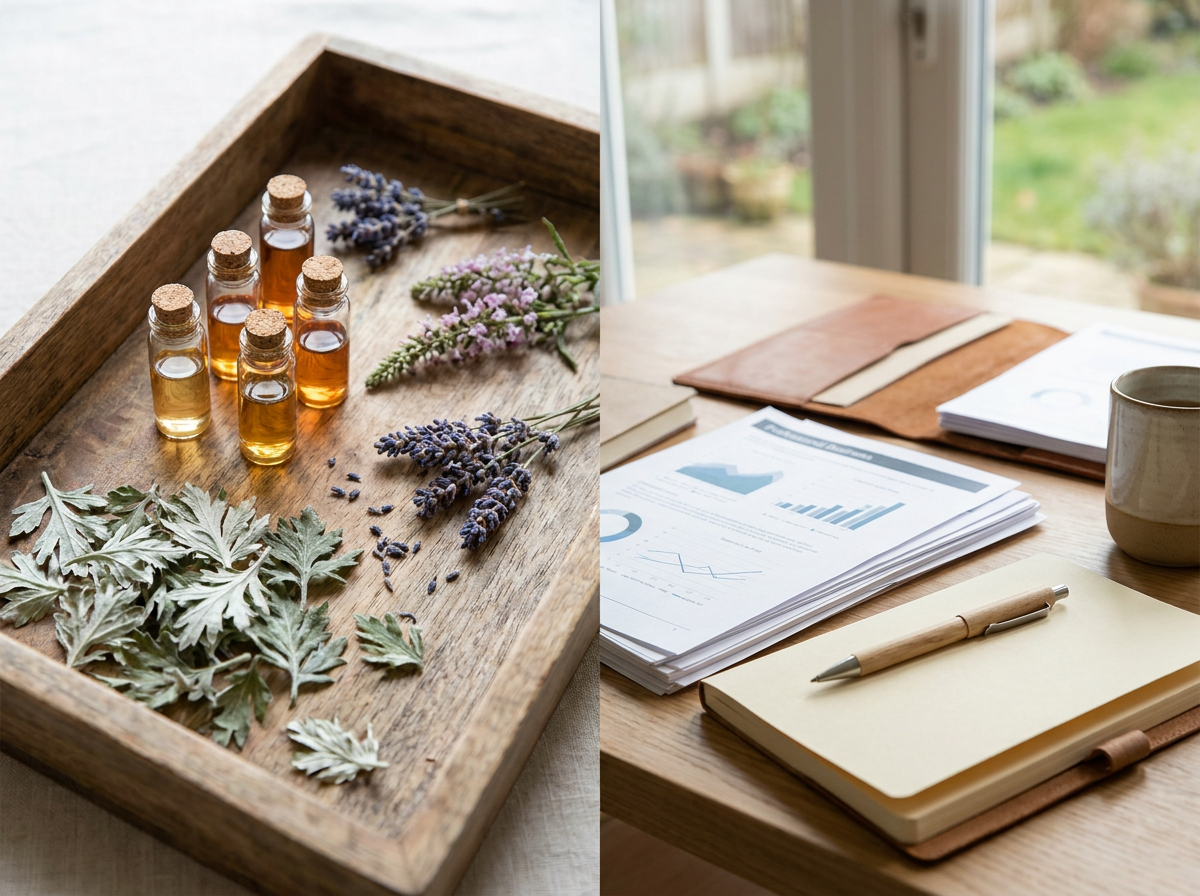
Gather these before you start. Having everything on hand prevents rushed measuring and blending errors.
- Mugwort essential oil (ideally from a reputable supplier who provides GC/MS testing data)
- Companion essential oils (specific recommendations follow below)
- A carrier oil for skin-safe blends (fractionated coconut oil, jojoba, or squalane work well)
- Small amber or cobalt glass dropper bottles (5 ml or 10 ml)
- A 1 ml graduated dropper or blending pipettes
- Perfumer's strips or scent blotter paper
- A small notebook or blending log
- Isopropyl alcohol (for cleaning droppers between oils)
- A diffuser or ultrasonic nebulizer for testing aromatic blends
Which Oils Mugwort Blends Well With: The Core Pairing Families
Mugwort essential oil blends well with a fairly wide range of oil families, but each pairing produces a different aromatic character. Understanding the families gives you a reliable framework rather than a rigid recipe list.
1. Coniferous and Woody Oils
This is mugwort's most natural territory. Cedarwood, Virginian or Atlas, shares mugwort's dry earthiness and amplifies its grounding base notes without competing. Fir needle adds crispness and pulls out mugwort's greener facets. Scots pine and black spruce create a forest-floor composition that is quietly complex. Cypress rounds out the pairing with a pencil-shaving dryness that softens mugwort's bitterness.
2. Resinous and Smoky Oils
Frankincense (Boswellia carterii or sacra) is a natural partner. Its balsamic warmth lifts mugwort's smoky undertone into something almost meditative in atmosphere. Vetiver works in small proportions, lending depth without overwhelming. Palo santo adds sweetness and a vanilla-like smokiness that rounds off mugwort's sharper edges beautifully.
3. Herbal and Aromatic Oils
Clary sage is a strong pairing. Both are herbaceous and slightly camphor-adjacent, so they read as intentionally related rather than mismatched. Lavender (Angustifolia, not spike lavender) softens mugwort's bitterness and adds familiarity for people new to the oil. Rosemary ct. verbenone bridges the herbal and camphorous aspects gracefully. Sage (Salvia officinalis) amplifies the wild-herb character considerably, so use it sparingly.
4. Citrus Oils
Used as top-note accents, citrus oils brighten mugwort blends without masking them. Bergamot is the most versatile choice, adding a green-floral lift. Yuzu is increasingly popular in K-beauty-inspired formulations for its tart brightness alongside mugwort's green depth. Lemon works in diffuser blends but can feel sharp in skin-application blends unless kept very low.
5. Florals (Use Thoughtfully)
Heavy florals tend to clash with mugwort's bitterness. Jasmine absolute at very low concentrations (under 2% of the essential oil portion) can create an interesting tension, but it is easy to tip into discord. Geranium Bourbon is a better choice: its green, rosy, slightly minty character bridges well. Roman chamomile shares a botanical family with mugwort (Asteraceae) and creates a softer, more approachable version of the herb-green profile.
Step-by-Step: Three Starter Blends to Try

Blend 1: Forest Floor Diffuser Blend
This blend draws on mugwort's earthy side and pairs it with coniferous and resinous companions. It is well-suited for evening wind-down diffusion in a living space.
- Prepare your workspace. Wipe down your blending surface and have your dropper bottles, pipettes, and blotter strips ready. Open your notebook to a fresh page and note the date, the oils you are using, and their batch numbers.
- Measure onto a blotter first. Before committing to a bottle, test on paper. Drop 2 drops of cedarwood, 1 drop of fir needle, and 1 drop of mugwort onto a blotter. Fan it gently and smell from a few inches away. Note your first impression, then re-smell after 5 minutes as the top notes settle.
- Adjust if needed. If mugwort reads as too sharp, add 1 drop of frankincense to the blotter. If it reads too flat, try 1 drop of black spruce instead. The goal is balance: no single oil should dominate.
- Commit to a small test bottle. Using a 5 ml amber bottle, build a 10-drop test blend: 4 drops cedarwood, 3 drops fir needle, 2 drops mugwort, 1 drop frankincense. Cap and roll gently between your palms to mix.
- Test in your diffuser. Add 4 to 6 drops of the blend to your diffuser with water per manufacturer instructions. Run for 30 minutes. Note how the scent evolves in the room versus on the blotter strip. Diffuser blends often read differently in open air.
- Record your results. Write down what worked, what you would adjust, and your overall impression. Blending logs are invaluable over time.
Blend 2: Green-Citrus Room Spray
This is a lighter, fresher pairing that people often describe as smelling like a damp herb garden after rain. It layers mugwort's greenness against bergamot and clary sage.
- Gather your base materials. For a room spray, you will need a 50 ml glass spray bottle, distilled water, and a solubilizer (polysorbate 20 or a comparable cosmetic-grade solubilizer to keep the oils dispersed in water).
- Build your essential oil portion first. In a small dropper bottle, combine: 10 drops bergamot, 6 drops clary sage, 4 drops mugwort. Cap and mix.
- Mix with solubilizer. In your spray bottle, combine your essential oil blend with 1 ml of polysorbate 20. Stir thoroughly. This step ensures the oils disperse evenly rather than floating on the surface.
- Add distilled water. Pour in 45 ml of distilled water. Cap and shake well. Spray into the air (not onto surfaces you have not tested) and evaluate the scent.
- Patch-test note: This blend is formulated as a room spray, not a skin product. Do not apply room spray formulations directly to skin without recalculating dilution ratios for topical use.
Blend 3: Botanical Serum Accent Blend
This is a skin-application blend for use in a facial serum or body oil. It pairs mugwort with geranium Bourbon and roman chamomile in a squalane base. It draws on the same botanical-green aesthetic that drives autumn harvest and moody green seasonal blends.
- Calculate your dilution carefully. For a facial application, total essential oil content should not exceed 1% of the finished product. In a 30 ml bottle of squalane, that means no more than approximately 9 drops of essential oil total.
- Build your essential oil drop count: 4 drops geranium Bourbon, 3 drops roman chamomile, 2 drops mugwort. This equals 9 drops, landing at approximately 1% in 30 ml.
- Add oils to your carrier. Pour 30 ml of squalane into a clean amber dropper bottle. Add the essential oils. Cap securely and roll between palms for 30 seconds to incorporate.
- Perform a patch test before full use. Apply a small amount to the inner forearm. Wait a full 24 hours before applying to the face or a larger area.
- Observe and note. People who use this blend often report that the scent is quiet and botanical rather than perfume-forward, which suits minimalist skincare aesthetics well.
Common Pairing Mistakes to Avoid
- Using too much mugwort. This oil has strong presence. In most blends, it should make up no more than 10 to 15% of the aromatic portion. Start lower and build up.
- Pairing with heavy musks or ambers too early. Mugwort can get lost under synthetic musks or heavy labdanum. If you want warmth, frankincense or vetiver are more transparent choices.
- Skipping the blotter test. Always evaluate on paper before building a full bottle. Scent relationships shift after 5 to 10 minutes, and what smells sharp on first contact may mellow into something excellent.
- Assuming all mugwort oils smell the same. They do not. A Korean Artemisia argyi distillation will behave differently in a blend than a European Artemisia vulgaris. Adjust your ratios when switching suppliers.
- Neglecting your blending log. A formula you create today may be difficult to recreate six months from now if you have not written it down precisely. Record every drop count.
Quick Pairing Reference Table
| Companion Oil | Pairing Character | Suggested Ratio (Mugwort : Companion) | Best Use |
|---|---|---|---|
| Cedarwood (Atlas) | Dry, earthy, grounding | 1:3 | Diffuser, room spray |
| Frankincense (Carterii) | Warm, balsamic, atmospheric | 1:2 | Diffuser, serum |
| Clary Sage | Herbal, slightly sweet | 1:2 | Room spray, diffuser |
| Bergamot | Bright, citrus-floral accent | 1:3 to 1:4 | Diffuser, room spray |
| Geranium Bourbon | Green-rosy, bridging | 1:2 | Serum, body oil |
| Roman Chamomile | Soft, apple-herbal, gentle | 1:1.5 | Serum, facial oil |
| Vetiver | Deep, smoky, rooty | 1:0.5 (use sparingly) | Diffuser accent |
| Fir Needle | Crisp, forest-green | 1:2 | Diffuser, room spray |
A Note on Sourcing and Quality
The best essential oil pairing work starts with honest, well-sourced oils. For mugwort specifically, request GC/MS (gas chromatography/mass spectrometry) reports from your supplier and check that thujone levels are within the range appropriate for your intended use. Cosmetic-grade formulations for leave-on skin products have lower acceptable thujone thresholds than diffuser-only uses, so the distinction matters.
Reputable suppliers will provide country of origin, plant part used (aerial parts are standard for mugwort EO), extraction method (steam distillation is most common), and harvest year. These details are not just marketing. They tell you what to expect aromatically and help you adjust your blending approach when you switch batches.
Mugwort oil is genuinely one of the more interesting materials available to botanical perfumers and cosmetic formulators right now. Its layered, slightly unpredictable nature rewards careful pairing work. Start with one blend from this guide, keep notes, and let the process build from there.