How to Use Mugwort Oil in Fragrance and Craft: The Ultimate Maker's Guide
Key Takeaways
- Mugwort essential oil carries a green, slightly bitter, herbaceous scent with earthy and faintly camphoraceous undertones that behave beautifully as a middle-to-base note in fragrance work.
- It blends well with woody, resinous, and floral oils, making it a versatile addition to perfume, candle, and soap projects.
- Proper dilution matters every time. Keep essential oil concentration at or below 1% for leave-on applications and follow all standard safety guidelines.
- Mugwort oil has deep roots in European and East Asian folk tradition, and those cultural stories add meaningful context to craft projects rooted in ritual and seasonal symbolism.
- Sourcing steam-distilled mugwort oil from reputable suppliers who share GC/MS reports is the clearest path to consistent, quality results.

Mugwort has been described as the traveler's herb, the dreamer's plant, and the moon's own green. For centuries, it wound through European cottage gardens, East Asian kitchens, and the bundled smoke of folk rituals. Today, its essential oil sits on the workbenches of perfumers, candle makers, soap crafters, and botanical enthusiasts who want their work to carry some of that layered, storied character.
This guide is built for makers. It covers mugwort essential oil uses across fragrance, candle, soap, and ritual craft, with practical ratios, honest scent notes, and the sourcing guidance you need to work confidently. If you have only encountered mugwort as a dried herb or a tea ingredient, the distilled oil will open a different dimension of the plant entirely.
1. What Is Mugwort Essential Oil? Scent Profile and Sourcing Basics
Mugwort essential oil is steam-distilled from Artemisia vulgaris, the common mugwort native to Europe, Asia, and naturalized throughout North America. The plant belongs to the same genus as wormwood (Artemisia absinthium), Roman and German chamomile, and tarragon, a family with a characteristically sharp, herbal aromatic presence.
The Scent in Detail
The oil's scent is not simple. Opening notes land green and slightly bitter, like freshly crushed leaves from a wild hedgerow on a cool morning. That initial brightness softens into an earthy, almost smoky middle with a faint camphoraceous quality. The dry-down is where mugwort earns its complexity: it settles into something woody and slightly resinous, occasionally with a whisper of sweetness depending on the origin of the plant material.
In classical fragrance terms, mugwort oil functions most naturally as a middle note with some base-note staying power. It does not shout. It grounds.
Key Chemical Constituents
The aromatic character of mugwort oil comes primarily from compounds including cineole (eucalyptol), camphor, thujone, borneol, and various sesquiterpenes. The exact ratio of these constituents shifts based on the plant's geographic origin, the time of harvest, and distillation method. This is why a GC/MS (gas chromatography/mass spectrometry) report matters when you are purchasing: it tells you precisely what you are working with chemically, which affects both the scent profile and the safety considerations.
"The most honest thing a mugwort oil supplier can offer you is a GC/MS report alongside the bottle. The chemistry of this genus varies significantly, and the difference between a camphor-forward oil and a cineole-forward oil shapes every creative decision you make."
Absolute vs. Essential Oil
You may encounter mugwort absolute alongside the essential oil. Absolutes are solvent-extracted and tend to carry a richer, more complex scent profile closer to the raw plant. They are popular in fine perfumery but not appropriate for candle or soap applications where heat or alkalinity is involved. For most craft uses described in this guide, steam-distilled essential oil is the practical choice.
2. Mugwort Oil in Fragrance Blending: Building Atmospheric Scents
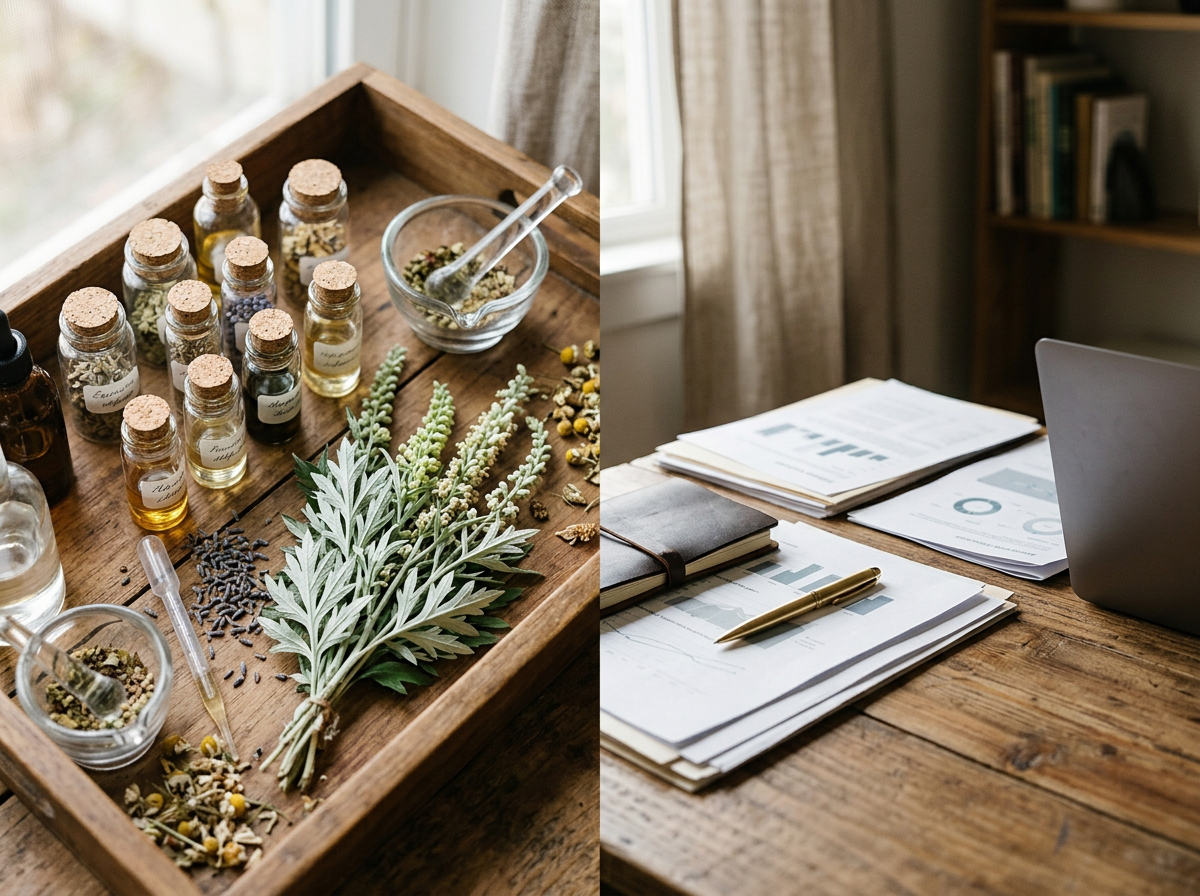
Fragrance blending is where mugwort oil genuinely shines. Its unusual scent profile gives blenders a tool that most mainstream fragrance collections lack: a green, slightly alien herbal note that sits between the freshness of a botanical accord and the depth of a resinous base.
Mugwort as a Middle Note
In standard fragrance construction (top, middle, base), mugwort falls into middle-note territory. It becomes perceptible after the brighter top notes evaporate and contributes to the heart of the composition. Because it has some camphoraceous weight, it can also function as a light base-note support, lending persistence without the heaviness of oakmoss or labdanum.
What Blends Well with Mugwort Oil
For a full pairing guide, see our dedicated article on what blends well with mugwort oil. The short version for makers:
- Woody notes: Cedarwood, sandalwood, vetiver, and guaiac wood soften mugwort's sharpness and extend its dry-down beautifully.
- Resins and balsams: Frankincense, benzoin, and labdanum create a smoky, ceremonial quality alongside mugwort that many makers associate with autumn and twilight atmospheres.
- Earthy and mossy accords: Oakmoss absolute, patchouli, and vetiver push mugwort into deeply grounded territory, ideal for forest-walk or hedgerow-inspired blends.
- Soft florals: Clary sage, geranium, and rose absolute offer contrast. They soften mugwort's austerity without masking it. Our in-house signature blend, Hedgerow Dusk, pairs mugwort with clary sage for exactly this reason.
- Citrus top notes: Bergamot and yuzu provide a bright opening that makes mugwort's entrance feel considered rather than abrupt.
- Spice accents: Cardamom and black pepper add a lively edge without competing with mugwort's herbal character.
Sample Fragrance Formula: Hedgerow at Dusk
This is a starting-point formula for a personal fragrance or room scent. Adjust based on your own GC/MS data and nose testing.
| Ingredient | Note Type | % of Blend |
|---|---|---|
| Bergamot essential oil | Top | 20% |
| Clary sage essential oil | Top/Middle | 15% |
| Mugwort essential oil | Middle | 20% |
| Geranium essential oil | Middle | 10% |
| Frankincense essential oil | Middle/Base | 15% |
| Cedarwood (Atlas) essential oil | Base | 15% |
| Vetiver essential oil | Base | 5% |
This formula represents the concentrate. For a perfume oil, dilute the concentrate to 15-20% in a carrier such as fractionated coconut oil or jojoba. For an eau de parfum, dilute to 15-20% in perfumer's alcohol. Always perform skin patch testing before use and consult current IFRA guidelines for usage limits on individual materials.
Room Diffuser and Spray Blends
Mugwort oil works well in electric ultrasonic diffusers and reed diffuser bases. For ultrasonic diffusion, a simple approach is 3-4 drops of mugwort combined with 2-3 drops of frankincense and 2 drops of bergamot per 100ml of water. The result is an atmospheric, woodland-edge scent well suited to evening hours or creative work sessions.
For a linen or room spray, combine your fragrance concentrate (the essential oil blend) at roughly 10-15% in perfumer's alcohol. Add a small amount of distilled water (no more than 10% of total volume) and shake before each use. Do not spray directly onto delicate fabrics without testing first.
3. Mugwort Oil in Candle Making

Candle making is one of the most popular mugwort oil crafts, and for good reason. The scent profile performs well when warmed, taking on a softer, more enveloping quality than it has cold from the bottle. The slightly smoky, herbal character deepens near a flame, evoking the atmosphere of old-world herb lofts and autumn evenings.
Fragrance Load and Wax Compatibility
Essential oils in candles behave differently from synthetic fragrance oils. They tend to have lower flash points and can be more volatile, which means scent throw may be lighter than a maker used to fragrance oils expects.
- Soy wax: Works well with mugwort oil. Aim for a fragrance load of 6-8% by weight of wax. Soy's slower, cooler burn extends the aromatic experience.
- Beeswax: A natural companion for botanically-inspired scents. Fragrance load for beeswax is typically lower (4-6%) because beeswax itself has a gentle honey scent that fills the room.
- Coconut wax: Excellent scent throw. Use 8-10% fragrance load. Coconut wax tends to show off complex essential oil blends clearly.
- Paraffin: Technically compatible, but most makers working with mugwort's botanical-and-ritual aesthetic prefer natural waxes for cohesion of brand and intent.
Temperature Matters
Add your essential oils at the right wax temperature. Most sources suggest adding fragrance between 140-160°F (60-71°C) for soy and coconut waxes. Adding oils when wax is too hot will cause volatile compounds to evaporate before the wax solidifies, reducing scent throw considerably. Use a reliable thermometer.
Botanical Additions for Candles
Some makers embed dried mugwort leaves into the top surface of their candles for visual appeal and a light aromatic accent when the candle is lit nearby (not in the melt pool). Keep dried botanicals away from the wick and melt pool entirely. Place them on the outer edges of the surface only, and always include a fire safety warning with finished candles. Never leave candles burning unattended.
Suggested Candle Blend
A simple two-oil candle blend that showcases mugwort's character: 70% mugwort essential oil, 20% cedarwood Atlas, 10% black pepper. This produces a quietly complex, forested, slightly spicy scent that is compelling without being difficult to live with over a long burn.
4. Mugwort Oil in Soap and Cleansing Crafts
Soap making introduces a chemical environment that essential oils must survive: the alkaline process of saponification in cold-process soap, or the heat of melt-and-pour bases. Not all essential oils fare equally well. Mugwort oil is reasonably robust but benefits from specific handling.
For a complete guide to using mugwort in this category, including detailed formulas, see our article on mugwort oil for skin-adjacent crafts: soaps and cleansing oils.
Cold-Process Soap
In cold-process soap making, essential oils are added at trace, just as the soap batter reaches a thin-to-medium consistency. Fragrance rate for essential oils in cold-process soap is typically 2-3% of total oil weight (which is lower than fragrance oils). Mugwort's camphoraceous top notes do fade somewhat through the setting phase, leaving a subtler, earthier scent in the finished bar. Plan your formula with that shift in mind: pair mugwort with deeper base notes (cedarwood, patchouli, vetiver) that will anchor the scent after the more volatile top notes dissipate.
Melt-and-Pour Soap
Melt-and-pour bases require lower temperatures and have less scent distortion. Add essential oils once the melted base has cooled to around 120-130°F (49-54°C) before pouring. Fragrance rate is similar: 2-3% by weight. The scent will be more true to the original oil in a finished melt-and-pour bar compared to cold-process.
Cleansing Oils and Balms
Cleansing oils are among the most elegant mugwort oil crafts. They require no heat and no alkaline chemistry, which means the oil's character survives fully intact. A mugwort-infused cleansing oil, drawing on the K-beauty double-cleanse tradition, offers a deeply botanical aromatic experience as part of an evening face-cleansing ritual.
Our DIY mugwort cleansing oil recipe walks through the exact formulation steps with safety guidance. The key principle: keep mugwort essential oil at or below 1% of total formula weight for any product intended for facial skin contact. Carrier oil makes up the bulk of a cleansing oil, with complementary essential oils added at cosmetically appropriate levels.
Visual Appeal: Color in Soap
Mugwort pairs beautifully with natural green colorants in soap: spirulina, French green clay, or chlorophyll can echo the plant's silvery-green visual identity. Some makers use a swirl technique with an uncolored portion and a green-tinted portion to suggest the underside of mugwort's distinctive leaves.
5. Ritual and Ceremonial Crafts: Sachets, Dream Pillows, and Incense
Mugwort's folklore runs centuries deep. In European tradition, it was placed in shoes for long journeys, woven into midsummer wreaths, and associated with vivid dreams and liminal spaces. In East Asian practice, the dried herb figures prominently in seasonal and ceremonial contexts. The essential oil carries that cultural weight into modern craft in a way that synthetic alternatives simply cannot.
Working with mugwort oil in ritual crafts is about intention and atmosphere. These are not medical projects. They are sensory and symbolic ones.
Dream Pillows and Sleep Sachets
Dream pillows are small fabric pouches filled with dried herbs, designed to be placed near a sleeping area for their aromatic presence. Mugwort has appeared in dream pillow recipes across European folk tradition for a very long time, associated with vivid and memorable dreaming.
To incorporate mugwort essential oil into a dream pillow project, add a few drops directly onto the dried herb mixture (dried mugwort leaf, lavender, hops, and rose petals are common companions) before stuffing the pillow. The oil refreshes the scent of older dried material and adds depth. Our dedicated guide to DIY mugwort dream pillows and sachets covers material sourcing, fabric choices, and scent longevity tips in full.
A note on sleep sachets: these are aromatic objects placed near the body, not on skin. Even so, keep the oil application restrained. A few drops on the herb filling goes a long way. Strong aromatic exposure during sleep hours can be disruptive for sensitive individuals.
Incense and Herb Bundles
Loose incense blends and hand-rolled stick incense are natural homes for mugwort essential oil. The oil can be used to boost the aromatic presence of dried mugwort material in bundles, or blended with other essential oils (frankincense, sandalwood, cedarwood) to create a liquid base that is then applied to a makko (incense-making powder) and shaped.
Mugwort herb bundles (sometimes called smudge sticks in modern craft circles, though that term carries specific Indigenous cultural significance that should be acknowledged) are made primarily from dried herb. A light misting of diluted mugwort essential oil (2-3% in water with a small amount of dispersant such as polysorbate 20) can be applied after drying to refresh bundles that have lost their aromatic intensity over time.
For detailed instructions on working with dried mugwort in incense and bundle form, see our guide to DIY mugwort incense and herb bundles.
Always burn incense in well-ventilated spaces. Never leave burning incense or herb bundles unattended.
Aromatic Ritual Oils and Anointing Blends
Anointing oils have a long history across many cultures: fragrant oils applied to objects, altar items, candles, or wrists during intentional rituals. A mugwort-based anointing blend is simple to make and carries the herb's folkloric character elegantly.
A basic formula: mugwort essential oil at 1% (for skin contact) or up to 3% (for object anointing only, not skin), combined with frankincense and a small amount of clary sage in a carrier of jojoba oil. Jojoba is ideal because it does not go rancid and has a very long shelf life, important for an object you want to last across a season or a year.
Always clearly label any anointing oil with its intended use (objects only, or diluted skin use) and store away from light and heat.
Seasonal and Lunar Craft Projects
Mugwort has strong associations with midsummer (Artemisia vulgaris blooms around the summer solstice in the Northern Hemisphere) and with lunar symbolism through its connection to the goddess Artemis. Makers working within seasonal craft traditions often incorporate mugwort into:
- Midsummer candle sets scented with mugwort and rose
- New moon intention sachets combining mugwort with silver botanicals (artemisia, lavender, yarrow)
- Autumn equinox potpourri blends with mugwort oil, cedarwood, and dried orange peel
- Winter solstice room sprays that pair mugwort with frankincense and pine
6. Safety, Dilution, and Responsible Use
Mugwort essential oil requires respectful handling. It contains thujone, a ketone compound that is present in several Artemisia-family oils and is associated with caution at high concentrations. This makes proper dilution not just a general essential oil best practice but a specific priority with this oil.
Safety Summary for Mugwort Essential Oil
- Dilution for skin contact: Stay at or below 1% in a carrier oil for leave-on applications. For rinse-off applications (soap), 2-3% by oil weight is standard.
- Patch testing: Always perform a patch test before applying any new essential oil blend to a larger skin area. Apply a small amount of the diluted blend to the inner forearm, wait 24 hours, and observe.
- Avoid during pregnancy: Mugwort oil is not recommended for use during pregnancy due to the thujone content and the herb's historical associations with uterine stimulation. Consult a qualified healthcare provider with any questions.
- Avoid with certain sensitivities: Individuals sensitive to plants in the Asteraceae (daisy/ragweed) family may react to mugwort. Exercise caution and consult a qualified healthcare provider.
- Not for internal use: No essential oils covered in this guide are intended for internal use.
- Children and pets: Keep all essential oils out of reach of children. Many essential oils, including those containing camphor and thujone, are not appropriate around young children or certain pets. Consult a veterinarian before diffusing any essential oil around animals.
- Ventilation: Always diffuse in a well-ventilated room and take regular breaks from continuous diffusion.
These guidelines apply regardless of the mugwort oil crafts context. A candle, a soap, a sachet: every application deserves thoughtful safety practice. When in doubt, consult a qualified healthcare provider, especially for individuals with known sensitivities or specific health considerations.
A Note on Thujone
Thujone content in mugwort oil varies significantly by origin and chemotype. A GC/MS report will show you the exact percentage in your batch. Some batches are quite low in thujone; others are higher. This variability is exactly why reputable sourcing (discussed in the next section) matters so much for makers using this oil regularly.
7. Sourcing Quality Mugwort Oil: What to Look For
The quality of your mugwort essential oil shapes every craft project downstream. An oil distilled carelessly from overripe or incorrectly stored plant material will smell flat, chemical, or off. A well-sourced oil will be complex, nuanced, and worth centering a product line around.
What to Ask Your Supplier
- GC/MS report: Request one for each batch. A reputable supplier makes these available readily. The report shows constituent percentages so you know exactly what aromatic compounds you are working with.
- Botanical identity: Confirm the oil is from Artemisia vulgaris specifically. Other Artemisia species (mugwort relatives) are sometimes sold under similar names and have different scent profiles and chemical makeups.
- Distillation method: Steam distillation is standard for essential oils. Solvent-extracted absolute behaves differently in craft applications (as noted earlier).
- Harvest location and date: Country of origin and harvest year give context to scent variation. European-origin oils (often from Hungary, France, or the UK) may differ noticeably from oils distilled from East Asian plant material.
- Organic certification: Where available, certified organic sourcing reduces the likelihood of agrochemical residues in the finished oil. For a plant often foraged wild, ask whether the supplier tests for pesticide residues.
Price as a Quality Signal
Mugwort essential oil is not as expensive as rose or neroli, but rock-bottom pricing is still a warning sign. Very cheap oil may be diluted in a carrier, adulterated with synthetic compounds, or distilled from lower-quality material. Mid-range pricing from a supplier with transparent documentation is a reasonable target.
Storage After Purchase
Store mugwort essential oil in a dark glass bottle (amber or cobalt) away from heat and direct sunlight. A cool, dark cabinet works well. Essential oils oxidize over time, and oxidized oil both smells worse and can become more likely to occasion skin sensitivity. Most essential oils are best used within 1-3 years of distillation. Check the supplier's recommended shelf life, which may vary based on constituent profile.
How Much to Buy
For occasional craft use, a 5ml or 10ml bottle is sufficient to explore the oil without risking significant waste to oxidation. For regular production (candle makers or soap makers incorporating mugwort into a product line), a 30ml or 100ml quantity makes sense, provided you will use it within the shelf life window.
8. Quick-Start Project Ideas for Every Skill Level
Below is a practical index of mugwort oil projects organized from simplest to most involved. Each project is a starting point, a prompt for your own experimentation rather than a fixed recipe. Adjust ratios based on your nose, your sourcing, and your craft goals.
Beginner Projects
- Diffuser blend: 3 drops mugwort, 2 drops frankincense, 3 drops cedarwood in an ultrasonic diffuser with 100ml water. Run for 30-60 minutes in a well-ventilated room. A simple introduction to the oil's character.
- Linen spray: 10ml perfumer's alcohol, 1ml mugwort essential oil, 0.5ml lavender essential oil, 8.5ml distilled water. Shake before each use. Mist onto linen or into the air of a room. Test on an inconspicuous fabric area first.
- Scented sachet: Fill a small muslin pouch with dried lavender and dried mugwort leaf. Add 5 drops of mugwort essential oil directly onto the herb mixture. Tie closed and place in a drawer or wardrobe.
Intermediate Projects
- Soy wax candle: 100g soy wax, 7g fragrance (your chosen mugwort blend at the ratios described in the candle section above). Melt, blend at correct temperature, pour into a prepared vessel with a pre-wicked container. Allow to solidify 48 hours before burning.
- Melt-and-pour soap bar: 100g clear glycerin melt-and-pour base, 2g mugwort essential oil blend, a few drops of chlorophyll or spirulina for color. Melt base, add color and fragrance at correct temperature, pour into mold. Unmold after 2-3 hours.
- Anointing oil for objects: 30ml jojoba oil, 0.3ml mugwort essential oil (1%), 0.2ml frankincense essential oil, 0.1ml clary sage essential oil. Blend in a dark glass bottle, label clearly as "for object use." Store away from heat.
Advanced Projects
- Cold-process soap with mugwort infusion: Incorporate mugwort-infused olive oil as part of your oil blend, then scent at trace with mugwort essential oil (2.5% of total oil weight). The double use of infused carrier and essential oil creates a more complex aromatic depth in the hardened bar. Full guidance is in our article on mugwort oil for skin-adjacent crafts.
- Botanical perfume oil: Work from the Hedgerow at Dusk formula above, or develop your own accord by starting with mugwort as the central middle note and building outward. Keep a fragrance journal logging ratios, resting times (let blends sit 48 hours before evaluating), and scent observations.
- Incense cones or sticks: Combine makko powder with your essential oil blend (mugwort, frankincense, cedarwood) and a small amount of distilled water to form a workable dough. Shape into cones or roll around bamboo sticks. Allow to dry fully (7-10 days) before burning. Always burn in a well-ventilated space on a heat-safe holder.
- Cleansing oil blend: A K-beauty-inspired facial cleansing oil featuring mugwort at under 1%, combined with skin-loving carriers like squalane and rosehip. Full formula and step-by-step instructions are in our DIY mugwort cleansing oil recipe.
Building a Consistent Practice
The makers who develop the most interesting work with mugwort oil are the ones who keep records. A simple notebook where you log batch dates, oil suppliers, GC/MS data, ratios, and your own scent observations over time becomes an invaluable resource. Scent memory is unreliable on its own. Written notes ground your creative decisions in something you can return to.
If you are building a small craft business around mugwort-forward products, consistency matters as much as quality. This means sourcing from the same supplier batch to batch where possible, re-testing when you switch suppliers, and documenting your formulas in enough detail that you can replicate them six months later.
Mugwort oil is not a prop or a novelty. It is a genuinely complex aromatic material with centuries of cultural significance behind it. The makers who engage with it carefully, both in craft terms and in cultural awareness, tend to produce work that resonates with the people who encounter it.
Start simple. Diffuse the oil on its own. Sit with the scent. Let it tell you what it wants to be paired with before you reach for the rest of your collection. That first honest, unhurried encounter with the oil is where most of the best creative decisions begin.
Continue Exploring Mugwort in Your Craft
- What Blends Well with Mugwort Oil: A Complete Pairing Guide
- Signature Blend: Hedgerow Dusk (Mugwort and Clary Sage)
- DIY Mugwort Cleansing Oil: A K-Beauty Inspired Recipe
- Mugwort Oil for Skin-Adjacent Crafts: Soaps and Cleansing Oils
- DIY Mugwort Dream Pillow and Sachets
- DIY Mugwort Incense and Herb Bundles