How to Make Mugwort Candles: Wax, Wick, Load and Pour
Pick the wax, the container and the wick first, and add the oil last. The oil is the smallest part of a candle by weight and the part that matters least until the other three are settled. This guide follows that order, works out the grams for a mugwort candle from published wax data sheets, and says plainly what we do not know: we have not poured a mugwort candle, and we publish no flash point for our oil.

Mugwort Essential Oil
Our own Mugwort Essential Oil, in sizes from 0.5 oz to bulk.
From $16.99
Shop Now →Decision one: the wax decides your ceiling
Every wax data sheet we read states a fragrance ceiling, and the ceiling belongs to the wax, not to the oil. Here is what six documents say. None of them is about an essential oil: they say "fragrance", and several add that fragrance made for natural waxes is recommended. Treat the numbers as the outer limit for a first guess, and treat their application to mugwort oil as inference.
| Wax (as the sheet names it) | Stated fragrance level | Temperatures stated |
|---|---|---|
| Kerawax 4105, container blend (Kerax, v5.0, revised 26 May 2020) | 5 to 10% | Pour 59 to 63 C; preheat containers to at least 60 C |
| Kerawax 4170, rapeseed blend (Kerax, v4.0, revised 26 May 2020) | Up to 10% | Do not heat above 85 C; preheat containers to about 50 C |
| EcoCoco ContainerBlend, predominantly coconut (v2.0, 10 Sep 2020) | Designed for 5 to 12% | Melt to about 70 C, pour at about 60 C |
| Soy container wax sheet (v5.0, revised 26 Aug 2020; the document does not name its maker) | Up to 10 to 12% | Pour near the congealing point, about 45 to 55 C; brief excursions to 90 C acceptable |
| Coco Pro, rapeseed and coconut (Supplies for Candles Ltd, v1.0, 2023) | Up to 10 to 12% | Advisable not to heat above 85 C or for long periods |
| Kerawax 4140, paraffin container (a supplier's product page, not a data sheet) | Holds up to 12% | Heat wax to about 70 C; pour at 60 to 65 C |
The sheets do not define the percentage. We read it as a share of the wax weight, which is the usual convention, and you should confirm that with your supplier. The reading across the table: the common working window for adding fragrance and pouring is roughly 60 to 70 C, and the ceilings cluster at 10 to 12%. A beeswax figure is lower: one supplier's essential-oil guide (Village Craft and Candle, 2026) gives 3 to 6% for beeswax, 6 to 10% for soy and coconut, and up to 12% for paraffin. The wax comparison itself is in the wax guide; this post only needs you to have one sheet in hand.
Decision two: container and wick
Use a container made for candles. The National Candle Association describes ASTM F2179 as the standard that sets scratch-test, temper and thermal-shock requirements for glass candle containers (NCA, ASTM standards page), and CPSC lists it as ASTM F2179-20. A jar from the kitchen cupboard has no such record.
The wick is where candles go wrong, and the sheets say so repeatedly. The soy sheet states that burn pool size and depth "greatly affect fragrance throw so correct wicking is paramount", that natural waxes tend to need larger wicks than paraffin, that too large a wick can cause sooting, fast burn and guttering, and that too small a wick causes tunnelling. A wick supplier adds that more additives such as fragrance or dye mean a larger wick is needed to get a full melt pool (Candlewic, 2025). Every sheet ends with the same instruction: test the combination of container, wax, dye, fragrance and wick, because no table can do it for you. Changing the oil changes the wick answer, which is one more reason to pick the wick against the oil load you intend to use.
Decision three: the load, and why we would not start at the ceiling
Here is the arithmetic for a candle holding 200 g of wax. The 200 g is our assumption, chosen for round numbers: weigh the wax in your own container. The batch on our published COA has a relative density of 0.895, so 1 ml weighs about 0.895 g, and at about 20 drops per ml a gram is roughly 22 drops (droppers vary, so weigh the oil instead).
| Oil load (of wax weight) | Oil in 200 g wax | About | Share of a 0.5 oz bottle (13.2 g) |
|---|---|---|---|
| 2% | 4 g | 89 drops | 30% |
| 4% | 8 g | 179 drops | 61% |
| 6% | 12 g | 268 drops | 91% |
| 10% | 20 g | 447 drops | 1.5 half-ounce bottles (76% of a 1 oz bottle, 26.5 g) |
Our recommendation is a pilot ladder, not a number: three small candles at 2%, 4% and 6%, same wax, same wick, same jar, labelled by load. That is reasoning, not a result. The grounds for it are the data sheets (three of the sheets warn that some fragrances react poorly with the wax, causing bleeding, a poor surface or poor flame quality) and the shop's own description of the oil as green, bitter and camphoraceous, which is a character you may find fills a room at a low load. The load that works is the lowest one that gives an acceptable throw once the wick is right, and it will sit well under the 10 to 12% ceilings. See the load and flash point buying guide for the buying side, and the dilution calculator for other batch sizes.
What we cannot tell you about mugwort oil in a candle
We state no flash point for our oil. A buyer who needs one should ask for the safety data sheet in writing before ordering and get the number in writing. Why it matters is disputed among candle suppliers. One guide says to add essential oil once the wax has cooled to about 10 degrees below the oil's flash point, and that oil added hotter volatilises before the candle sets (Village Craft and Candle, 2026). Another supplier says fragrance is lost by evaporation near the boiling point, not at the flash point, and that without an open flame nothing ignites (Supplies For Candles, undated). Neither is a standards body. A practical way through is to add the oil as late and as cool as the wax allows, inside the sheet's pour window of roughly 60 to 65 C, and to subtract 10 from the SDS flash point if you follow the first rule.
On regulation: IFRA's complete Standards compilation (51st Amendment, January 2024) has no standard naming mugwort or any Artemisia oil. It does have a standard on thujone, a compound found in some Artemisia oils, with a limit of 9.5% of the finished product for candles (Category 12) and far lower limits for skin categories (IFRA, 2024, pp. 309 to 311). IFRA's guidance places candles of all types in Category 12 and says the skin-sensitisation risk from such products is considered negligible, so the fragrance concentration is not restricted (IFRA, 2023). The arithmetic for candles: oil load times the thujone share of the oil must stay under 9.5%. At a 6% load that cannot be reached; at 10% the oil would need to be more than 95% thujone. We hold no thujone figure for our oil, and the published COA does not contain one. This is not a finding that a mugwort candle is acceptable to burn, only that this particular limit is far away at candle loads.
What the limit does not cover is the air. This article's search found no published measurement of thujone released from a candle scented with mugwort oil. EFSA's panel lists alpha- and beta-thujone, camphor and 1,8-cineole as substances of concern for the essential oil of Artemisia vulgaris in its compendium, and says in an opinion on a feed tincture that no conclusion could be drawn on skin or eye effects (EFSA FEEDAP, 2019). Published oils also differ widely: one Brazilian-grown A. vulgaris oil was dominated by sesquiterpenes, with caryophyllene at 37.45% (Malik et al., 2019), and a 1992 analysis of another oil found beta-caryophyllene at 24.1% the major component of 46 identified (Dung et al., 1992). A buyer who wants a GC-MS report should ask for it in writing and must not assume a literature range describes the bottle.
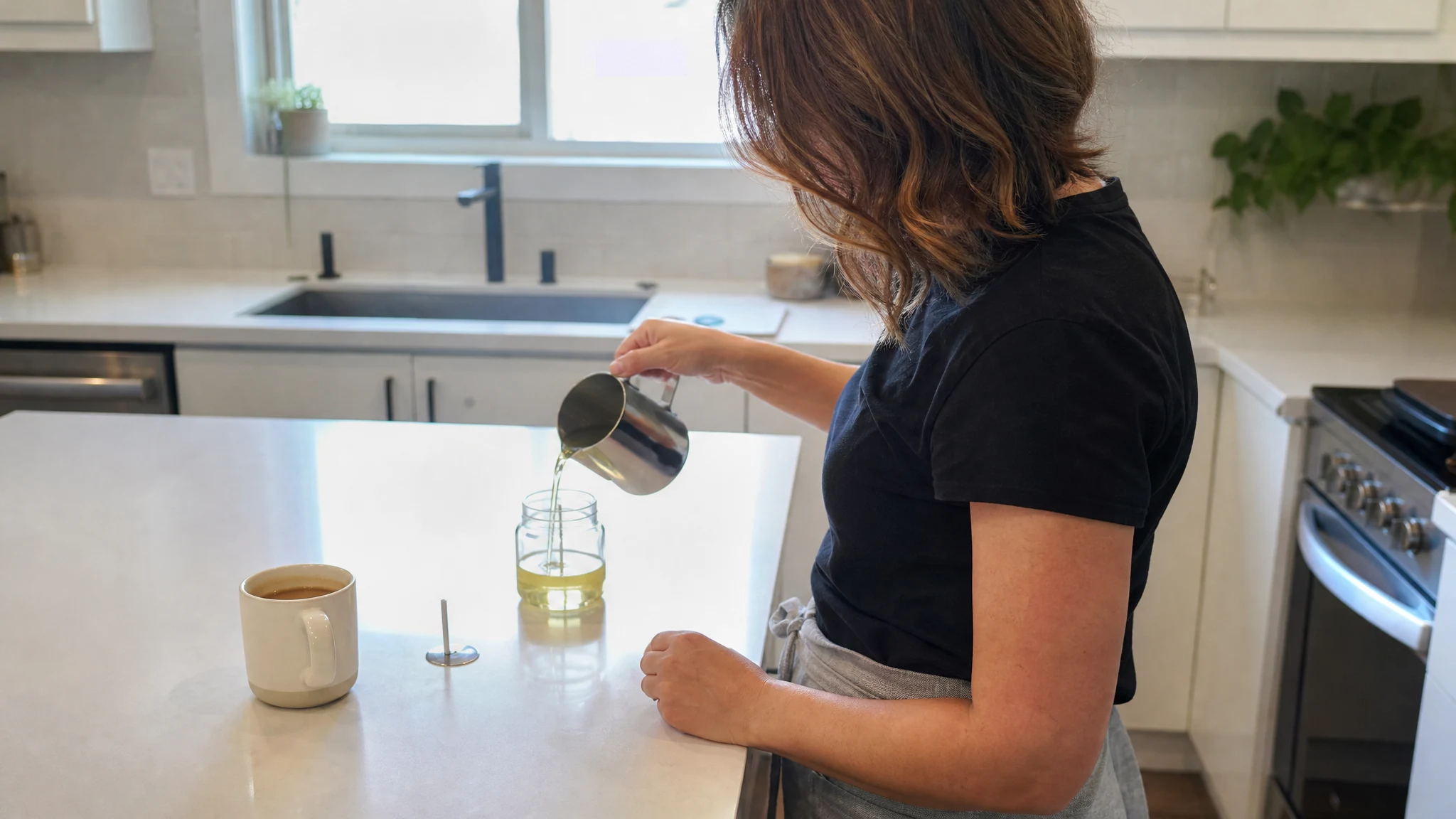
The pour, in order
This sequence is assembled from the sheets above and is untested by us.
- Weigh the wax and the oil separately. Weigh, do not count drops.
- Melt the wax in a pouring pitcher over a heat source you attend. Do not exceed your sheet's limit (85 C on two of the sheets above; the soy sheet allows brief excursions to 90 C if the wax is cooled quickly).
- Preheat the container if the sheet says so (50 to 60 C on the sheets above).
- Let the wax cool into the pour window, add the oil, and stir thoroughly. The soy and coconut sheets say to add fragrance at pour temperature and mix well, immediately before pouring.
- Pour, then cool undisturbed at room temperature.
Cure time is a real disagreement. The sheets say to wait 48 hours before a test burn. A candle supplier says crystallisation is usually complete within 48 hours, yet recommends 10 to 14 days for vegetable waxes for scent throw, while admitting that none of its two explanations has been investigated enough to say which, if either, is right (Candle Shack). Our suggestion: burn-test the wick at 48 hours, judge scent after the longer wait, and write both dates on the label. The problems that follow are covered in the scent throw guide.
Burning it
The National Candle Association's guidance is to trim the wick to a quarter inch before each use, stop burning when half an inch of wax remains, keep burning candles at least 12 inches from curtains, bedding and books and 3 inches apart, and never leave one unattended (NCA, candle safety). If you sell candles, the label has its own standard: ASTM F2058 covers the warning that tells people to burn a candle within sight (NCA, ASTM standards page). Our own safety copy for the oil says to avoid use during pregnancy and to keep it away from children and pets. Whether to burn a mugwort candle around a pregnant person, a child or an animal is a question for an obstetric clinician, a physician or a veterinarian, not for a candle recipe.
The wax, wicks, jars and any dye are not ours to sell. Buy them from a candle supply shop, ask for the data sheet and the safety data sheet for each, and keep them with your batch record. When the pilot candles are done, our oil is on the shop page in sizes from 0.5 oz up.
Mugwort Essential Oil
Mugwort Essential Oil from our own shop, in sizes from 0.5 oz to bulk.
From $16.99
Shop Now →Sources & Further Reading
- Kerax Ltd, 2020. Technical data sheet, Kerawax 4105, v5.0. candle.gr/KW-4105-TDS-v05.pdf
- Kerax Ltd, 2020. Technical data sheet, Kerawax 4170, v4.0. smellingood.com/KW-4170v4.0-TDS.pdf
- EcoCoco, 2020. Technical data sheet, ContainerBlend, v2.0. candle.gr/EcoCoco-ContainerBlend-TDS.pdf
- Soy wax container technical data sheet, v5.0, revised 2020 (maker not named in the document). cdn.shopify.com/Soy_Wax_Container_Technical_Data_Sheetv5.0.pdf
- Supplies for Candles Ltd, 2023. Technical data sheet, WAX042 Coco Pro Container Wax. suppliesforcandles.co.uk/WAX042 TDS
- Supplies For Candles. Paraffin Container Wax (Kerawax 4140), product page. suppliesforcandles.co.uk/product/paraffin-container-wax
- Supplies For Candles. Flash points explained. suppliesforcandles.co.uk/flash-points-explained
- Village Craft and Candle, 2026. Candle making essential oil guide. villagecraftandcandle.com/candle-making-essential-oil
- Candlewic, 2025. Wicks for candles: how to choose the right one. candlewic.com/wicks-for-candles
- Candle Shack. Understanding curing time in candle making. candle-shack.com/understanding-curing-time
- National Candle Association. ASTM standards for candles. candles.org/?p=593
- National Candle Association. Candle safety. candles.org/candle-safety
- CPSC. Candles and candle accessories, voluntary standards. cpsc.gov/Candles-and-Candle-Accessories
- IFRA, 2024. IFRA Standards, 51st Amendment (Thujone Standard, pp. 309 to 311). ifrafragrance.org/ifra-standards---51st-amendment.pdf
- IFRA, 2023. Guidance for the use of IFRA Standards, 51st Amendment. cloudfront.net/ifra-51st-amendment-guidance
- EFSA FEEDAP Panel, 2019. Safety and efficacy of a tincture derived from Artemisia vulgaris L. (EFSA Journal 17(11):e05879). PMC7008811
- Malik S. et al., 2019. Chemical profile and biological activities of essential oil from Artemisia vulgaris L. cultivated in Brazil. Pharmaceuticals. PMC6631396
- Dung N.X. et al., 1992. Chemical composition of the essential oil of Artemisia vulgaris L. Journal of Essential Oil Research 4(4):433-434. research.tue.nl