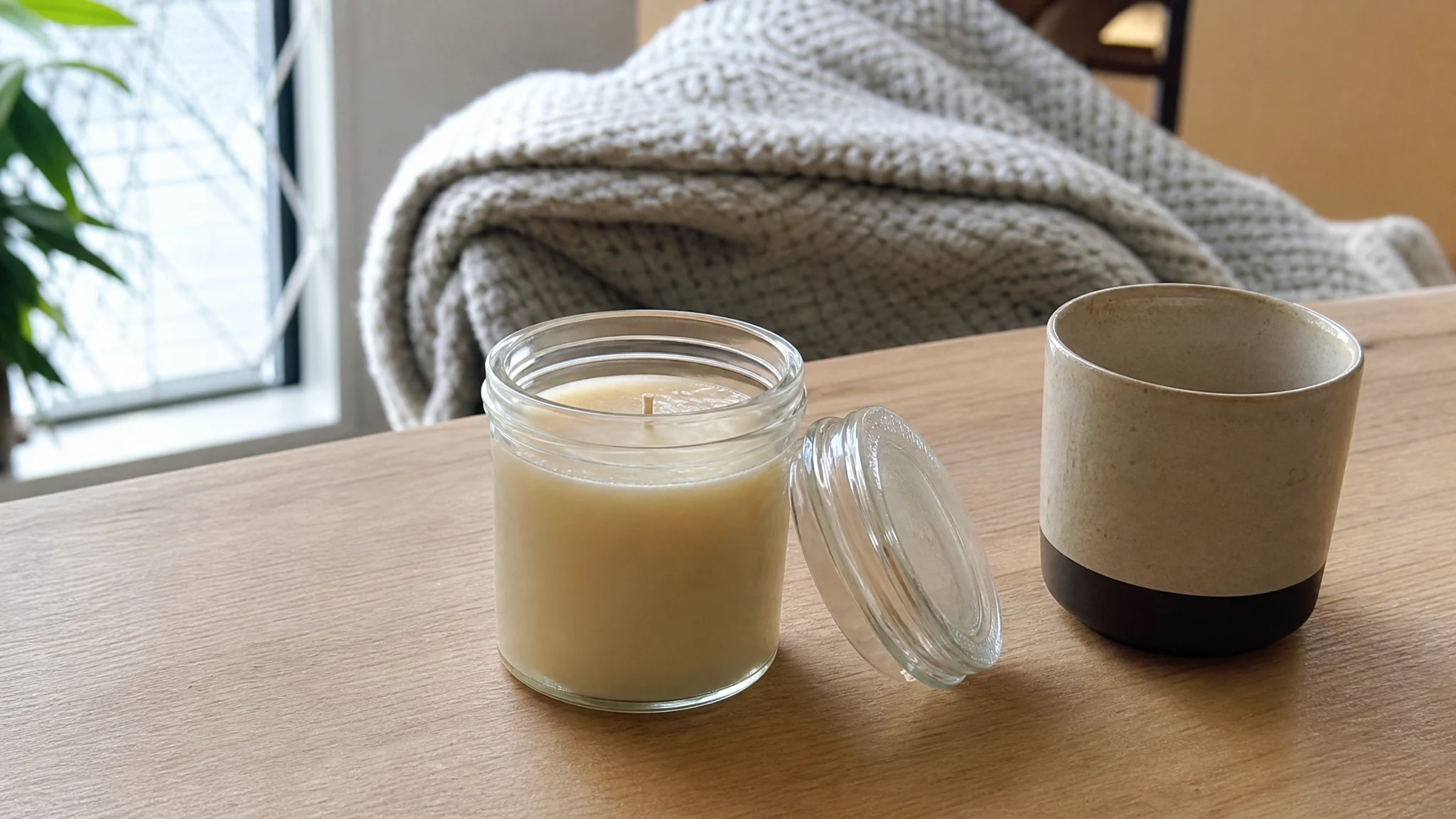
Why Your Mugwort Candle Has Weak Scent Throw
When a mugwort candle smells faint, the oil is rarely the first thing to change. The wax sheets and wick suppliers put the wick and melt pool first, then the temperature the oil went in at, then cure time, and only after those the load. Raising the load past the wax maker's ceiling is the fix we would avoid. This guide follows that diagnostic order. We have not made or burned a mugwort candle, so there are no before-and-after photos here: every step below rests on a named source, and the mugwort-specific points are labelled as reasoning.
Mugwort Essential Oil
Our own Mugwort Essential Oil, in sizes from 0.5 oz to bulk.
From $16.99
Shop Now →Step 1: check the wick and the melt pool
A soy container wax sheet says burn pool size and depth greatly affect fragrance throw, so correct wicking is paramount. It says too small a wick tunnels and produces a smaller flame, and too large a wick causes sooting, fast burn and guttering (wax leaking through the side); it also says natural waxes tend to need larger wicks than paraffin (soy container wax sheet v5.0, 2020). A wick supplier adds that the more fragrance or dye you include, the larger the wick you need for a full melt pool (Candlewic, 2025).
Practical consequence, reasoning from those two statements: a wick chosen for an unscented jar can be too small once oil is in the wax, and a candle that tunnels will smell faint however good the oil is. Test the wick, and do it after the wax has sat for 48 hours, which is when the sheets say to test burn. The sheets also name a failure to look for: "mushrooming", carbon building on the wick end, which they say can cause sooting and poor odours. Trim the wick to a quarter inch before each burn, which both the sheets and the National Candle Association give (NCA, candle safety), and never leave a test burn unattended.
Step 2: the temperature the oil went in at
This is a real disagreement. One supplier's guide says to add an essential oil once the wax has cooled to about 10 degrees below the oil's flash point, and that oil added to hotter wax volatilises before the candle sets (Village Craft and Candle, 2026). Another says fragrance is lost by evaporation near its boiling point, not its flash point (Supplies For Candles, undated). Wax sheets give only the wax's own window: pour at about 59 to 63 C for one container blend (Kerax, 2020), melt to about 70 C and pour at about 60 C for a coconut-predominant one (EcoCoco, 2020), and do not heat a rapeseed blend above 85 C (Kerax, 2020).
We publish no flash point for our oil; a buyer should request the safety data sheet in writing. If the oil went into wax at 85 C or hotter and you suspect loss, the cheap experiment is one candle with the oil added at the bottom of your wax's pour window. If you later learn the SDS flash point, the first guide's rule is that number minus 10 C. Treat the loss explanation as a hypothesis the sources dispute, not a diagnosis.
Step 3: cure time, and how little anyone knows about it
The wax sheets say to wait 48 hours before test burning. A candle supplier recommends 10 to 14 days for vegetable waxes for scent throw, and states that none of its proposed mechanisms (fragrance migrating toward the top, or spreading more evenly through the wax crystals) has been investigated enough to say which, if either, is correct (Candle Shack). A fragrance supplier says several days for paraffin and one to two weeks for soy (AFI, undated). So the fix is cheap and the evidence is thin: judge throw at 48 hours, again at 10 to 14 days, and record both dates. Judge the wick (pool, flame, soot) at 48 hours, and judge scent only after the longer wait.
Step 4: the load, and why not to chase it
Every sheet we read has a ceiling (10 to 12% on several), and Village Craft's essential-oil guide gives lower ranges for some waxes: 6 to 10% for soy and coconut, 3 to 6% for beeswax. Three of the sheets warn that some fragrances react poorly with the wax, causing bleeding, an objectionable surface or poor flame quality. Raising the load also raises the wick demand, as step 1 says.
The arithmetic shows what "a bit more" costs. In a 200 g candle (our assumption), going from 4% to 8% takes the oil from 8 g to 16 g. With a relative density of 0.895 on the batch on our published COA, that is about 179 drops becoming about 358, and 16 g is 60% of a 1 oz bottle (about 26.5 g) in one candle. If the wax's ceiling is 10%, 8% is already four-fifths of it. A better order: fix the wick, then the temperature, then cure, then move the load by two points at a time with the wick held constant. The how-to guide sets out a pilot ladder (2%, 4%, 6%) for exactly this.
Step 5: the wax
Sheets for coconut and soy blends say fragrance made for natural waxes is highly recommended and that fragrances designed for paraffin exaggerate bleeding, surface and flame problems. None addresses a plant oil. If you moved from paraffin to a natural wax and throw changed, the wick and cure figures above apply first; the ceilings in the wax comparison second.
Step 6: the oil itself, and what we cannot say
Mugwort oils differ. The EFSA compendium lists alpha- and beta-thujone, camphor and 1,8-cineole as substances of concern for the essential oil of Artemisia vulgaris (EFSA FEEDAP, 2019), yet a Brazilian-grown A. vulgaris oil was dominated by oxygenated sesquiterpenes (44.4%) and sesquiterpene hydrocarbons (33.3%), with caryophyllene at 37.45% (Malik et al., 2019). Reasoning, not a finding: heavier sesquiterpene-rich oils and lighter monoterpene-rich oils would not be expected to behave alike in hot wax or at room temperature, so a throw problem could be partly a composition problem. Our published COA reports no constituent data, so we cannot say which kind the batch is; a buyer who needs a GC-MS report must ask in writing before ordering and get it in writing. The composition guide covers the literature.
Step 7: expectations
One supplier says fragrance oils give a much stronger hot and cold throw than essential oils (NI Candle Supplies, undated). Our standards page calls the oil a restrained perfumery and ritual material, not a general-purpose oil, and the shop describes its aroma as green, bitter and camphoraceous. A candle that perfumes a small room at a low load may be the intended outcome, not a failure. See mugwort oil versus fragrance oil.
A one-variable log
Change one thing per candle and write down wax, load, addition and pour temperatures, cure time and burn result, the log that fragrance suppliers recommend (AFI). Our safety copy says to avoid use during pregnancy and keep the oil from children and pets; ask an obstetric clinician or a veterinarian before burning mugwort candles in a home with either. Wax, wicks and jars come from a candle supply shop.
Mugwort Essential Oil
Mugwort Essential Oil from our own shop, in sizes from 0.5 oz to bulk.
From $16.99
Shop Now →Sources & Further Reading
- Soy wax container technical data sheet, v5.0, revised 2020 (maker not named in the document). cdn.shopify.com/Soy_Wax_Container_Technical_Data_Sheetv5.0.pdf
- Candlewic, 2025. Wicks for candles: how to choose the right one. candlewic.com/wicks-for-candles
- National Candle Association. Candle safety. candles.org/candle-safety
- Village Craft and Candle, 2026. Candle making essential oil guide. villagecraftandcandle.com/candle-making-essential-oil
- Supplies For Candles. Flash points explained. suppliesforcandles.co.uk/flash-points-explained
- Kerax Ltd, 2020. Technical data sheet, Kerawax 4105, v5.0. candle.gr/KW-4105-TDS-v05.pdf
- Kerax Ltd, 2020. Technical data sheet, Kerawax 4170, v4.0. smellingood.com/KW-4170v4.0-TDS.pdf
- EcoCoco, 2020. Technical data sheet, ContainerBlend, v2.0. candle.gr/EcoCoco-ContainerBlend-TDS.pdf
- Candle Shack. Understanding curing time in candle making. candle-shack.com/understanding-curing-time
- AFI (Aromatic Fragrances International). Hot throw: the scientific method to stronger smelling candles. afi-usa.com/hot-throw
- NI Candle Supplies. Fragrance oils vs essential oils: the ultimate maker's guide. nicandlesupplies.com/fragrance-oils-vs-essential-oils
- EFSA FEEDAP Panel, 2019. Safety and efficacy of a tincture derived from Artemisia vulgaris L. (EFSA Journal 17(11):e05879). PMC7008811
- Malik S. et al., 2019. Chemical profile and biological activities of essential oil from Artemisia vulgaris L. cultivated in Brazil. Pharmaceuticals. PMC6631396