
How Mugwort Oil Is Made: Steam Distilling Artemisia Vulgaris
Most people encounter mugwort oil as a finished product: a small amber bottle with a complex, herbaceous scent and a long folk history behind it. But where does that oil actually come from? How does a wild-growing, somewhat unruly plant like Artemisia vulgaris become a concentrated aromatic extract?
The answer is steam distillation, one of the oldest and most elegant techniques in botanical extraction. Understanding the process gives you a much sharper eye for evaluating quality, sourcing intelligently, and appreciating what you're actually working with when you open that bottle. If you're new to mugwort oil entirely, it's worth reading our complete guide to mugwort essential oil before diving into the distillation specifics.
This article walks through the full process, from plant to oil, including the equipment involved, the critical variables that affect quality, and the common mistakes that lead to poor yields or compromised results.
What Is Steam Distillation?
Steam distillation works on a simple physical principle. Water boils at 100°C (212°F). Many aromatic plant compounds, called volatile organic compounds or VOCs, would degrade or oxidize if heated to their own boiling points. But when plant material is exposed to steam, those aromatic compounds are carried along with the water vapor at a much lower effective temperature. The steam and volatilized plant compounds rise together, pass through a cooling condenser, and return to liquid form in a collection vessel.
Because essential oil and water do not mix, they separate naturally in the collection vessel. The lighter oil floats on top and can be drawn off. The remaining water, now infused with water-soluble aromatic compounds, is called a hydrosol or floral water. In the case of Artemisia vulgaris, the mugwort hydrosol has its own aromatic character and is sometimes used separately in cosmetic applications.
Steam distillation is considered the gold standard for producing true essential oils. Solvent extraction and CO2 extraction are alternatives, but for mugwort, steam distillation is by far the most common commercial and small-batch method.
The Plant: Artemisia Vulgaris and Why Sourcing Matters
Artemisia vulgaris is a vigorous perennial in the daisy family (Asteraceae). It grows throughout Europe, Asia, and North America, often in disturbed soils along roadsides, riverbanks, and field edges. The plant has deeply lobed, dark green leaves with distinctive silvery-white undersides, and it can reach well over a meter in height by late summer.
The chemical profile of Artemisia vulgaris oil varies considerably depending on where and when the plant is grown. Geography, soil conditions, altitude, and the specific chemotype of the plant all influence which volatile compounds dominate. Thujone content is one of the most significant variables. Some chemotypes produce oil with very high thujone concentrations; others produce much lower levels. This is not a minor detail. Thujone is a compound that warrants careful attention, and you can read more about it in our guide to mugwort oil safety and dilution.
For distillation purposes, sourcing organically grown or wildcrafted plant material from a known, reputable origin is strongly preferable. Pesticide and herbicide residues concentrate during distillation. If they are present in the plant, they may appear in the finished oil.
Materials and Equipment Needed

Small-batch home distillation of mugwort is possible with hobby-grade equipment. Commercial production uses the same principles but at much larger scale. Here is what you will need for a small-batch distillation:
Plant Material
- Fresh or dried Artemisia vulgaris aerial parts (leaves, stems, and flowering tops)
- A significant volume is required: expect roughly 50 to 200 kg of fresh plant material per liter of oil, depending on chemotype and harvest timing
- For a home still with a 10-liter plant chamber, plan on 1 to 3 kg of packed fresh material
Equipment
- A dedicated distillation still with a separate plant chamber (also called a retort or alembic)
- A boiler for generating steam (separate from the plant chamber in a proper steam distillation setup)
- A condenser with a cold water supply or ice bath
- A Florentine flask or separator funnel for collecting and separating oil from hydrosol
- Clean glass collection vessels
- A thermometer and, ideally, a pressure gauge
- Amber glass bottles for storing the finished oil
Optional but Recommended
- A refractometer or basic gas chromatography access (for commercial producers verifying chemical composition)
- pH strips for hydrosol assessment
- Nitrile gloves and eye protection for handling concentrated plant material and finished oil
Harvest Timing: The Most Underestimated Variable
Before the distillation process begins, harvest timing deserves its own section. It is one of the most consequential decisions in the entire process, and it is frequently underestimated by first-time distillers.
Artemisia vulgaris reaches its peak aromatic oil concentration just before or at the very beginning of flowering, typically in mid to late summer in the Northern Hemisphere. Once the plant has fully flowered and begun setting seed, the concentration of volatile compounds drops noticeably. The leaves are also the primary oil-bearing tissue. Stems contribute bulk but relatively little oil.
Harvest in the morning, after any dew has dried but before the heat of midday volatilizes surface oils. Cut the top third to half of the plant, focusing on leafy, pre-flowering stems.
Step-by-Step: The Distillation Process
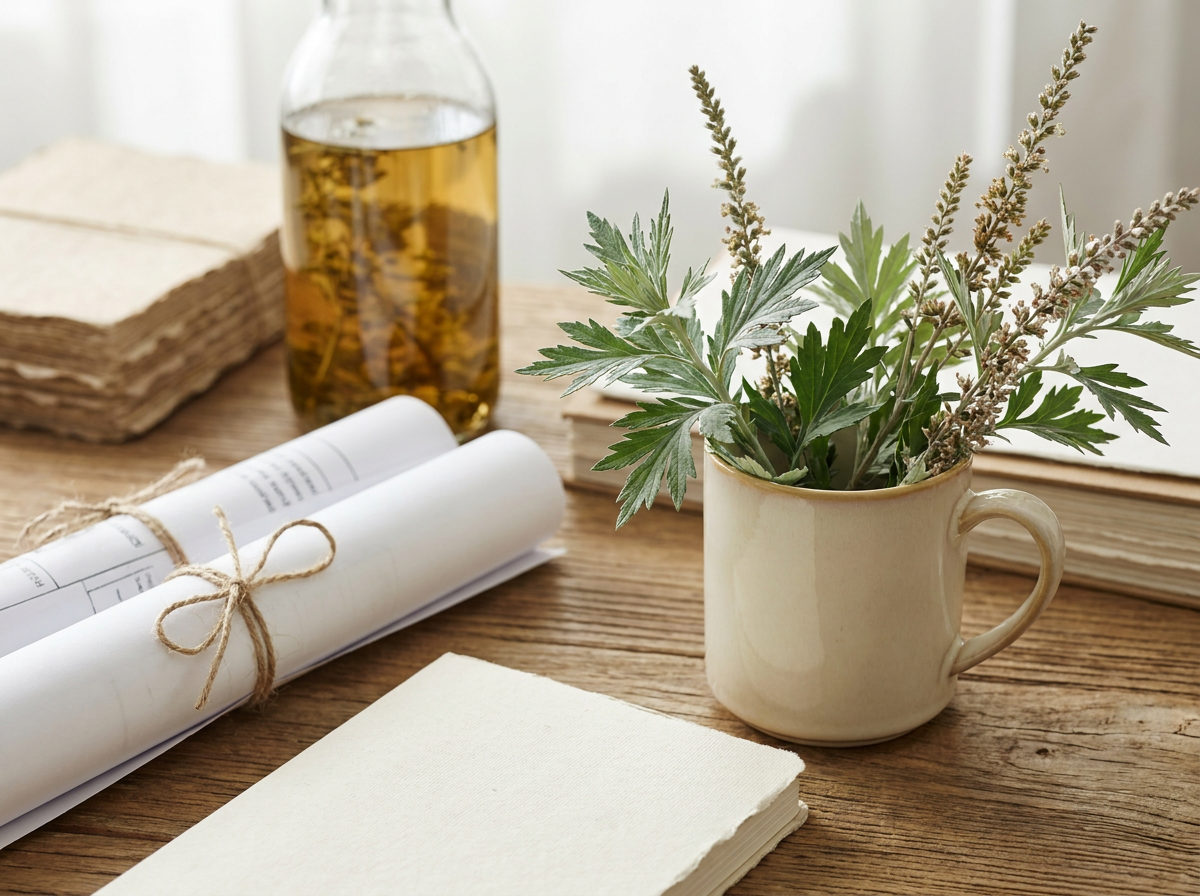
-
Prepare the Plant Material
If using fresh plant material, allow it to wilt for several hours after harvesting. A short wilt (not full drying) reduces water content slightly without losing significant volatile compounds, which can improve oil yield. Do not allow the plant to heat up or begin composting: this damages aromatic compounds before distillation even begins.
If using dried material, it should be dried at low temperature (below 35°C or 95°F) and stored away from light and heat. Dried material is denser and you will pack more into the chamber by weight, but very dry material can produce a slightly different aromatic profile compared to fresh.
-
Load the Plant Chamber
Pack the plant material loosely into the retort or plant chamber. "Loosely" is the key word. Overpacking creates channels where steam bypasses large portions of the plant material, reducing contact and lowering yield. Leave space for steam to move through the entire charge evenly.
Do not compress the material by hand or tamp it down. The weight of the plant itself is sufficient.
-
Fill the Boiler and Check Connections
Fill the boiler with clean water, distilled or filtered if possible. Minerals in hard tap water can accumulate and eventually affect equipment. Check all connections between the boiler, plant chamber, and condenser for leaks. A small steam leak is a loss of aromatic material and a burn hazard.
-
Begin Heating Slowly
Bring the boiler to temperature gradually rather than at maximum heat. A slow, steady steam generation produces more consistent results than blasting the plant material with high-pressure steam from the start. Aggressive steam pressure can push plant material around, create uneven extraction, and may carry unwanted water droplets into the condenser.
Maintain condenser cooling throughout. Whether you are using a water-cooled coil or an ice bath, keep the condenser cold enough that vapor fully condenses before reaching the collection vessel.
-
Monitor the First Distillate
The first liquid to arrive in the collection vessel will be a mix of hydrosol and the first wave of essential oil. In a Florentine flask, the oil will begin accumulating on top as the run progresses. Early distillate often contains the lightest volatile compounds. Later distillate carries heavier sesquiterpene fractions.
Some distillers separate early and late fractions to compare their aromatic profiles. For most small-batch production, the full run is collected together.
-
Run Time and Knowing When to Stop
A typical run for Artemisia vulgaris lasts between one and three hours, depending on the volume of plant material, the still size, and steam pressure. You can monitor progress by watching the oil accumulation rate in the Florentine flask. When the rate of oil production visibly slows and distillate appears nearly clear with minimal oiliness, the run is largely complete.
Running a still well past the productive window wastes water, energy, and time. It can also pull heavier, less desirable compounds into the oil in later fractions.
-
Separate and Store the Oil
Once the run is complete, allow the collection vessel to cool. Use a Florentine flask or carefully decant to separate the essential oil layer from the hydrosol below. Transfer the oil to clean, dark amber glass bottles. Fill to minimize headspace, seal tightly, label with the plant name, chemotype if known, distillation date, and origin of plant material.
Store in a cool, dark location. Mugwort essential oil is sensitive to heat, light, and oxygen. Proper storage significantly extends its shelf life.
Expected Yield and What Affects It
Yield from Artemisia vulgaris is modest by essential oil standards. Published yield figures range from roughly 0.1% to 0.5% by weight of fresh plant material, meaning 1 kg of fresh aerial parts might produce 1 to 5 mL of essential oil. The wide range reflects genuine variation in chemotype, harvest timing, and distillation technique.
Do not expect large volumes from small-batch home distillation. A 10-liter still charged with 2 kg of fresh mugwort may produce only 5 to 15 mL of oil. This is normal. Low yield is one reason quality mugwort oil costs what it does from reputable suppliers.
The finished oil is typically pale yellow to greenish-yellow, with a complex scent: sharp and camphorous at first, settling into something more herbal, slightly bitter, and resinous. The scent profile is part of what makes this oil distinctive in aromatic blending and cosmetic formulation. For a deeper look at the plant's cultural and aromatic history, our article on mugwort in folklore offers useful context.
Common Mistakes to Avoid
- Overpacking the plant chamber. Steam needs to flow through the material. Dense packing leads to channeling and poor extraction.
- Harvesting at the wrong stage. Post-flowering plant material produces significantly lower oil yields with a noticeably different aromatic profile.
- Insufficient condenser cooling. If the condenser cannot keep up with steam volume, vapor escapes without condensing. Check your cooling capacity before starting a run.
- Using contaminated plant material. Pesticide residues concentrate in the distillation process. Source clean material.
- Storing oil in clear glass or plastic. Light degrades aromatic compounds. Plastic can interact with the oil chemically. Always use dark glass.
- Skipping documentation. Batch records (date, plant origin, harvest stage, run time, yield) are invaluable for improving technique and for traceability.
A Note on Safety for DIY Distillers
Working with a still involves sustained heat, pressurized steam, and concentrated aromatic compounds. Use appropriate heat-resistant gloves when handling hot components. Never leave an active still unattended. Ensure your workspace is well ventilated, because concentrated mugwort volatiles in an enclosed space can be intense.
The finished oil is highly concentrated and should never be applied to skin undiluted. Mugwort oil carries specific safety considerations related to its thujone content, and those apply whether you distilled the oil yourself or purchased it from a supplier. Please review our full mugwort oil safety guide before working with the finished product. If you have any health considerations that might be relevant, consult a qualified healthcare provider before use.
From Plant to Bottle: Why the Process Shapes the Product
Steam distillation of Artemisia vulgaris is not a particularly complex process, but it rewards careful attention at every stage. Harvest timing, plant sourcing, packing density, steam pressure, run length, and storage all leave their mark on the finished oil. Two distillers working with the same species can produce oils with meaningfully different scent profiles and chemical compositions depending on how they approach each variable.
This is why knowing how mugwort oil is made matters when you are buying rather than producing it. Questions about plant origin, harvest stage, distillation method, and batch testing are reasonable to ask any supplier. Reputable producers of quality mugwort essential oil will have answers. That transparency, from field to bottle, is what distinguishes an oil worth using from one that simply carries the right label.