
Mugwort Cleansing Oil Products vs the Essential Oil: What You Are Really Buying
Walk through any K-beauty section and you will spot the word "mugwort" on a surprising number of bottles. Cleansing oils, toners, essences, balms. Then open a reputable aromatics supplier and you find a small amber bottle labeled Artemisia vulgaris essential oil. Same plant. Very different products. Very different purposes.
This guide breaks down exactly what separates a mugwort cleansing oil from pure mugwort essential oil, so you can spend your money on whichever one actually fits your routine.
The Core Difference: Formulation vs. Concentrate
A mugwort cleansing oil is a finished cosmetic product. It typically contains a blend of skin-conditioning carrier oils (sunflower, caprylic/capric triglycerides, or rice bran oil are common bases), emulsifiers so the product rinses cleanly with water, fragrance or botanical extracts, and some quantity of mugwort extract or mugwort-derived ingredients. The mugwort component may be a CO2 extract, a hydrodistilled essential oil used at a low percentage, or simply a plant extract in an oil-soluble base.
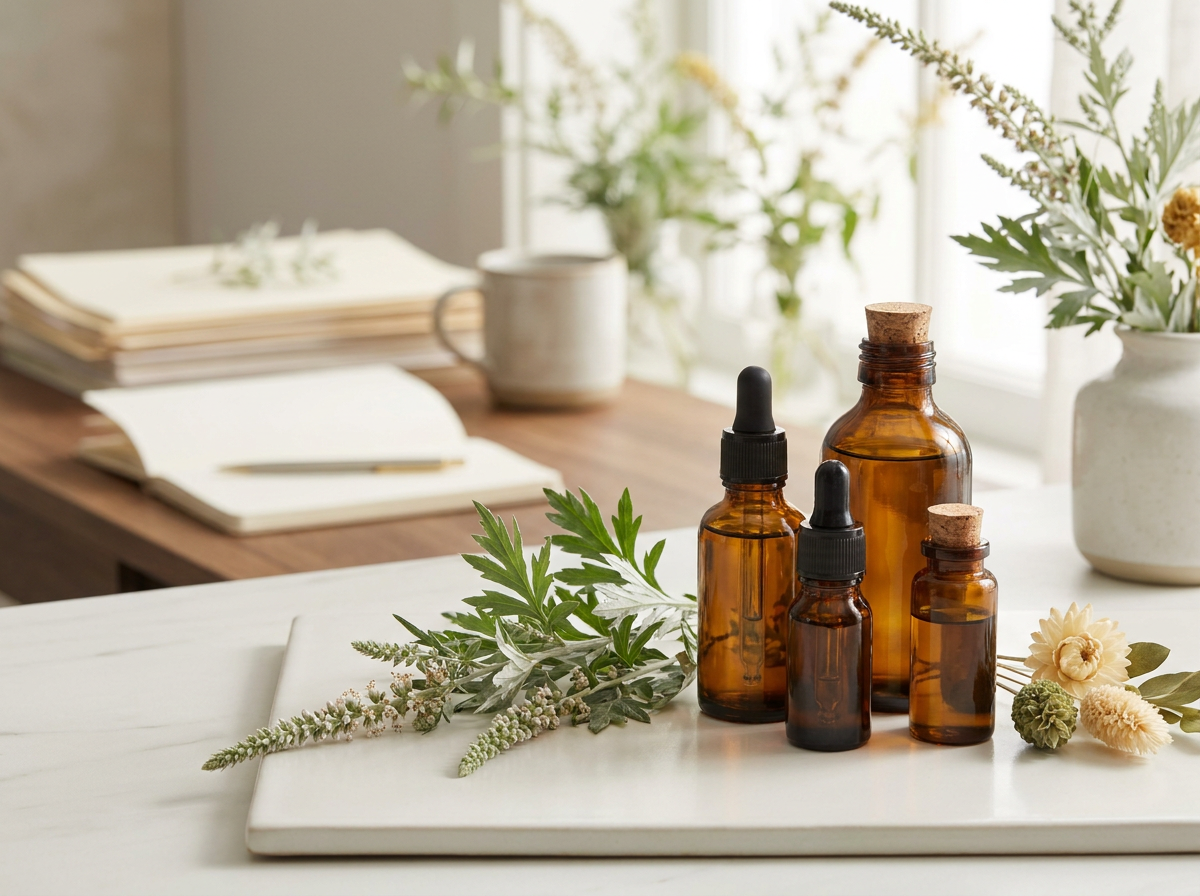
Pure mugwort essential oil is something else entirely. It is a concentrated aromatic distillate, typically steam-distilled or hydrodistilled from the aerial parts of Artemisia vulgaris or a related species. No carrier, no emulsifier, no fragrance blend. Just the volatile compounds pulled from the plant. Because it is so concentrated, it is not applied undiluted to skin and is not a standalone face wash. It is a raw ingredient or an aromatic tool.
Neither product is inherently superior. They answer different questions.
What Goes Into a Mugwort Cleansing Oil
Cleansing oils became a staple in double-cleansing routines because oil dissolves oil. Sebum, sunscreen, and long-wear makeup lift away more completely when an oil-based first cleanser emulsifies them before a water-based second cleanser follows.
Mugwort cleansing oils lean into the botanical's longstanding place in East Asian skincare traditions. Formulators incorporate mugwort for its aromatic profile (earthy, faintly herbaceous, slightly green) and for the presence of naturally occurring plant compounds that have attracted cosmetic research interest. Brands range from large K-beauty labels to small-batch independent makers.
A few things to check on the ingredient label of any mugwort cleansing oil:
- Where does mugwort actually appear? Ingredients are listed in descending order of concentration. If mugwort extract appears near the end, it is present in a very small amount.
- What form of mugwort is used? "Artemisia vulgaris extract," "Artemisia vulgaris leaf oil," and "mugwort ferment" are all different things with different aromatic and skin-feel profiles.
- What is the base oil? The carrier oils do most of the cleansing work. A product built on quality jojoba or squalane behaves differently on skin than one built on heavy mineral oil.
- Are there added fragrances or essential oil blends? Some formulas use mugwort essential oil as part of the scent profile, then supplement with other botanicals.
What You Are Getting With Pure Mugwort Essential Oil

Pure mugwort essential oil is primarily an aromatic product. Its scent is distinctive: camphorous, herbaceous, green, and slightly woody, with variations depending on the growing region and distillation method. Material from Chinese-grown Artemisia argyi (a close botanical relative often sold under the mugwort umbrella) reads differently from European A. vulgaris. Both are legitimately called mugwort in common usage, so species identification matters when you are buying.
In a cosmetic or aromatic context, pure mugwort essential oil is used in several ways:
- Diffused for aromatic atmosphere, particularly in evening wind-down rituals
- Diluted into a carrier oil or unscented lotion for a botanical body oil or chest rub (at appropriate dilution ratios)
- Added in small quantities to homemade skincare formulations or room sprays
- Used in bath products where the steam carries the scent
- Incorporated into candle or soap making for fragrance
Because the essential oil is so concentrated, proper dilution is non-negotiable. A standard cosmetic dilution for a leave-on product is 0.5% to 1% (roughly 3 to 6 drops per ounce of carrier). Mugwort essential oil contains thujone, a naturally occurring compound that warrants careful handling. It should not be used during pregnancy, by those who are nursing, or by young children. Patch testing before any skin application is always the right first step. When in doubt, consult a qualified healthcare provider before adding any new botanical to your routine.
For more guidance on selecting a genuine, quality-tested product, our guide on how to buy mugwort oil covers sourcing and quality markers in depth.
Side-by-Side Comparison Table
| Attribute | Mugwort Cleansing Oil | Pure Mugwort Essential Oil |
|---|---|---|
| Primary purpose | Remove makeup, SPF, and daily buildup | Aromatics, DIY formulation, diffusion |
| Mugwort content | Low to moderate (extract or trace oil in a base) | 100% concentrated distillate |
| Ready to use as-is? | Yes, apply and rinse | No, must dilute before skin contact |
| Scent intensity | Mild to moderate (blended, softened) | Strong, camphorous, concentrated |
| Typical price range | $15 to $45 for 150 to 200 ml | $8 to $30 for 5 to 15 ml |
| Shelf life | 12 to 24 months (watch for oxidation in carrier oils) | 2 to 3 years stored correctly in dark, cool conditions |
| Pregnancy / sensitivity notes | Check full formula; varies by brand | Avoid during pregnancy; consult provider |
| Customizable? | No, finished formula | Yes, blend into your own creations |
| Label transparency | Varies widely by brand | Look for GC/MS testing and species disclosure |
| Best starting point for | Skincare routine simplicity | Aromatics enthusiasts and DIY formulators |
Pros and Cons
Mugwort Cleansing Oil: Pros
- Convenient and ready to use with no measuring or blending required
- Formulated by cosmetic chemists with emulsifiers that rinse off cleanly
- Carries skin-feel benefits from quality carrier oil bases
- Many options across price points from drugstore to premium
- Scent is usually softened and accessible for those new to mugwort's aroma
Mugwort Cleansing Oil: Cons
- Actual mugwort concentration is often very low
- Some formulas rely on "mugwort" as a marketing label with minimal plant content
- Added fragrance compounds or preservatives may not suit every skin type
- You are largely buying the base formula, not a mugwort-forward product
- Harder to verify botanical quality or source
Pure Mugwort Essential Oil: Pros
- High concentration of the plant's actual aromatic compounds
- Versatile: diffuse, dilute, blend, formulate
- Longer cost-per-use value when you buy a quality product in the right size
- Species and origin can be verified through GC/MS reports from reputable suppliers
- Full control over what else goes into your formulation
Pure Mugwort Essential Oil: Cons
- Requires knowledge of safe dilution practices
- Not suitable for everyone, particularly during pregnancy
- Strong scent may be polarizing if you are unfamiliar with camphorous botanicals
- More supplier research required to find a trustworthy source
- Not a substitute for a complete cleansing product
Best-For Recommendations by Use Case
You want a simple addition to your evening cleanse
A mugwort cleansing oil is the right call. It fits neatly into a double-cleanse routine, rinses away without residue if the formula is well-made, and requires no preparation. Look for a product where mugwort extract appears in the first half of the ingredient list.
You want to create your own botanical body oil or room spray
Pure mugwort essential oil gives you something a cleansing oil never can: control. You decide the concentration, the carrier, and the companion botanicals. Start small, dilute carefully, and patch test every new blend.
You are drawn to mugwort for its aromatic atmosphere in a diffuser
Essential oil, without question. No cleansing oil is designed for diffusion, and attempting it would be wasteful and potentially damaging to your diffuser. A few drops of pure mugwort essential oil in an ultrasonic diffuser creates the earthy, dreamy atmosphere that has made this plant a fixture in folklore and ritual for centuries.
You are a formulator or skincare DIY enthusiast
Both products have a place on your workbench, but for different jobs. Use the essential oil as a fragrance and botanical-interest component at safe cosmetic percentages. Study a well-made cleansing oil for emulsifier ratios and texture goals. You can even add a trace amount of mugwort essential oil to your own cleansing oil base, as long as you stay within safe usage guidelines.
You are buying a gift for someone new to mugwort
A well-reviewed mugwort cleansing oil from a reputable K-beauty brand is more approachable. The scent is gentler, the format is familiar, and there is no learning curve around dilution. For the scent-curious gift recipient, a small bottle of essential oil paired with a simple diffuser can work beautifully, but include a note about safe use.
If you are still deciding on bottle size or quantity for pure essential oil, our piece on the best mugwort oil bottle sizes walks through when each size makes sense for different use patterns.
A Note on Marketing Language in Mugwort Skincare Products

Mugwort has become a genuine trend in skincare, which means brands have an incentive to feature the word prominently on packaging regardless of how much of the plant is actually present in the formula. This is not unique to mugwort. It happens with most trending botanicals.
When evaluating any mugwort oil product, read the full INCI ingredient list rather than the front-of-pack claims. A cleansing oil that lists Artemisia vulgaris leaf extract as the fifth ingredient is a meaningfully different product from one where it appears twenty ingredients deep. Neither product is making a false claim by featuring mugwort. You just want to know what you are paying for.
The same scrutiny applies to essential oil suppliers. Terms like "pure," "natural," and "wild-crafted" are not regulated in the same way as organic certification. The best suppliers share GC/MS test results, disclose the botanical species, and identify the country of origin. Our smart shopping guide for mugwort essential oil covers exactly what to look for before you commit to a supplier.
The Verdict
These two product categories share a botanical name and a scent family. That is roughly where the overlap ends.
A mugwort cleansing oil is a finished skincare product built for a specific job: dissolving and lifting surface impurities as part of a cleansing ritual. Its value depends mostly on the quality of the carrier oil base and the emulsifier system. The mugwort content adds aromatic character and botanical interest, but it is rarely the dominant functional ingredient.
Pure mugwort essential oil is a concentrated aromatic material that rewards the buyer who knows how to use it safely. It requires more care, more knowledge, and more respect. In return, it offers genuine versatility: diffuser blends, diluted body oils, candle projects, and DIY formulations where you control every element.
Buy the cleansing oil for your skincare shelf. Buy the essential oil for your aromatics practice and your crafting table. If you love this plant, there is a good case for having both.