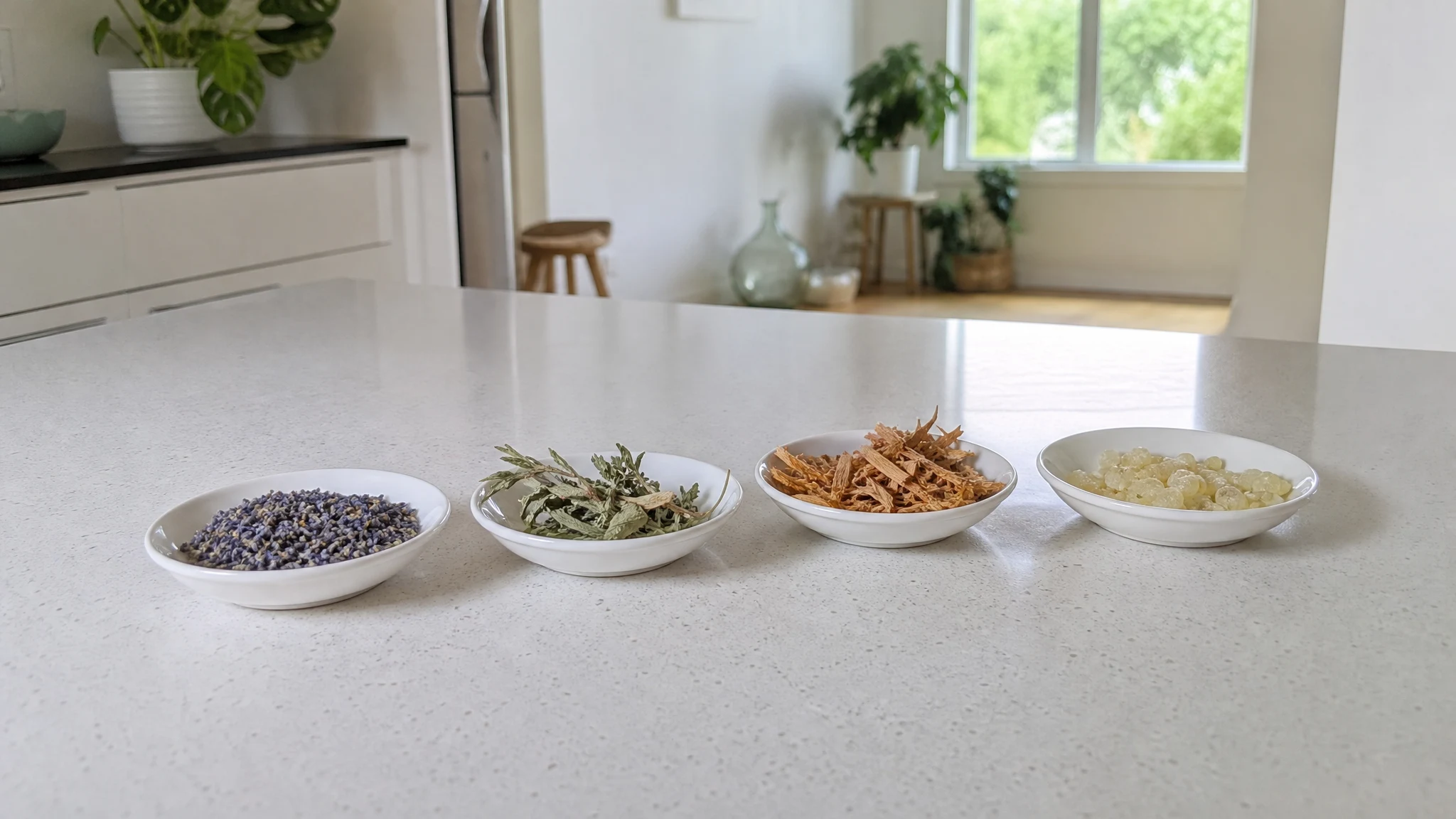
Mugwort in Fougère and Chypre Accords: The Limits First
Neither classic structure was built around mugwort, and none of the fougère or chypre histories read for this article names it. So this is a limits-first exercise: mugwort oil would be a bitter green accent added to an existing frame, and the frame is where the arithmetic bites, because oakmoss and treemoss together are capped at 0.10% of a finished fine fragrance and expressed bergamot at 0.40%. Two starting structures follow, by weight in a 10 g concentrate. We have not blended, smelled or tested either one.
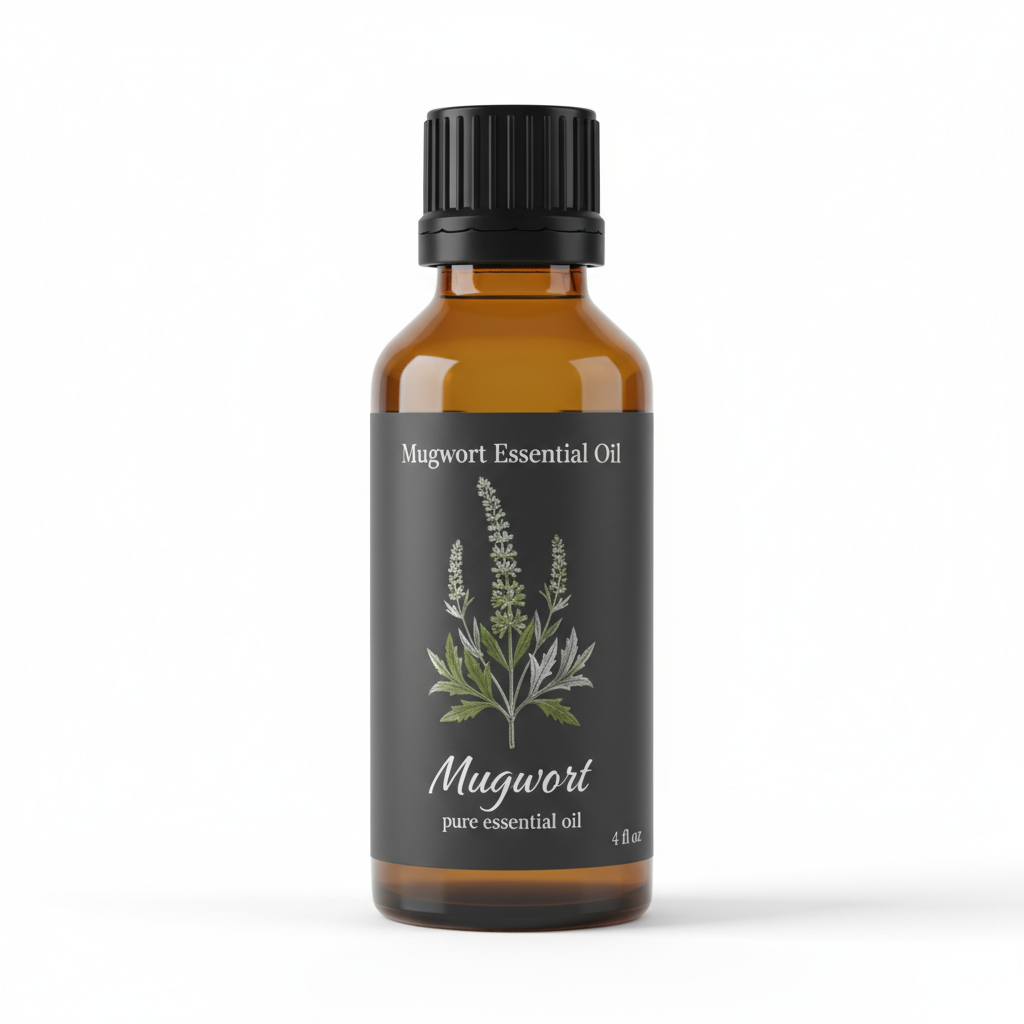
Mugwort Essential Oil
Our own Mugwort Essential Oil, in sizes from 0.5 oz to bulk.
From $16.99
Shop Now →What the two families are, and what the sources do not say
A fougère is built on a lavender, oakmoss and coumarin accord; the aromatic fougère variant adds herbs, spice or wood. The family takes its name from Fougère Royale, composed by Paul Parquet for Houbigant in 1882, with coumarin (first synthesized in 1868) as a key component (Wikipedia, Fougère, reference article). A chypre is a different frame: Bois de Jasmin dates it to François Coty's 1917 Chypre, built on bergamot, dry woods and moss with patchouli facets, and says Coty used an aroma chemical, isobutyl quinoline, to get a heavy oakmoss radiance (Victoria, Bois de Jasmin, 2020). The article also reports that restrictions on oakmoss and treemoss pushed perfumers to rebuild the mossy effect from other naturals and synthetics.
The search for a source placing armoise or mugwort inside a classic fougère or chypre found none. The fougère article names only generic "herbs". Putting mugwort oil here is therefore an extrapolation from its listed aroma and from the structure, not a documented tradition. For the oil itself, see the armoise post.
The budget comes first: IFRA Category 4
IFRA Category 4 covers fine fragrance, including cologne and solid perfume, and its caps are on the finished product, not the concentrate (IFRA, Guidance, 51st Amendment, 2023). IFRA's implementation dates apply to the supply of fragrance mixtures and are not a certificate for a finished product. Assume a 15% concentrate in the finished perfume (an assumption; no standard sets it). Then a material's maximum share of the concentrate is its cap divided by 0.15.
| Material | IFRA Cat 4 cap (finished) | Max share of concentrate | Grams in 10 g concentrate |
|---|---|---|---|
| Oakmoss extracts (summed with treemoss) | 0.10% | 0.667% | 0.067 g |
| Bergamot oil, expressed (furocoumarins unknown) | 0.40% | 2.67% | 0.27 g |
| Coumarin | 1.5% | 10% | 1.0 g |
| Thujone (any source) | 1.4% | 9.33% | 0.93 g |
| Estragole (if tarragon or basil is added) | 0.014% | 0.093% | 0.0093 g |
| Methyl eugenol (if tarragon or basil is added) | 0.011% | 0.073% | 0.0073 g |
Source for every cap: the IFRA Standards compilation, 51st Amendment, January 2024 (oakmoss, treemoss, bergamot, coumarin and thujone: Amendment 49, 2020; estragole and methyl eugenol: Amendment 51, 2023). The oakmoss entry is driven by dermal sensitization and ties to atranol and chloroatranol, which the text says should each be below 100 ppm in the extract. A text search of the compilation found no standard named lavender, labdanum, patchouli or mugwort. IFRA's 52nd Amendment is not yet final: its end-of-consultation letter is dated 31 August 2026 and notification is expected in January 2027 (IFRA, 2026); that page does not mention mugwort or thujone.
Where mugwort oil fits in the arithmetic
IFRA has no standard for mugwort oil as such, but it does have one for thujone, and the guidance says to count a constituent's natural contribution from any oil. The cap divided by the oil's thujone share gives the ceiling for the oil. Thujone in mugwort oils varies from none to about a fifth: one review lists trans-thujone from 0 to 20.2% in oils from northern Lithuania (Ekiert et al., 2020), and seven oils of a different species from seven Chinese provinces showed thujone in three of them (1.31, 4.18 and 16.66%) (Luo et al., 2022). Those are literature figures. The COA we publish carries no thujone figure, so none can be assumed for our oil.
- At 5% thujone, the thujone cap would allow 187% of the concentrate: it never binds.
- At 20% thujone, mugwort could be at most 46.7% of the concentrate (4.7 g in 10 g).
- At a hypothetical 50% thujone, at most 18.7% (1.9 g).
An accent sits far below any of those. The COA batch has a relative density of 0.895, so one drop (about 0.05 ml) weighs about 0.045 g. In a 10 g concentrate that is 0.45%, which is 0.067% of the finished perfume at 15%; two drops are 0.134%. A drop is too coarse for a 0.01 g scale, so make a 10% dilution by weight in the same alcohol and weigh 0.45 g of it.
Two starting structures (untested)
The grams below are placeholders chosen to sit under the caps, not tested proportions. Only the caps are sourced. Fill the balance with woods, geranium, vetiver, musk or whatever the frame needs, and check each against its own supplier's IFRA certificate.
| Material | Aromatic fougère (g) | Chypre (g) | Finished, at 15% |
|---|---|---|---|
| Lavender oil | 3.00 | 0 | no IFRA standard of that name |
| Coumarin | 0.60 | 0 | 0.09% (cap 1.5%) |
| Bergamot oil, expressed | 0.25 | 0.26 | 0.375% and 0.39% (cap 0.40%) |
| Oakmoss or treemoss material | 0.06 | 0.06 | 0.09% (cap 0.10%, combined) |
| Labdanum and patchouli | 0 | 1.8 together | no standard of those names |
| Mugwort oil (1 drop) | 0.045 | 0.045 | 0.067% |
| Balance of your own materials | 6.05 | 7.84 |
The fougère places mugwort between the lavender top and the coumarin and moss base, as the herb of an aromatic fougère. The chypre uses it as a bitter bridge between bergamot and the mossy base. The shop page describes the aroma as green, bitter and camphoraceous with sage-like facets and lists cedarwood, clary sage, juniper, frankincense and cypress as blend partners; those are intended-use statements, not results. Oakmoss is the awkward partner: the 0.067 g ceiling is why modern chypres lean on other materials, and none of those are sold by us. Buy them from a perfumery supply house and ask for the batch IFRA certificate and the SDS.
Which number governs on skin
Our own copy says to dilute to 0.5% to 2% in a carrier for skin and patch test first, and our standards page adds that dilutions should be very low indeed. The accent dose above is 0.067% of the finished perfume, which is under the bottom of that range. It would stay under IFRA's thujone cap even as a body oil: IFRA places body oils in Category 5A, with a thujone cap of 0.095%, and 0.067% of oil stays under that whatever the oil's thujone share. The trouble starts if the accent grows. At 1.5% mugwort in a Category 5A product, the oil could hold at most 6.3% thujone (0.095 divided by 1.5), and our oil's thujone is unpublished. The same logic applies to our 2% top: it needs 4.75% thujone or less. That is a figure lower than our copy, on a conditional basis, so stay near the accent dose unless the supplier gives thujone data in writing.
No Tisserand figure for mugwort oil could be obtained. One retailer page citing Essential Oil Safety (2014) gives 0.25% for a different species, armoise (Artemisia herba-alba), for short-term or occasional use; treat it as a flag, not a limit for our oil. Our copy says to avoid use during pregnancy and to keep the oil from children and pets. Questions about pregnancy or epilepsy go to a physician, not to a perfume recipe.
What to do first
Weigh a 10 g batch, not 100 g. Smell the accent on a strip against a control without it, and patch test the finished perfume before wearing it. Ask in writing for GC-MS and thujone data before ordering larger sizes, and for an SDS; we publish no flash point. Alcohol is a partner material too: TTB says buying specially denatured alcohol takes an industrial alcohol user permit while completely denatured alcohol does not (TTB, definitions, 2018), and Formula 39-B is authorized for perfumes and perfume tinctures (27 CFR 21.71). Ask the seller which grade you are getting.
For the smell side of the oil, see the perfumery post, and for why the oil's place on the volatility scale is not fixed, the note-position article. Safety basics are in the safety post.
Mugwort Essential Oil
Mugwort Essential Oil from our own shop, in sizes from 0.5 oz to bulk.
From $16.99
Shop Now →Sources & Further Reading
- IFRA, 2024. The complete IFRA Standards, up to and including the 51st Amendment. ifra-standards-51st-amendment.pdf
- IFRA, 2023. Guidance for the use of IFRA Standards, 51st Amendment. ifra-51st-amendment-guidance
- IFRA, 2026. End of Consultation Letter for the 52nd Amendment. ifrafragrance.org
- Wikipedia. Fougère (reference article). en.wikipedia.org/wiki/Fougère
- Victoria, 2020. Revolutionary Perfume: A Brief History of Chypre. boisdejasmin.com
- Ekiert et al., 2020. Significance of Artemisia vulgaris L. in the history of medicine. Molecules 25(19):4415. PMC7583039
- Luo et al., 2022. Seven Mugwort (Artemisia argyi) essential oils against Anopheles sinensis. Sci Rep 12:5337. PMC8964668
- TTB, 2018. Definitions (specially and completely denatured alcohol). ttb.gov/node/2278
- 27 CFR 21.71. Formula No. 39-B. law.cornell.edu/cfr/text/27/21.71