Mugwort Tincture vs Essential Oil in Perfumery
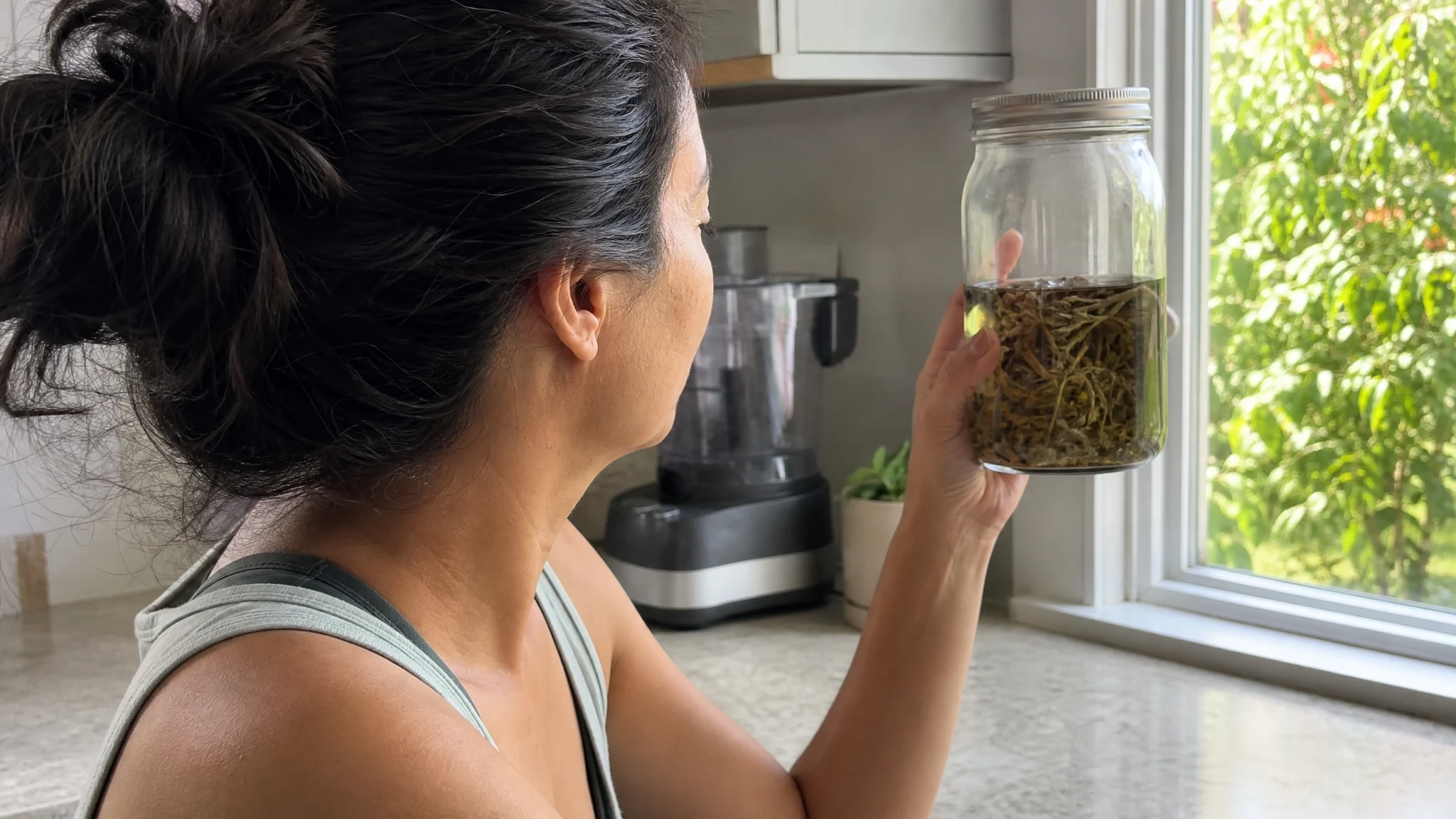
A mugwort tincture is not a weak version of the essential oil. It is a different material, and EFSA's published analysis of one mugwort tincture found it to be about 98% solvent. We sell the steam-distilled oil only, not dried herb or alcohol, so this article compares the two on published numbers and gives an untested starting formula for the tincture side, for readers who want to make one from herb bought elsewhere.

Mugwort Essential Oil
Our own Mugwort Essential Oil, in sizes from 0.5 oz to bulk.
From $16.99
Shop Now →What each one captures
Steam distillation carries over the volatile fraction. Ethanol maceration takes whatever dissolves: one perfumery writer, citing Sell (2006), says a tincture covers "a broader spectrum of aromatic and non-aromatic molecules" than a distilled oil, including resins, pigments and waxes that dissolve in ethanol (Ciccolo, Scentspiracy; the books cited were not read). The numbers for mugwort come from a 2019 EFSA opinion on a tincture of Artemisia vulgaris aerial parts made by extended water and ethanol extraction, assessed as a feed additive, with the solvent ratio redacted (EFSA FEEDAP Panel, 2019).
- The tincture was a brown liquid of density 940 kg/m³; solvent made up about 98.34% and dry matter 1.66% (organic fraction 1.34%).
- Alpha- and beta-thujone were not detected (limit of detection 0.005%), although the raw herb held 268.5 mg/kg of thujones (0.027%).
- 1,8-Cineole was 0.0011% in the tincture and 75.4 mg/kg in the herb.
- About 74% of the dry matter was uncharacterised, EFSA could not conclude on safety, and the applicant supplied no data on skin or eye irritation or skin sensitisation.
Compare the oil. Seven Artemisia argyi oils from China had 1,8-cineole at 4.86 to 21.89% (Luo et al., 2022), which is 48.6 to 219 mg per gram. EFSA's tincture held 0.011 mg per gram. By that arithmetic the oil is about 4,400 to 20,000 times richer in cineole. This compares two different species and materials, and it shows the order of magnitude, not a conversion factor. Our COA reports no constituent data, so nothing here is a claim about our oil. One more caveat: perfumers use 90 to 95% ethanol, a stronger solvent than a water and ethanol mix, so a perfumery tincture will not match EFSA's analysis.
A starting formula by weight (untested)
We have not made this. The ratios are from a perfumery writer citing Arctander (1960) and Sell (2006), not from our own batches: 3 to 20% raw material to ethanol by weight, 10 to 15% for strongly aromatic botanicals, ethanol of 90 to 95%, and maceration from about two weeks to several months, with filtering because waxes and pigments come through (Scentspiracy, above). The books were not read, so treat the ranges as a starting point.
- 10 g dried mugwort herb and 90 g of 95% ethanol, weighed, in a sealed glass jar (a 10% tincture by weight).
- Keep it capped, away from heat and flame, and filter at the end.
- Make a small batch first. Date and label the jar, including the Latin name on the herb's label.
When you buy the herb from an herb supplier, ask for the Latin name, the plant part and the harvest year in writing. Species matters: literature thujone ranges from none to about a fifth in oils, and the tincture's thujone depends on the herb (Ekiert et al., 2020). Do not infer which species is in any bottle from its name. The plant itself is covered in the plant post, and the oil against infused oil in that comparison.
The thujone budget, worked
IFRA's thujone standard counts thujone from any source, tincture included, and caps it at 1.4% of a finished fine fragrance (Category 4) (IFRA, 51st Amendment, 2024). Take the EFSA herb sample, 268.5 mg/kg thujones, and assume a worst case in which every milligram moves into the ethanol. In the 10% formula that is 2.685 mg in 100 g, or 0.0027% of the tincture. If the tincture is 10% of a finished perfume, that is 0.00027% thujone, about 5,000 times under the cap. One drop of oil in a 10 g concentrate at 15% is 0.067% of the finished perfume (COA batch relative density 0.895; about 20 drops per ml). If that oil carried a literature-high 20% thujone, the drop would deliver 0.013% thujone, about 50 times more thujone than the full-transfer tincture. A thujone-rich oil is the larger thujone source of the two, which is a result of arithmetic on one herb sample, not a rule.
On skin, our copy says to dilute our oil to 0.5% to 2% in a carrier and patch test, and our standards page says very low indeed. IFRA's thujone cap for Category 5A body products is 0.095%, so a 2% oil in such a product must hold 4.75% thujone or less, which is a limit that can fall below our copy; our oil's thujone is unpublished. No Tisserand figure for mugwort oil could be obtained. A retailer page citing his 2014 book gives 0.25% for armoise (Artemisia herba-alba), a different species. Our copy says to avoid use during pregnancy and to keep the oil from children and pets. EFSA offered no skin data on the tincture, so apply the same caution to it, patch test, and ask a physician or an allergist about any reaction.
A perfumery tincture is not a drink
Three rules, from three sources, all point the same way. The US food rule lists Artemisia species as natural flavoring only if the finished food is "thujone free" (21 CFR 172.510). The EMA's thujone statement describes alpha-thujone as a modulator of the GABA-gated chloride channel, names convulsions as the most prominent sign of acute intoxication, notes a Council of Europe tolerable daily intake of 10 µg per kg of body weight and, for alcoholic beverages made from Artemisia species, an EU maximum of 35 mg/kg thujone (EMA, 2012). And perfumer's alcohol is denatured by formula: Formula 39-B, authorized for perfumes and perfume tinctures, adds 2.5 gallons of diethyl phthalate and 1/8 gallon of tert-butyl alcohol per 100 gallons (27 CFR 21.71). Our oil and any tincture are not for internal use. Label the jar, and keep it away from children and pets.
FDA also treats intended use as the test for a drug: it says a fragrance with aromatherapy claims, such as helping a consumer sleep, is a drug, not a cosmetic (FDA, 2024). A mugwort tincture that is marketed for anything but fragrance is outside what we describe.
Permits, fire and where to buy
TTB's definitions page says an industrial alcohol user permit is needed to procure specially denatured spirits and that a permit is not needed to buy completely denatured alcohol (TTB, 2018). Ask any alcohol supplier which grade it is selling and whether it is meant for perfumery. Ethanol has a flash point of 55 F and a lower explosive limit of 3.3% (NIOSH Pocket Guide), so a macerating jar is a fire matter. We state no flash point for our oil; a buyer who needs one should request the SDS in writing.
The decision is simple. Use the oil when you want dose control by weight, and ask for GC-MS and thujone data first. Make a tincture only if you want a non-distilled extract and will source the herb and alcohol elsewhere. Neither the EFSA opinion nor the perfumery source describes a mugwort tincture's smell, so no claim about it is made here. For the oil in blends, see the perfumery post and the armoise article.
Mugwort Essential Oil
Mugwort Essential Oil from our own shop, in sizes from 0.5 oz to bulk.
From $16.99
Shop Now →Sources & Further Reading
- EFSA FEEDAP Panel, 2019. Safety and efficacy of a tincture derived from Artemisia vulgaris L. as a sensory additive in feed. PMC7008811
- Ciccolo. Tinctures in perfumery: definition and overview. Scentspiracy. scentspiracy.com
- Luo et al., 2022. Seven Mugwort (Artemisia argyi) essential oils against Anopheles sinensis. Sci Rep 12:5337. PMC8964668
- Ekiert et al., 2020. Significance of Artemisia vulgaris L. in the history of medicine. Molecules 25(19):4415. PMC7583039
- IFRA, 2024. The complete IFRA Standards, 51st Amendment (Thujone, pp. 309-311). ifra-standards-51st-amendment.pdf
- 21 CFR 172.510. Natural flavoring substances and natural substances used in conjunction with flavors. law.cornell.edu/cfr/text/21/172.510
- EMA, 2012. Public statement on the use of herbal medicinal products containing thujone (EMA/HMPC/732886/2010 Rev. 1). ema.europa.eu
- 27 CFR 21.71. Formula No. 39-B. law.cornell.edu/cfr/text/27/21.71
- TTB, 2018. Definitions (specially and completely denatured alcohol). ttb.gov/node/2278
- NIOSH. Ethanol, Pocket Guide to Chemical Hazards. cdc.gov/niosh/npg/npgd0262
- FDA, 2024. Is it a cosmetic, a drug, or both? fda.gov