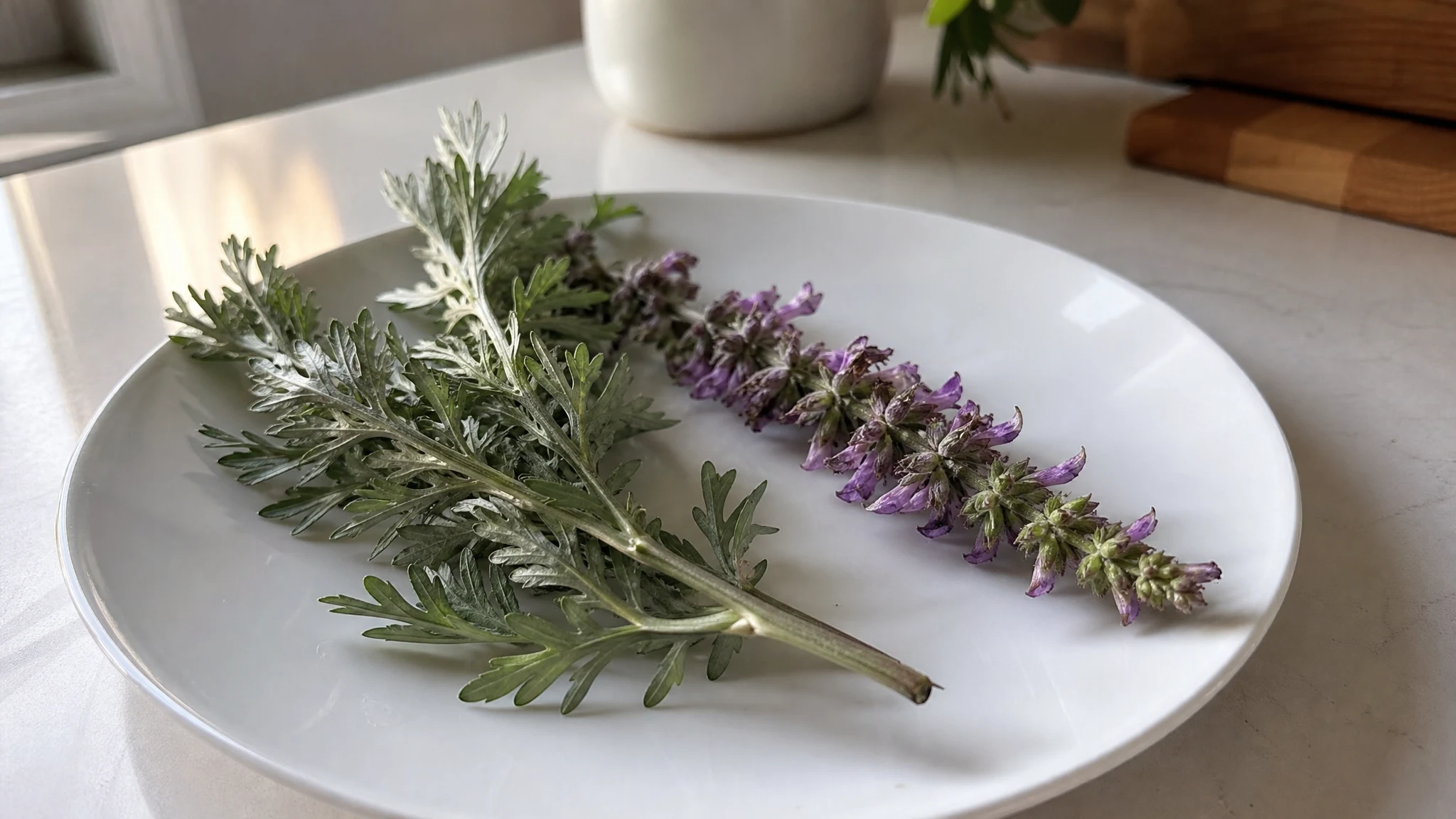
Mugwort vs Clary Sage Oil: Not Interchangeable, and Why
Mugwort oil is not a clary sage substitute and clary sage is not a mugwort substitute. They come from different plant families, are dominated by different kinds of molecules, and sit under different regulatory arithmetic. The shop lists clary sage as a blend partner for mugwort oil, which is a pairing, not an equivalence. We sell mugwort oil only; clary sage comes from a supplier of your choice, and what follows is built from one clary sage data sheet, published composition studies and IFRA text. We have not smelled or blended the two together for this article.

Mugwort Essential Oil
Our own Mugwort Essential Oil, in sizes from 0.5 oz to bulk.
From $16.99
Shop Now →Two families, two chemistries
Clary sage is Salvia sclarea L., family Lamiaceae; common mugwort, Artemisia vulgaris L., is in the family Asteraceae, according to the GBIF backbone taxonomy, which lists both names as accepted (GBIF, Salvia sclarea; GBIF, Artemisia vulgaris). Other Artemisia species are sold as mugwort oil, so the Latin name on any bottle's label matters; the genus is covered in the label-reading post. A shared word in a descriptor, such as "sage-like", is not a botanical relationship.
The clary sage numbers come from one supplier's technical data sheet for a French organic oil, steam distilled from aerial parts (Golgemma data sheet B870, modified 18 June 2019). The mugwort numbers come from the literature, per species, and are not claims about our oil.
| Clary sage (one data sheet) | Mugwort oil (literature; COA figures for the batch we publish) | |
|---|---|---|
| Main molecules | Linalyl acetate 54 to 78%, linalool 6.5 to 24%, germacrene D up to 14% | Varies by origin and species: for example 1,8-cineole 32 to 42%, camphor 12 to 14%, borneol 10 to 12% in Austrian-grown A. argyi; caryophyllene 37.45% and germacrene D 16.17% in Brazilian A. vulgaris |
| Thujone | Not among the sheet's listed main ingredients (not a thujone analysis) | 0 to 20.2% trans-thujone in northern Lithuanian oils; thujone in 3 of 7 Chinese A. argyi oils (1.31, 4.18, 16.66%) |
| Specific gravity | 0.890 to 0.908 | The COA batch we publish: 0.895 |
| Refractive index | 1.455 to 1.470 | The COA batch: 1.4750 |
| Declared allergens | Linalool 6.5 to 24%, limonene up to 3%, geraniol up to 2% | None published for our oil |
| Odor as described by the seller | "Herbaceous, tobacco, note of hay" (data sheet) | "Green, bitter, and camphoraceous" with sage-like, herbaceous facets (our shop page) |
Sources: Golgemma, TDS B870, 2019; Ekiert et al., 2020 (Lithuania); Chizzola and Gansinger, 2023 (Austria); Malik et al., 2019 (Brazil); Luo et al., 2022 (China). The clary column is one product, and another supplier's oil can differ.
Two readings from the table. A density of 0.895 sits inside the clary sheet's range, so a density reading would not separate the two oils. The refractive index 1.4750 lies above the sheet's range, so that reading would, but one physical constant is not an identification; that takes GC-MS. Our COA contains no constituent data, which matters below.
The regulatory documents differ in kind
A text search of IFRA's complete Standards compilation (51st Amendment, January 2024) found no standard named for clary sage oil, and none named for mugwort or any Artemisia oil. The mugwort question is routed through a constituent standard: thujone, a restriction driven by neurotoxicity, with caps in the finished product that vary by category, for example 1.4% in fine fragrance (Category 4) and 0.095% in body lotion and body oil (Category 5A) (IFRA, 51st Amendment, 2024, Thujone, Amendment 49). IFRA's guidance says the natural contribution of a constituent from an essential oil counts toward its cap (IFRA, Guidance, 2023). So the ceiling for mugwort oil is the cap divided by its thujone share, and the share is exactly what our COA does not state.
The clary sage question is different. Its main documentation burden in the sheet is allergen labelling. The sheet gives the EU labelling levels as 10 ppm in a leave-on product and 100 ppm in a rinse-off one. At 1% clary sage oil in a leave-on product, linalool alone would be 0.065 to 0.24%, which is 65 to 240 times the 10 ppm (0.001%) level. That is a labelling consequence, not a prohibition. For mugwort oil we hold no allergen declaration, so a buyer who needs one should ask in writing and get it in writing.
On skin, our own copy says to dilute to 0.5% to 2% in a carrier and patch test, and our standards page says dilutions should be very low indeed. No Tisserand figure for mugwort oil could be obtained. One retailer page citing Essential Oil Safety (2014) gives 0.25% for armoise (Artemisia herba-alba), a different species, for short-term or occasional use. Where an authority limit applies, it can fall below our copy: with a 2% oil in a Category 5A product, the oil may hold at most 4.75% thujone (0.095 divided by 2). Our copy says to avoid use during pregnancy and to keep the oil from children and pets; pregnancy questions go to an obstetric clinician. We make no equivalent statement about clary sage and none should be assumed.
A worked swap, and why it fails
Suppose a cologne uses a 15% concentrate in which clary sage is 10 parts in 100 of the concentrate, which is 1.5% of the finished product (an assumption). Replace it weight for weight with mugwort oil and the finished product holds 1.5% mugwort oil. That is about 22 times a one-drop accent in a 10 g concentrate (0.067% of the finished product, using the COA batch's 0.895 relative density and about 20 drops per ml). At that level, thujone cap arithmetic does the following: in Category 4 the oil could hold up to 93% thujone before breaching 1.4%, so fine fragrance is not the limit. If the same blend were sold as a body oil, Category 5A allows the oil at most 6.3% thujone (0.095 divided by 1.5), a figure our oil cannot be shown to meet. Aroma is the second failure: the data sheet describes hay and tobacco and our shop copy describes green, bitter and camphoraceous. Oils built on an ester and an alcohol (clary sage) and oils with ketones and ethers among their main molecules (some mugwort oils) are different materials, and nothing in these sources says they trade places at the same weight.
Before you substitute either way
- Get the supplier's GC-MS, IFRA certificate and SDS in writing for the batch. We publish no flash point, thujone figure or allergen declaration for our oil; the clary sheet above does publish a flash point of 85 C for its own product.
- Re-run the IFRA arithmetic for the category you are making, from the supplier's figures, not from the tables above.
- Test a 10 g batch and patch test before wearing it. Your own smell strip, not a table, decides whether the swap is acceptable.
- For blends that use both oils, see the pairing guide and the clary sage and cedar blend post.
For the other Artemisia people confuse with mugwort, see the wormwood comparison, and for green oils beyond clary sage, the green oils roundup.
Mugwort Essential Oil
Mugwort Essential Oil from our own shop, in sizes from 0.5 oz to bulk.
From $16.99
Shop Now →Sources & Further Reading
- Golgemma, 2019. Clary Sage France Organic Oil, technical data sheet B870. biolandes.com/fiche-technique-B870.pdf
- GBIF, 2026. GBIF Backbone Taxonomy, species match for Salvia sclarea and Artemisia vulgaris. api.gbif.org/v1/species/match
- IFRA, 2024. The complete IFRA Standards, 51st Amendment (Thujone, pp. 309-311). ifra-standards-51st-amendment.pdf
- IFRA, 2023. Guidance for the use of IFRA Standards, 51st Amendment. ifra-51st-amendment-guidance
- Ekiert et al., 2020. Significance of Artemisia vulgaris L. in the history of medicine. Molecules 25(19):4415. PMC7583039
- Chizzola and Gansinger, 2023. Artemisia argyi essential oil and hydrolate. Compounds 3(3):521-531. phaidra.vetmeduni.ac.at/o:2677
- Malik et al., 2019. Artemisia vulgaris essential oil cultivated in Brazil. Pharmaceuticals 12(2):49. PMC6631396
- Luo et al., 2022. Seven Mugwort (Artemisia argyi) essential oils against Anopheles sinensis. Sci Rep 12:5337. PMC8964668