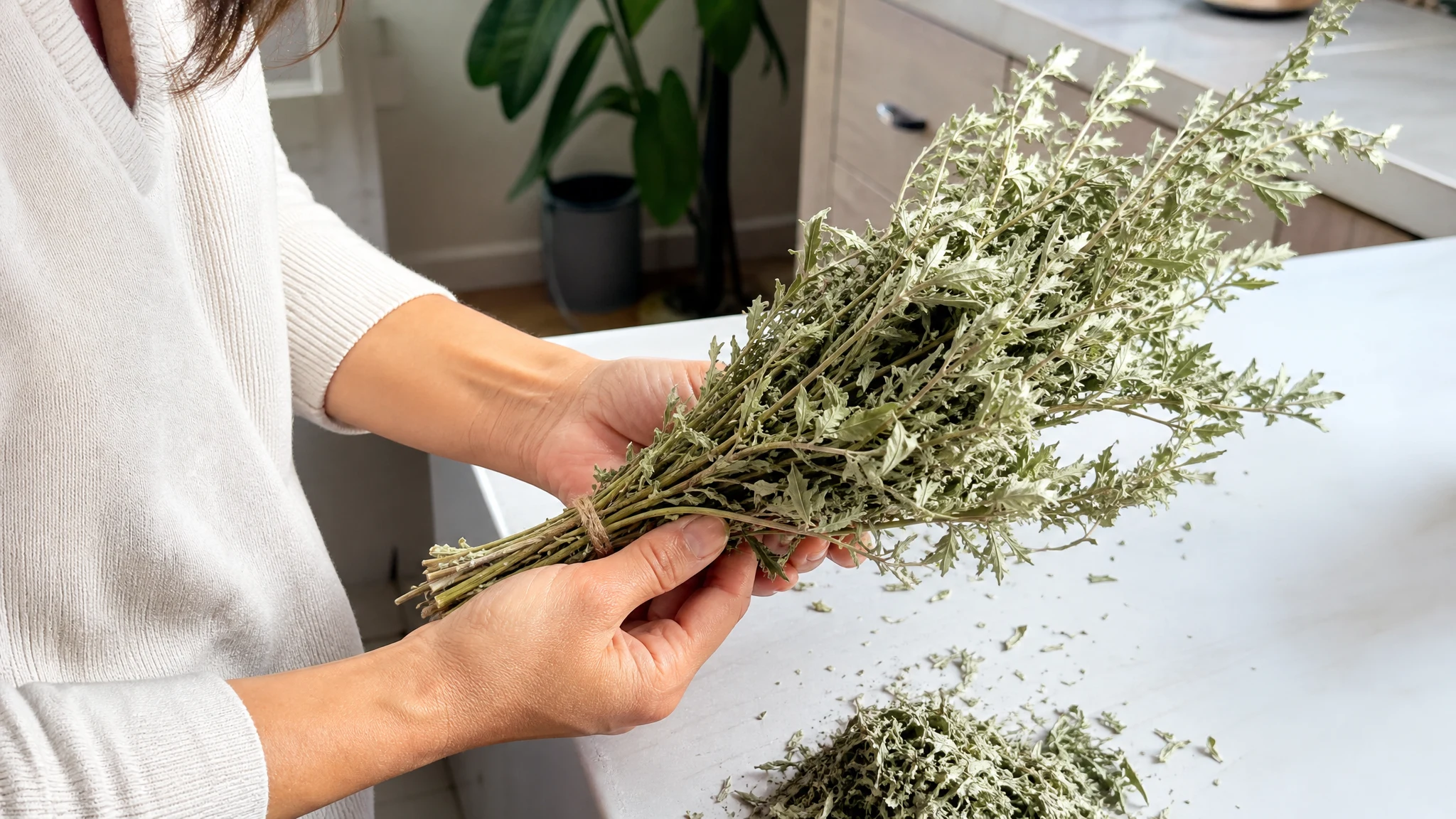
Mugwort vs White Sage: What the Sustainability Record Shows
Mugwort is not a like-for-like swap for white sage, and whether to swap at all is not a question a shop can answer for you. What a seller can do is lay out what the published record says about white sage supply, what a few Indigenous sources have written about it, and what is documented about mugwort. This article does that, and it says up front that our shop sells an oil, not smudge sticks or dried herb.
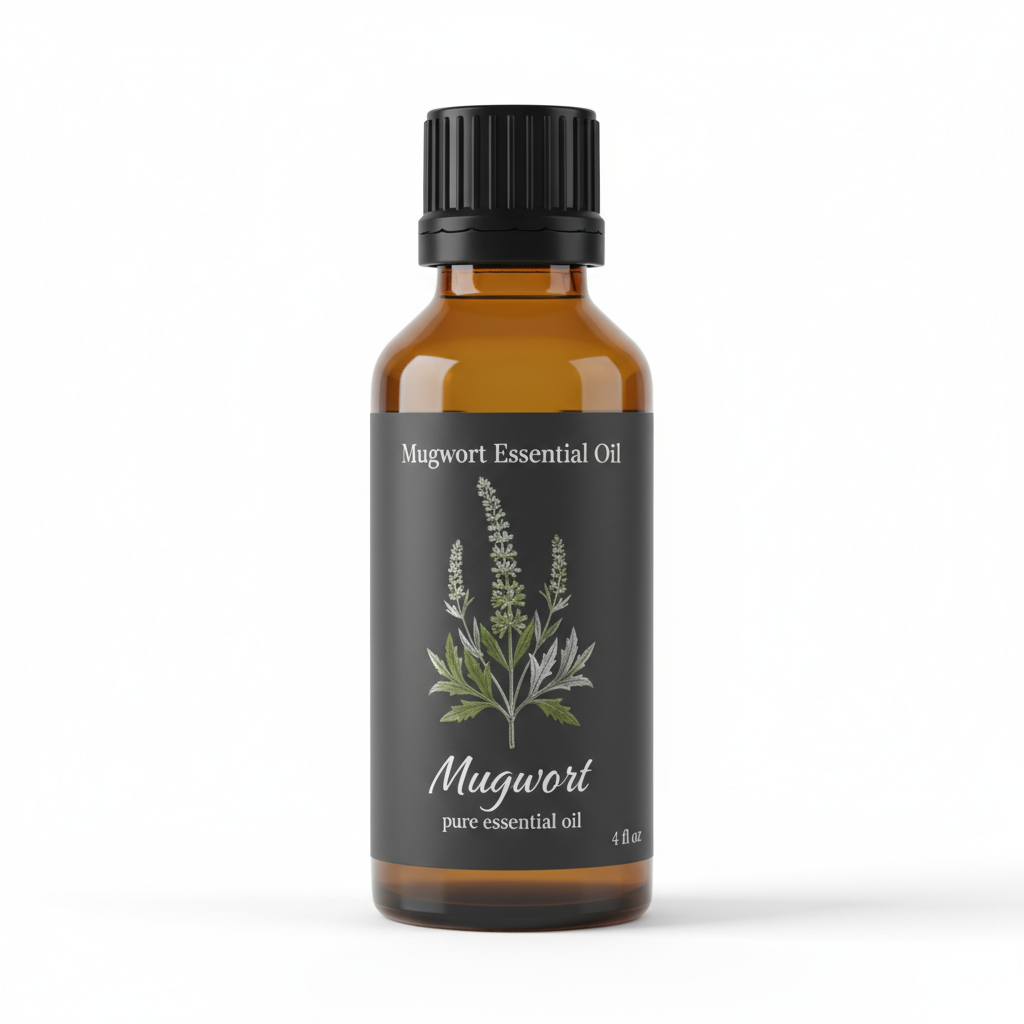
Mugwort Essential Oil
Our own Mugwort Essential Oil, in sizes from 0.5 oz to bulk.
From $16.99
Shop Now →Two unrelated plants
White sage is Salvia apiana, a member of the mint family (Lamiaceae); mugwort in the European sense is Artemisia vulgaris, in the daisy family (Asteraceae), per the accepted names in the GBIF Backbone Taxonomy, white sage entry and the mugwort entry. Different family, different genus, different continent of origin for the plant most often sold under each name. Wormwood (Artemisia absinthium) is a third plant, which Frazer's 1913 notes already insist is "not to be confounded" with mugwort; the wormwood comparison covers that neighbour. A label that says "mugwort" can also name more than one Artemisia species, which the label-reading guide takes up.
The detail that drives the white sage story is range. JSTOR Daily's 2022 Dumbarton Oaks piece gives coastal sage scrub in southwestern California and Baja California as the plant's only natural wild habitat, and ABC7's 2022 report says the same. A plant with a home range that small is more exposed to a global trade than a weed that grows across continents (reasoning, not a finding in any source cited here).
What the record on white sage says, and how firm each item is
| Statement | Who says it | How firm |
|---|---|---|
| Steward at the North Etiwanda Preserve describes crews of two to four people with duffel bags carrying 60 to 100 pounds each | Ron Goodman, preserve steward, in ABC7, 2022 | First-hand testimony, one site, no dataset |
| "It is believed" that more than 15,000 pounds were poached in that region over roughly a decade | Same report | An estimate stated as belief; the report gives no method |
| With very few commercial growers, most white sage sold globally is wild-harvested | California Native Plant Society estimate, as quoted by ABC7, 2022 | Advocacy-group estimate |
| About 300 pounds confiscated by rangers reached a member of the Gabrielino (Tongva) Band of Mission Indians in June 2021; about 30 pounds had spoiled in the bags | JSTOR Daily / Dumbarton Oaks, 2022, citing the recipient's own posts | One documented case |
| Not classified as endangered or threatened, though numbers are described as declining; on the United Plant Savers At-Risk list | Same JSTOR Daily piece | Status claim from a secondary source; a regulator's listing page was not retrieved |
| Harvest treatments (by hand, cutting, leaf only; 0, 5, 25 or 50 percent removal; spring or summer) did not significantly change plant size, leaf-volume ratio or flower abundance | Cassidy Adlof, California State University Northridge, abstract at the Society of Ethnobiology | A student study abstract; it tested small hand harvests, not poaching or trade volumes |
Read together, the sources agree on direction (illegal commercial taking, a small habitat, few farms) and disagree on nothing important, but the numbers are testimony and estimates. The search behind this article found no peer-reviewed measurement of wild population decline or of trade volume. Adlof's abstract is the one experimental result found, and it concerns careful harvesting; it does not say that commercial taking is sustainable, and it should not be quoted as if it did. JSTOR Daily adds that under California Penal Code Section 384a it is illegal to take plant material from public land, or from private land without the owner's written permission, and that "wildcrafted" on a label is often a euphemism for "poached." That is the author's characterisation; the label wording is a reason to ask the seller where the plant grew, not proof about any one seller.
What Indigenous sources have published
This section reports a few published statements and does not speak for any nation; Indigenous nations are not of one voice, and these are the voices the search found, not a survey.
Kimberly Morales Johnson, tribal secretary of the San Gabriel Band of Mission Indians, told ABC7 in 2022: "To Native people, white sage is an ancestor, it's not just a plant." The tribe's own White Sage page (read 2026-10-28; undated) states that poached sage is "often taken from our land and the land of our Southern California Native neighbors," that the tribe is "no longer allowed to gather our own sage" without land to grow it, and that "Sage is a Gift not a Purchase." It asks non-members who do not belong to a tribe whose territory has white sage to "refrain from any other part of the practice," and names the abalone shell and bird feather specifically. The same page lists alternatives for improving the feel of a space: incense, candles, other smudge sticks "such as lavender or rosemary," even baking. It does not name mugwort, so nothing on that page should be cited as the tribe endorsing mugwort.
JSTOR Daily (2022) quotes Heidi Lucero (Acjachemen and Mustun Ohlone) on harvesting relationships: "You wouldn't go and pull your grandmother out by the roots," and reports that many Indigenous practitioners say white sage should not be bought and sold.
What is documented about mugwort
Mugwort is, in parts of North America, a weed. A University of Connecticut Extension factsheet (2024) calls Artemisia vulgaris an invasive perennial native to Europe and Eastern Asia, introduced to North America as early as the 1600s, and notes its pollen is a common cause of allergies and hay fever. That is the documented sense in which supply pressure is lower than for a small-range shrub. It is a statement about one species on one continent, not a claim that any particular harvest is sustainable, legal or respectful: land access rules still apply, and look-alike plants exist (see the plant guide).
Mugwort smoke has its own recorded history, which is history and not endorsement. In the third edition of The Golden Bough (Frazer, 1913, vol. 11) Frazer reports, from a 1910 study of Chinese religion, mugwort figures hung at gates on the fifth day of the fifth month "in order to expel poisonous airs or influences," and, from a 1901 book on the Ainu, mugwort bunches used in exorcisms "because it is thought that demons of disease dislike the smell." Those are reported beliefs from other cultures, gathered by a European compiler; they are not instructions, and they do not show what any practice accomplishes. The folklore post and the dried-herb post go further.
Smoke is smoke
Whatever the plant, burning it makes particles. The U.S. EPA's particulate matter basics page lists fires among particle sources and says particles under 2.5 micrometres "pose the greatest risk to health," because they can get deep into the lungs and some into the bloodstream. A reader with asthma, a heart condition or a pregnancy should ask a physician before burning anything indoors; the indoor burning post is the place for mugwort specifics.
Where our oil sits, and what we will not say
Our shop sells mugwort essential oil. It is not a smudge stick, a dried bundle or a substitute for either, and our safety copy says to keep it away from children and pets, to avoid it during pregnancy, and that it is not for internal use. Retail copy that says a plant "removes negative energy" is a claim about an outcome. The FDA's aromatherapy page (content current as of 2023-09-08) says intended use decides how a product is regulated and that claims such as helping you sleep or treating anxiety are drug claims. We make no such claim, and nothing here says mugwort cleanses, clears or protects anything.
If you are deciding what to do instead of buying white sage, a sensible order is: first, whose practice is it, and is it yours to adopt (the tribe's page above asks non-members to refrain); second, if the purpose is simply a scented room, a candle or incense is the alternative that tribe itself lists; third, if you buy any herb, ask in writing where it was grown and whether it was farmed. For allergy to plants in the daisy family, ask an allergist; for smoke and lungs, a physician.
The honest summary: the white sage problem is a supply and respect problem, and swapping one plant's name for another solves neither unless the practice itself is yours.
Mugwort Essential Oil
Mugwort Essential Oil from our own shop, in sizes from 0.5 oz to bulk.
From $16.99
Shop Now →Sources & Further Reading
- GBIF Secretariat, accessed 2026. GBIF Backbone Taxonomy: Salvia apiana Jeps. and Artemisia vulgaris L. gbif.org/species/2927016, gbif.org/species/3120946
- Munoz, A., 2022. The white sage black market is contributing to the native plant's decimation in Southern California. ABC7 Los Angeles. abc7.com/11775091
- Cannon, A. K., 2022. Plant of the Month: White Sage. JSTOR Daily / Dumbarton Oaks Plant Humanities Initiative. daily.jstor.org
- Adlof, C. Effect of harvest practices on a culturally-significant plant, Salvia apiana (white sage). Abstract, Society of Ethnobiology. ethnobiology.org
- Gabrieleno San Gabriel Band of Mission Indians, undated (read 2026-10-28). White Sage. gabrieleno-nsn.us
- Wallace, V., Siegel-Miles, A., Sowizral, K., 2024. Invasive Plant Factsheet: Common mugwort (Artemisia vulgaris), EXT070. UConn Extension. extension.uconn.edu
- Frazer, J. G., 1913. The Golden Bough, third edition, Part VII, Balder the Beautiful, vol. 2 (vol. 11 of 12), Macmillan. Project Gutenberg #43433. gutenberg.org/ebooks/43433
- U.S. EPA. Particulate Matter (PM) Basics. epa.gov
- U.S. FDA, 2023. Aromatherapy (content current as of 09/08/2023). fda.gov/aromatherapy