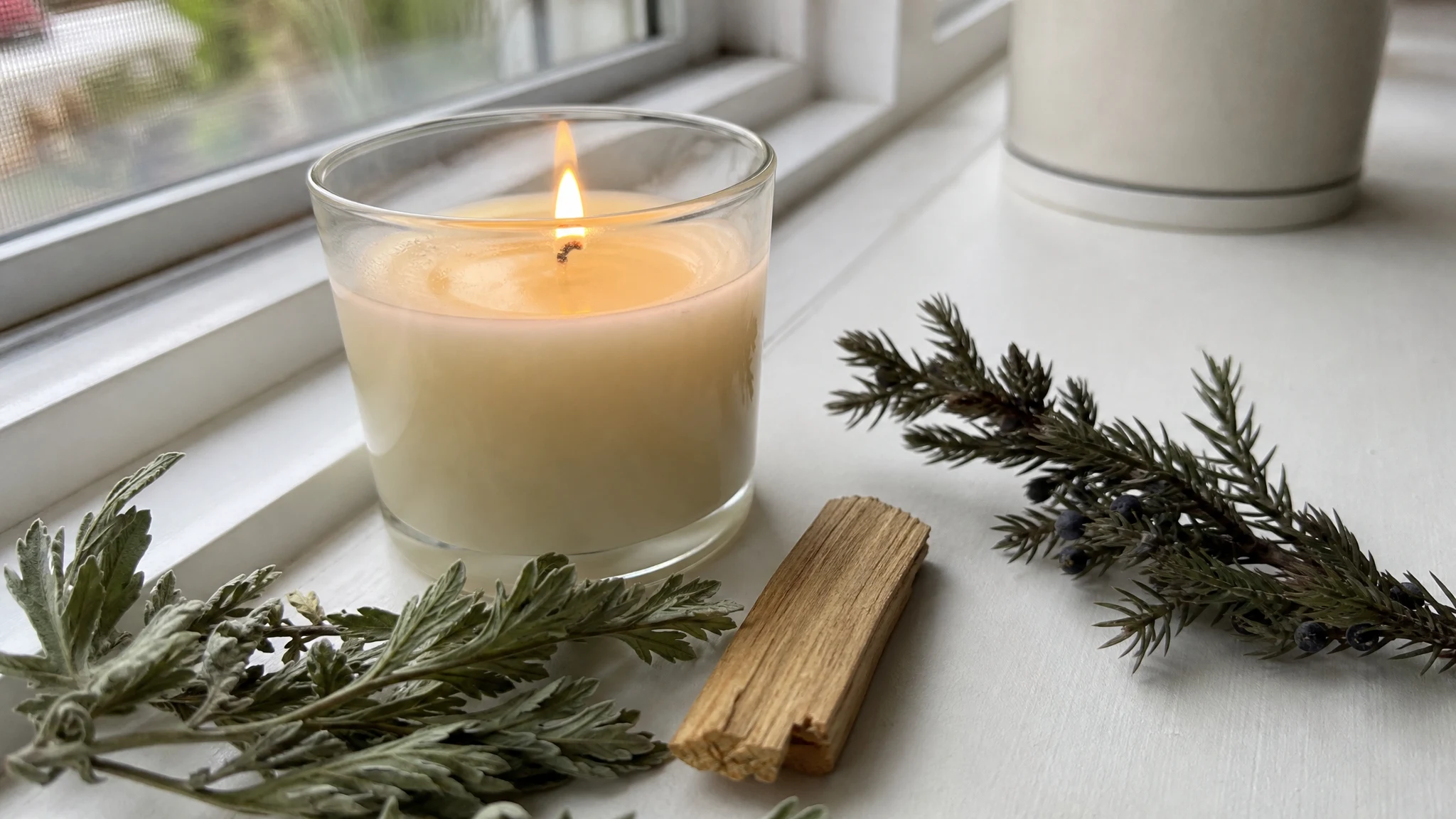
Mugwort Candle Blend Recipes: Five Starting Structures
Five ways to build a mugwort candle blend, written as parts of the total oil load so they scale to any wax weight. We have not poured any of them and have not smelled any of the combinations in wax, so read each one as a starting structure for a pilot batch, not a result. What this post adds to the pairing guides is the candle arithmetic: how many grams of each oil go into a 200 g candle, how far a half-ounce bottle of mugwort oil goes, and what the regulatory record does and does not say about each partner oil.
Mugwort Essential Oil
Our own Mugwort Essential Oil, in sizes from 0.5 oz to bulk.
From $16.99
Shop Now →The frame: one total load, set by the wax
Pick the total oil load first, from your wax's data sheet. The sheets we read give ceilings of 10 to 12% of fragrance, for example Kerawax 4105 at 5 to 10% (Kerax, 2020) and EcoCoco ContainerBlend at 5 to 12% (EcoCoco, 2020). Those sheets are about fragrance, not plant oils, and they do not define the percentage; we read it as a share of wax weight. The recipes below use a 4% total load as the pilot level, which is our choice (see the how-to guide for why), and every structure divides that load into ten parts. In 200 g of wax (our assumption, weigh your own) a 4% load is 8 g of oil, so one part is 0.8 g. At another load, one part is wax weight times load, divided by ten.
Five structures
The names are our labels for what each structure is aiming at, not a measured outcome. The partner oils are those the shop pages list as blending partners (cedarwood, clary sage, juniper, frankincense, cypress, vetiver); we do not sell them.
| Structure (10 parts) | Mugwort | Cedarwood | Clary sage | Juniper | Frankincense | Cypress | Vetiver |
|---|---|---|---|---|---|---|---|
| 1. Green and cool | 4 | 0 | 0 | 3 | 0 | 3 | 0 |
| 2. Dry woods and root | 3 | 3 | 0 | 0 | 1 | 0 | 3 |
| 3. Apothecary | 3 | 2 | 3 | 0 | 2 | 0 | 0 |
| 4. Woods-led with a mugwort edge | 2 | 5 | 0 | 0 | 0 | 2 | 1 |
| 5. Mugwort as an accent | 1 | 6 | 2 | 0 | 1 | 0 | 0 |
In grams, for a 200 g candle at the 4% pilot load (8 g of oil, 0.8 g per part):
| Structure | Mugwort | Partners (grams) | Mugwort as share of candle | Candles per 0.5 oz bottle of mugwort (13.2 g) |
|---|---|---|---|---|
| 1 | 3.2 g (about 71 drops) | juniper 2.4, cypress 2.4 | 1.6% | 4.1 |
| 2 | 2.4 g (about 54 drops) | cedarwood 2.4, vetiver 2.4, frankincense 0.8 | 1.2% | 5.5 |
| 3 | 2.4 g (about 54 drops) | cedarwood 1.6, clary sage 2.4, frankincense 1.6 | 1.2% | 5.5 |
| 4 | 1.6 g (about 36 drops) | cedarwood 4.0, cypress 1.6, vetiver 0.8 | 0.8% | 8.3 |
| 5 | 0.8 g (about 18 drops) | cedarwood 4.8, clary sage 1.6, frankincense 0.8 | 0.4% | 16.5 |
Drops are for mugwort only, from the 0.895 relative density on our published COA (1 ml is about 0.895 g) and about 20 drops per ml; droppers vary, and the other oils have their own densities, so weigh everything. Resins and woods are thick: weigh them by pouring into the pitcher on the scale, not by drops.
How to use the table: pick the structure nearest to the room you imagine, make it at 2%, 4% and 6% in the same wax, jar and wick, and keep the one that burns cleanly and smells right at the lowest load. Where mugwort is a small part (structures 4 and 5), the oil goes a long way: one half-ounce bottle covers about 8 to 16 candles at this load. In structure 1, where mugwort is 40% of the oil, it covers about 4. The live pairing guide and Hedgerow Dusk cover blending for other uses; this post does not reuse their ratios.
Scaling the structures
Worked example for a different batch: ten candles of 200 g is 2,000 g of wax. At the 4% pilot load that is 80 g of oil, 8 g per part. For structure 3 that is 24 g mugwort, 16 g cedarwood, 24 g clary sage and 16 g frankincense, which uses 24 g of a 1 oz bottle's roughly 26.5 g of mugwort oil. If the wax sheet's ceiling is 10%, the same batch at the ceiling would take 200 g of oil, which is more than seven 1 oz bottles of total oil. That is the reason to pilot at the low end and write the load on the label.
What the regulatory record says about each partner
We read IFRA's complete Standards compilation (51st Amendment, January 2024) for each oil (IFRA, 2024). It has no standard named for cedarwood, clary sage, juniper berry, frankincense, cypress or (non-acetylated) vetiver oil. That is a statement about the list, not about the oils: IFRA standards also work through named constituents, and the guidance says a natural oil's contribution of a restricted constituent must be counted (IFRA, 2023). The ones that touch this table:
- Thujone (the compound some Artemisia oils carry): restricted, 9.5% of the finished product for candles (Category 12), much lower for skin. Candles of all types sit in Category 12. At the largest mugwort share in the table (1.6% of the candle), the oil could not reach that figure even if it were all thujone. We hold no thujone figure for our oil.
- Cedrene (a constituent of cedar-type woods): restricted for skin categories but "no restriction" for Category 12 in Amendment 49.
- Limonene and linalool: specifications, not limits. For limonene, natural products rich in it should be used with the peroxide level kept low, with a peroxide value below 20 millimoles per litre. Ask a supplier of any limonene-rich oil for its peroxide value.
- Juniper-named materials: savin oil from Juniperus sabina is prohibited as a fragrance ingredient, and crude cade oil (Juniperus oxycedrus) is prohibited. A "juniper" oil should carry its Latin name on the label so you can tell which material you have.
Two cautions. IFRA's candle category exists because candles involve almost no skin contact; it is not a finding about air quality or burning. And IFRA's guidance says that for essential oils the information worth exchanging between supplier and user is the presence of IFRA-restricted materials in the oil. So the right request to any partner-oil supplier is the Latin name, the safety data sheet and written information on restricted constituents. For our oil, ask in writing for any document you need before ordering; we publish no GC-MS, thujone, IFRA or safety data sheet document and do not promise one.
Why we would not stack all six oils
Each added oil is one more material with its own hazards, its own supplier paperwork and its own flash point. This article's search covered the IFRA record only; it did not retrieve a published maximum dermal level or hazard summary for any of the six, and it makes no claim about them beyond the table. Our recommendation is that a first mugwort candle uses two or three oils, which is the range structures 1 to 5 stay inside. The rest of the method, including the pour temperature, is in how to make mugwort candles, and weak results are diagnosed in the scent throw guide.
Our own safety copy for mugwort oil says to avoid use during pregnancy and to keep it away from children and pets. If anyone in the home is pregnant, or if you keep animals, ask an obstetric clinician or a veterinarian before burning any of these candles. Weigh a small pilot, write the grams on the label, and keep the batch record with the data sheets.
Mugwort Essential Oil
Mugwort Essential Oil from our own shop, in sizes from 0.5 oz to bulk.
From $16.99
Shop Now →Sources & Further Reading
- IFRA, 2024. IFRA Standards, 51st Amendment (Thujone pp. 309 to 311; Cedrene; Limonene; Linalool; Savin oil; Cade oil). ifrafragrance.org/ifra-standards---51st-amendment.pdf
- IFRA, 2023. Guidance for the use of IFRA Standards, 51st Amendment. cloudfront.net/ifra-51st-amendment-guidance
- Kerax Ltd, 2020. Technical data sheet, Kerawax 4105, v5.0. candle.gr/KW-4105-TDS-v05.pdf
- EcoCoco, 2020. Technical data sheet, ContainerBlend, v2.0. candle.gr/EcoCoco-ContainerBlend-TDS.pdf