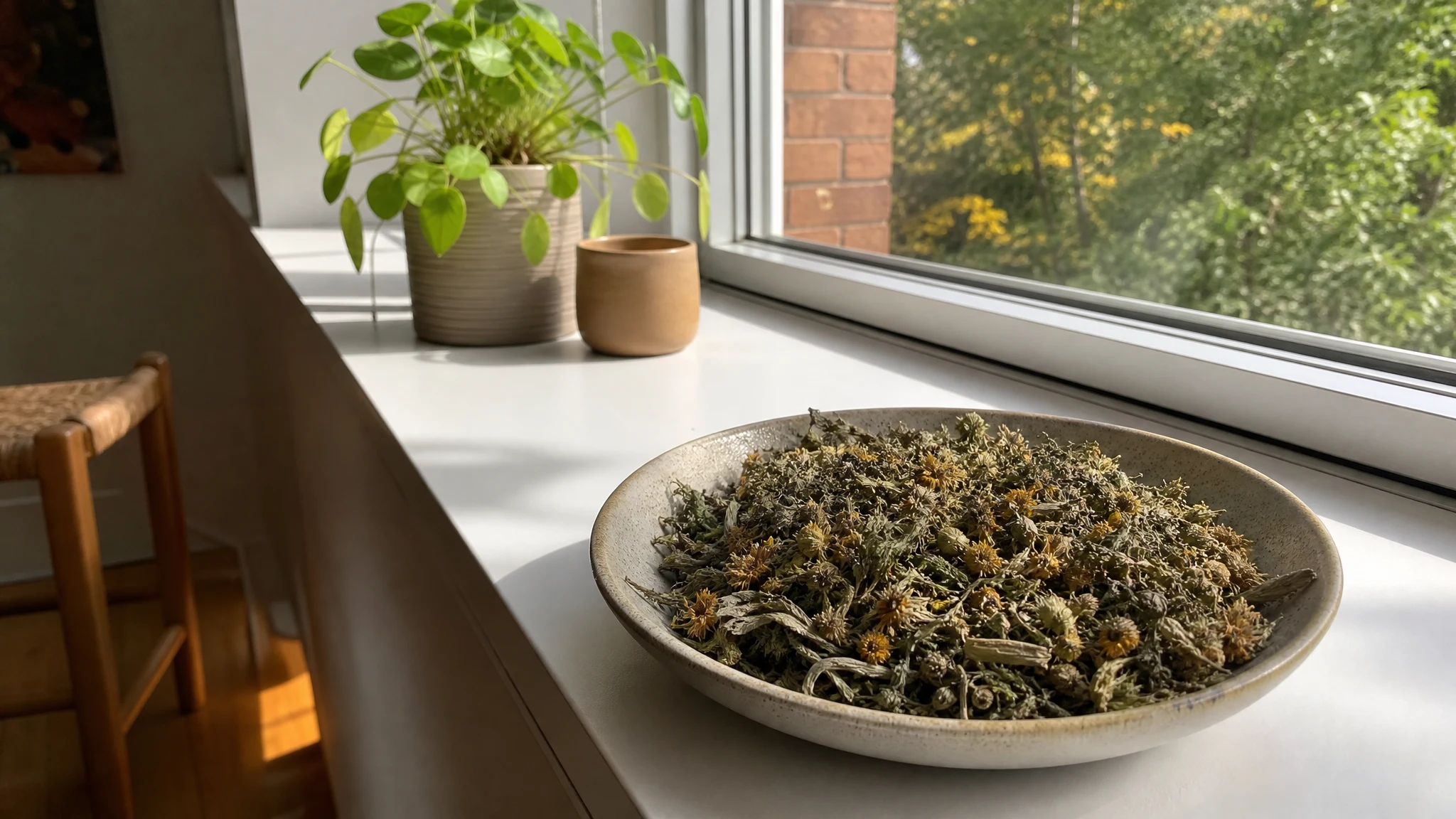
Mugwort Potpourri: Two Dry Mixes and the Dose Arithmetic
The published limit most likely to apply to a mugwort potpourri is IFRA's, and it is tighter than most home guides suggest. IFRA's guidance puts pot-pourri in Category 10A, the category it uses for products that are handled, and the Standard for thujone, a compound found in some Artemisia oils, allows 0.13% of thujone in a Category 10A finished product. Because we hold no thujone figure for our oil, the sensible default for a dry mix is a low dose, worked out below.

Mugwort Essential Oil
Our own Mugwort Essential Oil, in sizes from 0.5 oz to bulk.
From $16.99
Shop Now →The ceiling, and what it means in drops
IFRA is the fragrance industry's standard-setter; its rules bind fragrance suppliers, not a hobbyist, and they are the nearest published benchmark. Its Guidance for the use of IFRA Standards (51st Amendment) says reed diffusers and related products, including "fragranced oil for lamp ring, pot-pourri, and liquid refills for air fresheners," were placed in Category 10A to reflect potential exposure during manual handling. IFRA's Standard on thujone (CAS 546-80-5 and others; Amendment 49, 2020; driver: neurotoxicity) gives a maximum of 0.13% thujone in the finished product for Category 10A, and 9.5% for Category 12, which is where the same guidance puts fragrancing sachets and incense (products not intended for direct skin contact). Both appear in IFRA's 51st Amendment documents. The same compilation names no standard for mugwort oil itself.
The cap is on thujone, not on the oil, so the allowed oil dose depends on how much thujone the oil carries, a figure our published certificate of analysis does not give. The arithmetic is the cap divided by the oil's thujone share. The table shows, for three oil doses per 100 g of dry mix, the highest thujone share the oil could have and still sit under 0.13%. The drop counts use the relative density of 0.895 on our certificate of analysis batch and about 20 drops per ml.
| Oil per 100 g dry mix | Weight | About how many drops | Highest thujone share of the oil under 0.13% |
|---|---|---|---|
| 0.25% | 0.25 g | 6 | 52% |
| 0.5% | 0.50 g | 11 | 26% |
| 1.0% | 1.00 g | 22 | 13% |
Thujone is one of the compounds Kumar and colleagues (Resources 14(3), 2025) report as common across their 81 accessions of 40 Artemisia species, whose oil yields ranged from 0.02% to 1.65%; the abstract summary available gives no single thujone range, and nothing in it can tell you which row of the table applies to the oil in your hand. A buyer who needs a thujone or GC-MS figure should ask the supplier in writing before ordering and get the answer in writing; our published certificate of analysis has none. If you have no figure, stay in the top row or lower. Which Artemisia species is on the bottle's label, and whether the paperwork agrees, is the subject of reading a mugwort oil label.
For comparison, the extension sources fetched for this article give no oil quantity: Nebraska Extension (Frogge, 2021) says "a few drops of a compatible essential oil," and the Guelph-Wellington Master Gardeners page (Newman, 2016) says to add "several drops" to the bin. Neither states a batch size, so neither can be converted to a percentage. Our table starts from weight on purpose.
Two dry mixes, worked by weight
We have not made either mix. The compositions are illustrations, the oil is a placeholder to set by a small test, and the orris amount is an assumption: the sources fetched give no fixative quantity. Frogge (Nebraska Extension, 2021) names orris root as "the best known fixative," notes that chunks stay effective longer than powder and suit sachets and pillows because powder sifts through fabric, and gives no amount. Newman (Guelph-Wellington Master Gardeners, 2016, modified 2017) says to add only enough orris powder to lightly coat the mixture. We set 10% by weight as a starting point, which is our choice, not a sourced figure.
| Mix | Ingredients by weight | Oil at 0.25% (starting point) |
|---|---|---|
| 1. Bowl mix, 100 g | 40 g dried mugwort leaf, 30 g cedar shavings, 20 g juniper berries, 10 g orris root chunks | 0.25 g, about 6 drops |
| 2. Sachet filler, 50 g | 30 g dried mugwort leaf, 15 g dried rose petals, 5 g orris root chunks | 0.125 g, about 3 drops |
We sell none of these: dried mugwort, cedar, juniper, rose petals and orris root come from an herb or craft supplier. Ask for the plant species, the part used and whether anything was treated. The shop page lists cedarwood and juniper among the oils that pair with mugwort oil, which is the reason for those two in mix 1; see the pairing guide for the oils, though the pairing statement concerns oils, not dried botanicals.
Choose leaf, not flowering tops. Mugwort (Artemisia vulgaris) is one of the main triggers of weed pollen allergy in Europe, according to a release from Germany's Paul-Ehrlich-Institut on Ballmer-Weber and colleagues' 2024 study (Journal of Allergy and Clinical Immunology 154:679-689), where 77% of 79 patients with suspected celery allergy had IgE against mugwort pollen. That study is about pollen and celery, not potpourri; that dried flowering tops could shed pollen is our inference. Anyone with a known mugwort pollen allergy should ask an allergist before handling the dried plant; see the allergy article.
Mix, add the oil, then wait
Dry everything completely first. Frogge says drying can take a few days to a few weeks. Weigh the botanicals and orris into a bowl, then add the oil. Because the oil is sold neat, add it by weight on a scale that reads to 0.01 g where you can; counting drops from a dropper gives different amounts from different droppers. Put the mix in a tightly sealed glass jar, since Frogge says plastic or metal may interact with the oils. Frogge's curing advice is that potpourri "needs to age for at least a month" and that the jar should be shaken daily; Newman says to rest it in a dark place for about a month, stirring occasionally. Keep the jar cool and dry, away from heat and sunlight.
Smell it at the end of that month before judging the dose, then change one thing in the next batch. If you want a stronger scent, step the oil up through the table's rows and check the thujone column before you do, not after.
What this article does not cover, and who should skip it
This is for dry mixes only. Liquid potpourri is a different product; Pet Poison Helpline's liquid potpourri page (no date or author given) says ingesting it can cause chemical burns to a companion animal's lips, tongue, gums and throat and that cats are particularly sensitive to the corrosive chemicals in some products. It does not discuss dry potpourri or mugwort oil. Our own safety copy says to keep the oil away from children and pets, to avoid use during pregnancy, and that it is not for internal use. For a household with pets, ask a veterinarian before putting scented dried material where an animal can reach it, and keep bowls and sachets out of reach of children; our pets article collects the published statements. If you are pregnant or nursing, ask an obstetric clinician.
A sachet is different from a bowl. IFRA's Category 12 treats fragrancing sachets as products not intended for direct skin contact, so keep a sachet closed and out of contact with skin; a pillow stuffed with dried mugwort is covered in the dream pillow and sachet article, which this one does not repeat.
If the first jar smells right after its month, write down the grams, not the drops, and repeat it before changing anything.
Mugwort Essential Oil
Mugwort Essential Oil from our own shop, in sizes from 0.5 oz to bulk.
From $16.99
Shop Now →Sources & Further Reading
- IFRA, 2024. IFRA Standards, 51st Amendment (Thujone, Amendment 49, 2020) and Guidance for the use of IFRA Standards (51st Amendment, 2023). ifra-standards-51st-amendment.pdf
- Frogge, M.J., 2021. Potpourri: Make Your Own. Nebraska Extension, Lancaster County. lancaster.unl.edu/potpourri
- Newman, R., 2016 (modified 2017). Potpourri. Guelph-Wellington Master Gardeners. gwmastergardeners.ca
- Paul-Ehrlich-Institut, 2024. New insights into celery allergies (on Ballmer-Weber et al., J Allergy Clin Immunol 154:679-689). pei.de press release
- Kumar, B. et al., 2025. Chemical Diversity in Essential Oils of 40 Artemisia Species from Western and Trans Himalayan Regions of India. Resources 14(3). ideas.repec.org record
- Pet Poison Helpline. Liquid Potpourri. petpoisonhelpline.com