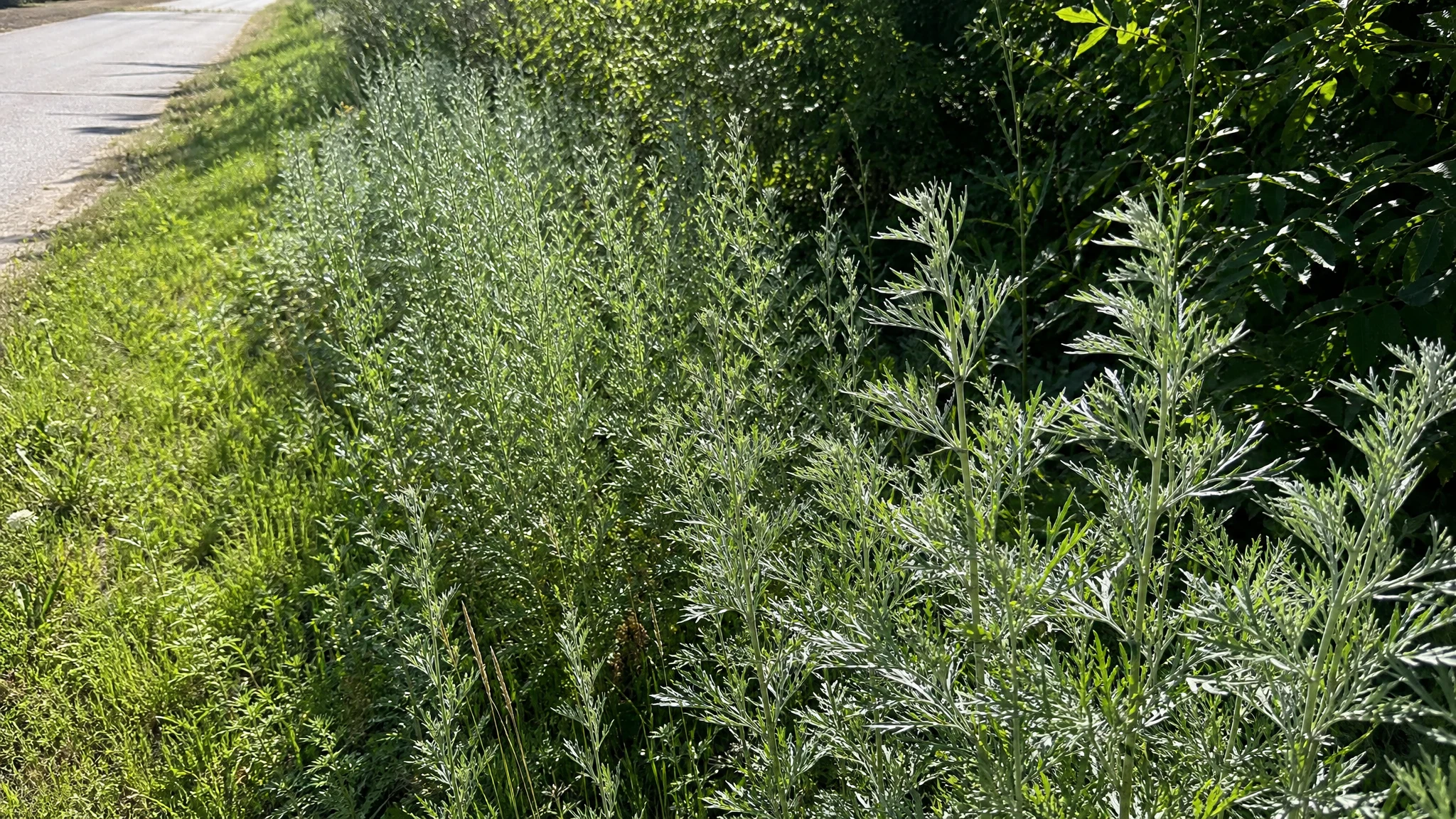
Organic vs Wildcrafted vs Conventional Mugwort Oil
None of the three labels, organic, conventional or wildcrafted, tells you what is in the bottle. Organic is a legal claim about how a crop was grown or collected and who inspected it; wildcrafted is a description with no federal definition that the search for this article could find; conventional is simply the absence of a certificate. For an Artemisia oil, where the compound that governs your dilution (thujone) swings widely between samples of the same species, the label you should care about is the batch's gas chromatography report. We make no organic claim in this post, and nothing here describes how any oil of ours was grown or collected.

Mugwort Essential Oil
Our own Mugwort Essential Oil, in sizes from 0.5 oz to bulk.
From $16.99
Shop Now →What each label is, in the texts that define it
| Label | Defined by | What it commits the seller to | What it does not tell you |
|---|---|---|---|
| Organic | US law: 7 CFR Part 205, enforced through the USDA National Organic Program | Production and handling to the organic rules, verified by an accredited certifier | Species, thujone or any constituent level, adulteration, freshness |
| Wildcrafted | No federal definition found; the term is descriptive | Whatever the seller means by it | Whether the harvest was sustainable, whether anyone inspected it, which species |
| Conventional | Not defined in the rules read; in practice, not certified organic | Nothing specific | Anything about inputs |
| FairWild | A private standard, version 3.0 launched 19 December 2023 | Sustainable collection and fair trade criteria for wild-collected species, audited by approved control bodies | Chemistry, again |
Organic: a legal claim with paperwork behind it
The federal rule defines "organic" as a labeling term for an agricultural product produced in accordance with the Organic Foods Production Act, and requires certification of each operation that produces or handles agricultural products sold or labeled as organic (7 CFR 205.2 and 205.100). There is an exemption for operations whose gross agricultural income from organic sales is 5,000 US dollars or less a year; such operations skip certification but must still meet the labeling requirements (7 CFR 205.101). For multi-ingredient products the labeling categories are 100 percent organic, organic (at least 95 percent), made with organic ingredients (at least 70 percent) and, below 70 percent, no use of the word "organic" on the principal display panel (7 CFR 205.301 and the USDA fact sheet below).
For anything sold as a cosmetic or personal-care product, the USDA National Organic Program's fact sheet (April 2008, hosted on the FTC site) says FDA does not define or regulate "organic" for those products, that a product with agricultural ingredients that meets the rules may be certified, that the operations producing the ingredients, the handlers and the final manufacturer must all be certified by a USDA-accredited agent, and that USDA's program does not regulate other private "eco" claims. The sheet is old, so confirm current USDA guidance with the certifier.
Wildcrafted: the nearest legal text is about organic wild crops
The word "wildcrafted" is not defined in the regulations read for this article. The nearest text is organic-specific: a "wild crop" is any mushroom, plant or portion of a plant collected or harvested from a site that is not maintained under cultivation or other agricultural management (7 CFR 205.2). To be sold as organic, a wild crop must come from a designated area with no prohibited substance applied for three years before harvest, and the harvest must not be destructive to the environment and must sustain the growth and production of the wild crop (7 CFR 205.207). So "organic wild-harvested" has a definition, a three-year land history and a sustainability test, and plain "wildcrafted" has none that the search found. A seller may use it truthfully or loosely; the label cannot tell you which.
FairWild is the standard that addresses the gap. The FairWild Foundation's Standard 3.0, announced 19 December 2023, has seven principles and 24 criteria across ecological, socio-cultural and business requirements, and covers commercially wild-collected plants, fungi, lichens and algae. Its FAQ says approved independent control bodies audit against all principles, that it is a private standard, and that organic certification, which is set in law in major markets, is mainly used for cultivation with wild-harvest guidance that is often less detailed (FairWild Foundation, FAQ). It calls the two complementary, not equivalent. None of the sources read rates mugwort or any other Artemisia as threatened in the wild, so whether a wild harvest of a particular species raises a conservation concern is a question for the seller and a botanist, not something a label answers.
Why none of the three replaces batch analysis
Everything above concerns inputs and process. What you formulate with is the oil's composition, and that moves for reasons organic rules do not touch. In the literature, Artemisia argyi leaves distilled three ways gave alpha-thujone at 7.99% by hydrodistillation and 11.31% by subcritical extraction from the same powder (Guan et al., 2019); Lithuanian Artemisia vulgaris oils reported trans-thujone at 8.9% and 10.9% in two samples and a lead compound that was something else entirely in others (Pandey and Singh, 2017). The composition article tabulates these. Neither paper concerns our oil.
The arithmetic is where it bites. IFRA's thujone Standard caps thujone in a body cream, oil or lotion (Category 5A) at 0.095% of the finished product, so the maximum oil percentage is 0.095 divided by the oil's thujone share: at 10% thujone about 0.95%, at 20% about 0.475% (IFRA, 2024). A certificate of organic status carries no thujone figure, so it cannot feed that calculation. IFRA's guidance says an analytically determined level in the oil replaces the indicative annex level (IFRA, 2023). That is the document to ask for, and our safety article covers why thujone matters.
What to ask a supplier for, in writing
- For any "organic" claim: the certificate itself, the certifier's name, the certificate number, the scope (crop, handler, product) and the date, then check it with the certifier. A certificate for a handler does not necessarily cover the oil on your invoice.
- For "wildcrafted" or "wild": who collected it, where in general terms, how much was taken, and the wild-harvest plan or FairWild certificate if one exists. If the answer is a slogan, treat the word as marketing.
- For every purchase regardless of label: the Latin name on the bottle matching the paperwork, a GC-MS report for the lot with alpha-thujone and beta-thujone as separate lines, the laboratory and date. Our buying guide and sourcing comparison cover the origin side.
Our own COA lists a relative density of 0.895 and a refractive index of 1.4750 for its batch and no constituent data, so a buyer who needs a composition report from us should ask for it in writing and get it in writing before ordering. Our copy says to avoid use during pregnancy, keep the oil from children and pets, and not for internal use, whatever the label on any oil says. For a legal question about how to label your own finished product, ask a regulatory consultant or an attorney.
Mugwort Essential Oil
Mugwort Essential Oil from our own shop, in sizes from 0.5 oz to bulk.
From $16.99
Shop Now →Sources & Further Reading
- US Code of Federal Regulations, 7 CFR 205.2, definitions (organic, wild crop). law.cornell.edu/cfr/text/7/205.2
- 7 CFR 205.100, what must be certified. law.cornell.edu/cfr/text/7/205.100
- 7 CFR 205.101, exemptions and exclusions from certification. law.cornell.edu/cfr/text/7/205.101
- 7 CFR 205.207, wild-crop harvesting practice standard. law.cornell.edu/cfr/text/7/205.207
- 7 CFR 205.301, product composition. law.cornell.edu/cfr/text/7/205.301
- USDA Agricultural Marketing Service, National Organic Program, April 2008. Cosmetics, Body Care Products, and Personal Care Products (fact sheet). ftc.gov nop_organiccosmeticsfactsheet.pdf
- FairWild Foundation, 19 December 2023. The FairWild Standard 3.0 launch. fairwild.org/news/launch-fw-standard-v3; FairWild FAQ fairwild.org/faqs
- Guan et al., 2019. Artemisia argyi essential oils extracted by simultaneous distillation-extraction, subcritical extraction and hydrodistillation. Molecules 24(3):483. pmc.ncbi.nlm.nih.gov/articles/PMC6384757
- Pandey and Singh, 2017. The genus Artemisia: a 2012 to 2017 literature review. Medicines 4(3):68. pmc.ncbi.nlm.nih.gov/articles/PMC5622403
- IFRA, 2024. Standards, 51st Amendment compilation, Standard "Thujone", pp. 309-311. ifrafragrance.org 51st Amendment standards; IFRA, 2023, Guidance for the use of IFRA Standards IFRA guidance PDF