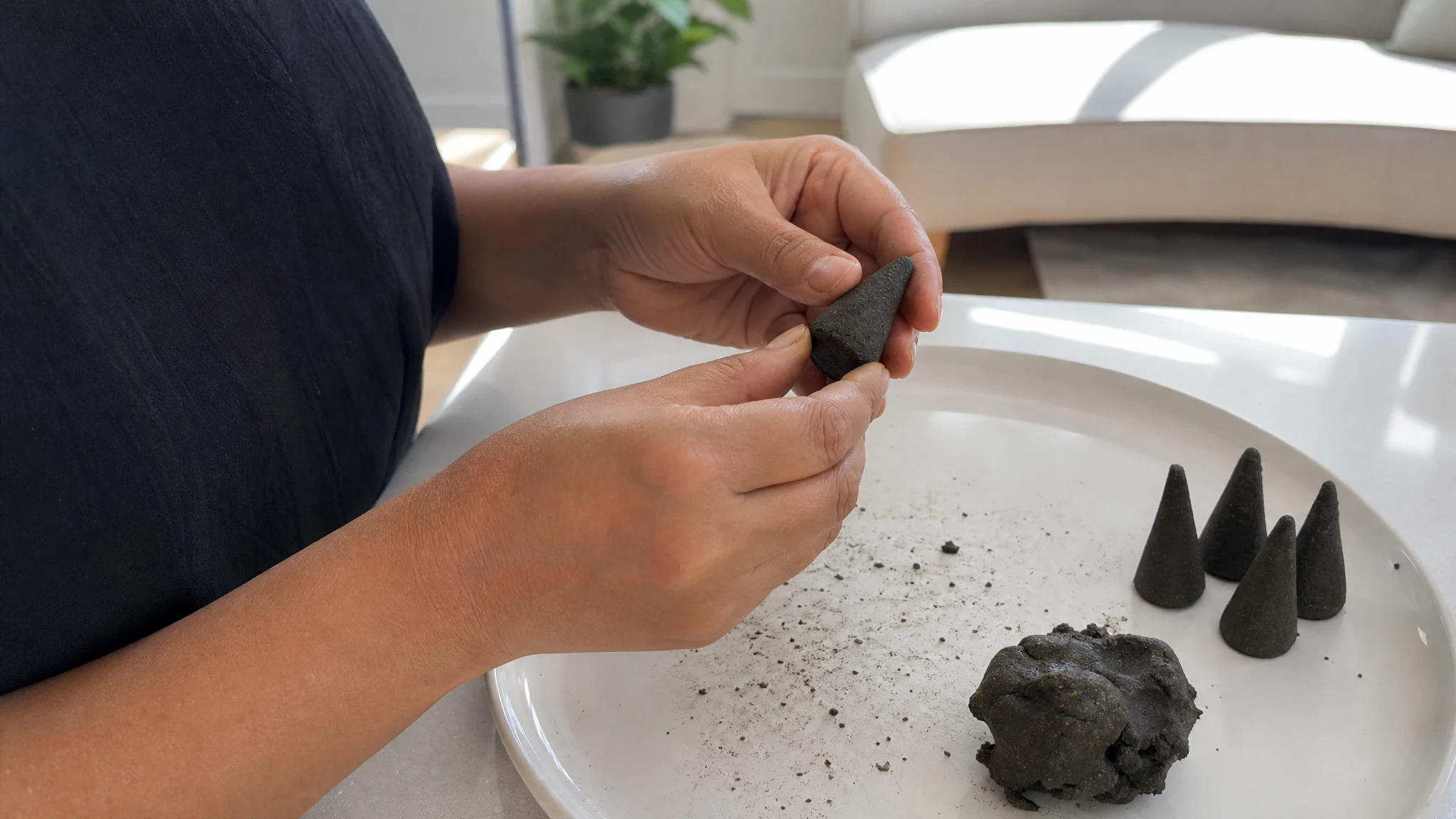
Mugwort Incense Cones with Makko: A Batch Worked by Weight
Our position: the first variable to settle in a makko cone is the binder share, not the scent. The two incense-making sources fetched for this article put makko at 10% of the mix on one side and 50% to 60% on the other, a fivefold gap, and a mugwort oil load only makes sense once you know which end your base needs. What follows is a 30 g test batch worked out by weight, with the oil dose derived from arithmetic and left for your own test to set.

Mugwort Essential Oil
Our own Mugwort Essential Oil, in sizes from 0.5 oz to bulk.
From $16.99
Shop Now →Start with three tiny batches, not one big one
We have not made or tested these cones; every figure below comes from a cited source or from arithmetic. That is the reason for the test design. A 30 g dry mix is enough for a few cones, uses a fraction of a 0.5 oz bottle, and lets you vary one thing at a time.
Makko is the bark powder of Machilus thunbergii (Japanese tabu no ki), and Baieido's makko page describes it as both a water-soluble binder and a burning agent. Baieido's "Making Incense" by David Oller (copyright 2000 to 2002) gives a floor: "at least 10% makko should be used," and more may be needed for the mix to burn properly depending on what else is in it, though a sandalwood-only incense may need as little as 10%. The Kohgen blog post by Kikuya Masahiko (Kohgen, 2025) gives a "basic ratio of aromatic ingredients to tabu powder" of 4:6 to 5:5, which is 50% to 60% makko. Neither source is about mugwort, and neither mentions essential oil. The gap may reflect different aromatic bases (reasoning: a resinous or leafy base is less able to sustain a burn on its own than sandalwood), so the practical answer is to bracket it.
| Test batch | Makko share of 30 g dry mix | Makko | Other dry powders |
|---|---|---|---|
| A | 20% | 6.0 g | 24.0 g |
| B | 35% | 10.5 g | 19.5 g |
| C | 50% | 15.0 g | 15.0 g |
The 20%, 35% and 50% rungs are our choice of steps inside and just under the two sourced figures, not a sourced recipe. "Other dry powders" means whatever aromatic base you have: a wood powder or dried, finely ground mugwort leaf. We sell neither, nor makko; an incense supply shop or herb shop does. Ask the shop for the makko grade, since Baieido notes that makko comes in four grades and the higher grades have less aroma of their own.
The oil dose: arithmetic, not a rule
No source fetched gives an oil load for makko cones that still burn well, so none is stated here as fact. The only cone-specific figure found is from a retailer's kit page (Voyageur Soap and Candle), which has you pour a mix of 28 g dipropylene glycol and 14 g of essential oil or fragrance over up to 25 ready-made unscented cones and wrap them for at least 48 hours; the page gives no cone weight, so no percentage can be derived from it. A review of incense chemistry (Lin, Krishnaswamy and Chi, 2008) describes a typical commercial stick as 21% herbal and wood powder, 35% fragrance material, 11% adhesive powder and 33% bamboo stick by weight, which shows factory sticks carry far more scent material than a hobby cone would, and says nothing about how a cone behaves.
So the load is a placeholder to be set by your own small test. The conversion basis is the relative density of 0.895 on the batch in our published certificate of analysis (1 ml is about 0.895 g, and a dropper delivers about 20 drops per ml; weigh instead of counting if you can):
| Oil as share of dry mix | On a 30 g batch | About how many drops | On 100 g dry mix |
|---|---|---|---|
| 1% | 0.30 g | 7 | 1.0 g (about 22 drops) |
| 2% | 0.60 g | 13 | 2.0 g (about 45 drops) |
Our recommendation is to run batch B at 1% first and judge the burn before raising it. Reasoning only: the oil is a liquid added to a powder you intend to dry and light, so a cone that sputters could be blamed on the binder share, the water or the oil, and changing one thing at a time is the only way to tell which. Write the weights on the bag.
Two routes for adding the oil appear in the sources, and neither source compares them. You can mix it through the dry powders before any water goes in, or you can soak finished, dried cones, which is what the retailer's kit does. The first lets you weigh a precise dose per batch; the second makes the dose per cone depend on how much a cone absorbs. We lean to the first for a first test for that reason (reasoning, untested). Wear gloves while kneading: the kit page lists rubber gloves among its tools, and the oil is sold neat.
Wet mix, shape, dry
Both sources agree on the method, not on the numbers. Water goes in a little at a time while you knead into a dough Baieido calls tama; Kohgen says there is "no set amount of water" and warns that too much makes the dough prone to cracking as it dries. For cones, Kohgen says to make the tip pointy and the size small, because the larger a piece is the harder it is to dry inside, and it adds that cone shapes burn more at the base, which creates more smoke.
Drying times are the least certain figure. Baieido says "about a week in the summer and ten days in the winter" for slow drying, Kohgen says about a week on cardboard, and the retailer's kit says 2 days to a week for cones that were soaked rather than kneaded, with essential oils drying faster than fragrance oils. Plan on a week for kneaded cones, label the three batches, and do not test-burn a cone that is still soft in the middle.
Smoke is the real limit
A cone is a small fire in a closed room. In a 1 m3 chamber, incense gave off PM2.5 at 154 to 255 mg per hour against 8.8 to 10.0 mg per hour for candles, and carbon monoxide at 378 to 790 mg per hour against 74.7 to 76.8 (Ongwandee and Pipithakul, Applied Environmental Research, vol. 32, issue 1, abstract); the authors suggest a higher ventilation rate to reduce risk. Lin and colleagues (2008) report more than 45 mg of particulates per gram of incense burned, against 10 mg per gram for cigarettes, along with benzene, aldehydes and polycyclic aromatic hydrocarbons, and they advise ventilating rooms. The same review describes one case of allergic contact dermatitis in a man who had performed incense ceremonies for about 15 years, where a 48-hour patch test implicated the perfume in the incense. These are studies of commercial incense, not of mugwort cones, so how a mugwort cone compares is unknown. Our indoor burning article is the place for the wider evidence.
IFRA is the fragrance industry's standard-setter, and its Guidance for the use of IFRA Standards (51st Amendment) places incense in Category 12, products not intended for direct skin contact. IFRA's Standard for thujone (a compound found in some Artemisia oils, cited here as a general fact about the genus and not as a statement about our oil) sets 9.5% of thujone in the finished product for Category 12. Even a hypothetical oil that was entirely thujone would put 2% thujone in a cone made at 2% oil, well under 9.5%, so the cap is not what limits a cone at these loads; burning behaviour and smoke are (reasoning). We hold no thujone figure for our oil, and the IFRA text names no mugwort oil standard. A buyer who needs GC-MS or thujone data should ask in writing before ordering and get the answer in writing; the same goes for the safety data sheet, since we state no flash point for our oil.
Who should skip this
Our own safety copy says to avoid use during pregnancy, keep the oil away from children and pets, and that it is not for internal use; the product pages also describe it as unsuitable for anyone nursing or with a history of seizures. Those are our statements, not a finding about cones. If you are pregnant or nursing, ask an obstetric clinician before burning anything in your home. If anyone in the house has asthma or another airway condition, ask their physician. If there are pets, ask a veterinarian; the pets article collects what the authorities say. Do not leave a lit cone unattended, and put it in a dish that will not burn.
Whether the label on any mugwort oil you buy, ours or someone else's, names the same species as the paperwork matters more than usual here; reading a mugwort oil label covers the check. For burning the plant itself instead of the oil, see working with the dried plant, and for the same oil on charcoal, loose incense recipes.
If a test batch works, scale by weight, not by drops, and see the shop page for the current price per size. Our 0.5 oz bottle holds about 13.2 g, enough for six 100 g batches at 2%.
Mugwort Essential Oil
Mugwort Essential Oil from our own shop, in sizes from 0.5 oz to bulk.
From $16.99
Shop Now →Sources & Further Reading
- Oller, D. (copyright 2000 to 2002). Making Incense. Baieido. baieido-usa.com/making-incense-by-david-oller
- Baieido. Makko. baieido-usa.com/makko-
- Masahiko, K., 2025. How to make incense. Kohgen. shop.kohgen.com
- Lin, T.-C., Krishnaswamy, G., Chi, D.S., 2008. Incense smoke: clinical, structural and molecular effects on airway disease. Clin Mol Allergy 6:3. PMC2377255
- Ongwandee, M., Pipithakul, W. Air pollutant emissions from the burning of incense, mosquito coils, and candles in a small experimental chamber. Applied Environmental Research 32(1):69-79. ph01.tci-thaijo.org/aer/9702
- IFRA, 2024. IFRA Standards, 51st Amendment (Thujone, Amendment 49, 2020) and Guidance for the use of IFRA Standards. ifra-standards-51st-amendment.pdf
- Voyageur Soap and Candle. Unscented incense cones, 1 inch, natural (kit instructions). voyageursoapandcandle.com