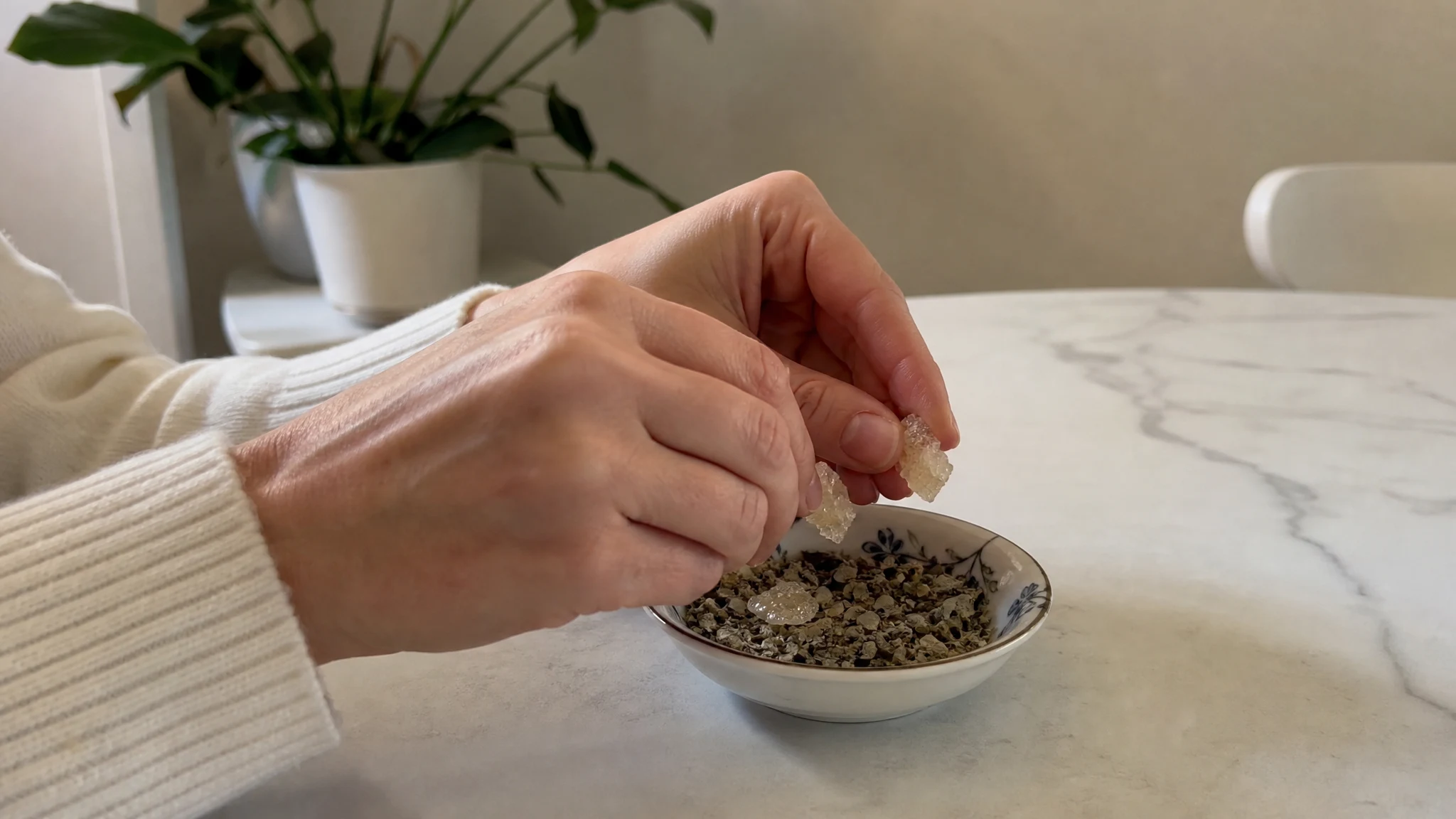
Mugwort and Resin Loose Incense: Three Blends by Weight
Loose incense is the one format where a fragrance oil never has to survive a binder, a mould or a drying rack, which makes it a reasonable first project for mugwort oil. It is also the format that puts a lit charcoal disc in your hands, and the US Consumer Product Safety Commission, in its warnings about charcoal and carbon monoxide, says charcoal should never be burned indoors. This article gives three blends by weight, a placeholder oil dose worked out from arithmetic, and a plain position on where to burn them.

Mugwort Essential Oil
Our own Mugwort Essential Oil, in sizes from 0.5 oz to bulk.
From $16.99
Shop Now →Decide where you will burn it before you blend anything
The US Consumer Product Safety Commission's 1999 release "CPSC Warns Never Use Charcoal Grills Indoors" (15 January 1999) says: "Never burn charcoal inside of homes, vehicles, tents, or campers" and "Charcoal should never be used indoors, even if ventilation is provided." It describes carbon monoxide as colorless, odorless and able to accumulate to toxic levels in closed environments, and estimates about 20 deaths a year from charcoal grills. The agency's charcoal page repeats the warning for enclosed areas and says people die every year when they burn charcoal in them.
Neither page names incense discs, which are small and made for the purpose, but the chemistry that produces the carbon monoxide, burning charcoal, is the same. Our position, as a reasoned reading and not a CPSC finding: burn charcoal-based loose incense outdoors, on a porch or in a yard, in a heat-resistant dish, and read the CPSC's words above before deciding to use a disc indoors. If that rules out charcoal for you, the cone route in the makko cone article avoids the disc (it has its own smoke figures) and the dry mix in the potpourri article avoids burning altogether.
Burning also makes smoke. Lin, Krishnaswamy and Chi (Clinical and Molecular Allergy, 2008) report that incense produces more than 45 mg of particulates per gram burned, against 10 mg per gram for cigarettes, and list benzene, aldehydes and polycyclic aromatic hydrocarbons among the emissions; they advise ventilating rooms. That is a review of commercial stick incense, not of a mugwort resin blend, so what a blend emits is unknown. Our indoor burning article covers the broader evidence.
Three blends, by weight
We have not made, burned or tested any of these. They are formulations built from a published layout and arithmetic. The layout comes from an unsigned, undated blender's guide on the Mystic Ryst site, which sorts a loose incense into 1 to 2 resins and 1 to 2 woods as the base, 2 to 3 herbs in the middle and one flower or spice as an accent, starts "with equal parts," and suggests 1/4 to 1/2 cup for a first batch. Its sample blend is 2 parts frankincense, 1 part sandalwood, 1 part lavender and half a part rose petals. It is a blogger's starting point, not a standard, and it does not mention essential oil. Weigh instead of using cups; resins and powders differ widely in density.
| Blend | Frankincense resin | Dried mugwort leaf | Wood powder | Resin used per 100 g |
|---|---|---|---|---|
| 1. Resin-forward (2 : 1) | 66.7 g | 33.3 g | none | 66.7 g |
| 2. Herb-forward (1 : 3) | 25.0 g | 75.0 g | none | 25.0 g |
| 3. Equal thirds (1 : 1 : 1) | 33.3 g | 33.3 g | 33.3 g | 33.3 g |
These are fractions of a 100 g batch; make 20 g first (a fifth of every figure). The shop's own page lists frankincense among the materials that pair with mugwort oil, which is why it is the resin here. We do not sell frankincense, dried mugwort, wood powder or charcoal. Buy them from an incense or herb supplier, and ask each for the plant species, and ask whether any of it is treated or scented.
The last column matters for a reason of supply. Bongers and 18 co-authors (Nature Sustainability 2(7):602-610, 2019) report, from inventories of 23 Boswellia papyrifera populations (21,786 trees), that over 75% of studied populations lack small trees, that natural regeneration has been absent for decades, and that projected frankincense production will be halved in 20 years. They attribute it to cattle grazing, frequent burns and reckless tapping, and say a literature review found similar threats for other Boswellia species. The finding concerns one species, B. papyrifera; frankincense on the market can come from several. Nothing was fetched on copal or myrrh, so this article does not discuss them. Our recommendation, which is a judgment and not a sourced rule: choose blend 2 or 3 if you want to burn less resin, and ask the supplier which species and which country the resin came from, and how it was tapped.
The oil dose: placeholder arithmetic
No source fetched gives an essential oil share for loose incense, so none is stated as fact. The conversion basis is the relative density of 0.895 on the batch in our published certificate of analysis (1 ml is about 0.895 g; about 20 drops per ml; weigh when you can). Per 100 g of dry blend:
| Oil as share of blend | Weight | About how many drops | In a 20 g first batch |
|---|---|---|---|
| 0.25% | 0.25 g | 6 | 0.05 g (about 1 drop) |
| 0.5% | 0.50 g | 11 | 0.10 g (about 2 drops) |
| 1% | 1.00 g | 22 | 0.20 g (about 4 drops) |
We would start at 0.25% and move up only if you cannot smell it from the burner. The shop page describes the aroma as green, bitter and camphoraceous, and describes using a drop or two as an accent in perfume accords; it is a strongly flavoured material, so under-dosing is the cheaper error (reasoning). At 20 g the numbers are one to four drops, which is why we suggest weighing the oil on a 0.01 g scale if you have one, or making a larger 100 g blend and splitting it.
Add the oil to the herb and wood powder, not to the resin. That is reasoning, untested: the powders can absorb it, while resin chunks coated with oil will clump and leave you unable to tell how much went where. Mix, then fold in the resin, and keep the blend in a closed glass jar for a few days before burning.
IFRA, the fragrance industry's standard-setter, places incense in Category 12 in its Guidance for the use of IFRA Standards (51st Amendment), meaning products not intended for direct skin contact. IFRA's Standard for thujone, a compound found in some Artemisia oils (a fact about the genus, not about our oil), allows 9.5% thujone in the finished product for Category 12 (IFRA, 51st Amendment, Thujone, Amendment 49, 2020). At 1% oil that cap is not close for any thujone share. The IFRA text names no mugwort oil standard, and we hold no thujone figure for our oil; a buyer who needs GC-MS data or the safety data sheet (we state no flash point) should ask in writing and get it in writing.
Burning it, as the fetched guides describe
The guide by Vanessa Hess for Vintage Alchemy (28 July 2023) says to place the disc in a heat-resistant burner filled with sand or ash, light its edge until it sparks and glows, add a small amount of resin, and let the charcoal and burner cool completely before discarding the ash. The Mystic Ryst guide gives numbers: 1 to 2 inches of sand, wait 2 to 3 minutes for the disc to glow, start with half a teaspoon, and keep water nearby. Neither guide says how long a disc burns, so do not plan around a number. Never leave it unattended, keep it clear of anything that burns, and keep it out of reach of children and pets.
Our own safety copy says to avoid use during pregnancy, to keep the oil away from children and pets, and that it is not for internal use. That is our statement, not a finding about incense. If you are pregnant or nursing, ask an obstetric clinician before burning anything in your home; if anyone in the house has asthma, ask their physician; for a household with birds, cats or dogs, ask a veterinarian (see the pets article). To choose which oils pair with mugwort in a blend, see the pairing guide, and for the plant on its own, working with the dried plant.
Burn small, burn outdoors, and record the grams you used so the second batch can differ from the first by one thing.
Mugwort Essential Oil
Mugwort Essential Oil from our own shop, in sizes from 0.5 oz to bulk.
From $16.99
Shop Now →Sources & Further Reading
- US Consumer Product Safety Commission, 1999. CPSC Warns Never Use Charcoal Grills Indoors. cpsc.gov news release 1999
- US Consumer Product Safety Commission. Carbon Monoxide Information Center: Charcoal. cpsc.gov/Charcoal
- Lin, T.-C., Krishnaswamy, G., Chi, D.S., 2008. Incense smoke: clinical, structural and molecular effects on airway disease. Clin Mol Allergy 6:3. PMC2377255
- Bongers, F. et al., 2019. Frankincense in peril. Nature Sustainability 2(7):602-610. ideas.repec.org record, doi 10.1038/s41893-019-0322-2
- Hess, V., 2023. How to Burn Incense Resin: A Simple Guide. Vintage Alchemy. vintagealchemyshop.com
- Mystic Ryst (undated, unsigned). How to Create Your Own Incense Blends. mysticryst.com
- IFRA, 2024. IFRA Standards, 51st Amendment (Thujone, Amendment 49, 2020) and Guidance for the use of IFRA Standards. ifra-standards-51st-amendment.pdf