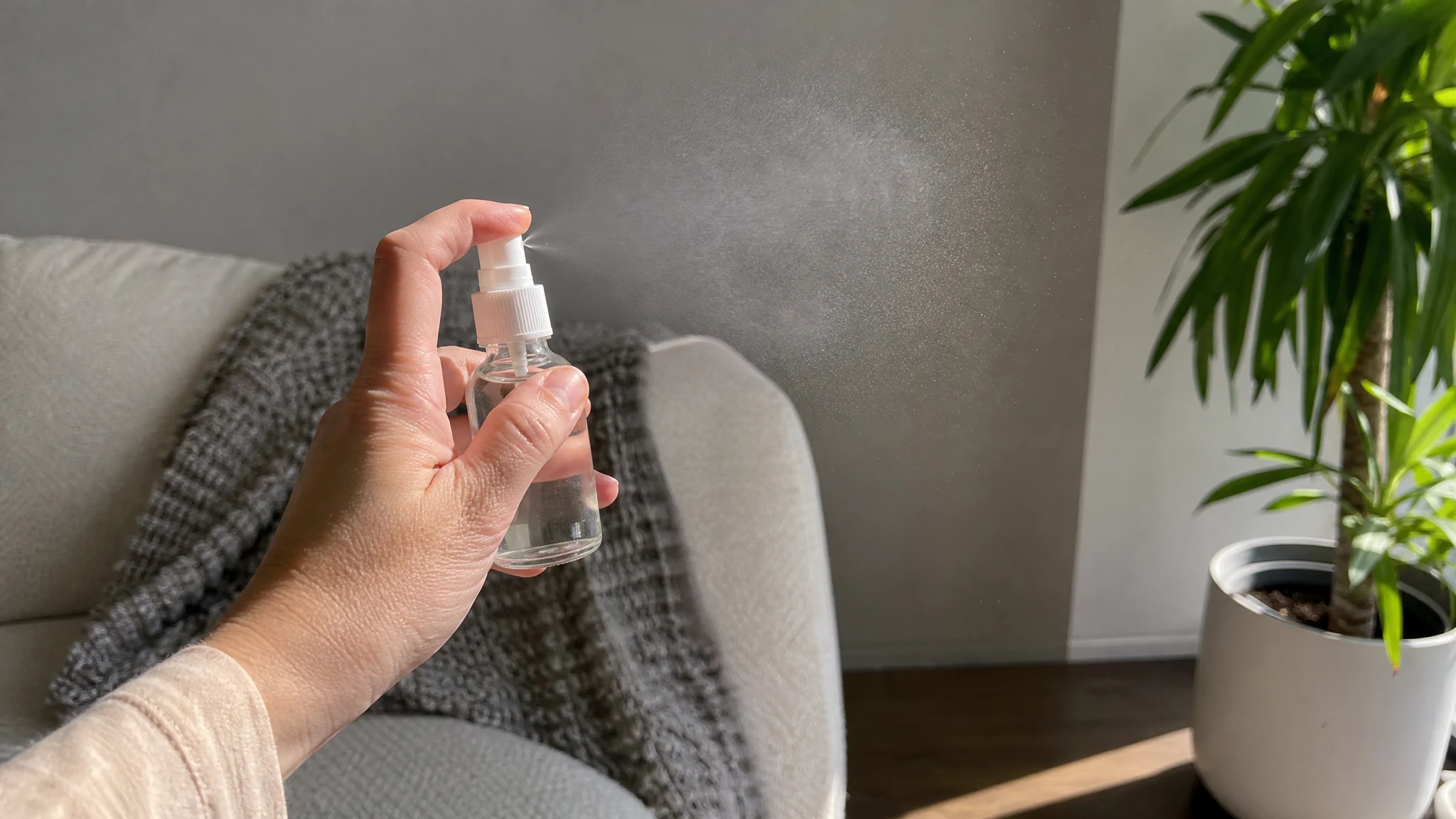
DIY Mugwort Room Spray: A 100 g Formula Worked Out by Weight
A DIY mugwort room spray is a scented water product, nothing more, and the useful question is how little oil it needs. We worked a 100 g batch out from a published IFRA thujone figure and two supplier ratios, and landed on 0.25% mugwort oil by weight, about 5 to 6 drops. We have not made it, so treat it as a formulation to test in small batches. We also make no claim that it cleanses, protects or replaces smoke in any practice; it is a room spray.

Mugwort Essential Oil
Our own Mugwort Essential Oil, in sizes from 0.5 oz to bulk.
From $16.99
Shop Now →Step 1: pick the load from a ceiling, not from a recipe blog
Supplier recipes for room sprays tend to be generous. One supplier blog (VINEVIDA, 30 October 2022) says to keep essential oils "less than 4% of the overall volume" (VINEVIDA, 2022). That is a general figure for essential oils, not a figure for mugwort oil. Mugwort oil has a particular issue: some Artemisia oils contain thujone, which IFRA restricts because of neurotoxicity.
The IFRA Standards have no entry named for mugwort or Artemisia oil in the compilation we read (up to the 51st Amendment, January 2024). They do have a thujone standard (Amendment 49, 2020) with a cap for manual air-freshener sprays, pump and aerosol, in Category 10B of 0.22% thujone in the finished product (IFRA Standards, 51st Amendment compilation, Thujone; the category placement is in IFRA Guidance, 30 June 2023). The ceiling for the oil then depends on how much thujone the oil carries, which is where literature varies widely: from none to about 20% trans-thujone in one Lithuanian set of common mugwort oils, and 1.31% to 16.66% in the three of seven Chinese Artemisia argyi oils where thujone was reported (Ekiert et al., Molecules, 2020; Luo et al., Scientific Reports, 2022). The COA we publish reports no constituent, so the share for our oil is not on paper; a buyer who needs it should ask in writing and get the figure in writing.
| Thujone share of the oil (assumed) | Highest oil load under the 0.22% cap | Thujone from the 4% supplier figure | Thujone from our 0.25% |
|---|---|---|---|
| 1% | 22% | 0.04% | 0.0025% |
| 5% | 4.4% | 0.2% | 0.0125% |
| 17% | 1.29% | 0.68% | 0.0425% |
Read the last row: at a 17% thujone share, the generic 4% figure delivers 0.68% thujone, about three times the 10B cap, while 0.25% delivers a fifth of it. That is the reasoning for 0.25%. It is also a spray you breathe, and the IFRA category speaks to incidental skin contact, not to inhaling a mist in a closed room, so the cap is a floor of caution, not a clearance. The shop's own pages say mugwort oil should be diffused lightly if at all; a room spray is a diffusion product, and we ask you to treat it that way.
The related flag for our skin copy: the IFRA thujone figure for body oils and lotions is 0.095%, which is under what the top of our 0.5% to 2% skin dilution copy would deliver at a high thujone share. This spray is not for skin; see the safety post for the skin-side arithmetic, and keep to the low end of that range.
Step 2: the arithmetic for 100 g
Our oil's relative density on the COA batch is 0.895, so 1 ml is about 0.895 g, and 20 drops to the milliliter gives about 22 drops per gram. At 0.25%, 100 g of spray holds 0.25 g of oil, which is 0.28 ml or about 5.6 drops. Droppers vary: weigh it on a 0.01 g scale. At 0.5% it would be 0.5 g, about 11 drops; we would not go there without the thujone figure in hand.
Step 3: solubilizer, and why the ratios disagree
Oil floats on water, so a water-based spray needs a solubilizer such as polysorbate 20. Suppliers disagree on how much. Makesy (17 February 2023) says the range runs "1:1 to 5:1" solubilizer to oil, that polysorbate 20 usually needs only 1:1, and that citrus oils want 3:1 or higher; mix the oil into the solubilizer first, then add that mixture to the base while stirring; if it goes milky, start over at a higher ratio (Makesy, 2023). GoNative, a New Zealand supplier, advises 5 to 10 times as much polysorbate 20 as oil and small test batches (GoNative, undated). Neither source mentions mugwort oil.
| Ratio (polysorbate 20 to oil) | Polysorbate 20 for 0.25 g oil | Share of 100 g spray |
|---|---|---|
| 1:1 | 0.25 g | 0.25% |
| 3:1 | 0.75 g | 0.75% |
| 5:1 | 1.25 g | 1.25% |
| 10:1 | 2.5 g | 2.5% |
Our suggestion is to make three 20 g test batches at 1:1, 3:1 and 5:1 (scale the table by one fifth: 0.05 g oil each) and keep the lowest ratio that stays clear for a week. At these small amounts the cost of a failed test is nearly nothing, and the supplier ratios give a bracket, not an answer. Because the spray is mostly water, use distilled or deionized water, and put the oil-and-solubilizer mix in first, stirring slowly; if it foams, let it stand before bottling.
Step 4: a water spray needs a preservative; the dose is not ours to give
FDA's page on microbiological safety in cosmetics names an ineffective preservation system as a pathway to contamination and says that although injuries from contaminated products are not common, they can be serious (FDA, content current as of 15 October 2024). A supplier's room spray guide is blunter: without a preservative, "bacteria will start to grow" (TheSoapery, updated 10 April 2026). Polysorbate disperses oil; it does not preserve. The dose, pH range and compatibility come from the preservative maker's data sheet, which is why we give no percentage here. Preservatives, solubilizers and spray bottles come from a cosmetic-ingredient or craft supplier; we sell only the oil.
The alcohol route, and its fire problem
Replacing much of the water with ethanol avoids the solubilizer and, according to one supplier blog, lengthens life ("just under half the volume" is that blog's choice); the search found no authority giving a percentage at which alcohol alone preserves a spray, so we give none. The hazard is documented: the NIOSH Pocket Guide lists ethanol's flash point as 55 F, its lower explosive limit as 3.3%, and its class as a Class IB flammable liquid (NIOSH, page reviewed 30 October 2019). A mist of alcohol and oil near a lit candle, a warmer or a stove is a fire question. On sourcing, TTB says no permit is needed to purchase completely denatured alcohol, while specially denatured alcohol needs an industrial alcohol user permit (TTB, updated 12 December 2018). We state no flash point for our oil; a buyer who needs one should request the safety data sheet in writing.
Using it, and who should not
- Spray into the air, away from faces, food, pets and anyone sleeping; do not use it on skin or fabric you will wear.
- Our copy: avoid use during pregnancy, keep away from children and pets, not for internal use; the shop's standards page also names anyone with a history of seizures. If any of those apply, ask an obstetric clinician, a physician or a veterinarian first.
- Poison Control says essential oils belong "locked up, out of the sight and reach of children and pets"; for any exposure the US help line is 1-800-222-1222 (National Capital Poison Center).
For the pet side see mugwort oil and pets; for fire and smoke questions see burning mugwort indoors; for the botanical difference from white sage, mugwort versus white sage.
If you plan to sell it
FDA's fragrances page lists room fresheners among non-body products regulated by the Consumer Product Safety Commission (FDA, content current as of 28 February 2022), and its aromatherapy page says the FTC regulates advertising claims (FDA, aromatherapy). A product made for sale needs a cosmetic formulator for the preservation and stability work, a testing laboratory, and a product-safety attorney for the label; our labeling post covers the framework for candles and the same thinking applies (labeling essential oil candles for sale in the US).
Start at 0.25%, three small test batches, a preservative from its maker's data sheet, and the thujone figure for your batch in writing before you go higher.
Mugwort Essential Oil
Mugwort Essential Oil from our own shop, in sizes from 0.5 oz to bulk.
From $16.99
Shop Now →Sources & Further Reading
- IFRA, 2024. The complete IFRA Standards up to and including the 51st Amendment (Thujone). ifra-standards-51st-amendment.pdf
- IFRA, 2023. Guidance for the use of IFRA Standards. ifra-51st-amendment-guidance.pdf
- Ekiert H. et al., 2020. Significance of Artemisia vulgaris L. (common mugwort) in the history of medicine and its possible contemporary applications substantiated by phytochemical and pharmacological studies. Molecules 25(19):4415. PMC7583039
- Luo D.-Y. et al., 2022. Repellency and insecticidal activity of seven mugwort (Artemisia argyi) essential oils. Scientific Reports 12:5337. PMC8964668
- VINEVIDA, 2022. How to make essential oil room spray. vinevida.com
- Makesy, 2023. How to solubilize fragrances and essential oils. makesy.com
- GoNative, undated. Polysorbate 20 (product page). gonative.co.nz
- TheSoapery, 2026. How to make room spray with essential oils. thesoapery.co.uk
- FDA, 2024. Microbiological safety and cosmetics. fda.gov
- NIOSH, 2019. Pocket Guide to Chemical Hazards: ethyl alcohol. cdc.gov/niosh/npg/npgd0262
- TTB, 2018. Alcohol for industrial use: denatured alcohol. ttb.gov/node/2278
- National Capital Poison Center, undated. Essential oils. poison.org
- FDA, 2022. Fragrances in cosmetics. fda.gov
- FDA, 2023. Aromatherapy. fda.gov