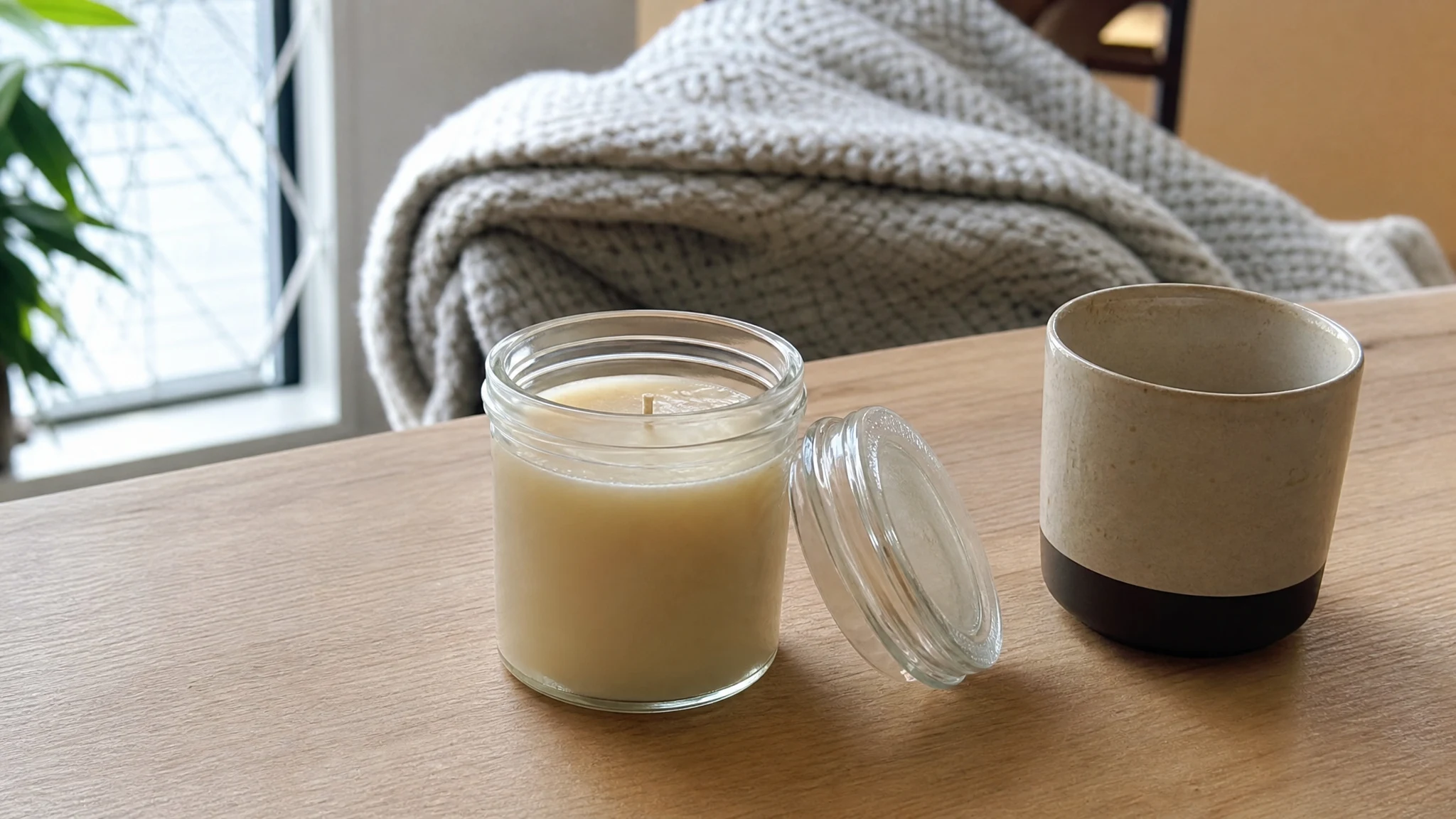
Faint Mugwort Candle? Where to Look First
A faint mugwort candle is a small mystery, and it is tempting to blame the oil or reach for the dropper. Wax makers and wick suppliers point somewhere else first. Wick and melt pool, then cure time, then how hot the wax was when the oil went in, and only then the load, so that is the order we would work through.

Mugwort Essential Oil
Our own Mugwort Essential Oil, in sizes from 0.5 oz to bulk.
From $16.99
Shop Now →Look at the flame and the melt pool
A candle can only throw scent from wax it has melted. A wick supplier notes that the more fragrance or dye is in the wax, the larger the wick needs to be for a full melt pool, so a wick picked for an unscented jar can be too small once oil is added. The result is tunnelling, a deep narrow well in the middle and a ring of unmelted wax that never gets warm enough to release anything. A candle like that will smell faint however good the oil is.
So begin with the wick. Let the candle rest, burn it for a few hours at a time, and see whether the melt reaches the edge of the jar. If it does not, try one size up in a fresh candle, keeping the oil load the same, so you change one thing at a time.
While you are checking the wick, take a minute to look at the flame itself. A steady, mostly upright flame about as tall as your thumbnail is usually a good sign. A tiny flame that struggles, or a tall one that flickers and smokes, tells you the wick and the wax are not yet matched. Sketch what you see in your log so you can compare it with the next candle.
Give it time to cure
A candle poured yesterday often smells quieter than the same candle two weeks later. One candle supplier says crystallisation is usually complete within 48 hours, but recommends 10 to 14 days of curing for vegetable waxes because that gives the best scent throw by their experience, and it admits the mechanism is not known. The evidence is thin, but the fix costs nothing. Judge the wick at 48 hours, judge the scent after the longer wait, and write both dates on the jar.
Think about how hot the wax was
This is the part where suppliers genuinely disagree. One guide says to add an essential oil once the wax has cooled to about 10 degrees below the oil's flash point, because oil added to hotter wax can volatilise before the candle sets. Another supplier says that scent is lost by evaporation, tied to boiling point and not flash point, and that flash point is about ignition near a flame. Wax data sheets themselves only give the wax's own pour window.
If you suspect the oil went in too hot, the cheap experiment is one candle with the oil added at the cool end of your wax's pour window, stirred in well. For a flash point on our oil or any other safety data sheet figure, ask us in writing through the contact page and get the answer in writing before you rely on it.
Raise the load last, and slowly
Wax has a ceiling, and going past it tends to cause sweating and surface trouble before it improves scent. The arithmetic shows what a bit more costs. In a 200 g candle (our round number), going from 4 percent to 8 percent takes the oil from 8 g to 16 g. At the 0.895 relative density on our Certificate of Analysis for one batch, that is about 179 drops becoming about 358, and 16 g is roughly 60 percent of a 1 oz bottle in one candle. Move the load two points at a time, with the wick held constant. Our candle-making guide sets out a 2, 4 and 6 percent ladder that suits this.
Know what kind of scent to expect
A candle supplier's guide says fragrance oils generally give a stronger hot and cold throw than essential oils. That is the nature of the material, and it matters for mugwort in particular. We describe its aroma as green, bitter and camphoraceous, with sage-like facets and a curious sweet undertone, and we sell it as a restrained oil for fragrance craft. A candle that quietly perfumes a small room at a modest load may be exactly the result you want, not a failure. If you are weighing the two materials, our comparison of mugwort essential oil and fragrance oil covers it.
Smell the right way
Noses are easy to fool. Try the candle in a room that does not already smell of something else, and give yourself a moment of fresh air before you judge it. Walk into the room from outside, instead of sitting in it, because the first breath tells you much more than the hundredth. If you can, ask someone else to walk in cold and tell you what they notice, without saying what you hoped they would notice.
Also remember that the scent of an unlit candle and the scent of a lit one are two different things. Lift the lid and you will smell the cold throw; light it and wait twenty minutes, and you will smell the hot throw. A candle that is quiet in one and clear in the other is giving you useful information.
Keep a one-variable log
The habit that solves most candle puzzles is dull and works: change one thing per candle, and write down wax, load, the temperature the oil went in at, pour temperature, cure time and what the burn looked like. After three or four candles you will know which of the steps above was your problem.
Our guidance for the oil is to avoid use during pregnancy and to keep it away from children and pets, so ask an obstetric clinician or a veterinarian before burning mugwort candles in a home with either. Wax, wicks and jars come from a candle supply shop.
Faint candles usually come from the wick or the wait, and the oil is rarely the first thing to change.
Mugwort Essential Oil
Mugwort Essential Oil from our own shop, in sizes from 0.5 oz to bulk.
From $16.99
Shop Now →