Blending With Mugwort Oil: Best Partners and Proportions
Mugwort oil does not whisper. It is green, bitter and camphoraceous, with sage-like edges and a faint sweetness underneath, and in a blend it behaves like a strong herb in a stew: a little defines the whole pot. The best partners are the ones that give it something to lean on, and the best proportion is usually smaller than you expect.

Mugwort Essential Oil
Our own Mugwort Essential Oil, in sizes from 0.5 oz to bulk.
From $16.99
Shop Now →The partners we point to
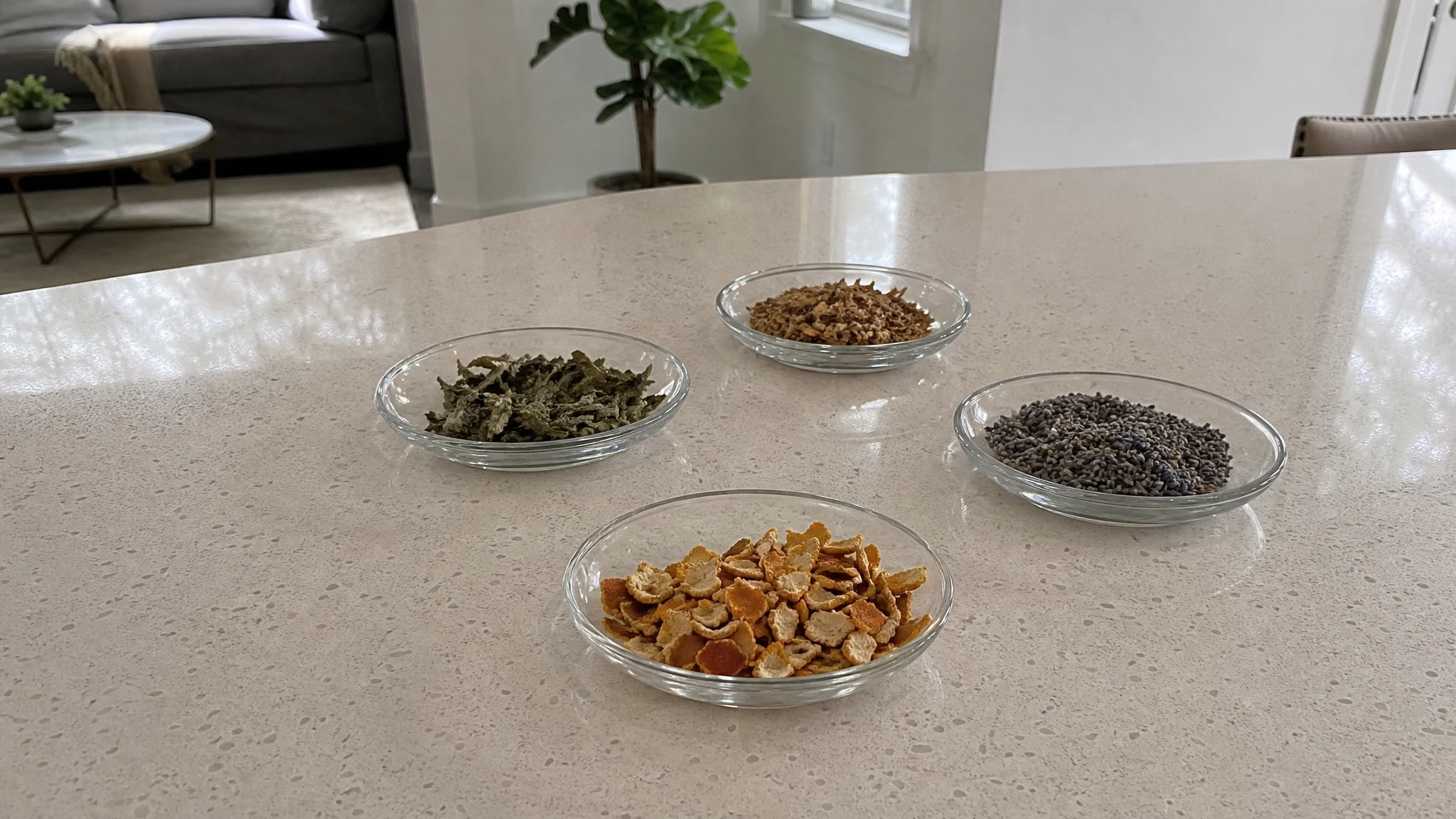
We list cedarwood, clary sage, juniper, frankincense and cypress as companions for our mugwort oil, and we would add vetiver for anyone who wants a deeper, earthier base. We sell the mugwort only, so those partners come from a perfumery or craft supplier. Our own page places mugwort in the middle of a scent, between the first lift of a blend and the lingering base, which is why it pairs so well with both a bright oil and a dark one.
Published analyses help explain why some of these pairings click. A Bulgarian juniper berry oil was more than half alpha-pinene, with myrcene, sabinene and limonene behind it (Höferl et al., 2014). That is a crisp, resinous register, and it makes a strong contrast with the bitter green of mugwort. A clary sage oil from a Slovak supplier was built on linalyl acetate and linalool, the sweet, soft-edged molecules (Kačániová et al., 2023). The mugwort leaf oil in one study and that clary sage both carried caryophyllene, a woody-spicy sesquiterpene, which suggests a shared thread. That last point is our reasoning from two single samples, not a tested finding, so let your nose have the final say.
In practice we would think of it as one contrast and one bridge. Juniper brings the contrast. Clary sage is the bridge. Cedarwood, frankincense or vetiver then supply the floor. For more on that second pairing, see our mugwort and clary sage comparison.
A word about the word cedar
Cedar is where a label deserves a second look. Several very different trees are sold under the name, and one of them, western red cedar (Thuja plicata), gave a leaf oil in an Idaho study that was roughly three quarters alpha-thujone (Swor et al., 2023). The European Medicines Agency names cedar leaf, sage, tansy, wormwood, thyme and rosemary as sources of thujone-containing oils, in highly variable amounts (EMA public statement on thujone). So whichever cedar you reach for, check the Latin name and ask your supplier for the thujone figure on that lot.
Smell your way in
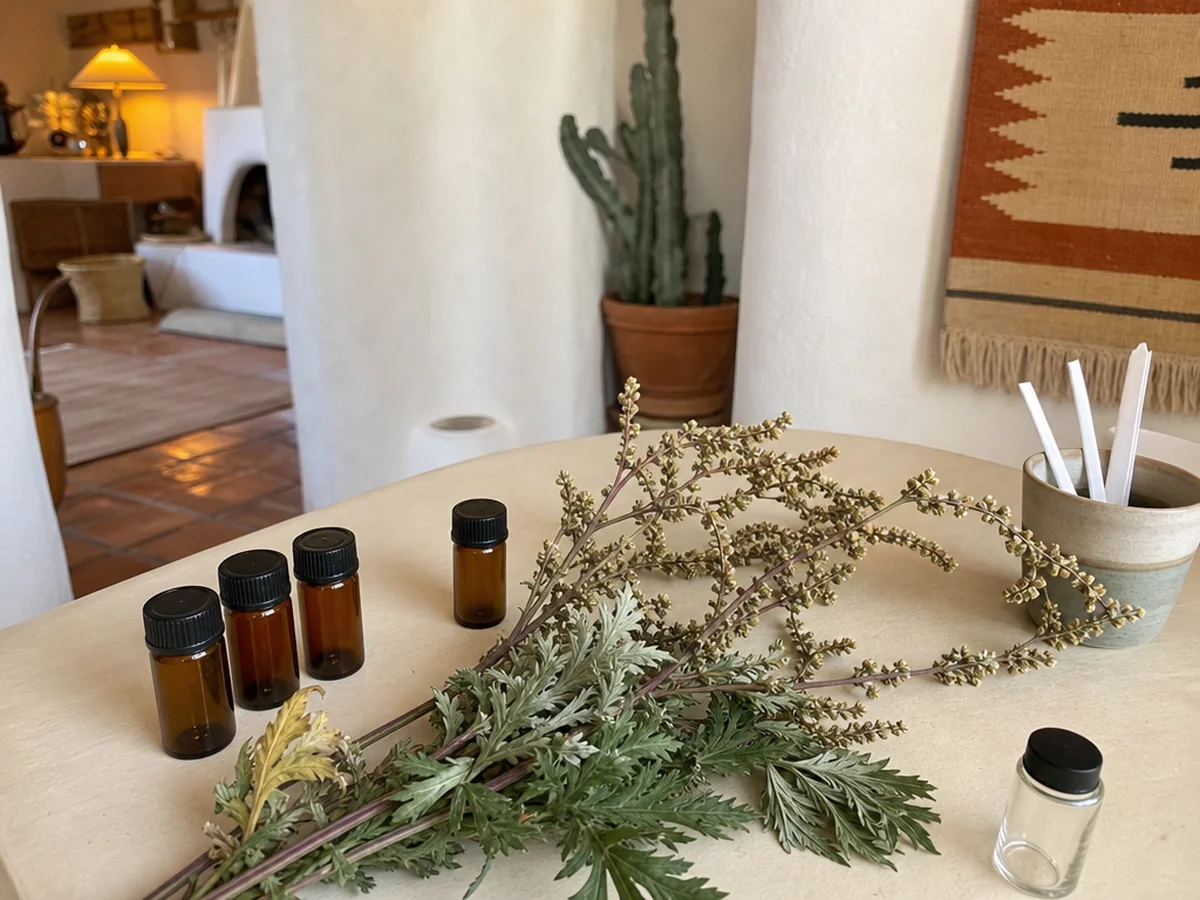
Before you plan a blend on paper, make friends with each oil on its own. A strip of plain paper works well: dip one end in the mugwort, label it, and breathe in slowly from a few inches away. Do the same with each partner on its own strip. Rest your nose between strips, and write down a couple of words for each, such as "green", "sharp", "sweet" or "woody".
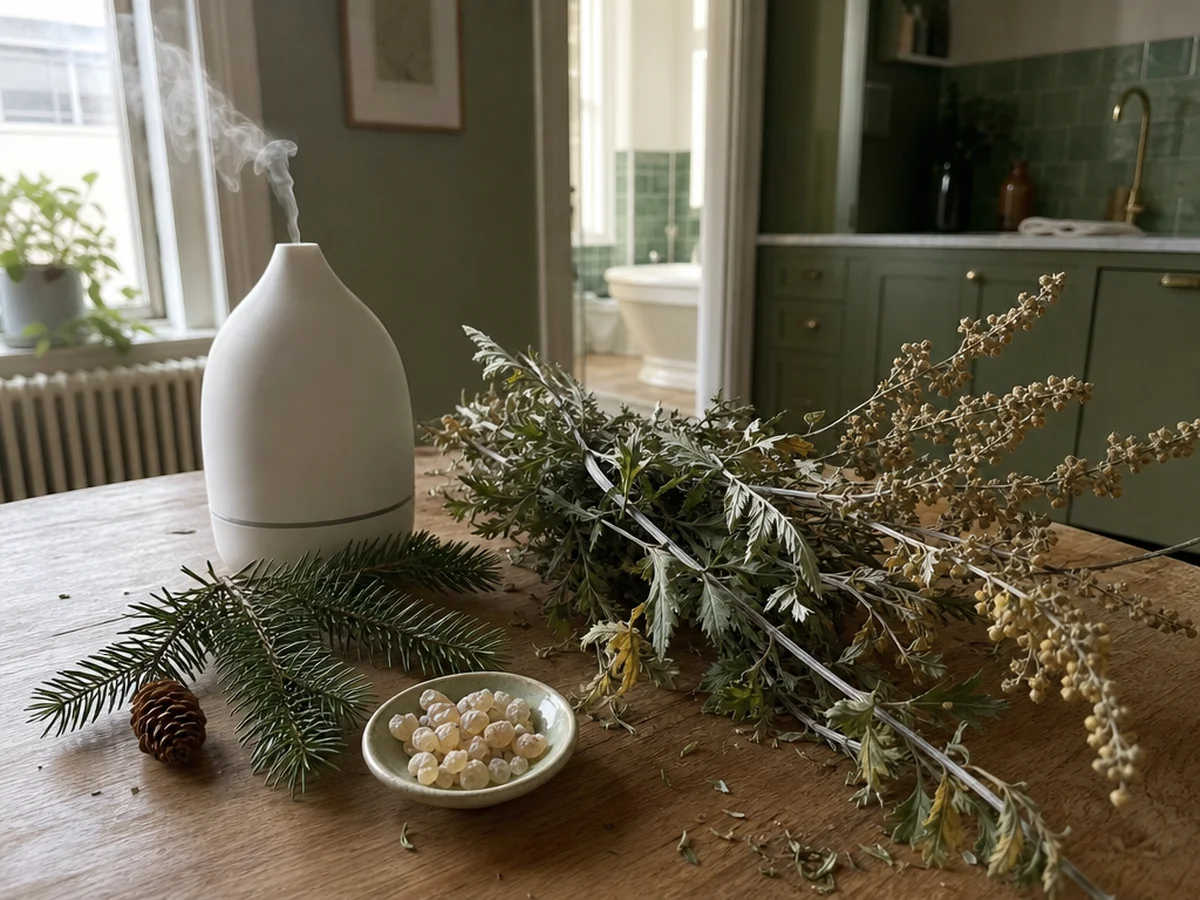
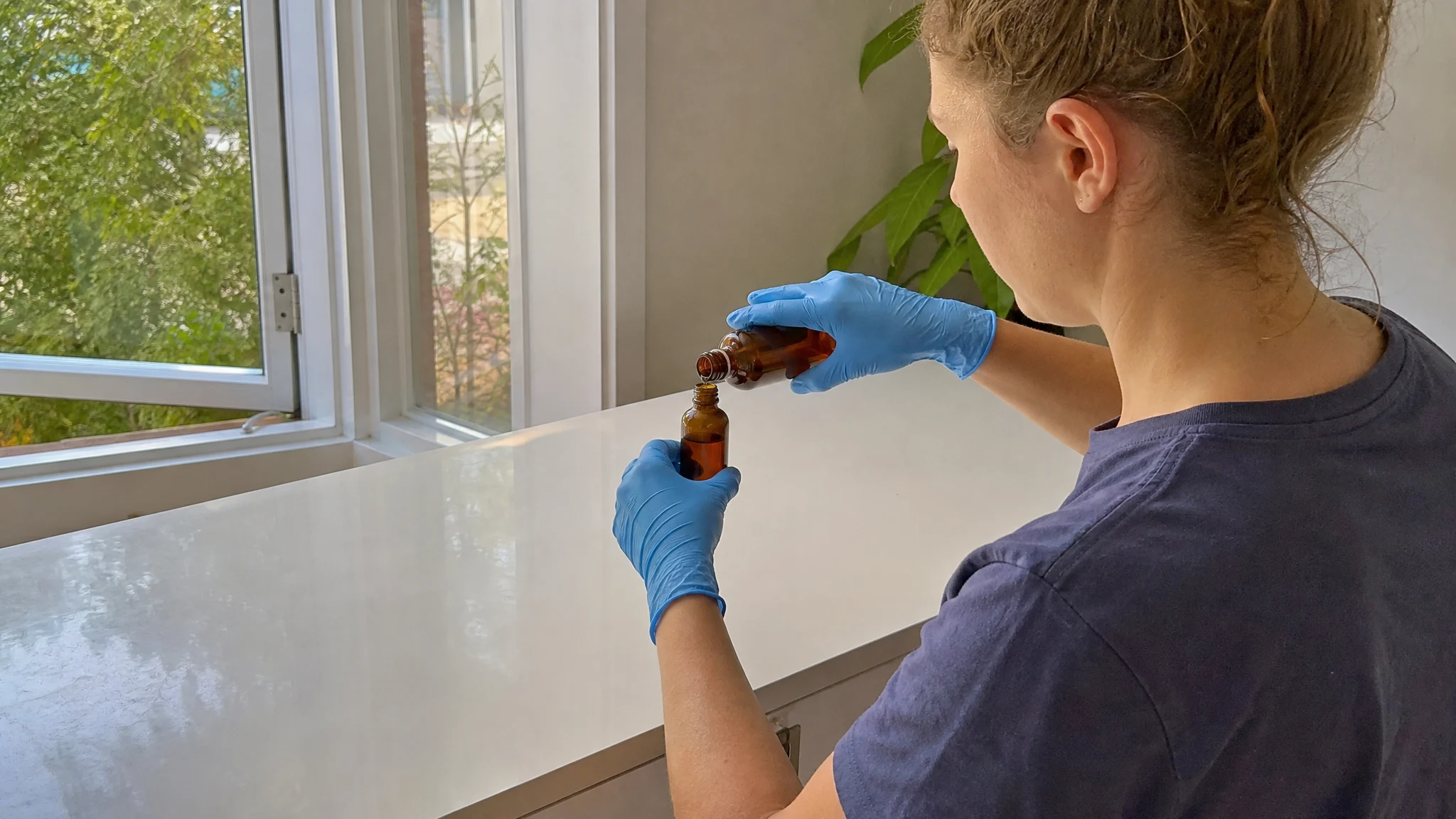
Then hold the mugwort strip and one partner strip together and fan them gently under your nose. You will quickly notice which pairs lean on each other and which compete. Build the real blend in small steps, starting with the partner and adding mugwort a drop at a time, because it is easy to add more and impossible to take it back out.
Give a finished blend a day or two in a closed jar before you judge it, then smell it again with a rested nose.
Mugwort oils can carry thujone, and the International Fragrance Association caps it in finished products by category. The cap for fragranced oil in reed diffusers and pot-pourri (Category 10A) is 0.13%, while candles and incense (Category 12) can go up to 9.5% (IFRA Standards, 51st Amendment; categories from IFRA's guidance). Every oil in a blend that contains thujone spends from the same budget.
Here is the arithmetic, using about 9.9% thujone, the combined figure for a Chinese mugwort leaf oil in one study (Guan et al., 2019), as a stand-in for illustration only. One gram of such an oil in 100 g of diffuser base contributes about 0.099% thujone, which fits under 0.13%. Two grams contributes about 0.2%, which does not. Swap one gram of a thujone-rich cedar leaf oil into the blend and the cap is passed several times over. In a candle or incense, the same blends sit comfortably below 9.5%.
That is why we suggest building from the product backwards.
- Decide the format first. Diffusers and sprays have the tightest limit; candles and incense have the loosest.
- Make mugwort the smallest share you can still smell. Our perfume guidance is a drop or two as an accent.
- Choose one contrast and one bridge, then a base.
- Weigh instead of counting drops, since droppers vary, and write every change down.
- Ask each supplier for the thujone figure of the lot. If you would like GC-MS or thujone data for ours, ask in writing through our contact page before you order, and rely on the answer once you have it in writing.
For ready-made starting points see our candle blend structures and room spray formula, and for where mugwort sits on the scent pyramid, top, middle or base.
A blend with mugwort in it should smell like the other oils with a green, slightly bitter edge you cannot quite place. If the mugwort is the first thing you notice, take a little out. If you blend often, larger sizes are listed on our bulk page.
Mugwort Essential Oil
Mugwort Essential Oil from our own shop, in sizes from 0.5 oz to bulk.
From $16.99
Shop Now →Sources & Further Reading
- Guan X et al., 2019. Chemical Composition and Antimicrobial Activities of Artemisia argyi Lévl. et Vant Essential Oils Extracted by Simultaneous Distillation-Extraction, Subcritical Extraction and Hydrodistillation. Molecules. PMC6384757
- Höferl M et al., 2014. Chemical Composition and Antioxidant Properties of Juniper Berry (Juniperus communis L.) Essential Oil. Action of the Essential Oil on the Antioxidant Protection of Saccharomyces cerevisiae Model Organism. Antioxidants. PMC4665443
- Kačániová M et al., 2023. Salvia sclarea Essential Oil Chemical Composition and Biological Activities. International Journal of Molecular Sciences. PMC10049179
- Swor K et al., 2023. Gymnosperms of Idaho: Chemical Compositions and Enantiomeric Distributions of Essential Oils of Abies lasiocarpa, Picea engelmannii, Pinus contorta, Pseudotsuga menziesii, and Thuja plicata. Molecules. PMC10057033
- European Medicines Agency, 2012. Public statement on the use of herbal medicinal products containing thujone (EMA/HMPC/732886/2010 Rev. 1). ema.europa.eu
- IFRA, 2024. The complete IFRA Standards, up to and including the 51st Amendment, Thujone (Amendment 49). IFRA Standards PDF
- IFRA, 2023. Guidance for the Use of IFRA Standards. IFRA guidance PDF