Mugwort Room Spray: A 100 g Formula and Oil Math
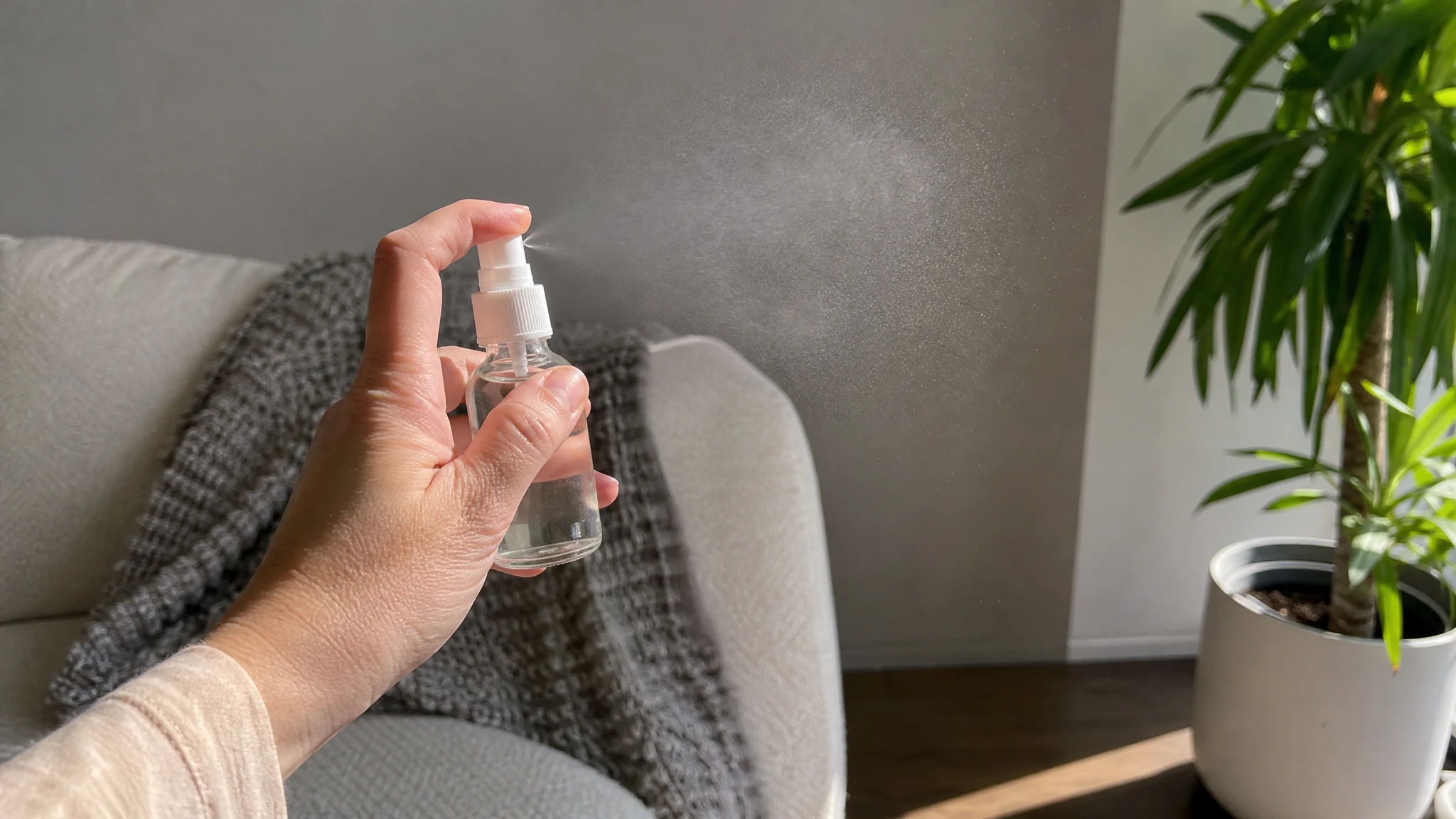
A room spray is scented water, and the most useful thing to work out is how little oil it needs. Mugwort is strong, green and bitter-sweet, so a whisper is enough. Here is a 100 g formulation, worked out from IFRA's published figures, that lands on 0.25% mugwort oil by weight, about five to six drops.

Mugwort Essential Oil
Our own Mugwort Essential Oil, in sizes from 0.5 oz to bulk.
From $16.99
Shop Now →Start from the ceiling, not a blog recipe
Recipes for room sprays tend to be generous with oil. Mugwort has a particular consideration: some Artemisia oils contain thujone, which IFRA, the fragrance industry's standards body, restricts because of neurotoxicity. IFRA's compilation, up to the 51st Amendment, has no standard named for mugwort oil, but its thujone standard allows 0.22% thujone in a finished manual air-freshener spray (Category 10B) (IFRA Standards, 51st Amendment; the category placement is in Guidance for the use of IFRA Standards, 51st Amendment). IFRA's rules bind fragrance suppliers, not hobbyists, so treat the figure as a benchmark.
The cap is on thujone, so the oil it allows depends on how much of the oil is thujone, which varies a great deal. A cultivated Brazilian Artemisia vulgaris oil listed none (Malik et al., 2019), and a hydrodistilled Artemisia argyi leaf oil had about 10% thujones combined (Guan et al., 2019). We publish no thujone figure for our oil; a buyer who wants one can ask us in writing through our contact page and get the answer in writing before relying on it. So we work with a range:
| Thujone share of the oil (assumed) | Most oil allowed under the 0.22% cap | Thujone delivered by 0.25% oil |
|---|---|---|
| 1% | 22% | 0.0025% |
| 10% | 2.2% | 0.025% |
| 40% | 0.55% | 0.1% |
Even for an oil that was 40% thujone, 0.25% oil stays under the cap, which is the reasoning behind that number. It is our suggestion, not a tested rate. This is also something you breathe, and IFRA's category speaks to incidental skin contact from a spray rather than a mist in a closed room, so the cap is a floor of caution, not a clearance. Spray lightly, as you would diffuse lightly.
The arithmetic for 100 g
The batch on our published certificate of analysis has a relative density of 0.895, so 1 ml weighs about 0.895 g. At 0.25%, 100 g of spray holds 0.25 g of oil, which is about 0.28 ml or 5.6 drops at roughly 20 drops per ml. Droppers vary, so weigh on a 0.01 g scale if you can. We would not go to 0.5% (about 11 drops) without the thujone figure for your batch in hand.
Getting oil to mix with water
Oil floats on water, so a water-based spray needs a solubilizer. Polysorbate 20 is a common one, and suppliers give different ratios of solubilizer to oil, which is why the maker's data sheet is the best guide. Our suggestion is to make three small 20 g test batches at different ratios (0.05 g oil each), mix the oil into the solubilizer first, then add that to the water while stirring slowly, and keep the lowest ratio that stays clear for a week. Failed tests at this size cost almost nothing. Use distilled or deionized water.
A water spray also needs a preservative, because plain water and oil can grow microbes. Polysorbate disperses oil but does not preserve it, so choose a preservative from a cosmetic-ingredient supplier and use the dose on its data sheet. We do not give a percentage, since that belongs to the preservative's maker. We sell only the oil, so the solubilizer, preservative, water and spray bottle all come from a craft or cosmetic-supply shop. We also suggest skipping alcohol-based versions near candles, warmers or stoves, since alcohol and oil mists are flammable.
Small touches that make a spray nicer to use
Label the bottle with the date and the oil percentage the moment you fill it, and shake it before each use, since a water-based spray can settle. Give it a test spritz well away from you and let the mist drift down before you walk through it. A bitter, green oil like mugwort rewards a light hand, and one or two sprays toward the middle of a room is a fair amount to judge it by. If the scent seems sharp, the fix is less spray or a lower oil dose in the next batch.
Using it, and who should skip it
Spray into the air, away from faces, food, pets and anyone sleeping. It is not for skin or for fabric you will wear. Our safety copy says to avoid mugwort oil in pregnancy, keep it from children and pets, and never take it internally. Anyone pregnant or nursing should ask an obstetric clinician first, and anyone with a seizure history or a home with birds, cats or dogs should ask a physician or veterinarian. Poison Control advises that essential oils be locked up, out of sight and reach of children and pets, and gives 1-800-222-1222 as the number to call after an exposure (Essential oils: Poisonous when misused, Poison Control).
For pets, see mugwort oil and pets. For smoke questions, see burning mugwort indoors, and for how mugwort differs from white sage, mugwort versus white sage. If you plan to sell a spray, it is a regulated product, so a cosmetic formulator and a product-safety attorney are the right advisers, and our labeling article shows the kind of framework involved for candles.
Start at 0.25%, run three small tests, and let the spray earn a little more oil only once you have the numbers.
Mugwort Essential Oil
Mugwort Essential Oil from our own shop, in sizes from 0.5 oz to bulk.
From $16.99
Shop Now →Sources & Further Reading
- IFRA. IFRA Standards, 51st Amendment (Thujone). IFRA Standards PDF
- IFRA. Guidance for the use of IFRA Standards, 51st Amendment. ifra-51st-amendment-guidance
- Malik et al., 2019. Chemical Profile and Biological Activities of Essential Oil from Artemisia vulgaris L. Cultivated in Brazil. Pharmaceuticals. PMC6631396
- Guan et al., 2019. Chemical Composition and Antimicrobial Activities of Artemisia argyi Lévl. et Vant Essential Oils Extracted by Simultaneous Distillation-Extraction, Subcritical Extraction and Hydrodistillation. Molecules. PMC6384757
- Poison Control. Essential oils: Poisonous when misused. poison.org