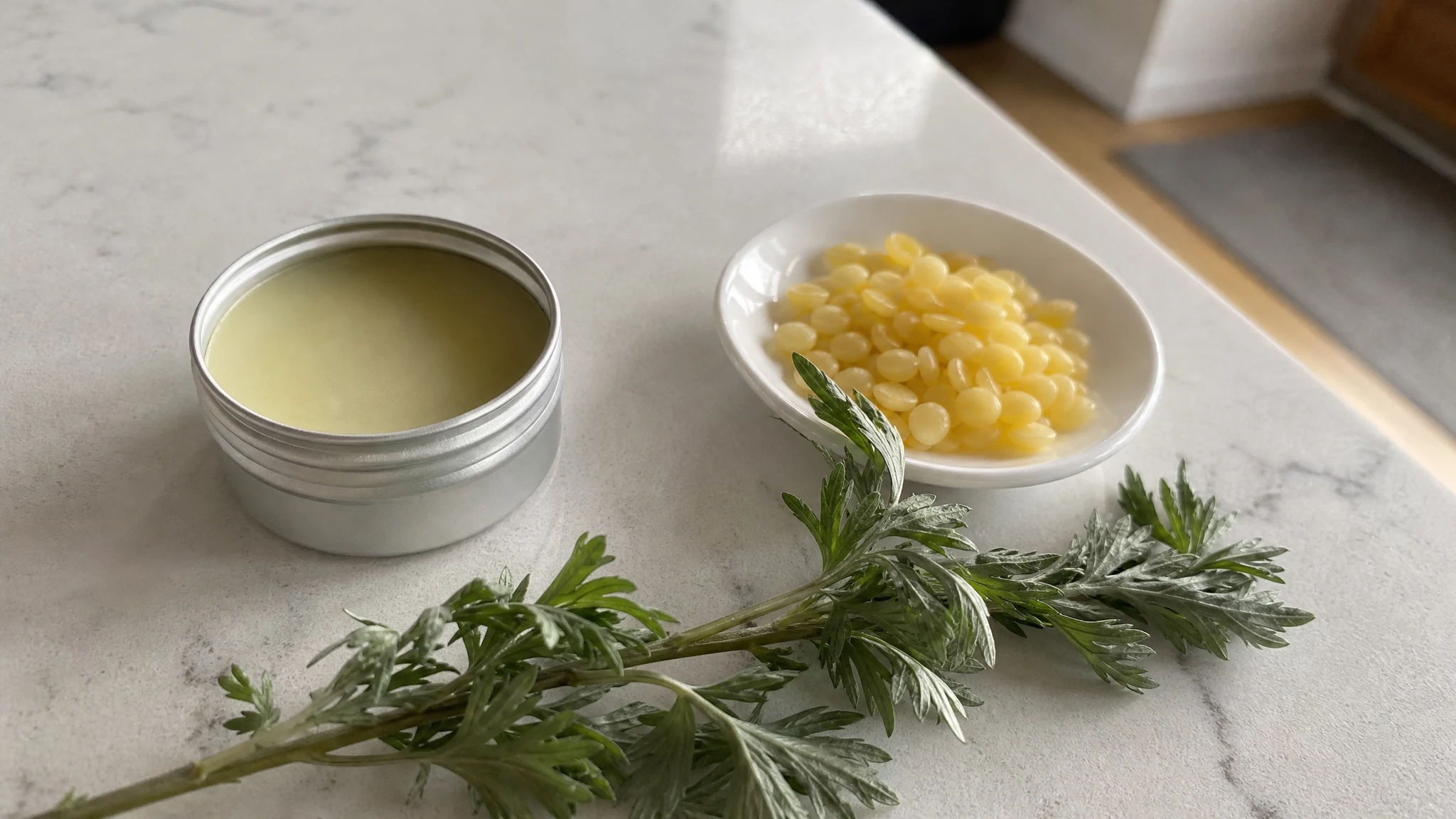
Mugwort Solid Perfume: How to Fill a 30 g Tin
A solid perfume is a lovely home for a bold oil like mugwort. A thumbnail of balm on a pulse point gives you a green, bitter, camphor-edged accent that stays close to the skin, and a 30 g tin is small enough to finish before the scent goes stale. Here is how we would build one by weight, starting with the decision that matters most: what the tin is called.

Mugwort Essential Oil
Our own Mugwort Essential Oil, in sizes from 0.5 oz to bulk.
From $16.99
Shop Now →The label is part of the formula
IFRA, the fragrance industry's standards body, sorts products by how they are used. Its guidance puts solid perfume in Category 4 (fine fragrance), body creams, oils and lotions in Category 5A, and lip products, balms included, in Category 1. Its thujone Standard then sets a different ceiling for each, measured in the finished product: 1.4% in Category 4, 0.095% in 5A and 0.11% in Category 1. A product marketed for more than one use follows the strictest of them.
In practice that means a tin sold as a perfume for pulse points sits in a roomy category, while the same tin sold as a balm for dry skin sits in a much tighter one. So decide first, label accordingly and tell the recipient it is a perfume. If you want a body balm, that is a different formula with a lower oil load.
The caps are on thujone, not on oil, and the Certificate of Analysis we publish for one batch lists density and refractive index only. To show how the sums work, take one published analysis of a mugwort leaf oil with about 9.9% combined alpha- and beta-thujone. That oil is not ours, and its authors note that composition varies markedly with how the oil is extracted, so use it as a worked example rather than a prediction.
The 30 g tin
Our shop guidance for skin is 0.5% to 2% in a carrier oil, with a patch test first, and we advise avoiding mugwort oil during pregnancy. The table converts that range for a 30 g tin. A gram of oil is about 1.1 ml at the batch density of 0.895, and at roughly 20 drops per millilitre (a loose convention; droppers vary) the drop counts are approximate. Weighing is better.
| Oil load | Mugwort oil | Approx. drops |
|---|---|---|
| 0.5% | 0.15 g | 3 |
| 1% | 0.30 g | 7 |
| 2% | 0.60 g | 13 |
Using the 9.9% illustration, those loads put about 0.05%, 0.1% and 0.2% thujone in the tin. All three sit well under the 1.4% perfume ceiling. Only the lowest sits under the 0.095% body-product ceiling, and only just. That is why we would start at 0.5% and judge the scent on your own wrist before going higher: it is the figure that fits whichever way the tin is eventually used, and a bold oil like this one announces itself early.
For the base, a suggested starting split is 20% beeswax to 80% liquid carrier by weight. At the 1% row that is 29.7 g of base: about 6.0 g of beeswax and 23.7 g of carrier, plus 0.30 g of mugwort oil. More wax makes a firmer tin and more carrier a softer one, so adjust those two and leave the mugwort alone. Beeswax, a carrier such as jojoba or sweet almond, and little tins come from a craft or soap-supply shop, since we sell only the oil.
Method, in the order that protects the scent
- Weigh the beeswax and carrier into a heatproof jar and melt them in a water bath, well away from any naked flame. Essential oils are flammable, and the Tisserand Institute advises keeping them away from open flame, so keep the mugwort bottle capped and across the room.
- Take the jar off the heat and let it cool until it is warm rather than hot.
- Weigh in the mugwort oil last, so it spends as little time warm as possible, and stir.
- Pour into the tins, leave them undisturbed until set, then cap.
Label each tin and keep a note of your weights. The formula has no water in it, which is what keeps it simple. The FDA's guidance on microbiological safety explains that adding water dilutes a product's preservatives, so if you want to add a hydrosol or aloe gel, the recipe needs a cosmetic chemist, and so does anything you plan to sell.
Who should sit this one out
Skip it if you are pregnant or nursing. The European Medicines Agency's herbal committee notes that no studies allow a reliable assessment of thujone exposure in pregnant women and children and that use in those groups should be minimised. Anyone with a seizure disorder or a daisy-family allergy should also pass; a review of edible Artemisia species links skin reactions to sesquiterpene lactones and found mugwort of medium sensitizing capacity in guinea pigs. A dermatologist is the right person to ask about patch testing, which our shop advises and the Tisserand Institute does not generally recommend.
For what mugwort does in a composition, mugwort in fougere and chypre accords, green and herbal oils for natural perfume and the note placement article are good next reads, and the room spray formula works the same arithmetic for a wet format. If you need a thujone figure for your own labeling, ask us in writing through the contact page.
Wearing and keeping the tin
Warm the balm with a fingertip first and touch it lightly to a pulse point, since a thumbnail is plenty and more only makes it heavy. Keep the tin capped in a drawer or bag, away from sun and radiators, because a warm place softens the balm and a cool one keeps its shape.
A single tin, a single accent, a scent you can carry in a pocket: this is mugwort at its most charming.
Mugwort Essential Oil
Mugwort Essential Oil from our own shop, in sizes from 0.5 oz to bulk.
From $16.99
Shop Now →Sources & Further Reading
- IFRA: Guidance for the Use of IFRA Standards (June 30, 2023)
- IFRA Standards, 51st Amendment (January 2024), Thujone Standard
- Chemical Composition and Antimicrobial Activities of Artemisia argyi Lévl. et Vant Essential Oils Extracted by Simultaneous Distillation-Extraction, Subcritical Extraction and Hydrodistillation
- Tisserand Institute: How to Use Essential Oils Safely
- Microbiological Safety and Cosmetics | FDA
- European Medicines Agency, HMPC: Public statement on the use of herbal medicinal products containing thujone (EMA/HMPC/732886/2010 Rev. 1)
- Research Advances on Health Effects of Edible Artemisia Species and Some Sesquiterpene Lactones Constituents