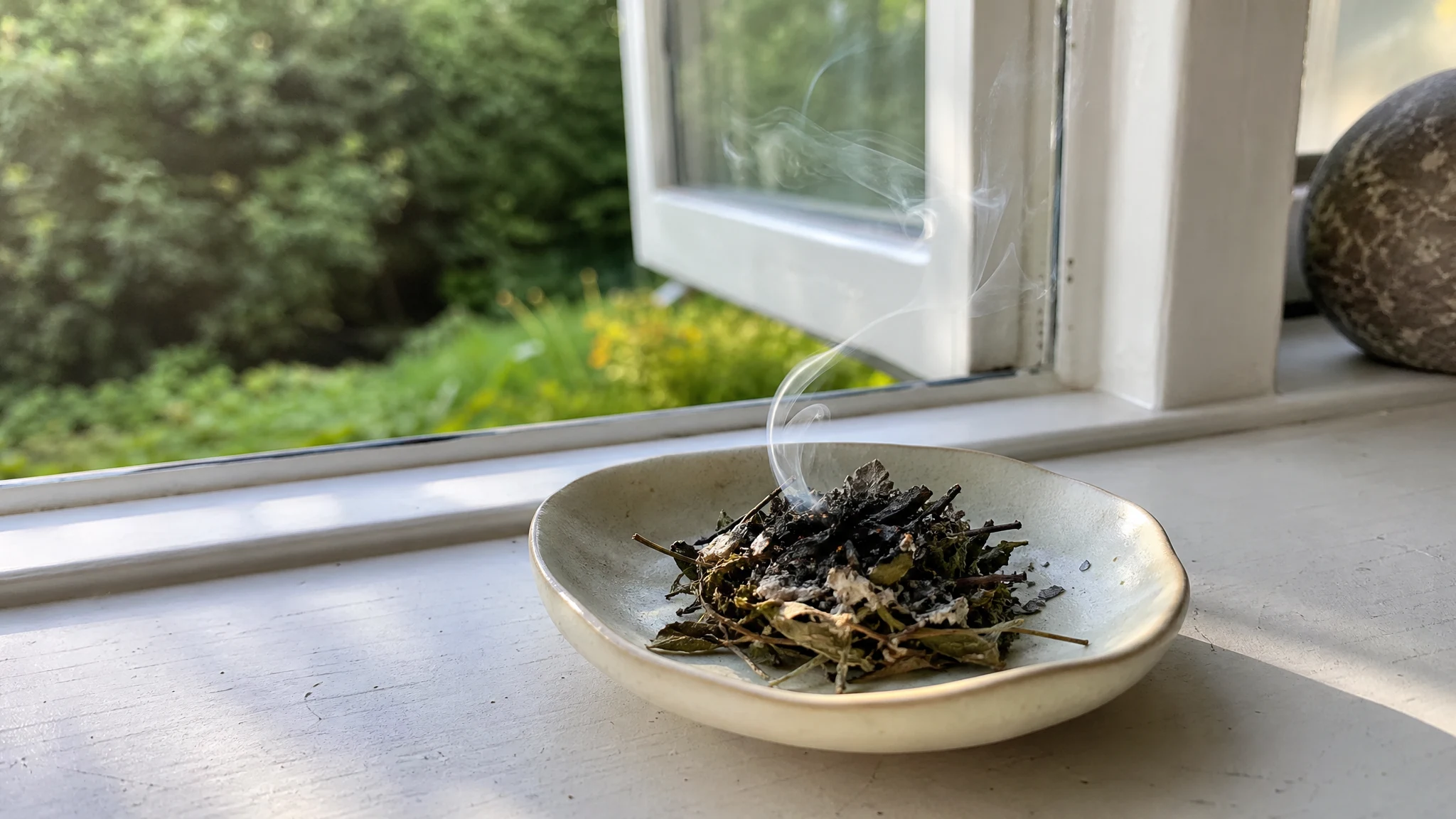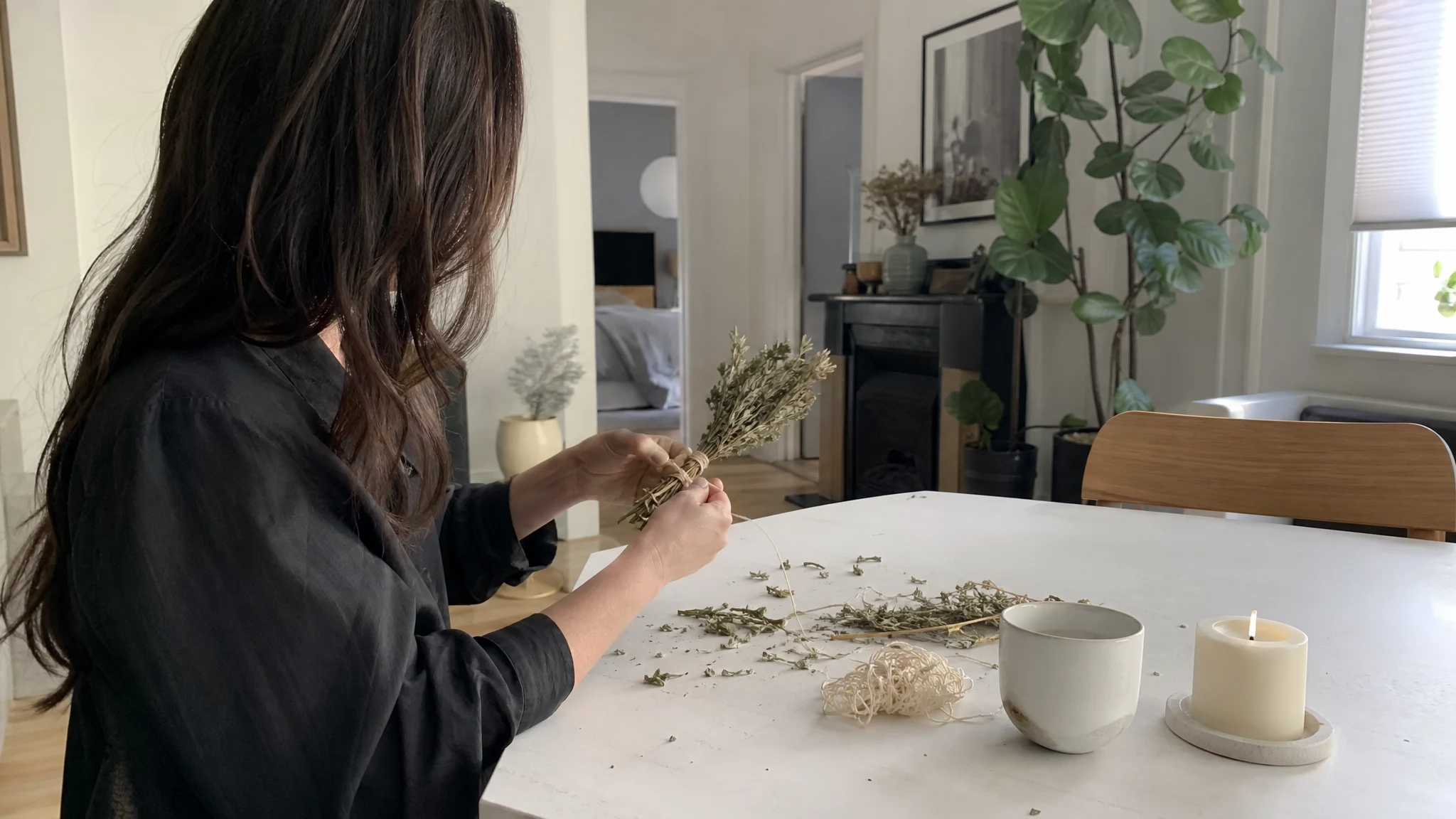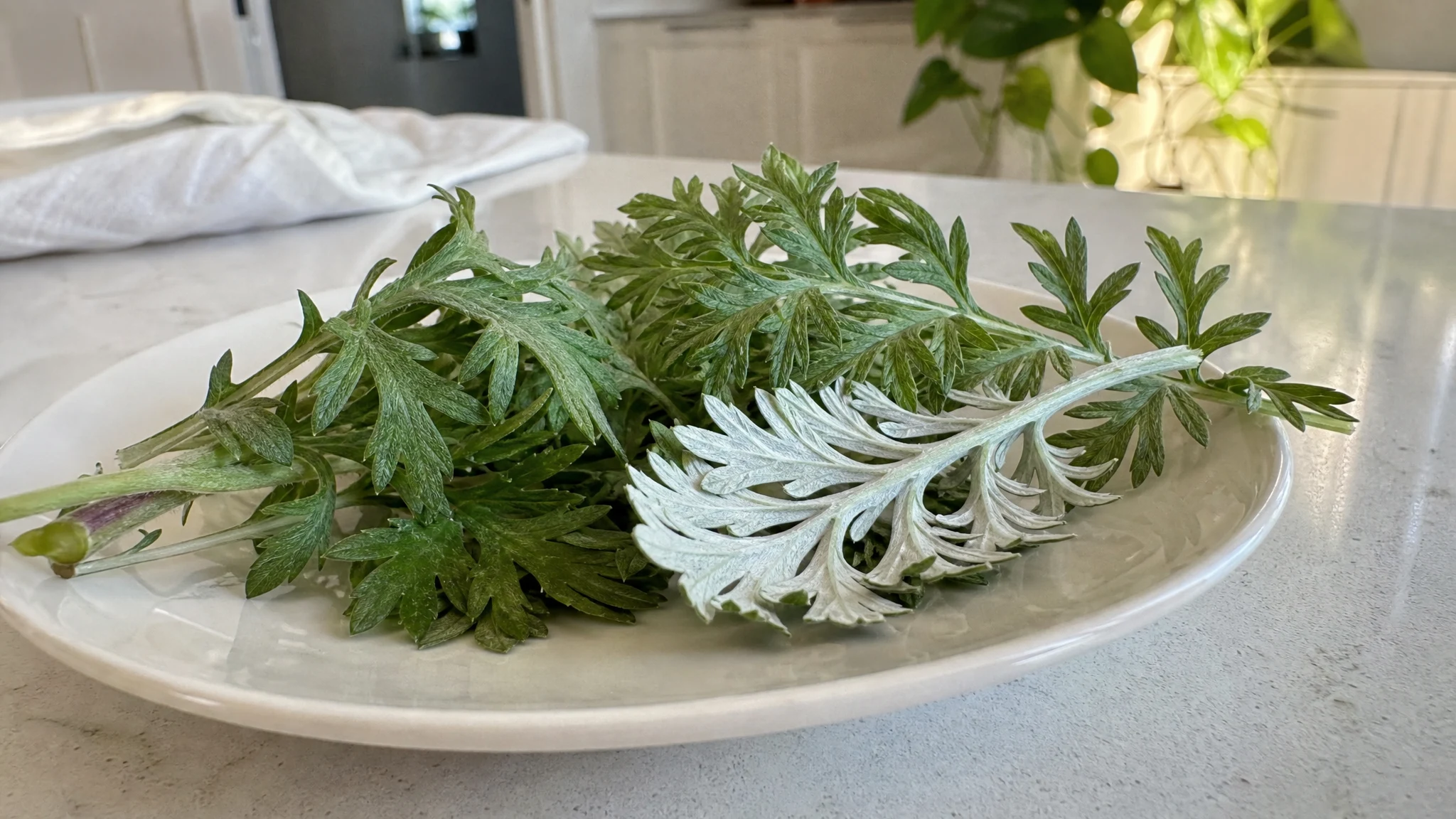
Mugwort in Fougère and Chypre: A Green Accent
A good fougère has a green, slightly bitter bite hiding behind the lavender, and a good chypre has a shadow of the same under its bergamot. Mugwort oil, with its green, bitter, camphoraceous character, sits right in that territory. We found no historical source placing mugwort in either classic, so what follows is our own idea of where it could go, built on the structure of the two families and the arithmetic of a very small dose.

Mugwort Essential Oil
Our own Mugwort Essential Oil, in sizes from 0.5 oz to bulk.
From $16.99
Shop Now →Two families, two frames
A fougère, the name coming from the French for fern, is built on lavender, oakmoss and coumarin, with the scent of new-mown hay in the base. The aromatic fougère adds herbs, spice or wood, and common extras include vetiver, geranium and bergamot (Fougère on Wikipedia). The family takes its name from Houbigant's Fougère Royale of 1882.
A chypre is a different frame: citrus on top, a middle centred on labdanum, and a mossy base from oakmoss. The pattern goes back to Coty's Chypre of 1917, built on a bergamot, labdanum and oakmoss accord (Chypre on Wikipedia). We use these as general descriptions of the families; for a recipe, you would want a perfumer's own formulas.
Mugwort belongs in the herbal layer of the first and as a bitter bridge between citrus and moss in the second. Our shop lists it as a middle note, which fits that placement. Our note-position article explains why that placement is not fixed.
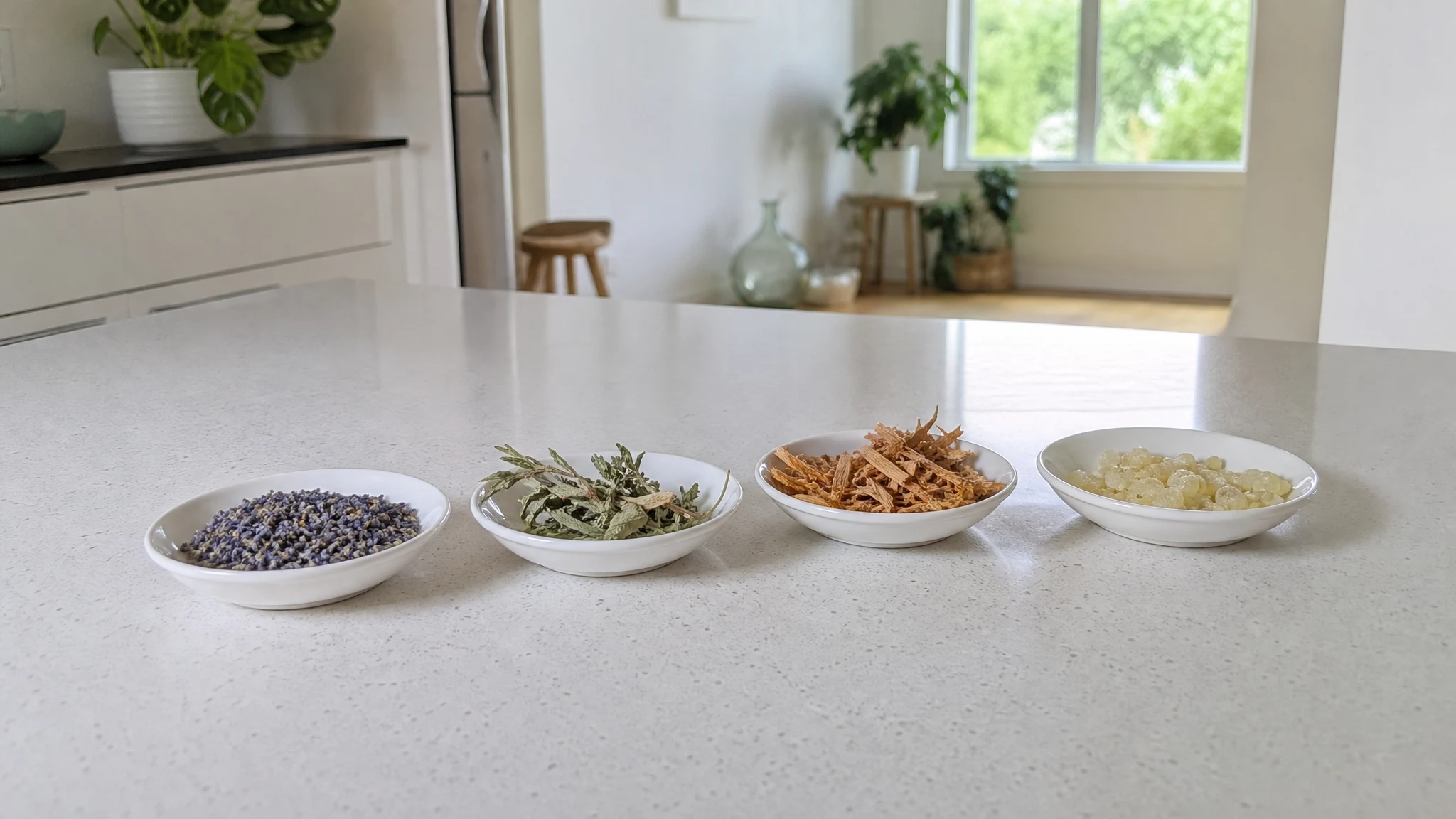
If you are new to these families, the quickest way to understand them is to smell their ingredients one at a time. Dip separate strips in lavender, bergamot and cedarwood, and smell them in a row before you try them together. You will start to feel why a fougère reads as clean and herbal, while a chypre feels shadowy and elegant. Mugwort goes in at the end, as the last small tweak.
The moss ceiling
Here is something that shapes any modern chypre. IFRA caps oakmoss extracts at 0.10% of a finished fine fragrance (Category 4), so the classic mossy base is limited to a small fraction of the formula (IFRA Standards, 51st Amendment). Perfumers work around it with other woods, resins and mossy accords. It is also the reason a bitter green material like mugwort is interesting: it can add depth without needing much room. Oakmoss, lavender, labdanum and the rest come from a perfumery supplier, as we sell the mugwort oil only. Ask them for each material's IFRA certificate.
How little mugwort is enough
For perfume, one drop is already a lot. At about 20 drops to the millilitre (a rough convention, and droppers vary), a drop is roughly 0.05 ml. Our Certificate of Analysis for one batch lists a relative density of 0.895, so a drop weighs about 0.045 g. In a 10 g concentrate that is about 0.45%, and if the concentrate is 15% of the finished perfume (our assumption; no standard sets it), the mugwort comes to roughly 0.067% of what you wear. A scale reading to 0.01 g cannot weigh one drop, so make a 10% dilution by weight in the same alcohol and weigh about 0.45 g of it.
IFRA also restricts thujone, with a cap of 1.4% in the finished product for fine fragrance (IFRA Standards, 51st Amendment). The most oil a perfume can carry is the cap divided by the oil's thujone share. As stand-ins, a Chinese leaf oil at about 9.9% thujone (Guan et al., 2019) would allow up to 14% oil in the finished perfume, and a cultivar at about 59% (Ming et al., 2025) would allow about 2.4%. A single-drop accent at 0.067% is well inside either figure. It is arithmetic on stand-ins, not a figure for our oil, and it shows that a mugwort accent is a small enough dose to leave room for everything else.
On skin, our shop guidance is to dilute to 0.5% to 2% in a carrier and to start at the low end. The accent dose sits below the bottom of that range. If you want to go beyond an accent, ask us in writing for GC-MS or thujone data through our contact page before ordering, and rely on the reply once you have it in writing. Our shop guidance is to avoid mugwort oil in pregnancy and to keep it away from children and pets, and a perfume is worn close to the face, so we would suggest a patch of diluted perfume on the forearm first.
Trying it
Give your trial a few days to rest in a sealed bottle, away from light, before you judge it. Fresh blends can smell sharper than they will once the oils have mingled. Take notes on the opening, on the heart after about twenty minutes, and on what is left after a few hours. The notes will tell you whether the green accent is doing something or whether it has simply been lost.
Our suggestion, not a tested method: weigh a small 10 g batch instead of 100 g, smell the accented version on a strip against a control without it, and look at both after an hour and again after a day. If you can pick out the mugwort straight away, it is more than an accent. For more on the oil itself in perfumery, see the armoise article and green and herbal oils for natural perfume, and for a gentler format, our solid perfume article.
A good habit with an accent oil is to write down not only what you used but what you left out. When a blend finally works, you will want to repeat it, and a clear record of weights and the order you mixed in saves a lot of guesswork.
The best compliment for a mugwort accent is a friend who says your perfume smells deeper and cannot say why.
Mugwort Essential Oil
Mugwort Essential Oil from our own shop, in sizes from 0.5 oz to bulk.
From $16.99
Shop Now →Sources & Further Reading
- Wikipedia. Fougère. en.wikipedia.org/wiki/Fougère
- Wikipedia. Chypre. en.wikipedia.org/wiki/Chypre
- IFRA, 2024. The complete IFRA Standards, up to and including the 51st Amendment, Oakmoss extracts (Amendment 49) and Thujone (Amendment 49). IFRA Standards PDF
- Guan X et al., 2019. Chemical Composition and Antimicrobial Activities of Artemisia argyi Lévl. et Vant Essential Oils Extracted by Simultaneous Distillation-Extraction, Subcritical Extraction and Hydrodistillation. Molecules. PMC6384757
- Ming J et al., 2025. Effects of drying methods on phenolic acids, flavonoids, and essential oils in three cultivars of Artemisia Argyi. Food Chemistry: X. PMC12721075