Mugwort in Folk Magic: Herb Against Witches
Ask someone who knows a little herb lore and they will tell you mugwort is a witch's plant. Read the old sources, though, and a different picture comes up: again and again, mugwort is the herb people hung over the door to keep witches, ghosts and bad luck out. It was a protector first, and a tired traveller's companion before that.

Mugwort Essential Oil
Our own Mugwort Essential Oil, in sizes from 0.5 oz to bulk.
From $16.99
Shop Now →Pliny and the tired traveller
The oldest line we found is in Pliny the Elder's Natural History. In the Bostock and Riley translation, he writes that the traveller who carries artemisia on his person will never feel lassitude, “it is said” (Book XXVI, chapter 89). That qualifier is Pliny's own; he is passing along a belief, not vouching for it. His separate chapter on artemisia says the plant took its name either from Queen Artemisia, wife of King Mausolus, or from the goddess Artemis (Book XXV, chapter 36). Even here, “artemisia” may not mean the plant we now call common mugwort, since the translators' notes tie the varieties to several different species.
Anglo-Saxon charms
The belief travelled well. Oswald Cockayne's collection of early English texts prints three passages worth setting side by side (Leechdoms, Wortcunning, and Starcraft of Early England).
- An Old English herbal says that anyone planning a journey should carry the plant in hand and will not feel much toil. It adds that the plant puts “devil sickness” to flight and, kept in the house, “turneth away the evil eyes of evil men.”
- Bald's Leechbook gives a travelling charm. Take mugwort in hand or put it in your shoe, pick it before sunrise, say “I will take thee, artemisia, lest I be weary on the way,” and sign it with the cross.
- The Nine Herbs Charm, from the Lacnunga manuscript, speaks to mugwort first: “Have a mind, mugwort, / What thou mentionedst ... Una thou hightest / Eldest of worts: / Thou hast might for three / And against thirty.”
Notice the mix of registers. The Leechbook charm is Christian in form, with a spoken formula, a time of day and a cross. These were medical and magical texts at once, and they are best read as a window into how people thought, not as instructions.
Village customs, collected later
The richest set of mugwort customs comes from James Frazer's The Golden Bough, which gathers European folk practice written down mostly in the nineteenth century (third edition, volume 11). On St John's Eve or Day, people in parts of France and Germany gathered it and wore it as a girdle, which gave it the name St John's girdle in Germany and Bohemia. In Bohemia such girdles were believed to protect the wearer for the whole year against ghosts, magic, misfortune and sickness. A bewitched cow that would give no milk could be washed three times with a decoction gathered on St John's Day to break the spell. In Normandy, stalks of mugwort were said to keep witches from laying spells on the butter, on the Isle of Man it was gathered at Midsummer Eve as a preventive against witchcraft, and in Belgium bunches hung on stable and house doors were believed to bring good luck and protect against sorcery. You can find more of those customs in our St John's Eve article.
Frazer also quotes an old Chinese calendar for the fifth day of the fifth month, when people made dolls of mugwort and hung them over gates and doors to expel poisonous airs. He notes the Ainu using bunches of it in exorcisms because demons of disease were thought to dislike its smell and taste. The picture across continents is consistent: mugwort stood at the threshold.
Reading old charms with a light touch
There is a particular pleasure in reading an old charm out loud. The rhythm of the Nine Herbs verse carries you along, and the little instructions, such as picking the plant before sunrise or slipping it into a shoe, make you smile at how practical the old world was about its magic. We think the best way to enjoy these texts is to read slowly, notice the details, and keep a notebook of the lines that stay with you.
So is it a witch's herb?
In the pre-modern sources we read, the answer leans no: they describe it used against witchcraft, not by witches. How modern pagan witchcraft came to adopt it is a question for specialist historians, and we would not want to tell that story without them. What the record does support is that mugwort has been a herb of protection, travel and midsummer for a very long time, and that the stories are good.
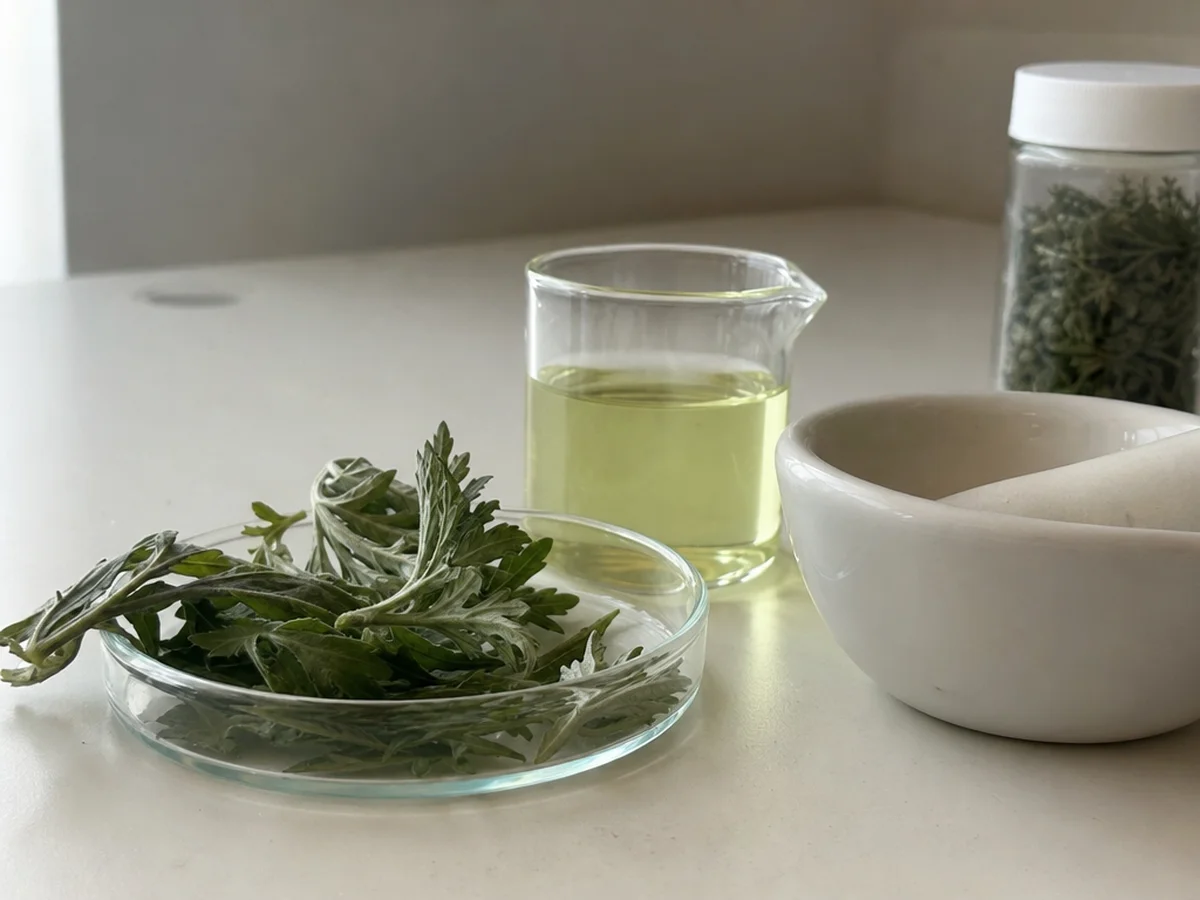
If you want to bring some of that tradition into your own craft, we think it works best when you name your source and treat it as the folklore it is. These are stories people told, not claims about what our oil does. We sell a cosmetic oil for fragrance craft, and our shop lists ritual and seasonal candles among its uses. Our ritual candle article covers that as a craft, the sachet article covers the dream pillow tradition, and the plant guide will help you recognise the herb itself.
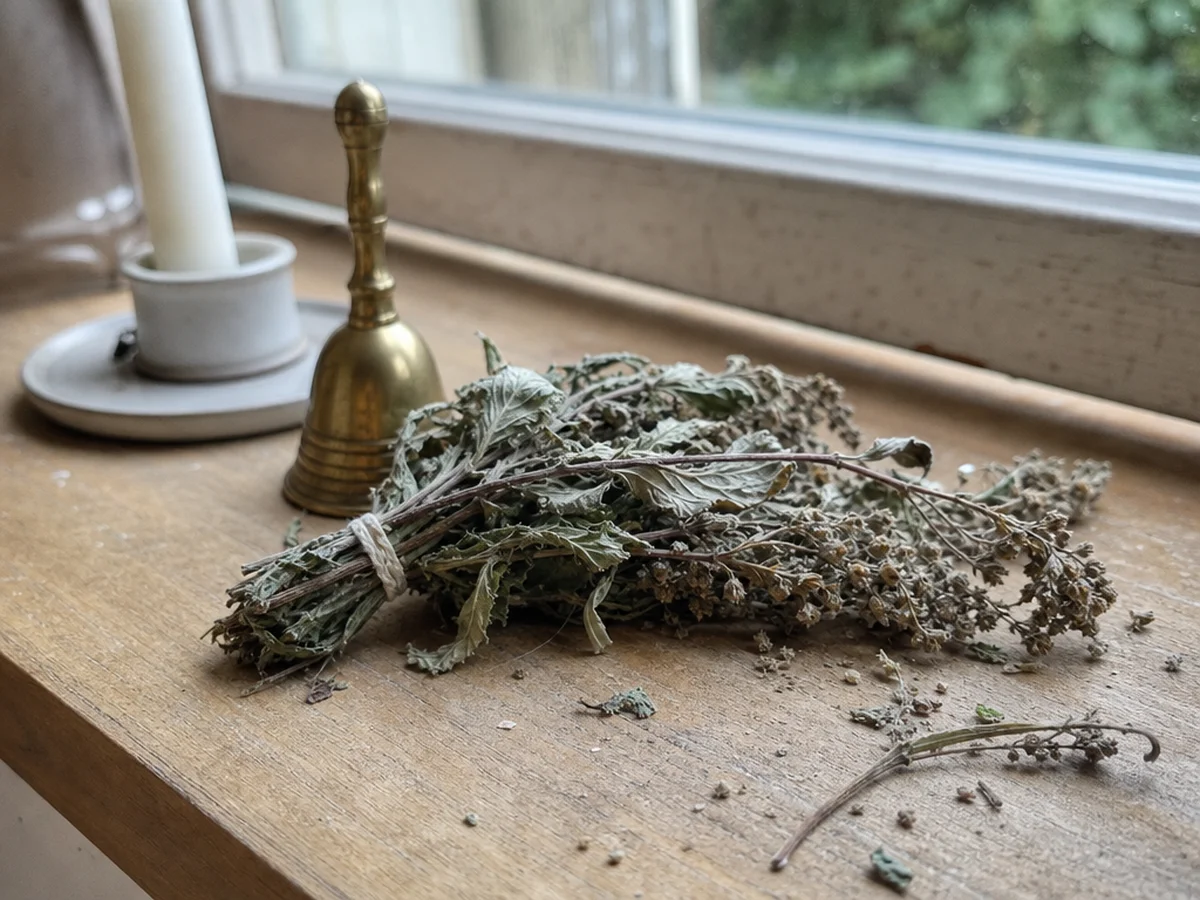
If you want to bring a little of this into your home as a craft, a small bundle of dried mugwort tied with string and hung by a door is the plainest version. It asks nothing of you, it smells green and a little bitter as it dries, and it looks handsome. That is all the tradition needs, and it is a warm, simple way to feel connected to the people who did it first.
Whether or not you believe a word of it, a bundle of mugwort on the door has a long and rather lovely history.
Mugwort Essential Oil
Mugwort Essential Oil from our own shop, in sizes from 0.5 oz to bulk.
From $16.99
Shop Now →Sources & Further Reading
- Pliny the Elder. The Natural History, Book XXVI, chapter 89, translated by John Bostock and H. T. Riley (London, 1855). Perseus Digital Library. perseus.tufts.edu
- Pliny the Elder. The Natural History, Book XXV, chapter 36: Artemisia, Parthenis, Botrys, or Ambrosia: Five Remedies. Perseus Digital Library. perseus.tufts.edu
- Cockayne O (ed.), 1864 to 1866. Leechdoms, Wortcunning, and Starcraft of Early England: Being a Collection of Documents, for the Most Part Never Before Printed, Illustrating the History of Science in This Country Before the Norman Conquest, volumes 1 to 3. archive.org
- Frazer JG, 1913. The Golden Bough: A Study in Magic and Religion (Third Edition, Vol. 11 of 12). Project Gutenberg. gutenberg.org