How to Make a Mugwort Dream Pillow or Sachet
Mugwort and pillows have been linked for a very long time, and the dream pillow is the form that survives in craft circles: a small cloth bag of dried herb, tucked near where you sleep. It is a pretty, fragrant thing to make. What it cannot honestly promise is any effect on dreams, so we treat it as a scented keepsake with a good story.

Mugwort Essential Oil
Our own Mugwort Essential Oil, in sizes from 0.5 oz to bulk.
From $16.99
Shop Now →Sachet or pillow? Decide first
The sewing is the same for both: a breathable cloth shell and a dried-herb fill. The exposure is not. A sachet lives in a drawer or closet and is smelled from arm's length, while a pillow is pressed against your face for hours. That difference drives every choice below. We sell one mugwort essential oil and no dried herb or sewing supplies, so the herb comes from an herb shop and the cloth from a fabric shop.
What the dream research actually says
A 2024 narrative review of substances proposed for inducing lucid dreams mentions mugwort as a common herb said to intensify dreams, and suggests monoamine oxidase inhibition and REM rebound as possible explanations. It gives no trial details for mugwort and frames the idea as a hypothesis. The authors also note how few studies exist on plants in this area (Oldoni et al., 2024). So the tradition is lovely and the evidence is thin. If sleep or dreams trouble you, a physician is the right person to ask. Our folk magic source history covers where the pillow tradition comes from.
Sewing the shell
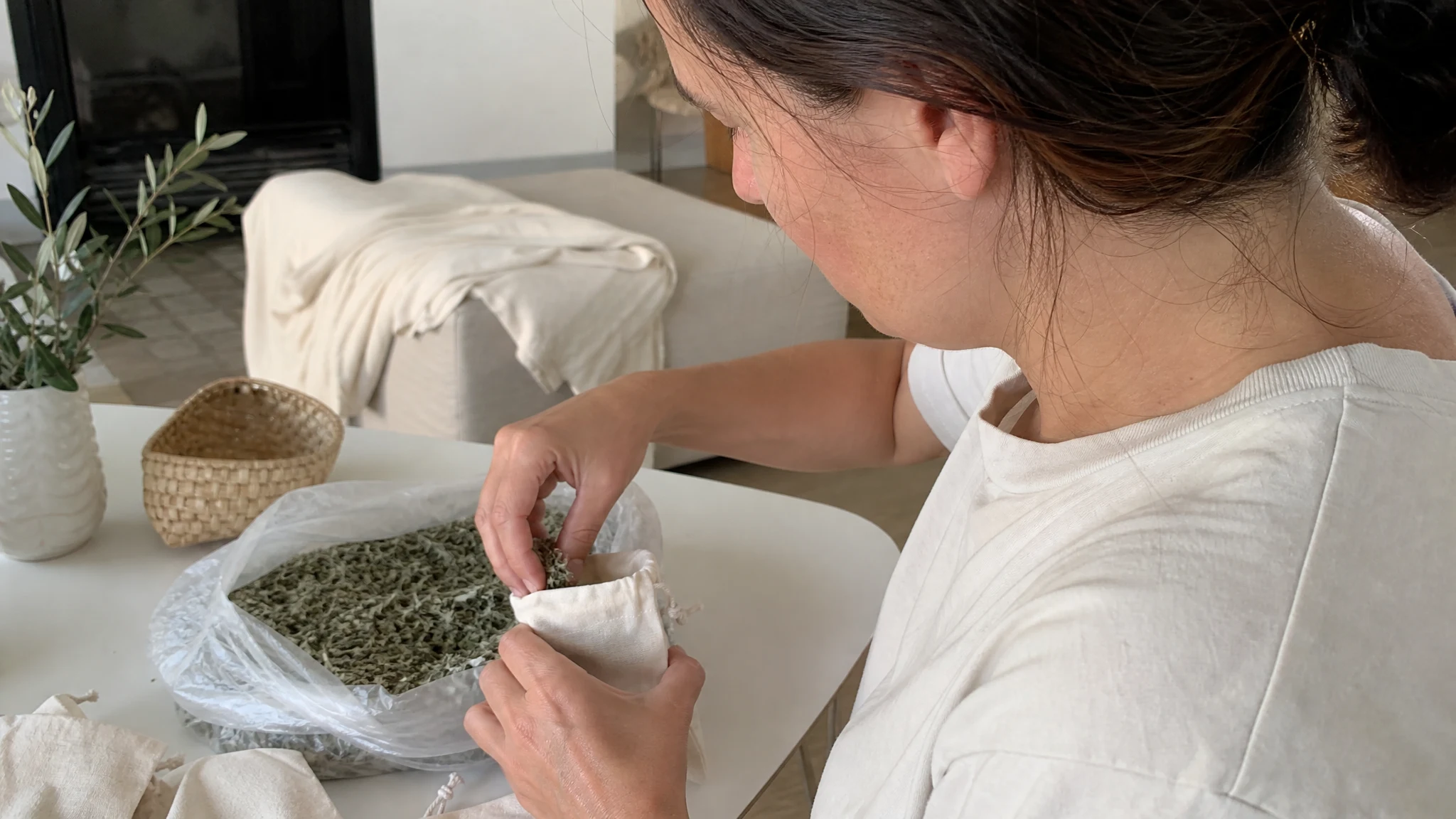
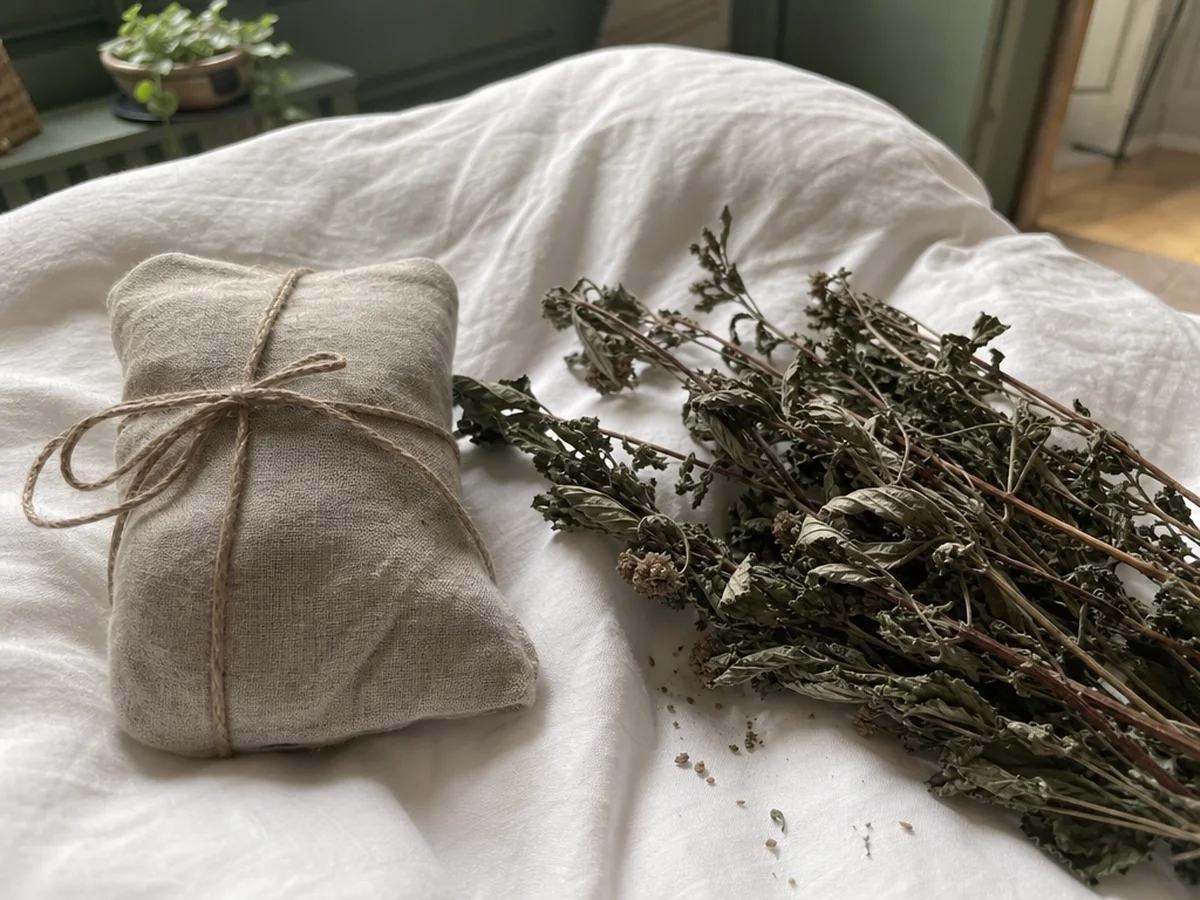
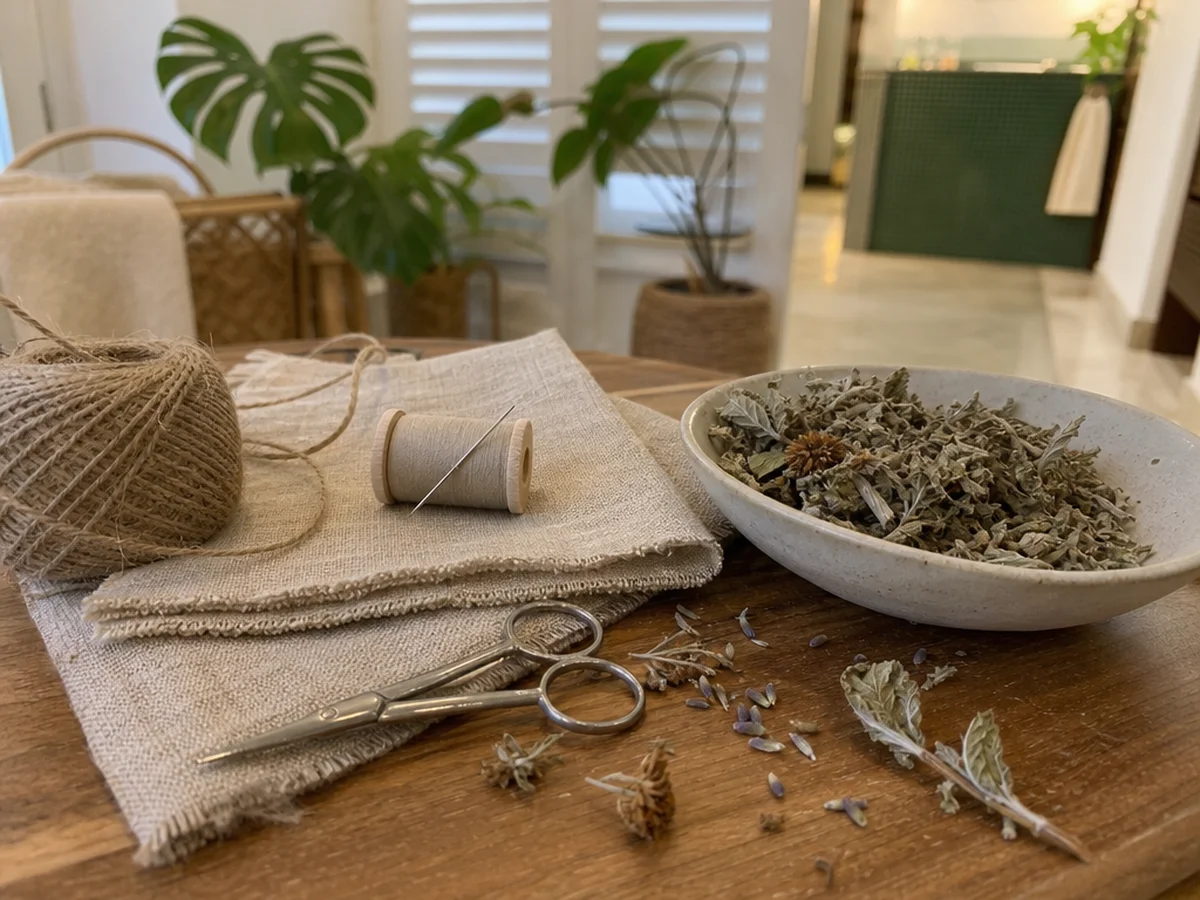
Choose a cotton or linen that is tightly woven enough to hold fine herb dust but soft enough to let the scent through. A pillowcase-style envelope closed with a few hand stitches is the easiest shape, and a rectangle about the size of your palm makes a pleasant sachet. Wash and dry the fabric first, so it does not shrink around the filling. Sew the three sides, turn it right side out, and press the seams flat with an iron before you fill it. A paper funnel makes the filling tidy, and a small spoon helps you pack the corners evenly.
Dry the herb properly
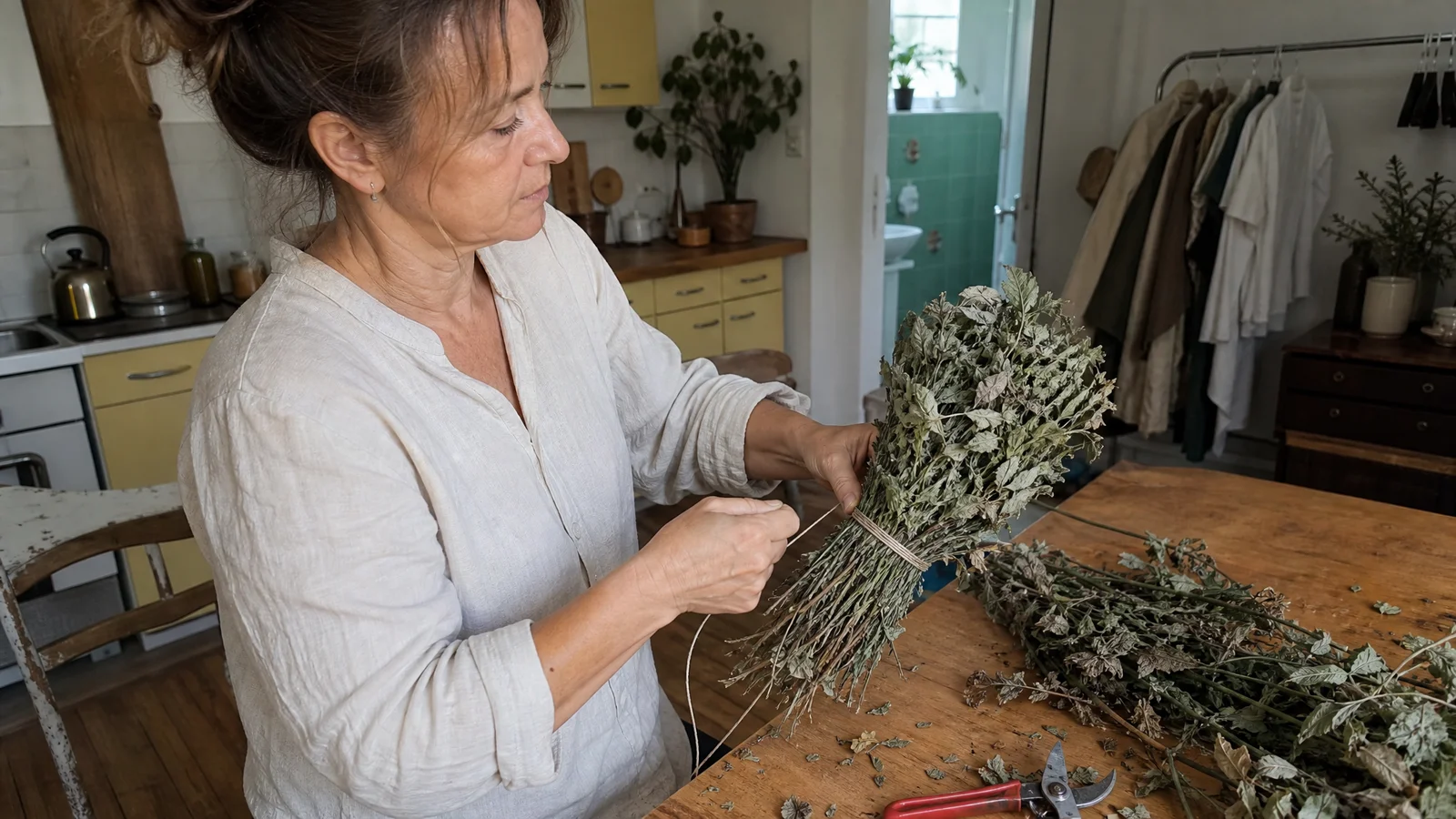
If you grow or gather your own mugwort, drying is where sachets succeed or fail. The National Center for Home Food Preservation says sturdy herbs air dry well in small tied bundles, that tender herbs and large bunches "will mold if not dried quickly", and that herbs are done when they crumble and the stems snap. Its dehydrator guidance is roughly 95 to 115 F for 1 to 4 hours (Herbs, National Center for Home Food Preservation). That page covers culinary herbs, so use the snap-and-crumble test rather than a clock. Anything limp sewn into a shell can mold inside it, and you will smell it before you see it.
Handling matters too. Mugwort pollen is a well-known allergen, and skin contact with some Artemisia species has been linked to dermatitis, which a review attributes to sesquiterpene lactones (Sharifi-Rad et al., 2022). A tightly woven inner liner and a pillowcase over the top keep the herb off skin. Our allergy article separates the problems that share the name.
Does the oil belong in it?
The dried herb has its own green, slightly bitter aroma, so the oil is optional. If you want a little extra, we like it as an accent: we suggest a drop or two as a fragrance accent, and a sachet is a natural home for that. IFRA, the fragrance industry's standards body, caps thujone at 9.5% of a finished Category 12 product, the category it uses for fragrancing sachets, and at 0.095% for Category 5A, body creams and oils (IFRA Standards, 51st Amendment). Those rules bind fragrance suppliers, not hobbyists, so treat them as benchmarks.
A drawer sachet fits Category 12 comfortably. A pillow your face rests on does not obviously fit it, and our own reasoning, not an IFRA ruling, is to use the stricter figure for a pillow or leave the oil out. The cap is on thujone, so what it allows depends on the thujone share of the oil. Using the 0.895 relative density from the batch on our published certificate of analysis and about 20 drops per ml, here is the arithmetic per 100 g of dry fill:
| Oil per 100 g fill | Weight | About how many drops | Oil thujone share that stays under the 0.095% cap |
|---|---|---|---|
| 0.25% | 0.25 g | 6 | up to 38% |
| 0.5% | 0.5 g | 11 | up to 19% |
| 1.0% | 1.0 g | 22 | up to 9.5% |
For scale, one published hydrodistilled mugwort leaf oil had about 10% thujones combined, while a Brazilian oil of the other common species listed none (Guan et al., 2019; Malik et al., 2019). We publish no thujone figure for our oil. If you want one, ask us in writing through our contact page and get the answer in writing first. Weigh the oil if you can, since droppers vary, and the same arithmetic applies to our potpourri article.
Once filled, give the sachet a gentle squeeze and notice the soft, dry rustle and the green, slightly bitter scent that rises with each press. A sachet keeps best in a drawer, or tucked into a linen cupboard, and you will find it needs a squeeze now and then to wake the aroma. Keep a spare handful of dried herb in a jar so you can top it up later.
Who should skip it
Anyone pregnant or nursing should avoid mugwort oil, and the European Medicines Agency's herbal committee notes that no studies allow a reliable assessment of thujone-containing products for pregnant women or children, advising that use there be minimised (EMA public statement on thujone, 2012). Its statement concerns swallowed products, so we cite it for the gap in knowledge. Keep sachets away from children and pets, and ask a physician about seizure history or any daisy-family allergy.
Sewn well and dried properly, a mugwort sachet is a simple pleasure: a handful of herb with a long history and a scent that is entirely its own.
Mugwort Essential Oil
Mugwort Essential Oil from our own shop, in sizes from 0.5 oz to bulk.
From $16.99
Shop Now →Sources & Further Reading
- Oldoni et al., 2024. Neuropsychopharmacological Induction of (Lucid) Dreams: A Narrative Review. Brain Sci. PMC11119155
- National Center for Home Food Preservation. Herbs. nchfp.uga.edu
- Sharifi-Rad et al., 2022. Artemisia spp.: An Update on Its Chemical Composition, Pharmacological and Toxicological Profiles. Oxid Med Cell Longev. PMC9467740
- IFRA. IFRA Standards, 51st Amendment (Thujone). IFRA Standards PDF
- Guan et al., 2019. Chemical Composition and Antimicrobial Activities of Artemisia argyi Lévl. et Vant Essential Oils Extracted by Simultaneous Distillation-Extraction, Subcritical Extraction and Hydrodistillation. Molecules. PMC6384757
- Malik et al., 2019. Chemical Profile and Biological Activities of Essential Oil from Artemisia vulgaris L. Cultivated in Brazil. Pharmaceuticals. PMC6631396
- European Medicines Agency. Public statement on the use of herbal medicinal products containing thujone, EMA/HMPC/732886/2010 Rev. 1. ema.europa.eu