Loose Mugwort Incense: Frankincense Blends by Weight
Loose incense is the friendliest format for mugwort oil: no binder, no mould, no drying rack, just a jar of dried herb and resin that you warm on a burner. It is also the format that asks the most of your setting, because most loose incense is burned on charcoal. So we start with where, then move on to the blends.

Mugwort Essential Oil
Our own Mugwort Essential Oil, in sizes from 0.5 oz to bulk.
From $16.99
Shop Now →Decide where you will burn it
The US Consumer Product Safety Commission is blunt about charcoal. Its release says: "Never burn charcoal inside of homes, vehicles, tents, or campers", and "Charcoal should never be used indoors, even if ventilation is provided" (CPSC Warns - Never Use Charcoal Grills Indoors). That warning is about grills, and incense discs are small, but the carbon monoxide comes from the same chemistry. Our reading, and not a CPSC finding, is to burn charcoal-based loose incense outdoors on a porch or in a yard, in a heat-resistant dish. If that does not suit you, the cone route in our makko cone article avoids the disc, and a dry potpourri avoids burning altogether.
Smoke is the other consideration. A review of incense research reports that incense gives off more than 45 mg of particulates per gram burned, against 10 mg for cigarettes, and advises ventilating rooms (Incense smoke: clinical, structural and molecular effects on airway disease). It looked at commercial incense, not mugwort blends, but it is good reason to burn small amounts. Our indoor burning article has more.
Three blends, by weight
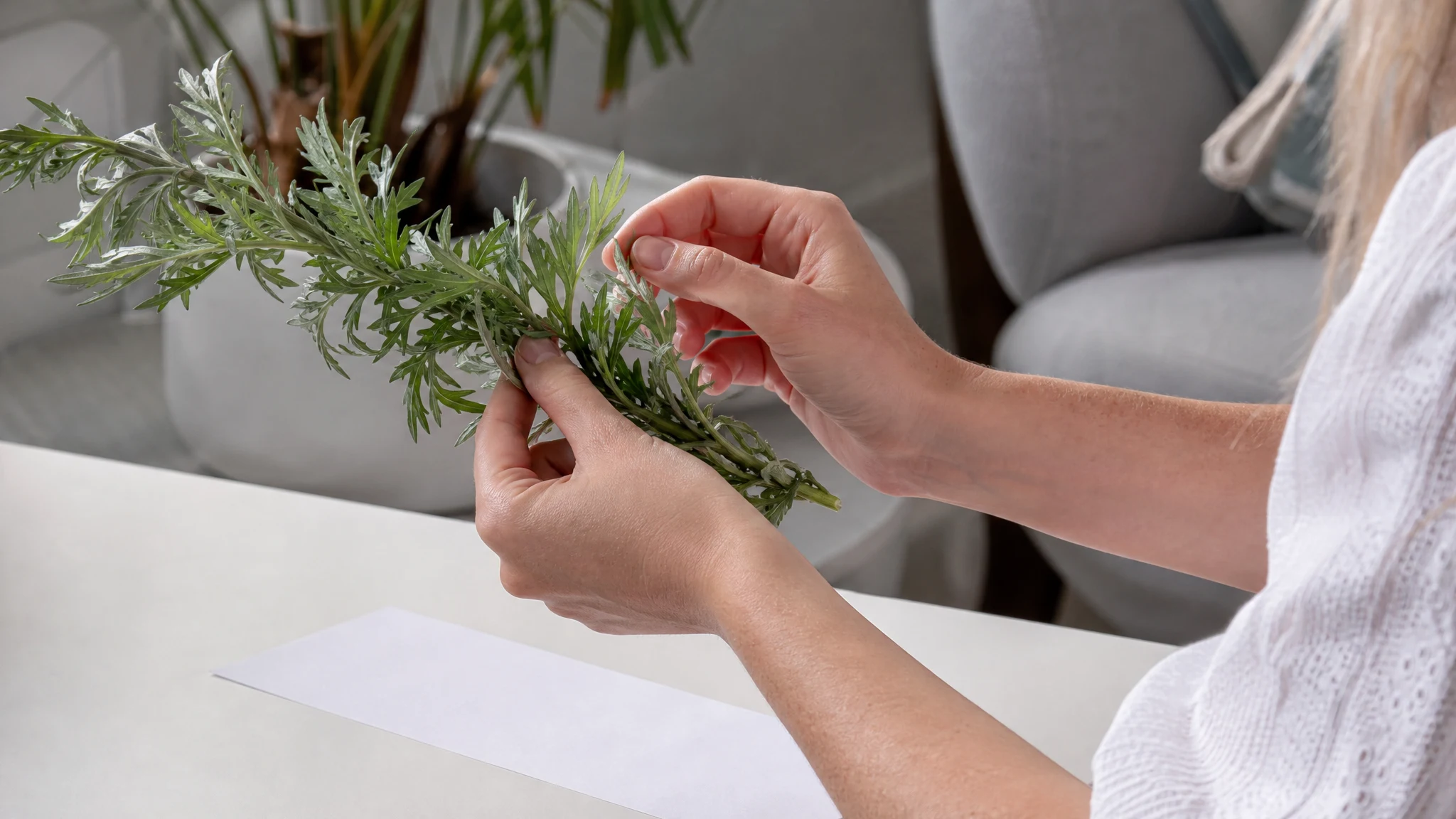
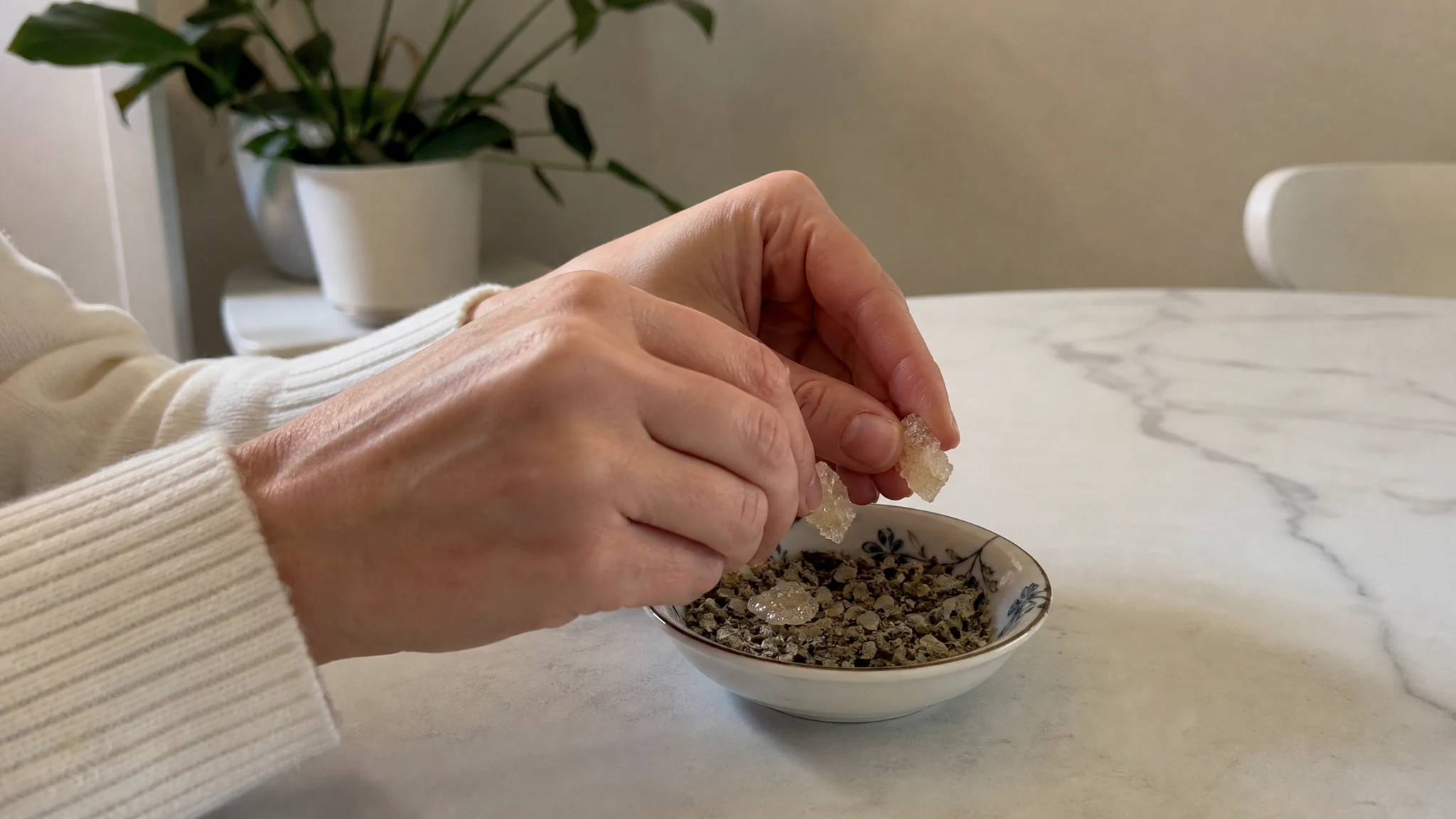
These are formulations worked out from the usual structure of loose incense: a resin base, a middle of dried herb, and sometimes a wood powder. Weigh rather than measure by cups, because resins and powders differ widely in density. Frankincense is the resin because we list it among the oils and materials that pair well with mugwort.
| Blend | Frankincense resin | Dried mugwort leaf | Wood powder |
|---|---|---|---|
| 1. Resin-forward (2 : 1) | 66.7 g | 33.3 g | none |
| 2. Herb-forward (1 : 3) | 25.0 g | 75.0 g | none |
| 3. Equal thirds | 33.3 g | 33.3 g | 33.3 g |
Figures are per 100 g, and a 20 g first batch (a fifth of each figure) is plenty. We do not sell frankincense, dried mugwort, wood powder or charcoal, so look to an incense or herb supplier, and ask each one for the plant species and whether anything was treated or scented. Frankincense is a tree resin that is not unlimited, so we would reach for blend 2 or 3 if you want to use less of it, and ask the supplier which species it is and how it was sourced.
The oil dose
We found no published oil share for loose incense, so these numbers are a starting suggestion. With the 0.895 relative density on the batch in our published certificate of analysis and about 20 drops per ml:
| Oil share of blend | Per 100 g | About how many drops | In a 20 g batch |
|---|---|---|---|
| 0.25% | 0.25 g | 6 | 0.05 g (about 1 drop) |
| 0.5% | 0.5 g | 11 | 0.10 g (about 2 drops) |
| 1% | 1.0 g | 22 | 0.20 g (about 4 drops) |
We would start at 0.25% and go up only if you cannot smell it from the burner. The aroma is green, bitter and camphoraceous, so under-dosing is the cheaper mistake. At 20 g the counts are tiny, so either weigh on a 0.01 g scale or make 100 g and split it. Add the oil to the herb and wood powder rather than the resin, since the powders absorb it while oiled resin chunks clump. That is reasoning rather than testing. Mix, fold in the resin, and rest the jar closed for a few days.
IFRA, the fragrance industry's standards body, places incense in Category 12 and caps thujone at 9.5% of the finished product (IFRA Standards, 51st Amendment). At 1% oil that cap is out of reach whatever the oil's thujone share. We publish no thujone figure and state no flash point, so a buyer who needs GC-MS data or the safety data sheet can ask us in writing through our contact page and get the answer in writing first.
What you will notice as it warms
Loose incense changes over a few minutes, so give each pinch time before you judge it. Expect the resin to give its sweeter, balsam-like warmth first, with the green, bitter edge of the dried herb coming up underneath as the blend heats. If mugwort is all you can smell, the blend wants more resin or a smaller share of oil. If you cannot find it at all, wait a little longer before adding more.
Keep a small notebook beside the jar. A line for each batch, with the grams of every ingredient, the date and a few words about the smell, is all it takes, and a month later it is the most useful thing on your bench.
The usual practice is a heat-resistant burner filled with sand or ash, a charcoal disc lit at the edge until it sparks and glows, then a small pinch of blend on top. Start with a very small amount, keep water nearby, let everything cool completely before disposing of the ash, and keep it away from anything that burns and out of reach of children and pets. Never leave it unattended.
Our safety copy says to avoid mugwort oil in pregnancy and not to take it internally. If you are pregnant or nursing, ask an obstetric clinician before burning anything at home. Ask a physician if anyone has asthma, and a veterinarian if you share your home with birds, cats or dogs (see our pets article). To choose partners for the oil, see the pairing guide, and for the plant alone, working with the dried plant.
Keep notes in grams, change one thing between batches, and the blend you like best will find you.
Mugwort Essential Oil
Mugwort Essential Oil from our own shop, in sizes from 0.5 oz to bulk.
From $16.99
Shop Now →Sources & Further Reading
- US Consumer Product Safety Commission, 1999. CPSC Warns - Never Use Charcoal Grills Indoors. cpsc.gov
- Lin, Krishnaswamy and Chi, 2008. Incense smoke: clinical, structural and molecular effects on airway disease. Clin Mol Allergy. PMC2377255
- IFRA. IFRA Standards, 51st Amendment (Thujone). IFRA Standards PDF