Mugwort Oil and Pets: A Cat, Dog and Bird Owner's Guide
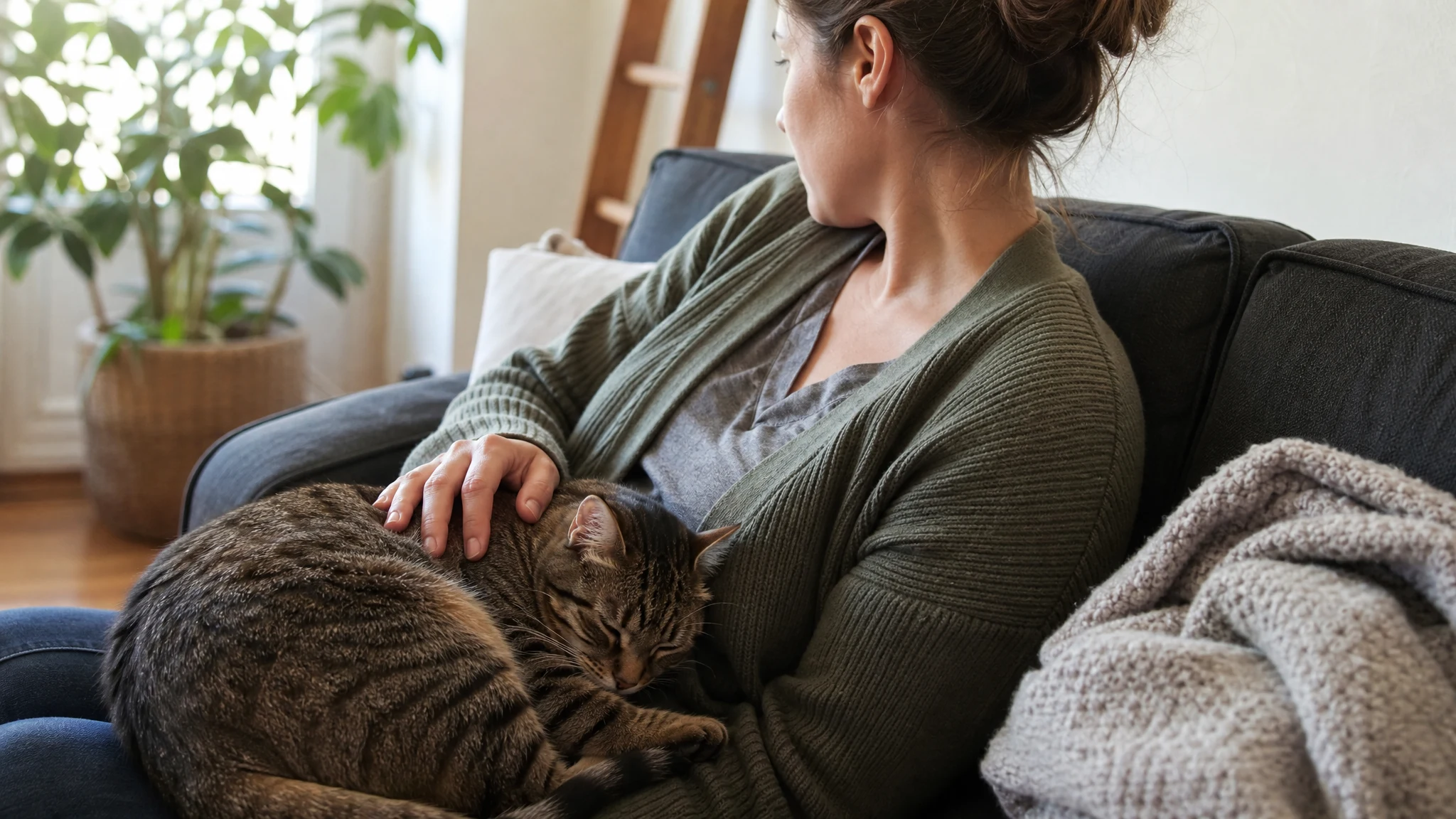
If your home has a cat, a dog or a bird in it, the simplest rule for mugwort oil is also the best one: keep the bottle capped and out of reach, and leave the diffuser out of it. That is our own guidance, and it matches what veterinary sources say about essential oils in general. Here is the thinking behind it, and what to do if an accident happens.

Mugwort Essential Oil
Our own Mugwort Essential Oil, in sizes from 0.5 oz to bulk.
From $16.99
Shop Now →Why animals need their own rules
Pets live closer to the floor, groom themselves constantly and have bodies that handle chemistry differently from ours. The Merck Veterinary Manual's page on essential oils lists dogs, cats and birds as animals at risk. It says concentrated oils should never be applied directly to pets, that absorption through skin is a major route, and that a cat's habit of grooming adds oral exposure on top. Birds, it adds, are highly sensitive because of their respiratory tracts (Toxicoses From Essential Oils in Animals - Toxicology - Merck Veterinary Manual). The ASPCA says it plainly: cats are especially sensitive to essential oils, and it would not recommend using any in areas pets can reach unless they are supervised or a veterinarian has approved it (Pet Poisons: Be Mindful of these Household Products and Cleaning Agents | ASPCA).
There is real biology behind the cat advice. Researchers found that the gene for a key detoxifying enzyme, UGT1A6, is switched off in every member of the cat family they sampled (Shrestha et al., 2011). The Merck manual links this to cats' sensitivity to phenols, which some oils contain. We want to be careful here: the main compounds discussed for mugwort oil, thujone, camphor and cineole, are not phenols, and none of the sources we read says how cats process them. So take the enzyme story as a reason for general caution, not a statement about our oil.
What we can and cannot say about mugwort oil specifically
We can say that no veterinary source we read gives a safe use level for mugwort oil in any animal, so we do not offer a number. We can also say that the oil is a concentrated botanical material, and that we advise keeping it away from children and pets and never using it internally. The Missouri Poison Center notes that mugwort oil contains varying amounts of compounds such as thujone, camphor and eucalyptol (Mugwort - Missouri Poison Center), and in a laboratory study alpha-thujone was toxic to mice (Höld et al., 2000). Neither is about pets, but together they explain why we would not experiment.
Where the real-world exposure happens
In a home where someone makes candles, incense or perfume, the realistic routes look like this:
- The diffuser. Merck notes that passive diffusers mainly irritate airways, while active ones, ultrasonic and nebulizing, put droplets into the air that settle on fur and feathers. We do not list diffusing among our uses (see can you diffuse mugwort oil).
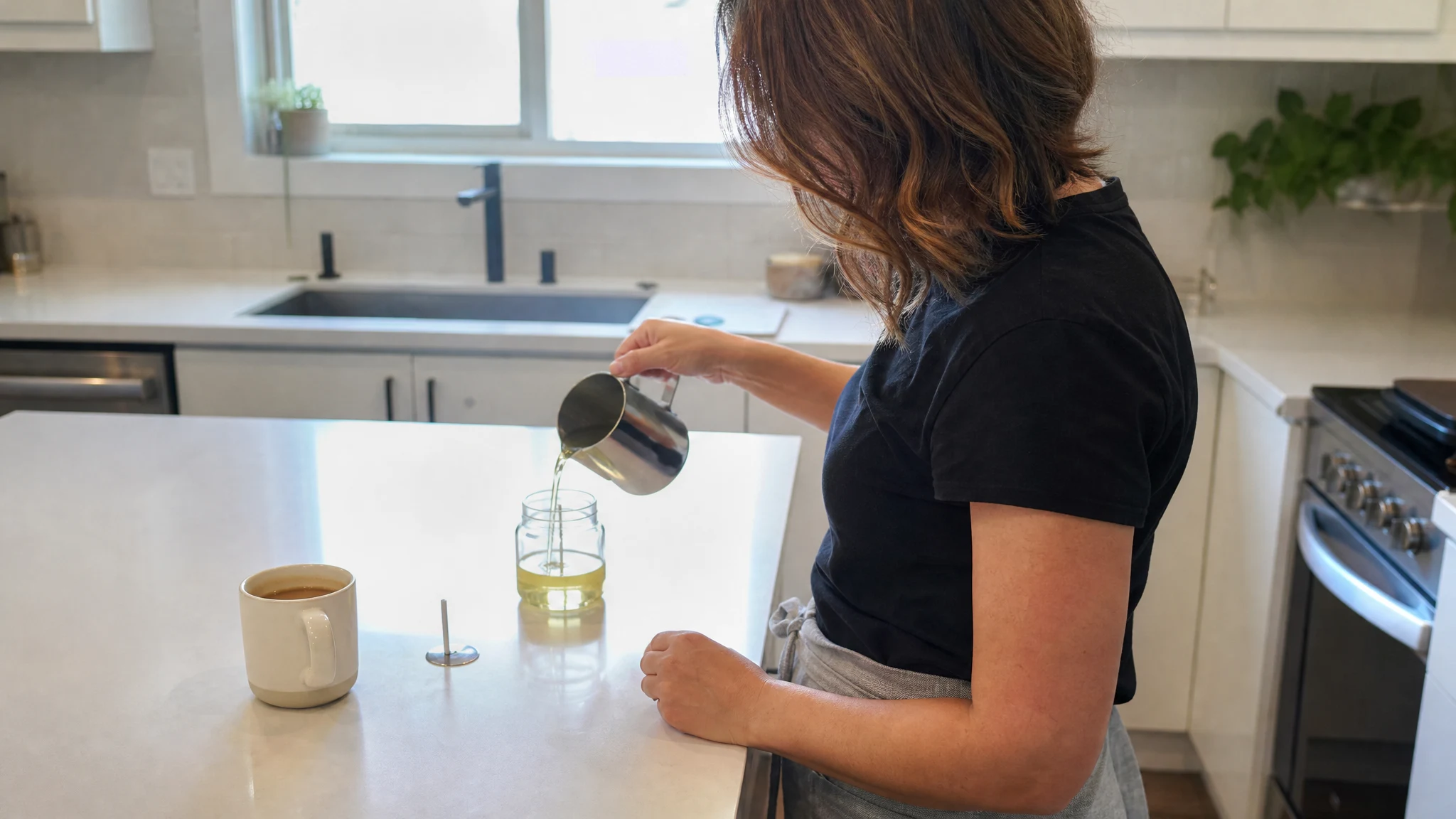
- Your hands and workbench. Oil on your skin or on a surface reaches a cat that sleeps on you or walks across the bench. Wash up and wipe down after you pour or blend.
- An open bottle or a dropper. A curious pet can knock one over in a second. Merck lists vomiting, lethargy, drooling and loss of coordination as the most common signs after swallowing or skin exposure.
- Smoke. Burning anything indoors adds particles to the air. We cover that in burning mugwort indoors.
Small animals deserve special mention. A published case report describes an 80 g cockatiel that became seriously unwell after three drops of tea tree oil were applied to its skin; it was hospitalized and recovered with care (Vetere et al., 2020). That was a different oil, and one case, but it shows how small an amount can matter to a small bird.
If something spills or gets swallowed
Call your veterinarian or an emergency clinic first, with the bottle and its label in your hand. Pet Poison Helpline lists a 24/7 line at (855) 764-7661 on its page (Essential Oils and Cats | Pet Poison Helpline); check whether a consultation fee applies. Merck advises against inducing vomiting because of the risk of aspiration, and says decontamination is by bathing and fresh air, so follow your veterinarian's instructions on that. If a person has been exposed, the US Poison Control line is 1-800-222-1222.
Small habits that do most of the work
- Put the cap back on the moment you have poured. Make it a reflex.
- Pour over a tray, so a knocked bottle ends up on something you can lift away.
- Wash your hands and wipe the bench before you let a cat or dog back into the room.
- Close the door while you work, and tell everyone in the house what is on the bench.
- Keep finished candles, sachets and potpourri out of an animal's reach as well.
A tidy shelf makes all of this easy. Keep the bottle tightly capped in a cool, dark cupboard with a latch, decant only what you need for a project, and work with the door closed. Our storage guide has more, and the safety article covers handling for people.
We sell our oil as an external cosmetic material for people who make things, not as a product for animals, and a question about a pet's skin, behavior or health belongs with a veterinarian. For crafts at home with animals around, a closed cupboard and a wiped-down bench do most of the work.
Mugwort Essential Oil
Mugwort Essential Oil from our own shop, in sizes from 0.5 oz to bulk.
From $16.99
Shop Now →Sources & Further Reading
- Toxicoses From Essential Oils in Animals - Toxicology - Merck Veterinary Manual. merckvetmanual.com
- Pet Poisons: Be Mindful of these Household Products and Cleaning Agents | ASPCA. aspca.org
- Essential Oils and Cats | Pet Poison Helpline. petpoisonhelpline.com
- Shrestha B, et al. 2011. Evolution of a major drug metabolizing enzyme defect in the domestic cat and other felidae: phylogenetic timing and the role of hypercarnivory. PMC3065456
- Vetere A, et al. 2020. Acute tea tree oil intoxication in a pet cockatiel (Nymphicus hollandicus): a case report. PMC6995176
- Mugwort - Missouri Poison Center. missouripoisoncenter.org
- Höld KM, et al. 2000. Alpha-thujone (the active component of absinthe): gamma-aminobutyric acid type A receptor modulation and metabolic detoxification. PMC18101