Mugwort Oil and Thujone: Why We Keep Dilutions Low
Our guidance for mugwort oil on skin is 0.5% to 2% in a carrier oil, with a patch test first, and we say to avoid it during pregnancy. We also start at the bottom of that range, and the reason is a compound called thujone. This is how it works, what the published limits say, and why we never describe 2% as a safe amount.

Mugwort Essential Oil
Our own Mugwort Essential Oil, in sizes from 0.5 oz to bulk.
From $16.99
Shop Now →Who should step aside
Skip mugwort oil on skin and in a diffuser, and ask the right professional first, if you are pregnant or nursing, have a seizure disorder, or are making something for a child. We say to keep it away from eyes, children and pets, and not to take it internally. The European Medicines Agency's herbal committee found no studies that allow a reliable assessment of thujone exposure in sensitive groups such as pregnant women and children, and said use there should be minimised. A review of edible Artemisia species also lists A. vulgaris among the plants to avoid in pregnancy. An obstetrician or midwife is the person to ask for pregnancy, a neurologist for a seizure disorder and a pediatrician for a child.
Why thujone is the number that matters
Thujone acts on the nervous system. In a 2000 study, researchers showed that alpha-thujone dampens the signals of a key inhibitory receptor in rat nerve cells and in mouse brain membranes, and that in mice, injected doses produced convulsions. Beta-thujone was weaker and less toxic. That was a laboratory study on animals and cells, so it explains why the compound is regulated, not what a diluted oil does on skin. The EMA statement also reports serious poisonings in people after swallowing thujone-rich essential oil, which is one reason our oil is for external fragrance use only.
How much thujone a mugwort oil carries varies. One published analysis of an Artemisia argyi leaf oil from Qichun, China found about 9.9 percent thujones combined, and the same paper showed the figures moved a lot with the extraction method. The Certificate of Analysis we publish for one batch lists density, refractive index and optical rotation, not constituents, so we cannot give you a thujone figure for our oil. If you need one, or a GC-MS report, ask in writing through the contact page and get the answer in writing before relying on it. Our composition article compares what published analyses report.
Putting our range beside the published ceilings
IFRA's thujone standard sets a maximum for thujone in the finished product by category: 0.095 percent for body creams, oils and lotions, 0.11 for lip products, 0.13 for rinse-off products such as soap and face cleanser and 0.032 for make-up remover for face and eyes. The cap is on thujone, so the oil percentage that fits depends on the oil.
Try the illustrative 9.9 percent oil in a body oil. At 0.5 percent it contributes about 0.05 percent thujone, under the 0.095 cap. At 1 percent it comes to about 0.099, just over, and at 2 percent about 0.198, more than double. In a face make-up remover, all three loads are over. An oil with little or no thujone would sit comfortably under these numbers, and we cannot tell you which kind ours is. That is the honest reason we treat 0.5 percent as a ceiling to stay under rather than a starting point to climb from, until you hold a thujone figure in writing for your lot.
| Category (IFRA example) | Cap on thujone | Oil at 0.5% | Oil at 1% | Oil at 2% |
|---|---|---|---|---|
| 5A, body cream or oil | 0.095% | 19% | 9.5% | 4.75% |
| 1, lip products | 0.11% | 22% | 11% | 5.5% |
| 9, rinse-off soap or cleanser | 0.13% | 26% | 13% | 6.5% |
| 3, make-up remover | 0.032% | 6.4% | 3.2% | 1.6% |
Each cell is the highest thujone share of the oil that keeps the finished product under the cap. IFRA's guidance adds that a product sold for several uses should follow the strictest restriction.
A word on patch tests and plant allergy
We suggest a patch test before skin use, and it is a sensible habit, though it checks for a skin reaction and says nothing about the nervous-system ceiling above. Skin reactions to Artemisia plants are attributed in the literature to sesquiterpene lactones, and mugwort showed medium sensitising capacity in guinea pigs. If you have ever reacted to plants in the daisy family, ask a dermatologist or allergist first. Our allergy article separates the three problems that share the mugwort name.
Habits that keep the low-end approach easy
The easiest way to stay conservative is to make it the default in your workroom. Measure by weight where you can, write the percentage on the label of anything you make, and keep the notebook entry beside the bottle so the next batch starts where the last one ended instead of creeping upward. If a recipe from somewhere else calls for "a few drops", treat that as a prompt to do the sum yourself rather than a figure to copy.
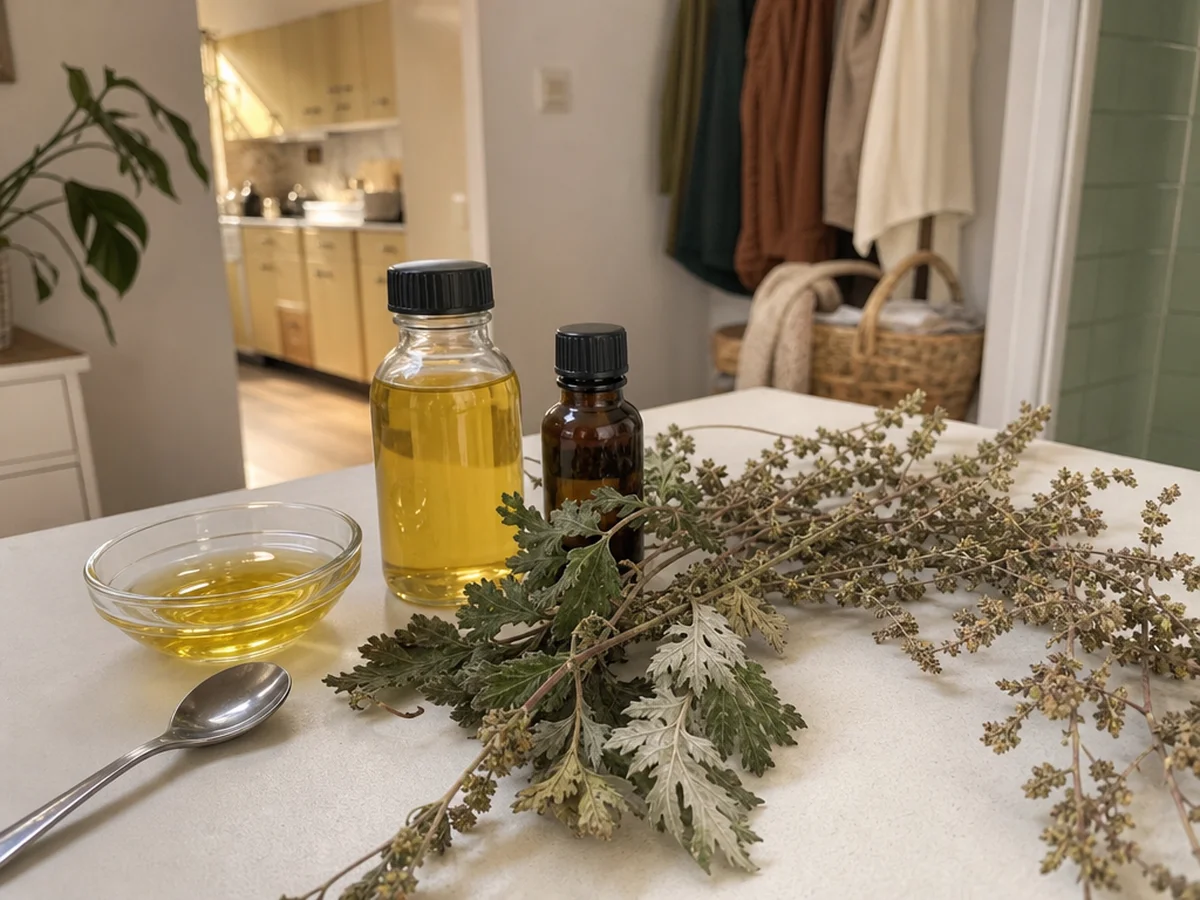
It also helps to keep mugwort apart from the oils you reach for without thinking. A bottle on its own shelf is a bottle you pick up on purpose.
Skin is only one route
These limits are for skin. Air has its own questions, covered in can you diffuse mugwort oil and burning mugwort indoors, and animals are not small people, as mugwort oil around cats, dogs and birds explains.
The short version is conservative on purpose. We sell mugwort oil for fragrance craft, and where skin use matters to you, a certified aromatherapist or cosmetic chemist can work from a written thujone figure. Without one, we would keep it out of leave-on products.
Mugwort Essential Oil
Mugwort Essential Oil from our own shop, in sizes from 0.5 oz to bulk.
From $16.99
Shop Now →Sources & Further Reading
- Alpha-thujone (the active component of absinthe): gamma-aminobutyric acid type A receptor modulation and metabolic detoxification.
- Public statement on the use of herbal medicinal products containing thujone (EMA/HMPC/732886/2010 Rev. 1)
- IFRA Standards, up to and including the 51st Amendment (January 2024), Thujone Standard
- IFRA, Guidance for the use of IFRA Standards (30 June 2023)
- Chemical Composition and Antimicrobial Activities of Artemisia argyi Lévl. et Vant Essential Oils Extracted by Simultaneous Distillation-Extraction, Subcritical Extraction and Hydrodistillation.
- Research Advances on Health Effects of Edible Artemisia Species and Some Sesquiterpene Lactones Constituents.