What Is in Mugwort Oil? Why No Two Analyses Agree
Ask five laboratories what is in mugwort oil and you could get five different answers, and all of them might be right. Published analyses range from oils led by caryophyllene to oils where thujone is the main compound, and the Latin name on the bottle does not settle it. That variety is the interesting part of this oil, and it is also why it pays to know what to ask for.
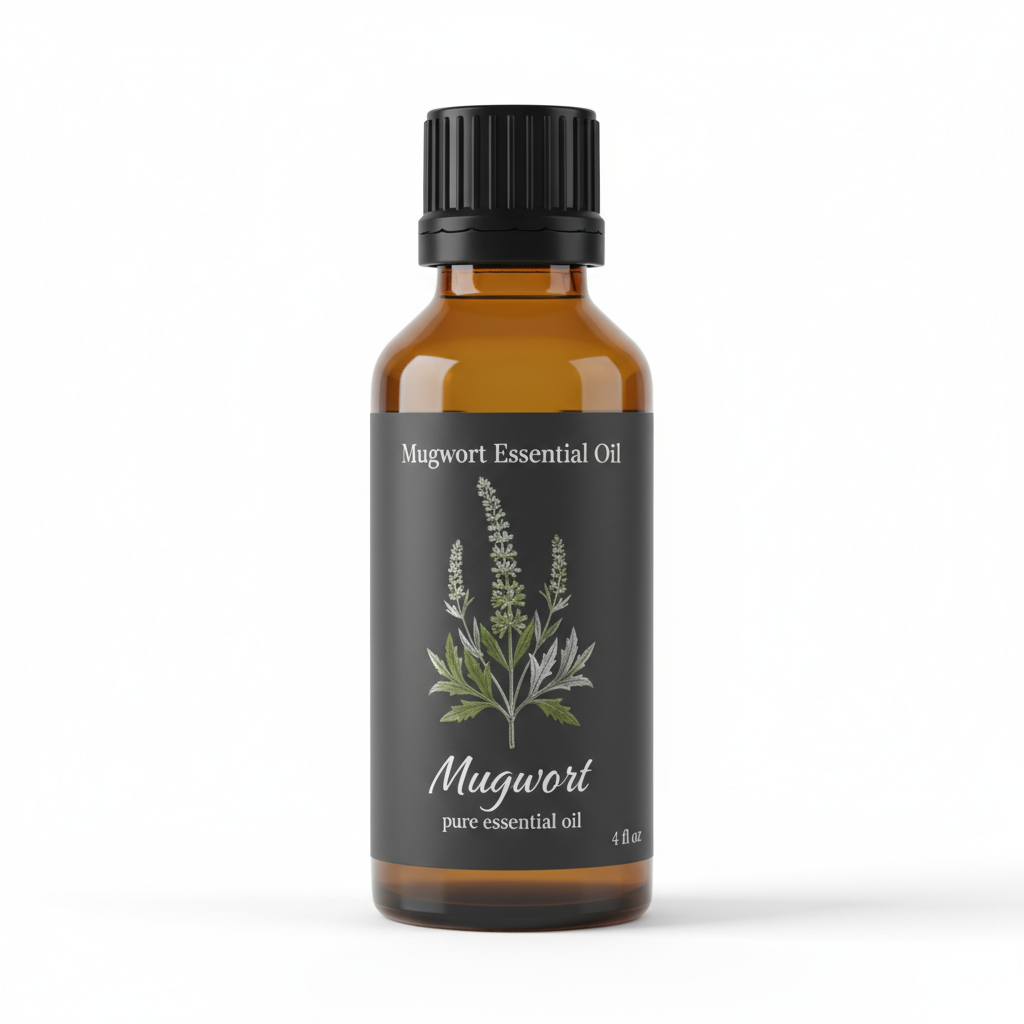
Mugwort Essential Oil
Our own Mugwort Essential Oil, in sizes from 0.5 oz to bulk.
From $16.99
Shop Now →Four oils, four profiles
Each row below comes from a published paper, reported as relative peak area from gas chromatography with mass spectrometry. None describes our oil.
| Plant and place | Method | Leading compounds |
|---|---|---|
| A. vulgaris, cultivated in Maranhão, Brazil (Malik et al., 2019) | Hydrodistillation | Caryophyllene 37.5%, germacrene D 16.2%, humulene 13.7% |
| A. argyi leaves, Qichun, China (Guan et al., 2019) | Hydrodistillation | Neointermedeol 9.7%, caryophyllene oxide 8.7%, alpha-thujone 8.0% |
| A. argyi, Anhui plantation, China (Li et al., 2024) | Steam distillation | Eucalyptol 13.8%, terpinen-4-ol 6.8% |
| A. argyi cultivar Qihuang 1, Wuhan, China (Ming et al., 2025) | Hydrodistillation | Thujone 57.0% |
A few things jump out. The same species, A. argyi, gives a thujone-poor oil in one study and a thujone-led oil in another, so the Latin name is no shortcut. Thujone turns up in both major species' literature, too. The method matters as much as the plant: Guan and colleagues processed the same ground leaves three ways, and one compound, caryophyllene oxide, measured 8.7% from hydrodistillation and 0.1% from subcritical extraction. And a review of earlier work reports Lithuanian common mugwort oils with leaders as different as davanones, germacrene D, camphor and trans-thujone (Pandey and Singh, 2017).
What does that mean for a nose? Camphor, borneol and 1,8-cineole (eucalyptol) are the sort of compounds we would expect behind a camphoraceous note, while caryophyllene is a woody, spicy one. So if you want to know why one mugwort smells sharp and another rounder, the GC-MS report is where to look. That is our reasoning, not a finding from these papers.
Thujone, the compound with rules
Thujone occurs as a mixture of alpha and beta forms in a number of plant oils, including cedar leaf, sage, tansy, wormwood, thyme and rosemary, in highly variable amounts. The European Medicines Agency's herbal committee says there are no studies allowing a reliable assessment for sensitive groups such as pregnant women and children, so use there should be minimised (EMA public statement on thujone). That statement concerns herbal medicines, not fragrance, and our shop guidance for mugwort oil is to avoid it in pregnancy and to keep it away from children and pets.
For fragrance, the relevant rule is IFRA's thujone standard. It caps thujone in the finished product by category: 1.4% in fine fragrance, 0.095% in body creams, oils and lotions, 0.016% in hand cream and 9.5% in candles (IFRA Standards, 51st Amendment). The most oil a product can carry is the cap divided by the thujone share. As stand-ins only: an oil that is 10% thujone could go to about 0.95% in a body oil, and one that is 20% to about 0.5%.
That is why we start at the low end of the 0.5% to 2% dilution we give for skin. Our range reaches the body-oil cap only if the oil is 4.75% thujone or lower at 2%, or 19% or lower at 0.5%. We have no thujone figure for our oil to place against those numbers, so we would sooner err low.
Let your nose keep the record
Numbers are one half of knowing an oil, and your nose is the other. When a new bottle arrives, open it in a ventilated room and take one slow breath from a few inches away. Write down what you find: green, bitter, camphor-like, sweet, sharp, rounded. We describe ours as green, bitter and camphoraceous, with sage-like, herbaceous facets and a curious sweet undertone, and we would encourage you to write your own words rather than borrow ours.
Keep those notes beside the paperwork for each lot. When the next bottle arrives, you can compare the two and see whether it reads the same. It is a small habit, and it turns a confusing subject into something you can follow with your own senses.
It is also why we enjoy this oil so much. A material that refuses to be one thing keeps you paying attention, and paying attention is most of what good fragrance work is.
What to ask for before you buy
- A GC-MS report for the lot, naming species, plant part and method, with alpha-thujone and beta-thujone as separate lines, plus the laboratory and date.
- The same Latin name on the bottle, the invoice and the report.
- A note on what the figures are: relative peak area is not mass percent.
The Certificate of Analysis we publish for one batch lists a relative density of 0.895 and a refractive index of 1.4750. These are physical constants, not a composition. If you need GC-MS or thujone data, ask us in writing through our contact page before ordering and rely on the answer once you have it in writing. Our label-reading guide goes through mismatches, our wormwood comparison contrasts a thujone-rich relative, and the safety article covers everyday handling.
There is no typical mugwort oil, only the one in your bottle, and the report that describes it.
Mugwort Essential Oil
Mugwort Essential Oil from our own shop, in sizes from 0.5 oz to bulk.
From $16.99
Shop Now →Sources & Further Reading
- Malik S et al., 2019. Chemical Profile and Biological Activities of Essential Oil from Artemisia vulgaris L. Cultivated in Brazil. Pharmaceuticals. PMC6631396
- Guan X et al., 2019. Chemical Composition and Antimicrobial Activities of Artemisia argyi Lévl. et Vant Essential Oils Extracted by Simultaneous Distillation-Extraction, Subcritical Extraction and Hydrodistillation. Molecules. PMC6384757
- Li D et al., 2024. The antimicrobial effect and mechanism of the Artemisia argyi essential oil against bacteria and fungus. Brazilian Journal of Microbiology. PMC10920523
- Ming J et al., 2025. Effects of drying methods on phenolic acids, flavonoids, and essential oils in three cultivars of Artemisia Argyi. Food Chemistry: X. PMC12721075
- Pandey AK, Singh P, 2017. The Genus Artemisia: a 2012-2017 Literature Review on Chemical Composition, Antimicrobial, Insecticidal and Antioxidant Activities of Essential Oils. Medicines. PMC5622403
- European Medicines Agency, 2012. Public statement on the use of herbal medicinal products containing thujone (EMA/HMPC/732886/2010 Rev. 1). ema.europa.eu
- IFRA, 2024. The complete IFRA Standards, up to and including the 51st Amendment, Thujone (Amendment 49). IFRA Standards PDF