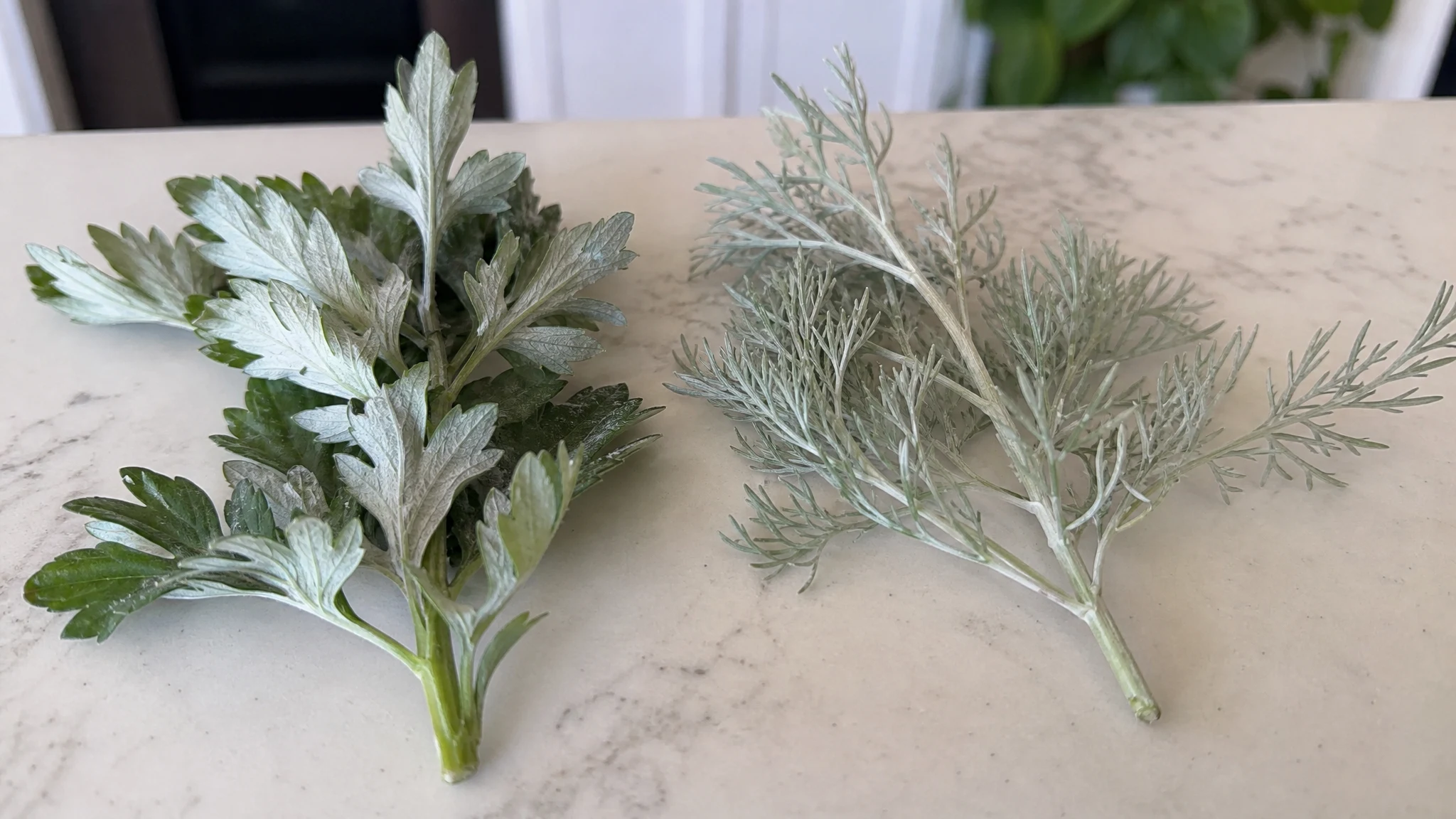
Mugwort Oil vs Wormwood Oil: How Thujone Sets Them Apart
Mugwort and wormwood sit in the same genus, Artemisia, and a lot of people assume the oils must be close cousins in the bottle too. Sometimes they are, and sometimes they are not, and the common name will not tell you which. What does tell you is a number: the thujone content.

Mugwort Essential Oil
Our own Mugwort Essential Oil, in sizes from 0.5 oz to bulk.
From $16.99
Shop Now →One genus, wildly different oils
Artemisia is a big family, more than 400 species by one count (Sharifi-Rad et al., 2022), and the published analyses show how far apart its oils can sit.
| Oil as analysed | What stood out |
|---|---|
| Artemisia vulgaris, grown in Maranhao, Brazil, aerial parts | Caryophyllene 37.45%, germacrene D 16.17%, no thujone listed (Malik et al., 2019) |
| Artemisia argyi leaves, Qichun, China | Alpha-thujone 7.989%, beta-thujone 1.916% (Guan et al., 2019) |
| Artemisia absinthium (wormwood), authenticated plants from Istanbul | Beta-thujone 39.87%, sabinyl acetate 13.87% (Tabanca et al., 2025) |
| Five lots of wormwood herb bought at retail and distilled by the researchers | Beta-thujone from none detected to 28.4%; camphor 30.5% to 50.8% in all five (Tabanca et al., 2025) |
The sources are Malik et al., Guan et al. and Tabanca et al. The pattern is the useful part. A mugwort oil can carry no thujone at all or around ten percent, wormwood can run far higher, and even five wormwood lots from one country ranged from none to a lot. So the species name alone does not predict the profile, and a single "typical" mugwort or wormwood is an average of materials that are not alike. Our composition article goes deeper on the mugwort side.
Why wormwood has the reputation
Wormwood's history with absinthe is why thujone became a regulated word. The European Medicines Agency's herbal committee records EU flavouring limits of 10 mg/kg thujone in most alcoholic drinks, 35 mg/kg in those made from Artemisia species, and 0.5 mg/kg in non-alcoholic drinks made from Artemisia species. It also notes severe intoxications after people consumed thujone-rich essential oil (Public statement on the use of herbal medicinal products containing thujone). In the United States, the FDA flavouring entry reads "Artemisia (wormwood)", scientific name Artemisia spp., with the limitation "finished food thujone free" (21 CFR 172.510). Because it names the genus, mugwort does not sit outside that wording. These are food and drink rules, and we never suggest swallowing any essential oil. They simply show why thujone is the number serious buyers ask about.
What the fragrance rules add
For scented products, IFRA caps thujone in the finished product by category: 9.5% in candles and incense, 1.4% in fine fragrance, 0.095% in body creams and oils (The complete IFRA Standards, Thujone). The cap is written for the compound, so it applies whichever Artemisia the thujone comes from. That makes the oil's own thujone figure the thing you need to do the sum. For example, an oil at 10% thujone would reach the fine-fragrance cap at 14% oil in the product; at 40% thujone, at 3.5%. Those are worked examples, not figures for any oil of ours, and our safety article shows the method step by step.
Telling them apart as a buyer
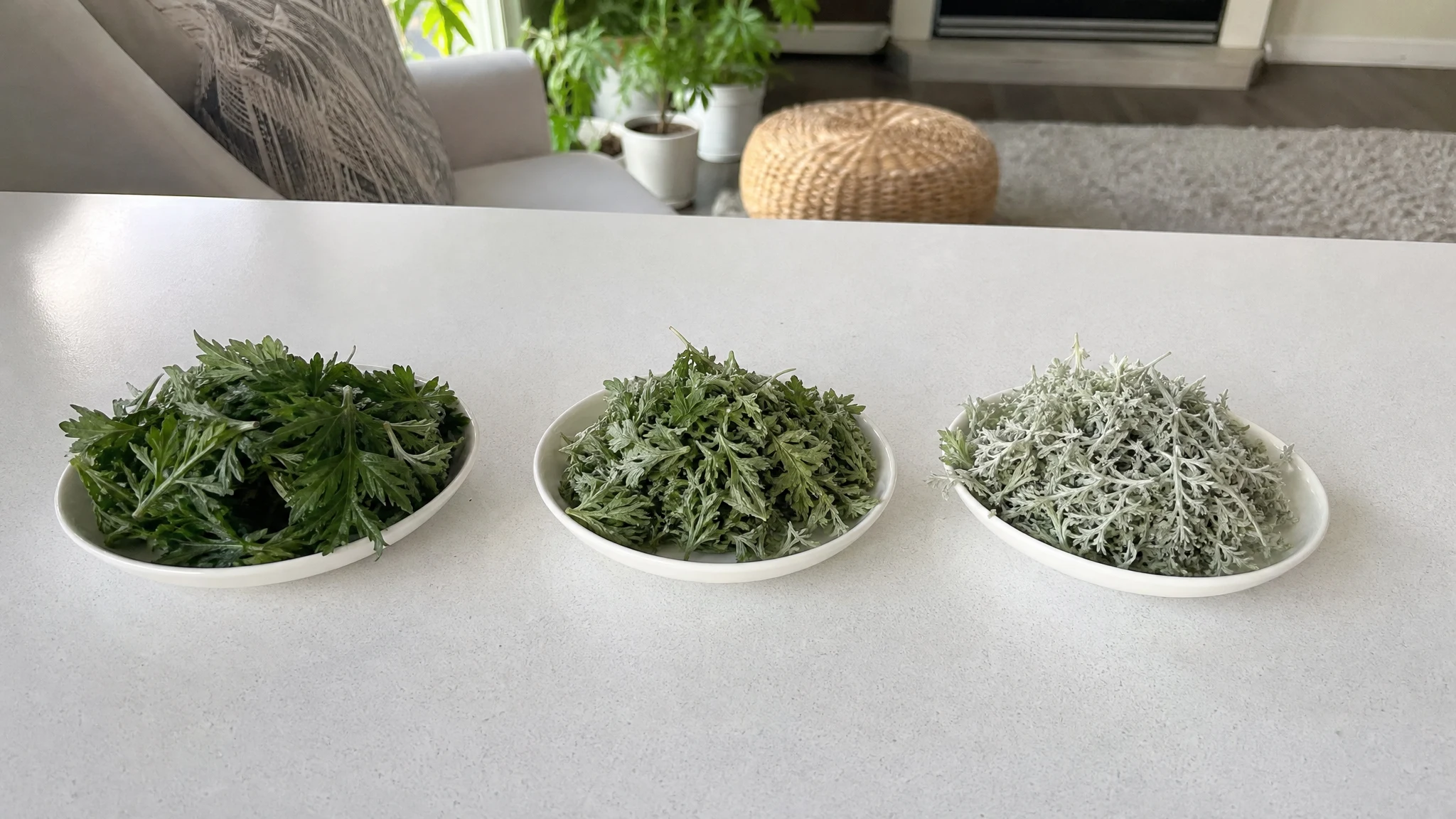
Scent helps a little. We describe our mugwort oil as green, bitter and camphoraceous with sage-like, herbaceous facets, and it is the kind of aroma you will want to compare on a blotter rather than from a description. Colour can hint at chemistry in wormwood, but it will not give you a thujone percentage. For a firm answer, ask the seller of any Artemisia oil for the Latin name, the plant part, the method, and a GC-MS report with the thujone lines shown separately. If you want a figure from us, ask in writing through our contact page and get the answer in writing before you rely on it.
Reading a listing for hints
When you are comparing Artemisia oils online, read the listing slowly, like a label. Look for the Latin name in full, the plant part, the place and the method, and notice what is missing as much as what is there. A page that gives a vivid aroma description and nothing else is telling you about marketing, not the oil. A page that names the species and offers a batch report is giving you something to work with.
Smelling what you have
If you already own more than one Artemisia oil, blotting strips can teach you a lot. Label each strip carefully, because the bottles are easy to confuse once your nose has met three or four. Smell them at the start, again after ten minutes, and the next day. You may find that some are sharply camphoraceous, some greener and some more bitter, and that the name on the bottle does not always predict which. Write down your words, because nobody else's description will fit your nose better than your own.
Whatever you decide, treat them as separate materials with separate paperwork, and keep the bottles labelled and apart so they never get mixed up on the bench.
If you are pregnant, nursing or have a seizure history, ask your doctor before using either oil. And if your question is really about perfumery, our armoise article covers the naming puzzle and the clary sage comparison covers another pair that people mix up.
The short version: two plants, one genus, and a lot of room for surprise. Let the paperwork speak, not the label.
Mugwort Essential Oil
Mugwort Essential Oil from our own shop, in sizes from 0.5 oz to bulk.
From $16.99
Shop Now →Sources & Further Reading
- Artemisia spp.: An Update on Its Chemical Composition, Pharmacological and Toxicological Profiles (Sharifi-Rad et al., 2022)
- Chemical Profile and Biological Activities of Essential Oil from Artemisia vulgaris L. Cultivated in Brazil (Malik et al., 2019)
- Chemical Composition and Antimicrobial Activities of Artemisia argyi Lévl. et Vant Essential Oils Extracted by Simultaneous Distillation-Extraction, Subcritical Extraction and Hydrodistillation (Guan et al., 2019)
- Chemical variability for authenticated and commercial Artemisia absinthium L. essential oils with thujones on tephritid fruit flies: Mediterranean fruit fly Ceratitis capitata (Wiedemann) and Caribbean fruit fly Anastrepha suspensa (Loew) (Tabanca et al., 2025)
- Public statement on the use of herbal medicinal products containing thujone (European Medicines Agency, 2012)
- 21 CFR 172.510 - Natural flavoring substances and natural substances used in conjunction with flavors
- The complete IFRA Standards, up to and including the 51st Amendment (IFRA, January 2024), Thujone standard