Mugwort Essential Oil vs Cleansing Oil: The Difference
It is easy to see why people wonder whether a bottle of mugwort essential oil could stand in for a mugwort cleansing oil. The names overlap, after all. They are, though, different kinds of product: one is a finished cosmetic made mostly of carriers and emulsifiers, and the other is a concentrated aromatic material that we sell neat for fragrance craft. Knowing how to tell them apart helps you shop for either one.

Mugwort Essential Oil
Our own Mugwort Essential Oil, in sizes from 0.5 oz to bulk.
From $16.99
Shop Now →What each one is
We sell one mugwort oil, steam-distilled and sold neat with no additives or fillers. Our shop lists incense and smudge-style blends, candles, perfume accords and potpourri as its uses, and our home page calls it an oil for fragrance craft rather than body care. We do not sell a cleansing oil, toner, balm or any other skincare product, and we make no claim that our oil cleanses or does anything for skin.
A cleansing oil is a recipe: a base of carrier oils, something that helps it rinse away, fragrance and, perhaps, a botanical. A mugwort essential oil is one ingredient that a different kind of recipe might call for.
How to read a cleansing oil's ingredient list
US rules for cosmetic labeling (21 CFR 701.3) ask for ingredients to be listed in descending order of predominance. Ingredients present at 1% or less may follow in any order, and "fragrance or flavor" may be declared as exactly that. That points to three useful readings.
- A mugwort ingredient near the top of the list is a large part of the product by weight.
- One that appears after a long run of others may be at 1% or less, and its position says nothing about the amount.
- If the list says only "fragrance", the label does not reveal which aromatic materials it contains.
The front of the pack is a marketing decision, while the list on the back is the regulated one. Look for the form of mugwort too: essential oil, extract, hydrosol, infused oil and single isolated compounds are different materials with different bodies of research behind them.
An extract is not an essential oil
Much of the conversation about mugwort and skin rests on laboratory work with extracts. A good example is a 2017 study by Hirano and colleagues, who prepared a hot-water extract of Artemisia princeps, a Japanese mugwort, spray-dried it and tested it on normal human skin cells in culture at 0.01% and 0.03%. Concentrations above 0.3% reduced cell viability. It is interesting science, and it also shows the limits of borrowing it: it was cells in a dish, a water extract rather than an essential oil, and a particular species. Carrying those findings across to an essential oil in a cleansing product, or to our oil, would be a leap that the study does not make. We make no claim about what mugwort does for skin, and a product page that does should show you the study, the material and the dose.
The essential oil carries its own safety arithmetic
Mugwort oils can contain thujone, and the fragrance industry limits it by product type. The IFRA Standards (51st Amendment) set maximums in the finished product of 0.13% for Category 9, which covers face cleansers that are rinsed off, and 0.032% for Category 3, which includes make-up remover for face and eyes, while body creams and oils (Category 5A) are 0.095%. The oil percentage a product can hold is the cap divided by the oil's thujone share. With an oil at 10% thujone, a Category 9 product could hold 1.3% oil and a Category 3 product 0.32%. Those numbers show how the sum works and are not figures for our oil.
Which category a cleansing product falls under is a job for its safety assessor. For our oil, the Certificate of Analysis we publish for one batch lists a relative density of 0.895 and a refractive index of 1.4750, and no thujone figure. If you are formulating something for skin, ask us in writing through the contact page and get the answer in writing before relying on it.
For skin our guidance is to dilute to 0.5% to 2% in a carrier oil and patch test first, but we keep dilutions minimal and think the low end is the sensible place to start, since the arithmetic above shows how quickly a product category can set a lower ceiling. Please avoid use during pregnancy, keep the oil away from eyes, children and pets, and never take it internally. A dermatologist is the right contact for a skin reaction and an OB/GYN or midwife for pregnancy questions.
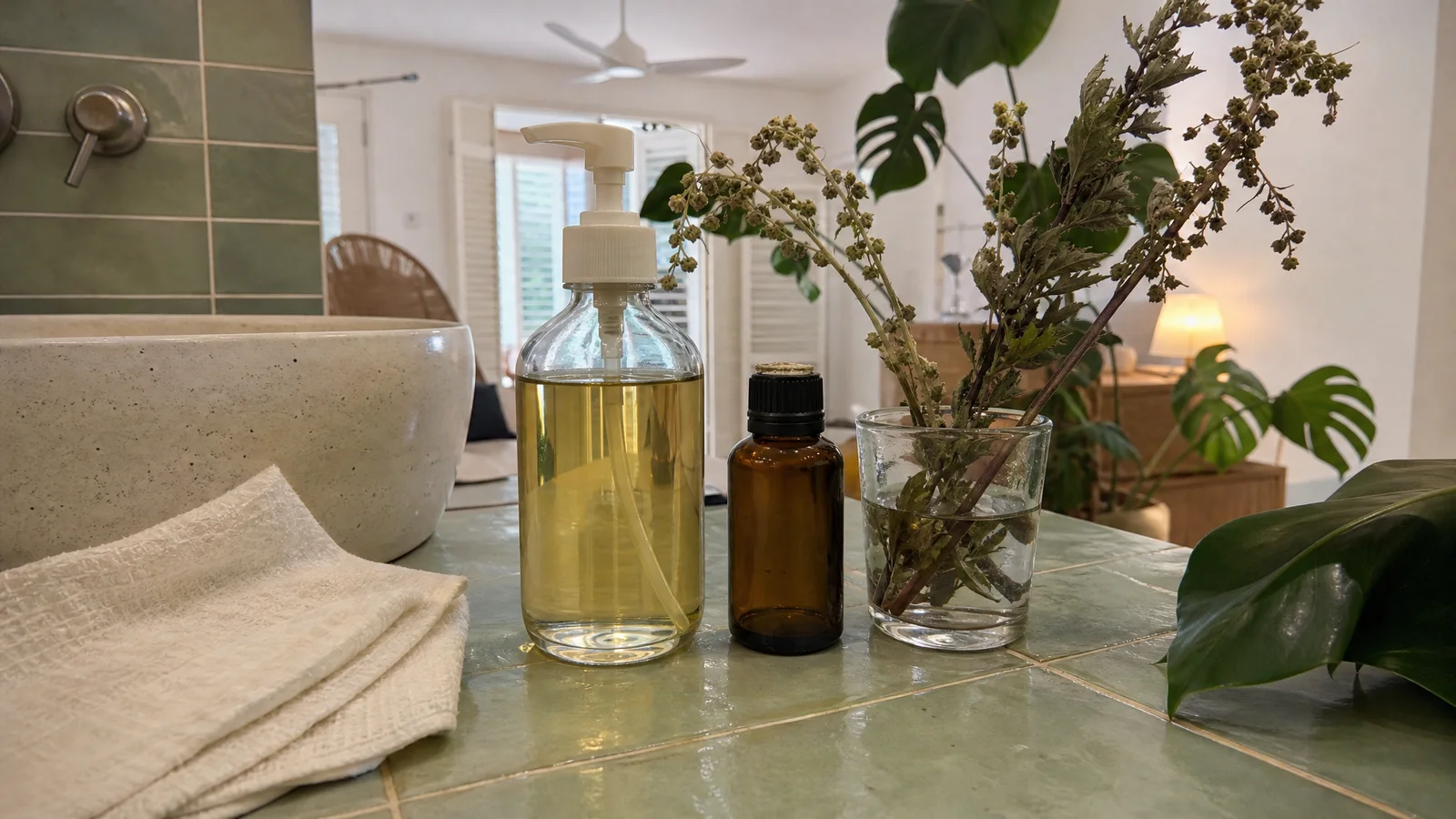
A simple way to remember the difference is the kitchen: a cleansing oil is a finished dish, and an essential oil is a pinch of a very strong spice. You would not eat the spice by the spoonful, and you would not expect a pinch of it to make a meal. Hold a bottle of our mugwort oil next to a bottle of cleansing oil and the contrast is plain: one is a small, dark vial you open with care, the other is a pump bottle meant for daily use.
Choosing your path
- Want a cleanser: buy a finished product, read the ingredient list and ask the maker which form of mugwort it contains and at what level.
- Want a fragrance material for candles or incense: that is what our oil is for, and the candle article covers load arithmetic.
- Want to make a skin product yourself: read our safety article first, get a thujone figure in writing and have a qualified formulator check the ceiling. Our skin-adjacent crafts article covers the soap side.
If you are still unsure, take a minute at the shelf with the ingredient list in your hand and ask yourself what you actually want the product to be. If the answer is a scent for a candle, a sachet or a perfume accent, you are in the right place. If it is something for the face, a finished product from a cosmetics maker is the straightforward path.
The allergy article separates the different reasons a mugwort product can cause a reaction, which is useful reading before you try any of them. A cleansing oil is a recipe and an essential oil is an ingredient, and that is the one distinction worth carrying away.
Mugwort Essential Oil
Mugwort Essential Oil from our own shop, in sizes from 0.5 oz to bulk.
From $16.99
Shop Now →Sources & Further Reading
- 21 CFR § 701.3 - Designation of ingredients. Legal Information Institute, Cornell Law School. law.cornell.edu
- Antioxidant Artemisia princeps Extract Enhances the Expression of Filaggrin and Loricrin via the AHR/OVOL1 Pathway. International Journal of Molecular Sciences 2017;18(9):1948. PMC5618597
- The complete IFRA Standards, up to and including the 51th Amendment (January 2024), Standard "Thujone" (Amendment 49). IFRA. IFRA Standards, 51st Amendment