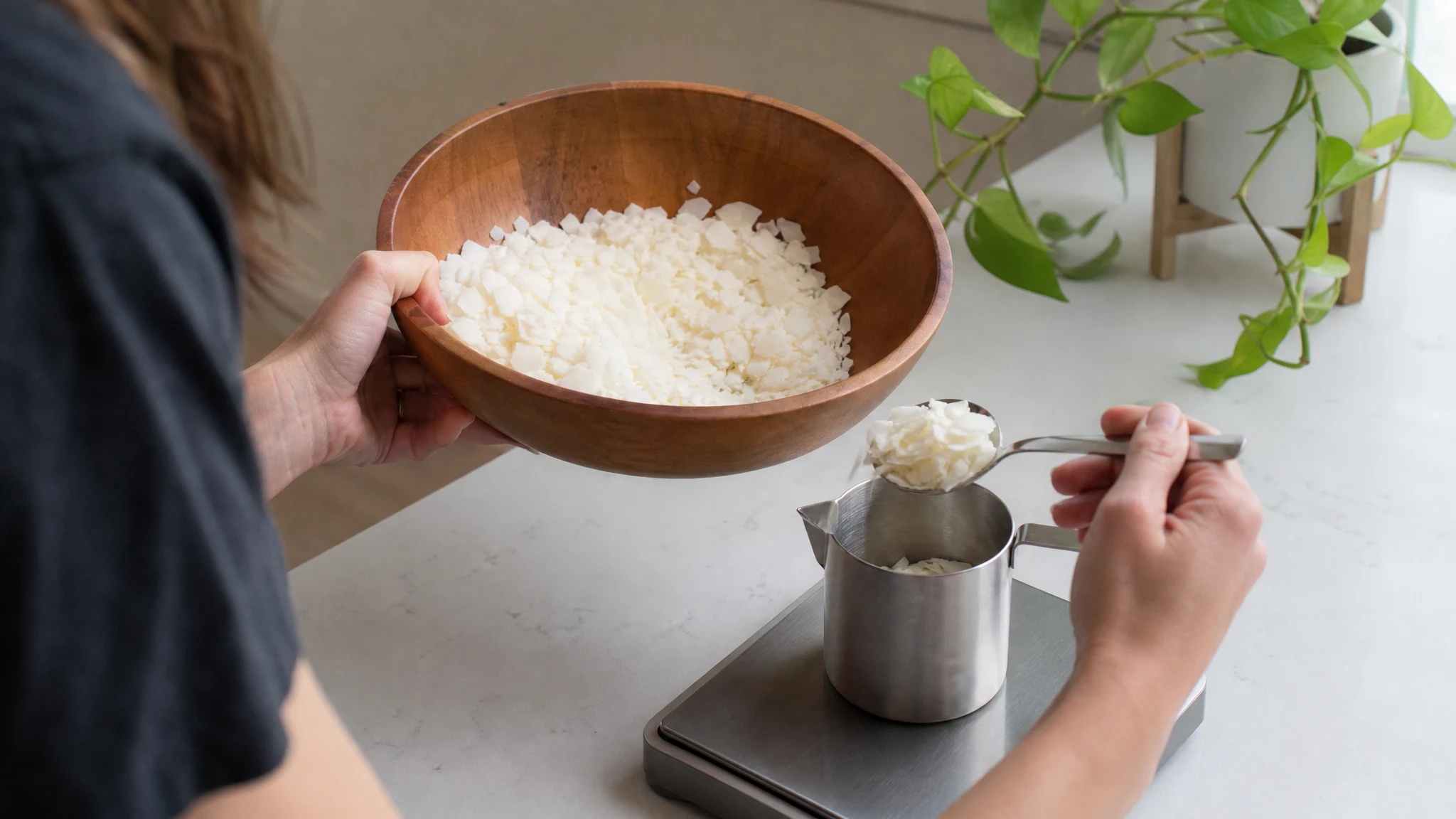
Best Wax for Mugwort Candles: What to Check
Ask ten candle makers for the best wax and you will hear soy, coconut blends, paraffin and beeswax, each with conviction. For a mugwort candle the more useful question is what a wax's data sheet actually promises, because three numbers do most of the steering: how much scent it will hold, how hot to work it, and which wicks suit it.

Mugwort Essential Oil
Our own Mugwort Essential Oil, in sizes from 0.5 oz to bulk.
From $16.99
Shop Now →Start with the data sheet, not the bag
Take one widely sold soy container wax. Its technical data sheet lists a congealing point of 34 to 42 C (typically 39), says the wax may be used with fragrance at levels up to 10 to 12%, and adds that fragrance developed for natural waxes is highly recommended. It warns that fragrances designed for paraffin can cause bleeding, odd surface finishes or poor flame quality, and it tells makers to run their own tests (Technical Data Sheet - Soy Wax Container, version 5.0). On wicks it is plain: natural waxes tend to need larger wicks than paraffin, and a wick that is too large can soot while too small a wick tunnels.
That is the pattern to look for. A good sheet gives a fragrance ceiling, a temperature range and some wick guidance. If a wax you like has none of those, ask the supplier for them in writing, along with the safety data sheet, and treat the answers as part of the product.
What a ceiling really tells you
A ceiling of 10 to 12% marks where trouble can begin for fragrance, not where a plant oil performs best. Those figures were written with fragrance oils in mind, and a single steam-distilled oil such as mugwort is a different thing, with its own character and its own handling needs. Retailer guides also vary in how they treat waxes; one suggests lighter loads for beeswax because it is denser and takes essential oils less readily. So the sheet for the exact wax in your hand beats any rule about wax families.
For a first batch, a modest load is a sensible place to begin and the maths is simple. As an illustration, a 200 g candle at 4% needs 8 g of oil. The batch on our published Certificate of Analysis has a relative density of 0.895, so a 1 oz bottle holds about 26.5 g and makes around three candles at that load. At a 10% ceiling the same candle takes 20 g, and the bottle makes one. Plan your batch around the load you settle on, not the ceiling printed on the sheet.
Temperature matters more with an essential oil
This is where plant oils behave differently from fragrance oils. Candle suppliers describe essential oils as having lower flash points than fragrance oils: one puts them around 40 to 60 C against 80 C and above, another says many common essential oils fall between 50 and 75 C and suggests adding the oil when the wax has cooled to roughly 10 degrees below the oil's flash point. Those are general statements and neither names mugwort. We do not state a flash point for our oil, so request the safety data sheet in writing through our contact page and read the number there before you decide when to add it.
In the meantime the sensible direction is clear: add the oil late, once the wax has cooled. Wax melted with a heat source needs the usual care, and the supplier's sheet covers its own hazards.
Wicks move with every change
Four things push a wick choice up: switching from paraffin to a natural wax, adding scent, adding dye and using a wider jar. A candle wick supplier puts the general rule neatly: the more additives you include, the larger the wick you need for a full melt pool. So a first pilot works best when you hold wax, jar and wick steady and change only the oil load, then test burn after the candle has cured. Our candle-making guide sets out a pilot like that, and the wax melt article covers the different waxes used for melts.
If you can, ask your supplier for a small sample of the wax before you commit to a large bag. Melt a little in a clean jar, watch how it behaves and notice how it smells on its own. Some waxes carry a faint scent of their own, and you will want to know that before you add anything green and bitter to it.
How we would choose
- Pick a container wax whose sheet states a fragrance ceiling, a working temperature and wick guidance.
- Prefer a wax the supplier recommends for natural scents over one built for synthetic fragrance.
- Add the oil late and cool, and settle the exact moment with the oil's safety data sheet in hand.
- Let a small pilot decide the final load and wick, not the table.
It also pays to look at the finished surface. Once a candle has set, the top of the wax tells you a lot: a smooth, even top is a good sign, while frosting, pits or oily patches suggest something is off with temperature or load. Take a photo of each pilot so you can compare them side by side later.
Our candle buying guide covers the paperwork side, and mugwort essential oil versus fragrance oil explains why a plant oil is not a drop-in swap. Wax, wicks and jars are not something we sell, so a candle-supply shop is the place for those. A good wax for mugwort is the one whose sheet answers your questions and whose burn you are happy with after a pilot.
Mugwort Essential Oil
Mugwort Essential Oil from our own shop, in sizes from 0.5 oz to bulk.
From $16.99
Shop Now →Sources & Further Reading
- Technical Data Sheet - Soy Wax Container, version 5.0, revised 26 August 2020. cdn.shopify.com
- Candle Making Essential Oil: The Complete Guide to Natural Scenting. Village Craft and Candle. villagecraftandcandle.com
- Fragrance Oils vs Essential Oils: The Ultimate Maker's Guide! NI Candle Supplies. www.nicandlesupplies.com
- Wicks for Candles: How to Choose the Right One for a Clean, Even Burn. Candlewic. candlewic.com