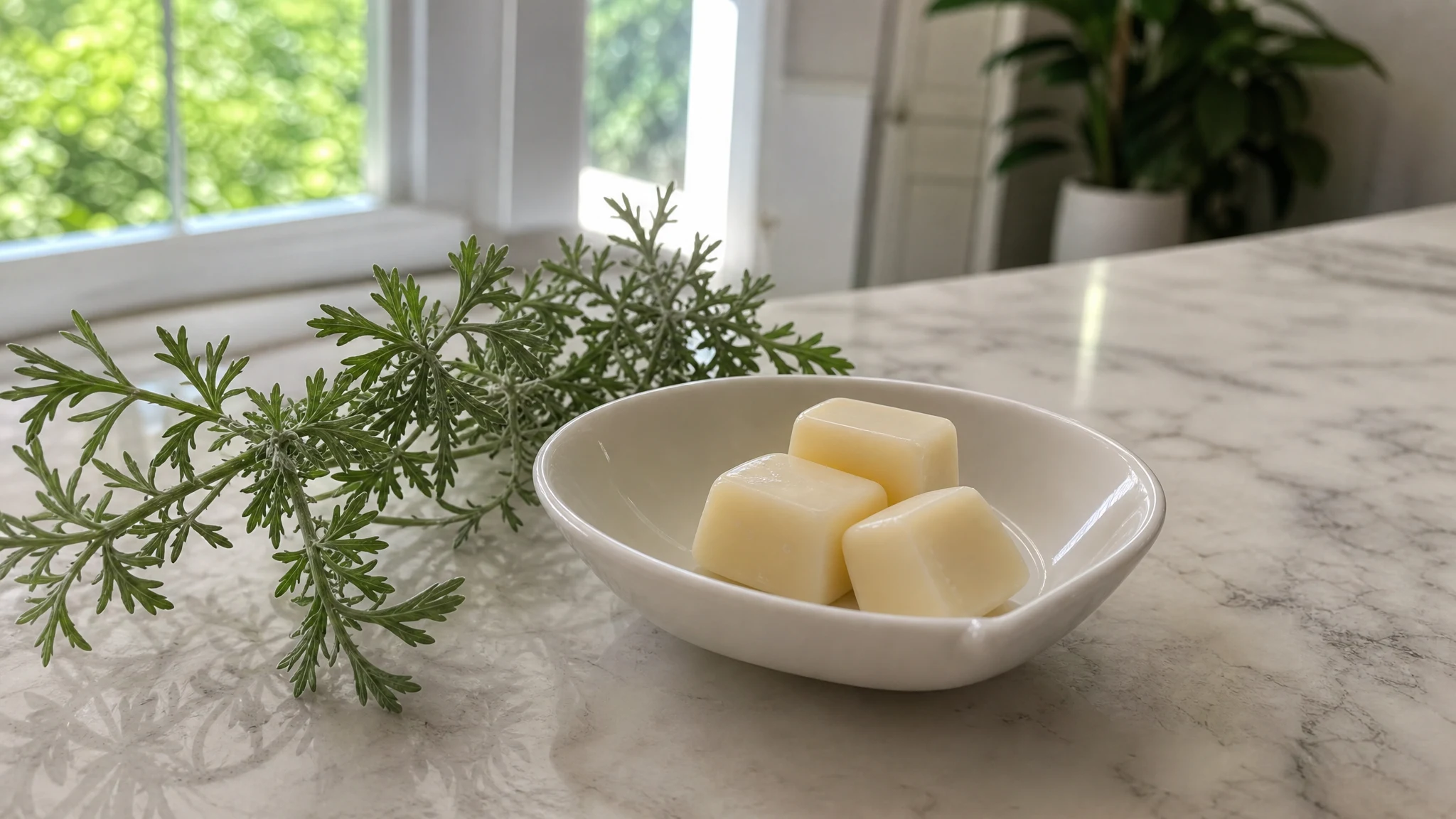
Mugwort Wax Melts: A Small 200 g Batch, Step by Step
A wax melt has no wick and no flame. Whatever oil goes into the wax is released by gentle warmth, for hours at a time, in the room where the warmer sits. That makes melts a lovely way to enjoy a scent and also a reason to think a little harder about a strong botanical like mugwort oil before you pour.

Mugwort Essential Oil
Our own Mugwort Essential Oil, in sizes from 0.5 oz to bulk.
From $16.99
Shop Now →Our position: small, low and short
We describe mugwort oil as a restrained perfumery and ritual material with a green, bitter, camphoraceous aroma, we advise avoiding it during pregnancy, and we keep it away from children and pets. A warmer is an all-day diffusion device, and we would diffuse this oil lightly, if at all. So if you make melts, make a small batch at a modest load, run the warmer in short sessions and decide household by household whether a continuous room scent suits. If anyone at home is pregnant or nursing, has a seizure history, or shares the room with small children or pets, ask the relevant professional (an obstetric clinician, a physician or a veterinarian) before the warmer goes on.
What wax makers say about load
Every melt wax comes with a maximum fragrance load, and it varies a great deal. CandleScience's melt guide lists up to 25 percent for its CocoSol soy wax, 12 percent for EcoSoya PB, 9 percent for IGI 6028 and 6 percent for IGI 4625, and uses 10 percent in its worked example. Blended Waxes lists its BW 923 melt blend at up to 15 percent. The same job has a ceiling of 6 percent in one wax and 25 percent in another, so your wax's own data sheet is the number that matters, and it is a ceiling and not a target. All of these figures are written for fragrance oils or for waxes in general, and none is a rule for mugwort essential oil. CandleScience's own advice for essential oils is to start with low percentages.
A 200 g batch worked out by weight
This is a formulation built from those figures and simple arithmetic. It uses the relative density of the batch on our Certificate of Analysis, 0.895, so 1 ml is about 0.895 g, and about 20 drops to the milliliter. Droppers vary, so weigh the oil on a scale and the drop error disappears.
| Load (by weight of wax) | Oil in 200 g wax | Volume | Drops, about |
|---|---|---|---|
| 2% | 4 g | 4.5 ml | 89 |
| 4% | 8 g | 8.9 ml | 179 |
| 6% | 12 g | 13.4 ml | 268 |
| 10% | 20 g | 22.3 ml | 447 |
We would pour three small test batches at 2, 4 and 6 percent, label them and let the warmer decide. Ten percent is in the table only because it is the load in a wax maker's worked example for fragrance oil. At 20 g it is about three-quarters of an ounce of oil in one 200 g batch, and a bitter, camphoraceous oil is more likely to come across as too much than too little. Never go past the ceiling on your wax's own sheet. If a candle is what you want, the wick changes everything, and how to make mugwort candles and our wax guide cover it.
Pouring
The two makers agree on the sequence. CandleScience adds fragrance at 185 F (85 C) off the heat, stirs gently for about two minutes, cools to 170 F (76.7 C) and pours into a silicone mold, then lets the melts cure for one to two weeks. Blended Waxes gives a pour window of 160 to 180 F, adds fragrance off the heat with about two minutes of stirring and asks that melts sit undisturbed for 48 hours before a first test melt.
Those temperatures are written for fragrance oils with known flash points. If your process needs a flash point or a safety data sheet figure for our oil, ask us in writing through the contact page before heating it in wax, and get the answer in writing. Until you hold a figure, the lower end of the makers' ranges is the cautious place to add the oil, and a thermometer, not a guess, should set it.
Label your molds before you pour, even if you think you will remember. Three batches at three loads look identical once they set, and a strip of tape with the percentage saves you from guessing later.
The warmer matters more than the wax
Essex County Fire and Rescue Service is direct on this: use a melter designed for wax melts, not a candle warmer or a hot plate, because those can get hot enough for the wax to catch fire. It also says not to melt wax melts for more than four hours at a time. Appliances do get recalled, so check your warmer against the recall lists and follow its manual over this page.
One more difference from a candle, and this is our reasoning, not a measurement: a melt releases its scent by evaporation alone, and the lighter parts of an oil tend to leave warm wax first, so the first hour may smell different from the fourth. Test in small steps.
Where the fragrance rules sit
IFRA's standards have no entry named for mugwort, but they do have one for thujone, a constituent of some mugwort oils. Candles fall under Category 12, where the cap is 9.5 percent thujone in the finished product, far above anything a melt reaches. Wax melts are not named in the guidance tables we read, so which category applies is worth confirming with your fragrance supplier, particularly if you plan to sell, because other home-fragrance categories carry much lower caps, such as 0.13 percent for fragranced oils for potpourri and reed diffusers. Selling melts also brings labelling questions; see labelling essential oil candles.
A mugwort melt is a small experiment: three labelled batches, the wax maker's ceiling as the hard stop and a short session on a warmer built for melts. Wax, molds, warmers and thermometers come from a craft or candle supply shop. For household questions about pets, see mugwort oil around cats, dogs and birds, and call a veterinarian or poison help (1-800-222-1222 in the United States) if anyone has been exposed.
Mugwort Essential Oil
Mugwort Essential Oil from our own shop, in sizes from 0.5 oz to bulk.
From $16.99
Shop Now →Sources & Further Reading
- How to Make Soy Wax Melts - CandleScience
- Blended Waxes - BW 923 Natural Tart/Melt Wax Blend - Voyageur Soap & Candle
- Candle Safety, Essex County Fire and Rescue Service
- IFRA Standards, up to and including the 51st Amendment (January 2024), Thujone Standard
- IFRA, Guidance for the use of IFRA Standards (30 June 2023)