How Much Mugwort Oil Per Candle, Soap or Diffuser?
A recipe that says 2% can quietly turn into 5% when you move between a candle book, a soap forum and a diffuser blog, because each counts fragrance against a different total. Mugwort oil adds one more number to keep in mind, the thujone ceiling for the product, so it pays to put everything on a single scale before you pour.

Mugwort Essential Oil
Our own Mugwort Essential Oil, in sizes from 0.5 oz to bulk.
From $16.99
Shop Now →One convention for everything
The scale we like is grams of oil per 100 g of finished product. Candle makers usually quote fragrance as a share of the whole candle; a candle supplier's example is a 100 g candle made from 90 g wax and 10 g fragrance. Soap makers usually quote the oil as a share of the oils in the recipe, not of the finished bar. Diffuser recipes are often given in drops. Three different denominators, so convert them all:
- Grams of oil divided by grams of finished product, times 100, gives the percentage.
- Millilitres times 0.895 gives grams, using the relative density on the Certificate of Analysis we publish for one batch. Grams divided by 0.895 goes the other way.
- Drops are a convenience: about 20 to a millilitre by a loose convention, and droppers vary. A scale reading to 0.1 g is steadier, and candle suppliers give the same advice to weigh fragrance in grams.
The ceiling for each product
The fragrance industry's IFRA Standard on thujone sets a maximum for the finished product in each category: 9.5% for candles (Category 12), 0.13% for rinse-off products like bar soap and face cleanser (Category 9) and for fragranced oil in reed diffusers and pot-pourri (10A), 0.22% for manual room sprays (10B), 0.095% for body creams, oils and lotions (5A), and 1.4% for fine fragrance including solid perfume (Category 4). A product used in several ways follows the strictest category that could apply.
Because those caps limit thujone, the most oil a product can carry is the cap divided by the oil's thujone share. We do not state a thujone share for our oil, so here is the method with one published example, a mugwort leaf oil at about 9.9% combined alpha- and beta-thujone. That oil is not ours, and the authors found composition varied markedly with the extraction method, so read the table as a demonstration of the arithmetic.
| Product (IFRA category) | Thujone cap | Largest oil share if the oil is 9.9% thujone |
|---|---|---|
| Candle (12) | 9.5% | 96% |
| Solid perfume (4) | 1.4% | 14% |
| Manual room spray (10B) | 0.22% | 2.2% |
| Bar soap, face cleanser (9) | 0.13% | 1.3% |
| Reed diffuser, pot-pourri oil (10A) | 0.13% | 1.3% |
| Body oil, cream, lotion (5A) | 0.095% | 0.96% |
The pattern is the useful part. In a candle the wax runs out of room long before the thujone cap is reached, since most waxes hold no more than about 12% fragrance, so the wax decides (see how to make mugwort candles). In soap and reed diffusers the cap is dozens of times lower and becomes the number to watch.
Three worked examples
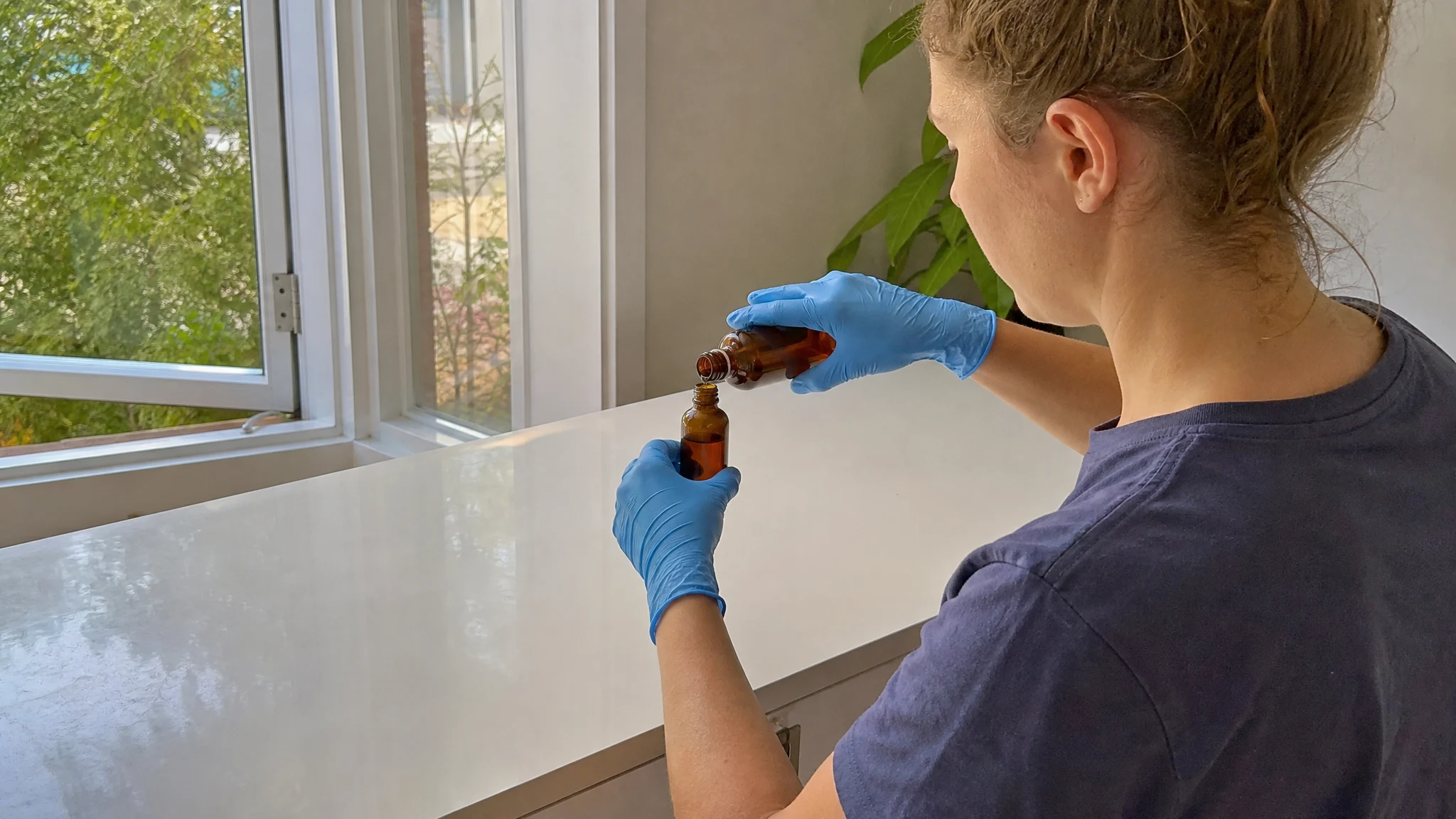
In each, put the container on the scale, zero it, add the wax or base, then add the oil last and read the grams, so the percentage you wrote down is the one you made.
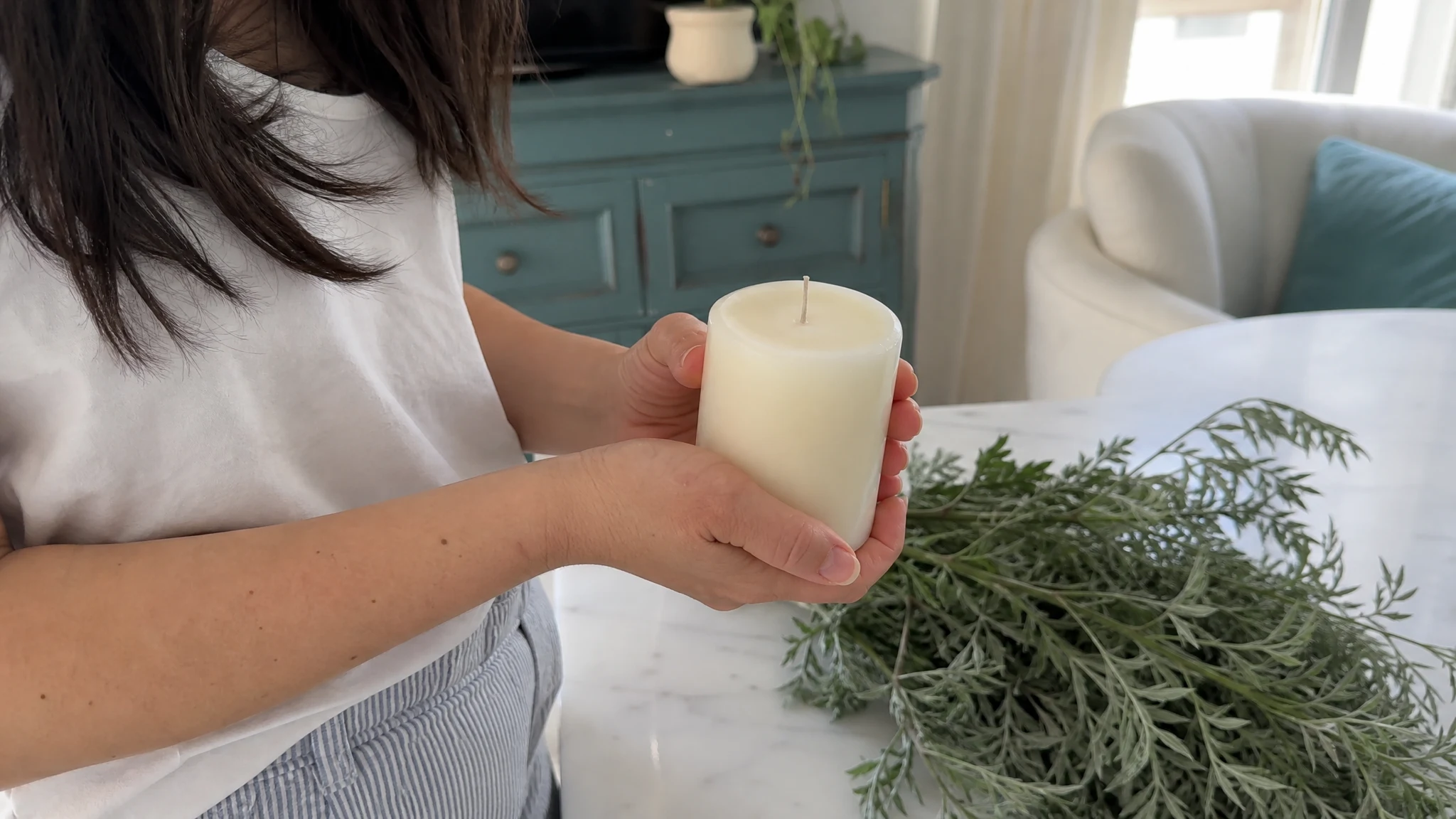
A 200 g candle at 6%. That is 12 g of oil (about 13.4 ml) in 188 g of wax. With the 9.9% illustration the candle carries about 0.6% thujone, far under 9.5%.
Cold-process soap from 500 g of oils at 1%. That is 5 g of oil, about 5.6 ml. The finished bar weighs more than the oils, because it also holds lye solution, so its true share is lower, but without a yield figure of your own the oils weight is the cautious denominator. On that basis the illustration gives about 0.1% thujone against the 0.13% cap. At 2% it would pass 0.13% unless your bar weighs about one and a half times the oils, which only weighing your own bar can tell you. Our note on skin-adjacent crafts covers the wider picture.
A 100 g reed diffuser base. The illustration allows about 1.3 g of oil, or 1.3%. The usual instinct of 10% fragrance would be 10 g and roughly 1% thujone, nearly eight times the cap. If you have no thujone figure, 0.5 g in 100 g is the sort of starting point this arithmetic supports, and it is only as good as the assumed share. Water-based ultrasonic diffusers are a separate question, which can you diffuse mugwort oil takes up.
Who should leave these numbers alone
We would not fragrance a living space with mugwort oil if anyone there is pregnant or nursing, has a seizure disorder, or if young children or pets share the air. Our guidance is to keep the oil away from eyes, children and pets and to avoid it during pregnancy, and the European Medicines Agency's herbal committee likewise says thujone use in pregnant women and children should be minimised because no studies allow a reliable assessment. The Tisserand Institute adds that essential oils are flammable and belong away from naked flame, which matters for every candle above. For skin, start with the arithmetic in mugwort oil safety; our own shop guidance of 0.5% to 2% in a carrier is where we begin, at the low end.
One habit makes every one of these sums easier: write the percentage, the grams of oil and the grams of finished product on the label of every trial batch. A month from now you will not remember which jar was which, and the label will.
If you plan to sell what you make, ask us in writing through the contact page for the safety data and thujone information your product needs before you set a price.
Mugwort Essential Oil
Mugwort Essential Oil from our own shop, in sizes from 0.5 oz to bulk.
From $16.99
Shop Now →Sources & Further Reading
- Supplies For Candles: How Much Fragrance To Add To Candles
- IFRA: Guidance for the Use of IFRA Standards (June 30, 2023)
- IFRA Standards, 51st Amendment (January 2024), Thujone Standard
- Chemical Composition and Antimicrobial Activities of Artemisia argyi Lévl. et Vant Essential Oils Extracted by Simultaneous Distillation-Extraction, Subcritical Extraction and Hydrodistillation
- European Medicines Agency, HMPC: Public statement on the use of herbal medicinal products containing thujone (EMA/HMPC/732886/2010 Rev. 1)
- Tisserand Institute: How to Use Essential Oils Safely