Make Mugwort Candles: Wax, Wick and Oil Load
Most candle trouble has very little to do with the oil. Wax, jar and wick decide how a candle burns, and the oil is the smallest ingredient by weight, so we would settle the other three first and bring the oil in last, with the most care.

Mugwort Essential Oil
Our own Mugwort Essential Oil, in sizes from 0.5 oz to bulk.
From $16.99
Shop Now →The wax sets the ceiling
Every wax comes with a maximum fragrance load, and that ceiling belongs to the wax rather than to your oil. One candle supplier's essential oil guide puts soy and coconut waxes at roughly 6 to 10 percent, beeswax lower at 3 to 6 percent because it is denser, and paraffin a little higher, up to about 12 percent. Those figures are about candle scent in general, not about mugwort, so treat them as the outer frame of a first guess. Our wax comparison helps if you have not picked yet.
The wick is where candles are won or lost
A wick supplier explains the rule that catches many first-timers: the more fragrance or dye you add, the larger the wick you need for a full melt pool. A wick that suits an unscented jar can therefore be a size too small once oil is in the wax, and a candle that tunnels will smell faint however good the oil is. The same supplier says the best way to choose is to test, starting from a wick chart and trying sizes. We agree, and it is one more reason to choose your wick against the oil load you plan to use, not the other way round.
A ladder of three small candles
Here is the arithmetic for a candle holding 200 g of wax, a round number we picked for the sums (weigh the wax in your own jar). The batch on our Certificate of Analysis has a relative density of 0.895, so 1 ml of oil weighs about 0.895 g, and at about 20 drops to the milliliter a gram is roughly 22 drops. Droppers vary a lot, so weigh the oil instead of counting.
| Oil load (of wax weight) | Oil in 200 g wax | About |
|---|---|---|
| 2% | 4 g | 89 drops |
| 4% | 8 g | 179 drops |
| 6% | 12 g | 268 drops |
Our suggestion is three small candles at 2, 4 and 6 percent, with the same wax, wick and jar, each labelled with its load. That is reasoning, not a result, but it fits mugwort's character. We describe the aroma as green, bitter and camphoraceous, with sage-like, herbaceous facets and a curious sweet undertone, and a scent like that can fill a room at a modest load. The load that works is the lowest one that gives a pleasing throw once the wick is right, and for most waxes it will sit well below the ceiling.
Adding the oil, pouring and waiting
Temperatures depend on your wax, so follow its data sheet, and add the oil as late and as cool as the wax allows, then stir thoroughly before pouring. Suppliers disagree about how much heat matters. One guide says to add an essential oil once the wax has cooled to about 10 degrees below the oil's flash point; others say flash point is about ignition near a flame, not about scent loss. If your process depends on a flash point or any other safety data sheet figure, ask us in writing through the contact page before ordering and get the answer in writing before you rely on it.
Then comes the wait. One supplier reports that crystallisation in vegetable waxes is usually done within 48 hours, yet recommends 10 to 14 days of curing for the best scent throw, and says openly that this rests on community experience rather than a proven mechanism. A practical reading is to check the wick and flame at 48 hours, judge the scent after two weeks, and write both dates on the label. If the scent still seems faint, our scent throw guide walks through the usual causes in order.
What the thujone limit does and does not tell you
Mugwort oils can contain thujone, so it is worth knowing where candles sit among the fragrance industry's rules. IFRA's compilation has no standard naming mugwort, but it does have one for thujone, and IFRA's guidance places candles in Category 12, where the maximum is 9.5 percent thujone in the finished product. Multiply load by thujone share and you can see how far away that is: at a 6 percent load, the oil would have to be more than 100 percent thujone to reach it, and at 10 percent it would need to be 95 percent. The skin categories are far lower, which is why we steer skin projects toward careful reading, as in our safety article.
That limit concerns the finished product and says nothing about the air in your room, and the sources we read do not measure what a mugwort candle releases when lit. Our guidance for the oil is to avoid use during pregnancy and to keep it away from children and pets, so an obstetric clinician or a veterinarian is the right person to ask before burning one in a home with either.
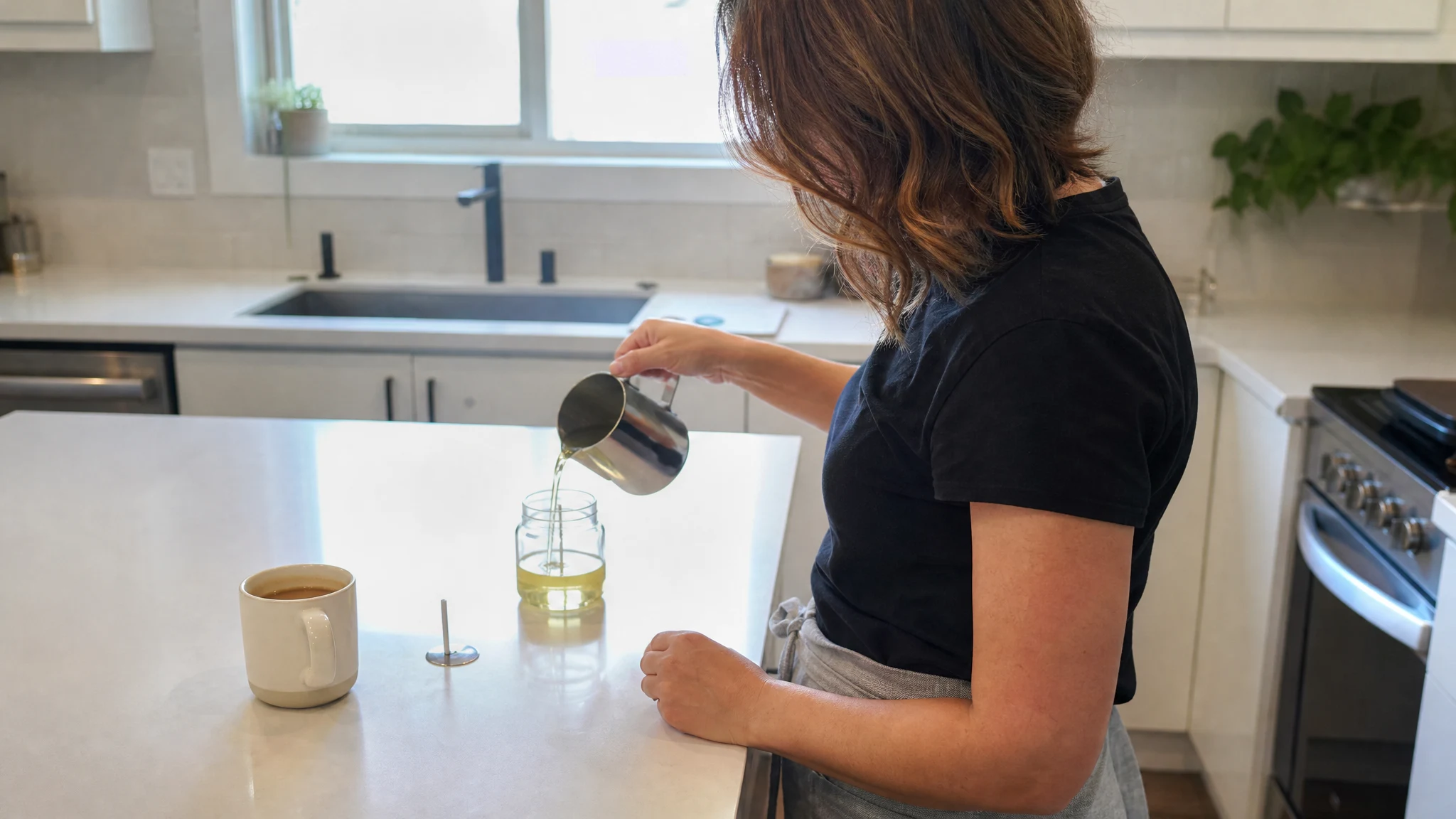
Before you pour, set up a clean table with a towel underneath, a pitcher with a spout, a spoon you will not use for food, and a spot where the candles can sit undisturbed for a couple of weeks. Having everything laid out first makes the pour feel unhurried, and a steady hand is the best defence against a crooked wick.
Burning it well
The basics come from a fire service: keep candles in a proper holder away from curtains and other flammable things, keep the wax pool clear of wick trimmings and debris, burn in a ventilated room without drafts, and put the candle out when you leave the room. Wax, wicks and jars come from a candle supply shop, and so does the thermometer.
A mugwort candle rewards patience: three labelled pilots, a wick matched to the load, and a couple of weeks of waiting will tell you more than any table.
Mugwort Essential Oil
Mugwort Essential Oil from our own shop, in sizes from 0.5 oz to bulk.
From $16.99
Shop Now →Sources & Further Reading
- Candle Making Essential Oil: The Complete Guide to Natural Scenting | Village Craft and Candle
- Wicks for Candles: How to Choose the Right One for a Clean, Even Burn
- Understanding Curing Time in Candle Making | Candle Shack
- IFRA, Guidance for the use of IFRA Standards (30 June 2023)
- IFRA Standards, up to and including the 51st Amendment (January 2024), Thujone Standard
- Candle Safety, Essex County Fire and Rescue Service