Mugwort Allergy vs Mugwort Oil: 3 Different Reactions
Say “mugwort allergy” to three different people and you may be talking about three different things. One sneezes every late summer. Another gets a rash after gardening. A third wonders whether a bottle of mugwort oil will bother them at all. It helps to pull these apart, because they have different triggers, different tests and very different amounts of research behind them.
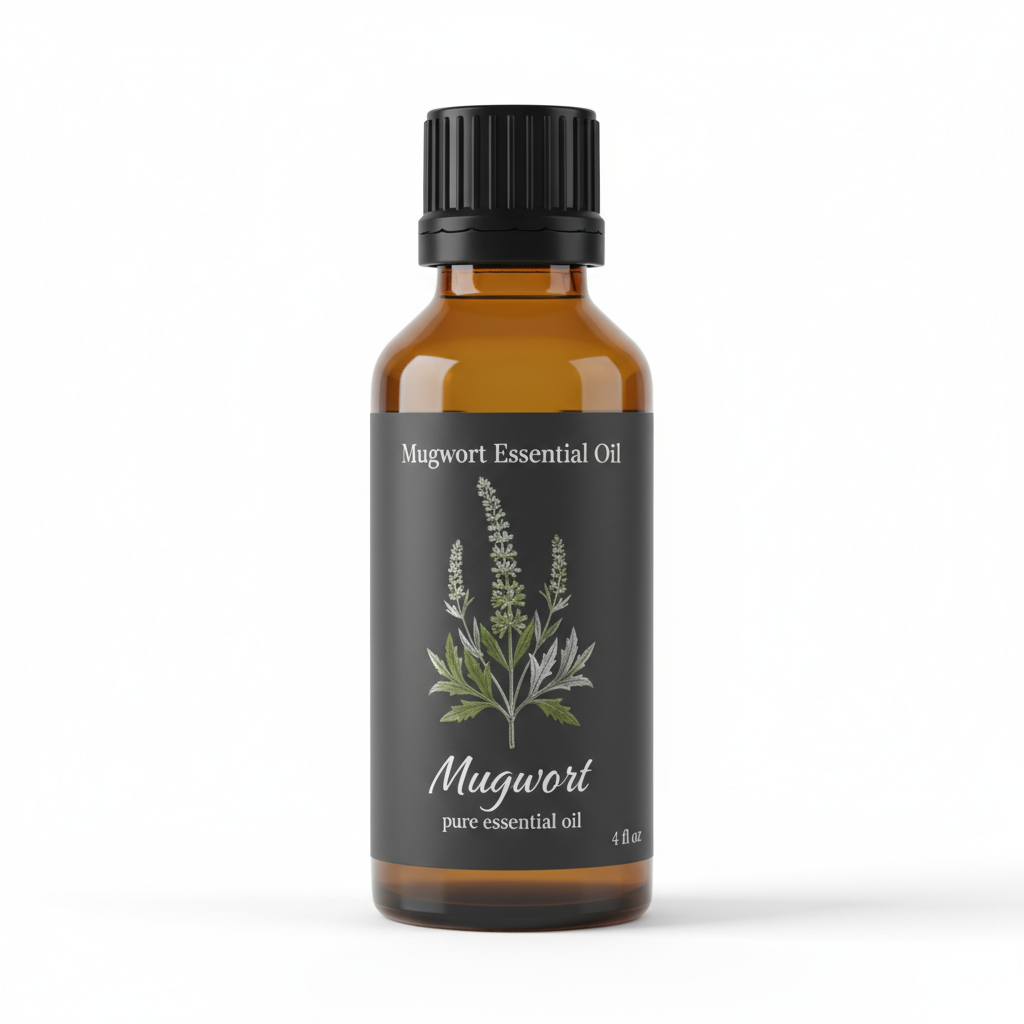
Mugwort Essential Oil
Our own Mugwort Essential Oil, in sizes from 0.5 oz to bulk.
From $16.99
Shop Now →The pollen allergy: a protein
Hay-fever-type reactions to mugwort come from proteins in the pollen, not from anything in an oil. The best-studied is Art v 1, a defensin-like protein. A 2019 study took pollen from seven Artemisia species and tested them against blood from mugwort-allergic patients. Art v 1, purified from common mugwort pollen, blocked between 82% and 90% of the patients' antibody binding to the pollen extracts at the highest concentration, and similar proteins in the other species behaved alike (Pablos et al., 2019). The practical meaning is that someone allergic to one mugwort's pollen may react to its relatives too. That is a finding about pollen, tested in a lab, and it tells us nothing direct about a steam-distilled oil.
The skin reaction: the daisy family
Contact allergy to the daisy family (Compositae, also called Asteraceae) is a skin reaction, mostly to compounds called sesquiterpene lactones, which DermNet describes as sitting in the oleoresin fraction of leaf, stem and flower. Mugwort appears among the plants it lists. Diagnosis is by clinic patch testing, and DermNet notes that once someone has become allergic to one trigger, the immune system is likely to react to similar chemical structures (DermNet, Compositae allergy).
How common is it? An Australian clinic tested 3,679 patients to Compositae over ten years. Forty-four (1.2%) reacted, and about 43% of those reactions were judged relevant to the person's daily life, mostly from handling plants in the garden (Punchihewa, Palmer and Nixon, 2022). In nearly a third of the relevant cases the source was a personal product, which is a good reminder to read ingredient lists.
If you have been sneezing at ragweed or other late-summer pollen for years, you may already have a good sense of your own triggers. Keep a short list of the plants, products and places that have bothered you, and bring it to your appointment. A clear history helps a professional far more than a guess, and it is the kind of note that is easy to write down now and hard to remember later.
The oil itself
Here the research is thin. We found no study measuring sesquiterpene lactones in a steam-distilled mugwort oil, and none testing mugwort oil on people with either allergy. Because that is unknown, we do not guess in either direction. What we can say is practical: if you have a known mugwort pollen allergy, or a daisy-family contact allergy, check with an allergist or dermatologist before bringing a mugwort oil into your home or workshop. Someone handling the neat oil by the ounce has more skin and air contact than a hobbyist, which is a good reason to have that conversation early.
A home patch test of a diluted oil on your forearm is a different thing from clinic testing, which uses standardised allergen series. It can flag an obvious reaction, but it cannot rule out pollen allergy or a delayed daisy-family reaction. That is our reasoning from DermNet's description of clinical testing.
A dilution note, on a separate question
Our shop guidance for skin is 0.5% to 2% in a carrier oil. Separately from allergy, IFRA caps thujone in leave-on skin products, at 0.095% for body creams, oils and lotions and 0.032% for face products (IFRA Standards, 51st Amendment; categories from IFRA's guidance). The most oil that fits under a cap is the cap divided by the oil's thujone share. As arithmetic: an oil that is 10% thujone could go to about 0.95% in a body oil, and one that is 20% thujone to about 0.5%. At the top of our 2% range, a body oil only stays under the cap if the oil is 4.75% thujone or less. We do not hold a thujone figure for our oil, so we start at the low end of our range, keep to the body, and keep it off the face until we have one. If you want GC-MS or thujone data before you buy, ask us in writing through our contact page and rely on the reply once you have it in writing.
We sell an external cosmetic oil, not a remedy of any kind, so questions about allergy treatment or pregnancy belong with a doctor. Our shop guidance is to avoid mugwort oil in pregnancy and to keep it away from children and pets. For more, see our safety article, the FAQ, the plant guide for telling mugwort from look-alikes, and can you diffuse mugwort oil.
Before you open any new bottle, check your workspace: a window that opens, a surface you can wipe down, a pair of gloves and a place to wash your hands. If anything on your skin or in the air feels off, stop, put the cap back on and wash up. The first minutes with a new oil are the best time to be careful, and a little habit now means a lot less worry later.
Pollen, skin and oil are three separate questions. Knowing which one you are asking is most of the work.
Mugwort Essential Oil
Mugwort Essential Oil from our own shop, in sizes from 0.5 oz to bulk.
From $16.99
Shop Now →Sources & Further Reading
- Pablos I et al., 2019. Similar Allergenicity to Different Artemisia Species Is a Consequence of Highly Cross-Reactive Art v 1-Like Molecules. Medicina. PMC6723817
- DermNet. Compositae allergy. Sesquiterpene lactone contact allergy. dermnetnz.org
- Punchihewa N, Palmer A, Nixon R, 2022. Allergic contact dermatitis to Compositae: An Australian case series. Contact Dermatitis. PMC9542089
- IFRA, 2024. The complete IFRA Standards, up to and including the 51st Amendment, Thujone (Amendment 49). IFRA Standards PDF
- IFRA, 2023. Guidance for the Use of IFRA Standards. IFRA guidance PDF