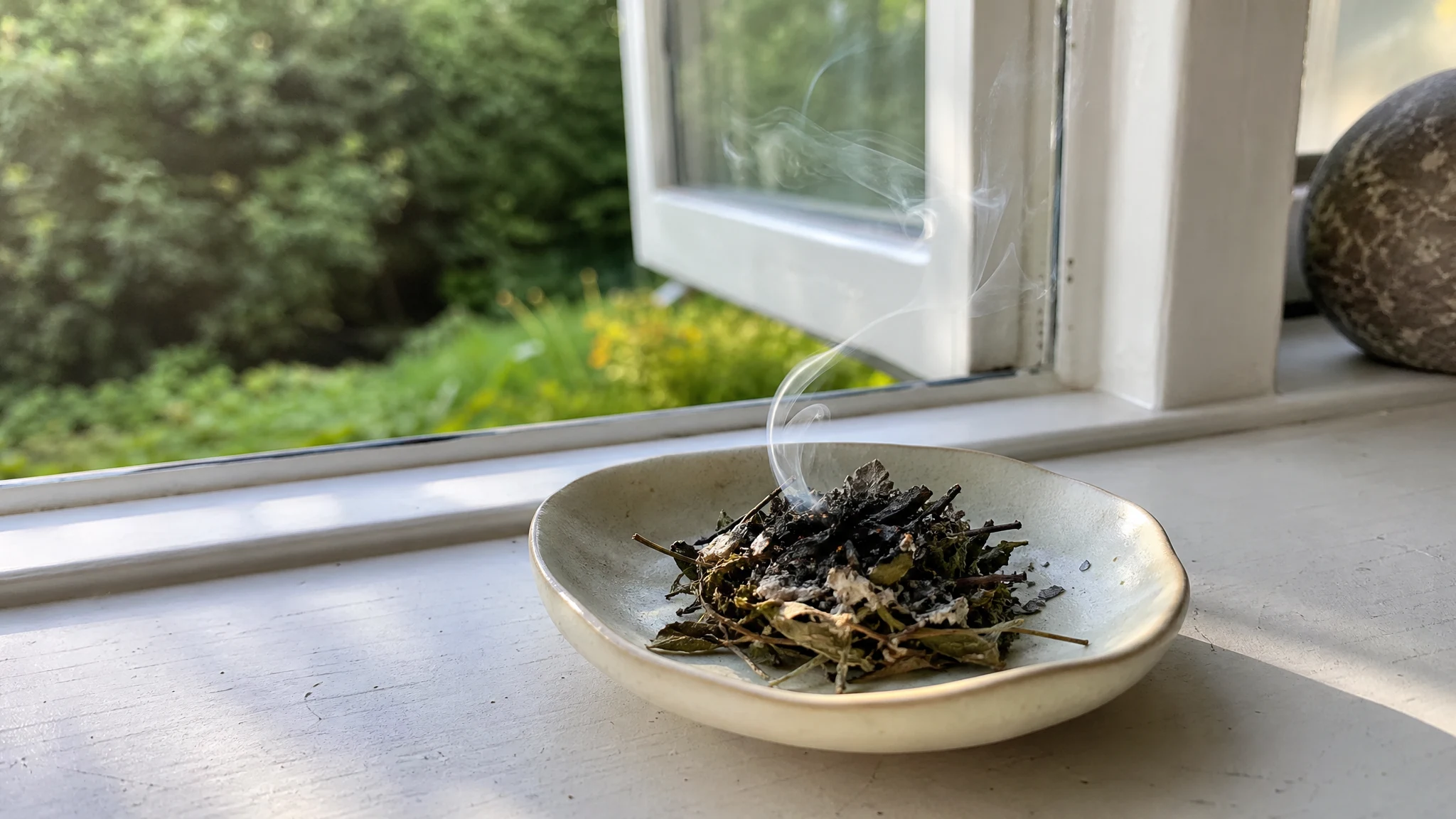
Burning Mugwort Indoors: What Air Studies Found
Inside one Taipei hospital treatment room, burning a single roll of mugwort moxa wool for 15 minutes pushed the fine-particle reading from 26 to 296 micrograms per cubic meter. Mugwort is a beloved herb for burning, and it is worth knowing what the measurements say, because the numbers apply to any plant material set alight indoors and the fixes are surprisingly simple.

Mugwort Essential Oil
Our own Mugwort Essential Oil, in sizes from 0.5 oz to bulk.
From $16.99
Shop Now →What was measured on burning mugwort
Moxibustion burns processed mugwort leaf, which the study describes as moxa made from dried Artemisia herb. Researchers monitored a 92 cubic meter acupuncture and moxibustion room with the ventilation off, through background, burning and decay periods (Lu et al., 2016). Fine particles (PM2.5) averaged 296 micrograms per cubic meter during burning, against 26 in the background. Coarser particles (PM10) rose from 147 to 409. The authors compared those with Taiwan's indoor air standards and found both above them.
That is one room and one burn, so it is best read as a sense of scale: burning plant material puts a lot of tiny particles into a closed space quickly. The same paper tested ways to bring the numbers down, and the results are the most useful part. A small extraction fan placed 25 cm from the burning wool, venting outdoors, cut the rise in fine particles by 96%. A room air cleaner cut it by 71%, and the authors called it inefficient for the gases. In other words, catching smoke at the source beat cleaning the air afterwards. The study did not test an open window.
Incense runs higher
If you are comparing burning formats, incense is the bigger particle source. A review of incense smoke reports particulate emissions above 45 mg per gram burned, against about 10 mg per gram for cigarettes, and measured total suspended particles in one Taiwanese temple at roughly 1,316 micrograms per cubic meter against 73 outside (Lin, Krishnaswamy and Chi, 2008). The same review says the health evidence is mixed and calls for more controlled studies, so the particle counts are well established and the long-term effects less so.
The US EPA's page on indoor particulate matter lists candles, fireplaces and other combustion among the indoor sources. It says particles smaller than 10 micrometers can get deep into the lungs, that people with heart or lung disease, children and older adults may be at greater risk, and that the effects include eye, nose and throat irritation (US EPA, Indoor Particulate Matter). It does not single out herbs, and nothing in it suggests plant smoke is gentler or harsher than other smoke.
Where mugwort oil comes in
We list incense and smudge-style blends and ritual or seasonal candles among the uses for our mugwort oil, as a restrained scent ingredient. The oil is the fragrance, not the fuel: the wax or incense base is what burns, and the oil rides along in it. We know of no measurement of what mugwort oil releases in a burn, so we stay with the scent and leave claims about the air alone.
On the formulation side, IFRA places candles of all types and incense in Category 12, products not meant for direct skin contact, and notes that dermal sensitization risk from them is negligible (IFRA guidance). Its thujone standard still sets a Category 12 cap of 9.5% thujone in the finished product (IFRA Standards, 51st Amendment), by far the loosest of its categories. If you need a thujone figure or SDS data for a burning product, ask us in writing through our contact page and rely on the answer once you have it in writing. Our workshop safety checklist covers handling.
A few things you will notice at home
Anyone who has burned dried herbs or incense in a small room knows the signs before any meter does. The haze gathers near the ceiling, the smell clings to curtains and cushions, and the room smells of smoke long after the ember is out. Those are simple cues that the air is carrying a lot of material, and they are the moment to open a window rather than light another stick.
A bathroom with a fan or a kitchen with a hood is a better place to burn than a bedroom, because the fan was built to move air outside. If you only have a living room, crack a window on two sides of the room so the air can cross through, and keep the burn near the window, not in the middle of the room.
Practical habits
From the studies above, here is how we would approach burning anything indoors, as reasoning from the measurements and not as a tested method:
- Put the source near an open window or extraction fan, so smoke leaves the room before it spreads.
- Keep burns short, and leave the room to clear before you sit back down in it.
- Burn on a heat-safe surface with a working smoke alarm nearby, and stay in the house while anything is lit.
- Ask a doctor first if anyone at home has asthma, heart or lung disease, or is pregnant. Our shop guidance also says to keep the oil away from children and pets, and our pet article goes into why birds, cats and dogs deserve a separate thought.
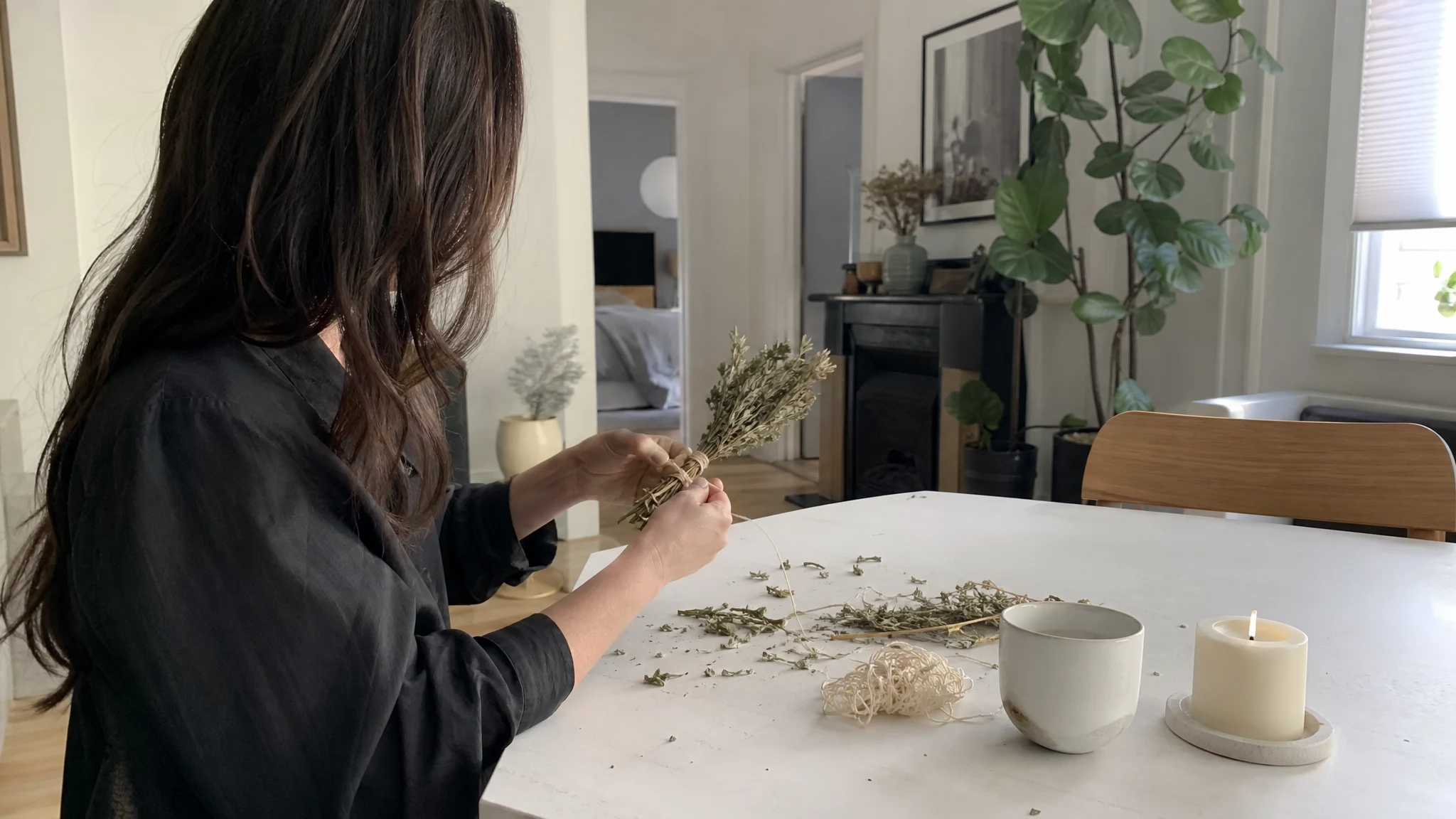
If you are drawn to burning the dried plant itself, see our incense and herb bundle article; we do not sell the dried herb. For a lighter way to scent a room, can you diffuse mugwort oil weighs up the alternatives, and the ritual candle article covers dressing a candle.
One last small habit: write down when you lit something and when you put it out. It is easy to lose track of time with a pleasant smell in the air, and a note on the back of your hand or a phone timer keeps a short burn short.
Whatever you burn, the measured advice is the same: let the smoke go outside before it goes into your lungs.
Mugwort Essential Oil
Mugwort Essential Oil from our own shop, in sizes from 0.5 oz to bulk.
From $16.99
Shop Now →Sources & Further Reading
- Lu CY et al., 2016. Controlling Indoor Air Pollution from Moxibustion. International Journal of Environmental Research and Public Health. PMC4924069
- Lin TC, Krishnaswamy G, Chi DS, 2008. Incense smoke: clinical, structural and molecular effects on airway disease. Clinical and Molecular Allergy. PMC2377255
- US EPA. Indoor Particulate Matter. epa.gov
- IFRA, 2023. Guidance for the Use of IFRA Standards. IFRA guidance PDF
- IFRA, 2024. The complete IFRA Standards, up to and including the 51st Amendment, Thujone (Amendment 49). IFRA Standards PDF