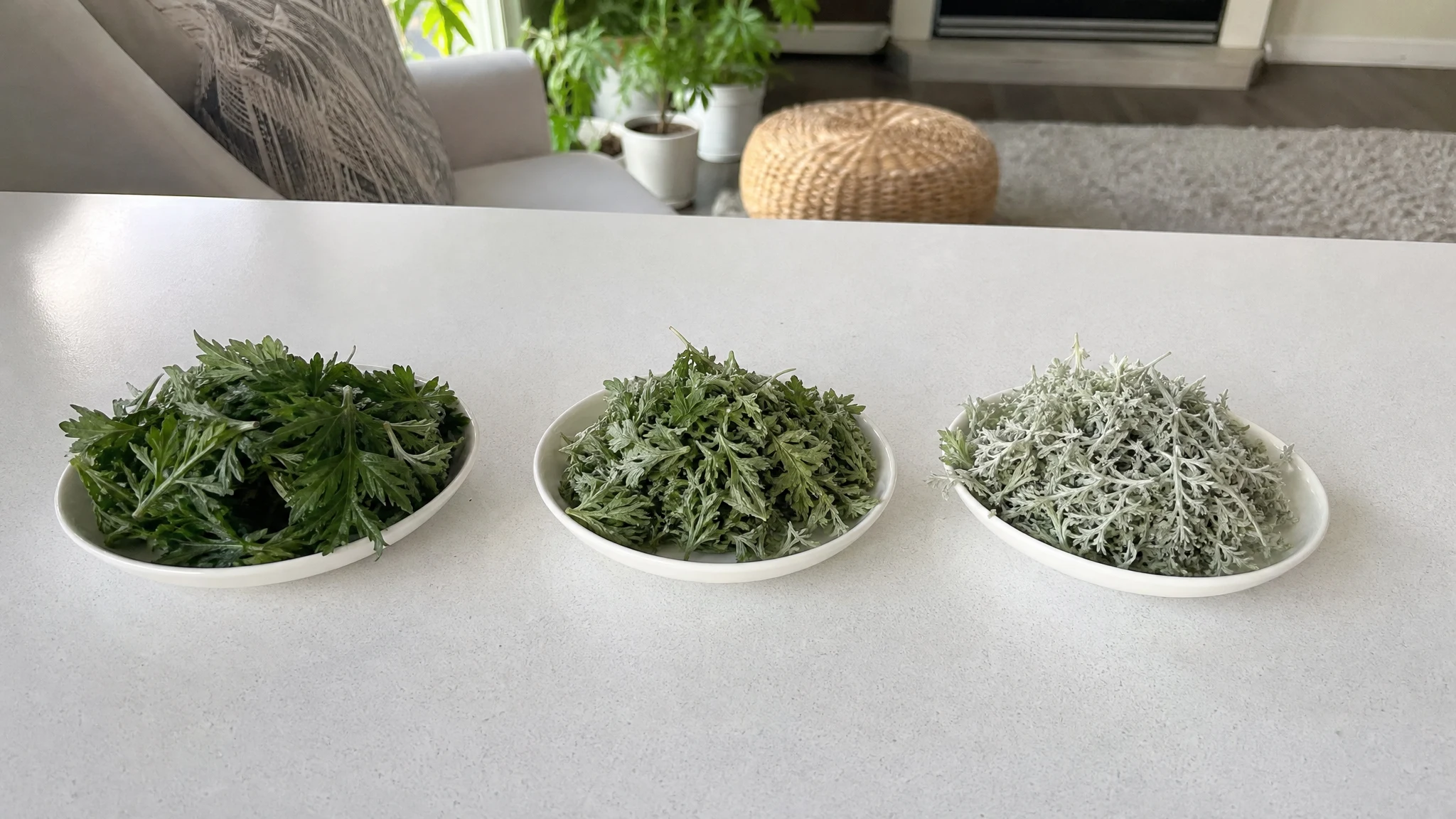
What Does Mugwort Oil Smell Like? A Word-by-Word Guide
Green, bitter and camphoraceous, with sage-like, herbaceous facets and a curious sweet undertone: that is how we describe our mugwort oil. It is a lot of words for one bottle, and each of them has a story behind it. Let us take them one at a time.

Mugwort Essential Oil
Our own Mugwort Essential Oil, in sizes from 0.5 oz to bulk.
From $16.99
Shop Now →Green and herbaceous
These are the words for the cut-leaf freshness that sits at the front of the oil, the smell of crushed foliage rather than flowers. Published analyses of mugwort oils point to caryophyllene as a frequent big player, a woody, spicy, clove-leaning molecule in reference records. In a hydrodistilled Chinese leaf oil it made up about 7.5% of the total; in a Brazilian Artemisia vulgaris oil it reached 37%. The more of it there is, the more the oil tends to lean toward that dry, woody-green character.
Camphoraceous
This is the word that separates mugwort from a simple garden herb. Camphor itself turned up at about 3.9% in that Chinese hydrodistilled oil and 7.3% in a subcritical extract of the same leaves, with borneol alongside at 6.5% and 8.3%. Reference records describe camphor as penetrating and fragrant and borneol as piney and camphor-like, and eucalyptol, which appears in other mugwort analyses, has a camphor-like smell of its own. Several molecules share the cooling, medicinal register, so the nose reads them as one sensation. That sharpness is a big part of why we suggest a drop or two as an accent in a perfume: camphor-type notes register at very low concentrations, and a little shows up quickly.
Bitter and sage-like
Bitterness is a quality of the whole composition, and sage is the comparison that comes to mind. There is a reasonable chemical bridge: thujone, a major component of some mugwort oils (about 8% alpha-thujone in the Chinese oil above), is also found in sage, as the European Medicines Agency's thujone statement notes, among other plants. We would not pin the sage-like note on one molecule, but the family resemblance is real, and it is why clary sage is on our list of blend partners. If you want to see the two side by side, mugwort vs clary sage oil does that.

The curious sweet undertone
Our favorite detail. One compound in these analyses has a sweet, fruity reference description: caryophyllene oxide. It made up 8.7% of the hydrodistilled Chinese oil and only 0.13% of the subcritical extract made from the same leaves. If it is behind the sweetness, as seems plausible, then the sweetness depends on how an oil is made, which is a charming thought for a note most people would assume belongs to the plant alone.
How to meet the oil for the first time
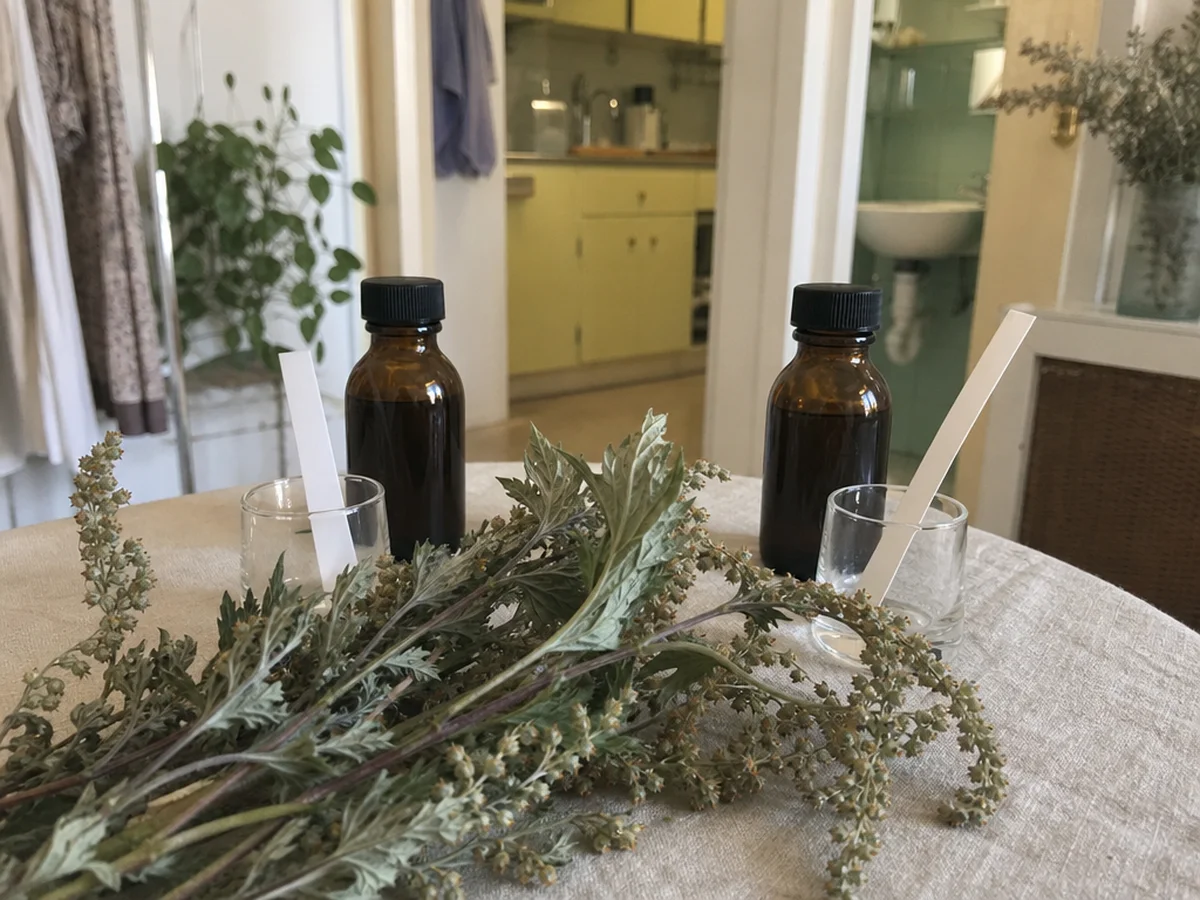
Do not push your nose into the bottle. Open it, hold it a hand's width away and wave it gently, because a concentrated oil can overwhelm the first sniff and leave you unable to tell what you are smelling. Better still, dip a blotting strip, wave it in the air and come back to it every few minutes. You will probably notice the cool camphor edge arrive first, with the greener, bitter side settling in behind it as the strip dries.
Give your nose a rest between sniffs, too. Smelling your own sleeve or a jar of coffee beans between strips is an old perfumery habit, and it makes the quieter sweetness easier to catch.
Why two bottles of mugwort oil can smell different
That same pair of extractions shows the bigger picture. The authors of the Chinese study note that compound contents varied markedly with the extraction method, and between plants it moves further: the Brazilian oil was led by caryophyllene, germacrene D and humulene with no thujone among its major components, while a Serbian Artemisia vulgaris, harvested in flower and shade-dried, was led by gurjunene and cis-chrysanthenyl acetate, with trans-thujone not detected. A nose meeting those oils would be meeting different smells that share a name.
So our advice is not to buy mugwort oil on a description, ours included. A description tells you about a type of oil; the lot is what you hold. If the aroma matters to your project, smell a sample before committing to a large size. Our wholesale page offers sample bottles for exactly that, and the composition article compares the published analyses side by side. The shop lists our oil as a middle note, and the note placement article looks at what that means.
The smell is not the whole story
A pleasant or sharp aroma says nothing about thujone, the constituent with a published ceiling. The EMA statement notes severe poisonings after consumption of thujone-rich essential oil and that thujone content should be shown for every batch of a herbal product. Our guidance is to avoid mugwort oil during pregnancy and to keep it away from children and pets, and the safety article is worth reading before you put the oil in anything you will wear or breathe. For how perfumers handle the name armoise, see armoise oil in perfumery.
Finding your own words
Descriptions are only starting points, and we would encourage you to write your own. Try finishing sentences such as "it reminds me of a cut stem", "it reminds me of a clean cupboard" or "it is greener than I expected". There are no wrong answers, and the words you choose will help you decide what to pair it with and how much to use.
Green, bitter, cool and a little sweet at the edges: once you know where the words come from, a bottle of mugwort oil becomes much easier to read.
Mugwort Essential Oil
Mugwort Essential Oil from our own shop, in sizes from 0.5 oz to bulk.
From $16.99
Shop Now →Sources & Further Reading
- Chemical Composition and Antimicrobial Activities of Artemisia argyi Lévl. et Vant Essential Oils Extracted by Simultaneous Distillation-Extraction, Subcritical Extraction and Hydrodistillation
- Chemical Profile and Biological Activities of Essential Oil from Artemisia vulgaris L. Cultivated in Brazil
- Allelopathic Potential of Artemisia absinthium and Artemisia vulgaris from Serbia: Chemical Composition and Bioactivity on Weeds
- PubChem, National Library of Medicine: compound records for camphor (CID 2537), borneol, eucalyptol, beta-caryophyllene and caryophyllene oxide
- European Medicines Agency, HMPC: Public statement on the use of herbal medicinal products containing thujone (EMA/HMPC/732886/2010 Rev. 1)