Is Mugwort a Top, Middle or Base Note? Test It Yourself
Ask three perfumers where mugwort sits in the pyramid and you may get three answers, and none of them would be wrong. We list our mugwort oil as a middle note, and we are comfortable with that. But the interesting part is why the question is harder than it looks, and how you can settle it for yourself with a strip of paper and a little patience.
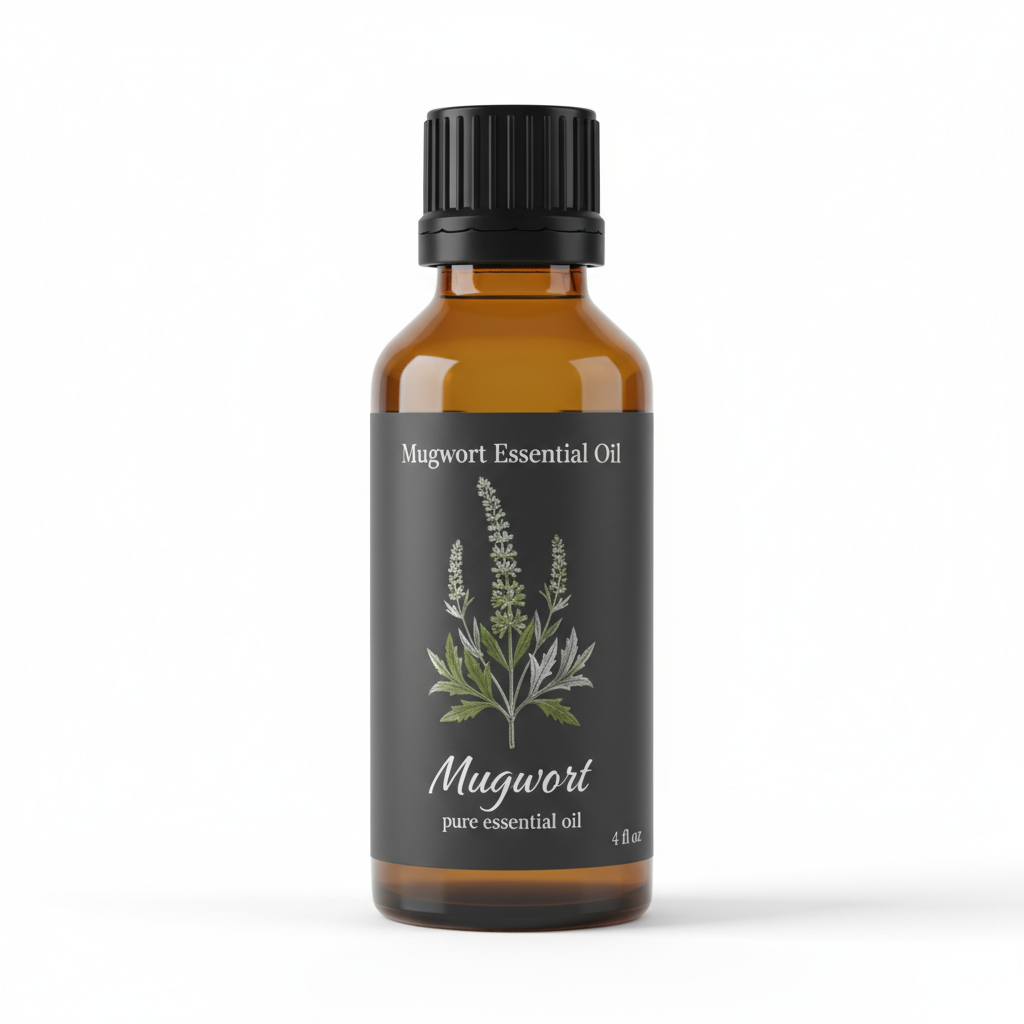
Mugwort Essential Oil
Our own Mugwort Essential Oil, in sizes from 0.5 oz to bulk.
From $16.99
Shop Now →The pyramid is a guide, not a law
Top, middle and base notes are a teaching tool for how a scent unfolds as its ingredients evaporate at different speeds. It is a useful picture, and a rough one. Armoise oils, the Moroccan relatives of mugwort sold to perfumers, show how loosely the labels are applied. Eden Botanicals lists its armoise as a top and middle note (Armoise (Mugwort) - Wild EO | Eden Botanicals), Biolandes describes sweet, fresh, slightly mentholated top notes with a camphor lift (ARMOISE - Biolandes), and Fraterworks calls its version a heart note that lasts around 18 hours on a smelling strip (Armoise Oil, Morocco - Fraterworks). Same word, three positions. It is a reminder that a note is a description of how a material behaves in a given blend and not a fixed property.
Why one name can cover very different oils
What an oil does on a strip depends on what is in it, and mugwort oils differ widely. Take two published analyses. A cultivated Artemisia vulgaris oil from Brazil was dominated by heavy sesquiterpenes: caryophyllene at 37%, germacrene D at 16% and humulene at nearly 14% (Malik et al., 2019). Those molecules are large and slow to leave a strip, which is how a base note behaves. An Artemisia argyi oil from China was led by cineole at about 14%, a lighter, quicker-moving molecule (Li et al.). From chemistry alone you would expect that oil to feel brighter and to move on sooner.
That is our reasoning from the molecules, not a measurement on any bottle. A review of common mugwort puts it more broadly: because of high diversity and differing test methods, it is hard to indicate one distinct profile for the species (Ekiert et al., 2020). So a number on a sheet is a convenience, and the oil you hold is the evidence.
How we think about ours
We describe our mugwort oil as green, bitter and camphoraceous, with sage-like, herbaceous facets and a curious sweet undertone, and we list it as a middle note. The Certificate of Analysis we publish for one batch gives a relative density and a refractive index, which are handy physical checks but say nothing about volatility, so they cannot place it on the pyramid. If a formula depends on knowing the constituents, write to us through the contact page and ask before you order.
Place it yourself in an afternoon
Perfumers have always done this with the nose, and it is more fun than reading a table.
- Dip a strip of blotting paper in a diluted solution of the oil. Dilution keeps the scent manageable and the oil off your skin.
- Dip a second strip in something you already know well that is quick to fade, such as a citrus oil, and a third in something slow, such as a woody one. They become your yardsticks.
- Smell all three at set times: right away, after ten minutes, after an hour, and the next morning. Write down what you notice.
If the mugwort is still singing when the citrus has gone and the wood is only just arriving, you have your answer, and it belongs to your bottle. The strips stay on the table, not on skin: we suggest mugwort for fragrance craft, and for skin our guidance is a 0.5% to 2% dilution in a carrier with a patch test, starting at the low end. It is best avoided in pregnancy and kept from children and pets.
What to write down
The strips only help if you record what happens, so keep a simple page: the time, a few words for the first impression, a few for the middle and a few for the dry-down the next morning. Words like "sharp", "leafy", "cool", "dusty" and "sweet at the edges" are plenty. After two or three oils you will start to see your own pattern, and it makes mugwort far less mysterious.
Resist the urge to judge too early. Camphor-edged materials can announce themselves loudly in the first minute and then step back, and the quieter part that follows is often the part you will actually blend with.
Using the result
Once you know where it lands for you, building around it is the fun part. Our pairing guide suggests partners, mugwort in fougère and chypre accords shows how it sits in classic structures, and the smell profile puts words to the scent.
When you do start blending, change one thing at a time. Add the mugwort a drop at a time to a base you already like, smell, and write down the count. It is the quickest way to learn how far a little goes, and it keeps every experiment easy to repeat.
A middle note is where a lot of the character of a perfume lives, so if mugwort turns out to be one for you, you are in good company.
Mugwort Essential Oil
Mugwort Essential Oil from our own shop, in sizes from 0.5 oz to bulk.
From $16.99
Shop Now →Sources & Further Reading
- Armoise (Mugwort) - Wild EO | Eden Botanicals. edenbotanicals.com
- ARMOISE - Biolandes. biolandes.com
- Armoise Oil, Morocco - Fraterworks. fraterworks.com
- Malik S, et al. 2019. Chemical Profile and Biological Activities of Essential Oil from Artemisia vulgaris L. Cultivated in Brazil. PMC6631396
- Li D, et al. The antimicrobial effect and mechanism of the Artemisia argyi essential oil against bacteria and fungus. PMC10920523
- Ekiert H, et al. 2020. Significance of Artemisia Vulgaris L. (Common Mugwort) in the History of Medicine and Its Possible Contemporary Applications Substantiated by Phytochemical and Pharmacological Studies. PMC7583039