Mugwort Potpourri Recipe: Two Mixes Worked Out by Weight
Potpourri is a slow, forgiving craft: dry some botanicals, add a fixative and a touch of oil, seal the jar and wait a month. Mugwort suits it well, because the dried leaf brings a soft, silvery green scent and the oil adds depth. Two mixes below are worked out by weight, so you can scale them up or down with a kitchen scale.

Mugwort Essential Oil
Our own Mugwort Essential Oil, in sizes from 0.5 oz to bulk.
From $16.99
Shop Now →How much oil, really?
The extension guides we read give no real quantity. Nebraska Extension says "a few drops of a compatible essential oil" (Potpourri: Make Your Own, Nebraska Extension). A few drops means very different things in a 50 g sachet and a 500 g bowl, so we start from weight.
The nearest published benchmark is IFRA's, the fragrance industry's standards body. Its guidance places pot-pourri in Category 10A, and its thujone standard allows 0.13% thujone in a finished Category 10A product, against 9.5% for Category 12, which covers fragrancing sachets and incense (IFRA Standards, 51st Amendment). IFRA's rules bind fragrance suppliers, not hobbyists, but it is sensible to borrow its caution.
The cap is on thujone, so the oil dose it allows depends on how much of the oil is thujone. We publish no thujone figure for our oil, and a buyer who needs one can ask us in writing through our contact page and get the answer in writing before relying on it. With the 0.895 relative density from the batch on our published certificate of analysis and about 20 drops per ml, this is the arithmetic per 100 g of dry mix:
| Oil per 100 g mix | Weight | About how many drops | Highest oil thujone share under 0.13% |
|---|---|---|---|
| 0.25% | 0.25 g | 6 | 52% |
| 0.5% | 0.5 g | 11 | 26% |
| 1.0% | 1.0 g | 22 | 13% |
Our suggestion is to start in the top row. The label's Latin name and the batch paperwork should name the same plant, a check that reading a mugwort oil label walks through.
Two mixes
These are formulations, not tested results. The 10% orris amount is our starting suggestion, since the sources give no fixative quantity. Nebraska Extension calls orris root "the best known fixative" and notes that chunks last longer and suit sachets because powder sifts through fabric.
| Mix | Ingredients by weight | Oil at 0.25% |
|---|---|---|
| 1. Bowl mix, 100 g | 40 g dried mugwort leaf, 30 g cedar shavings, 20 g juniper berries, 10 g orris root chunks | 0.25 g, about 6 drops |
| 2. Sachet filler, 50 g | 30 g dried mugwort leaf, 15 g dried rose petals, 5 g orris root chunks | 0.125 g, about 3 drops |
We sell none of the botanicals, so an herb or craft supplier is the place to buy dried mugwort, cedar, juniper, roses and orris. Ask for the plant species, the part used and whether anything was treated. Cedar and juniper in mix 1 echo the oils we list as good partners for mugwort (see the pairing guide), though dried botanicals behave differently from oils.
Choose leaf rather than flowering tops. Mugwort pollen is a recognised allergen, and our reasoning is that dried flowering tops could shed it, so anyone with a known allergy should ask an allergist before handling the dried plant. Our allergy article has more.
Mix, add the oil, then wait
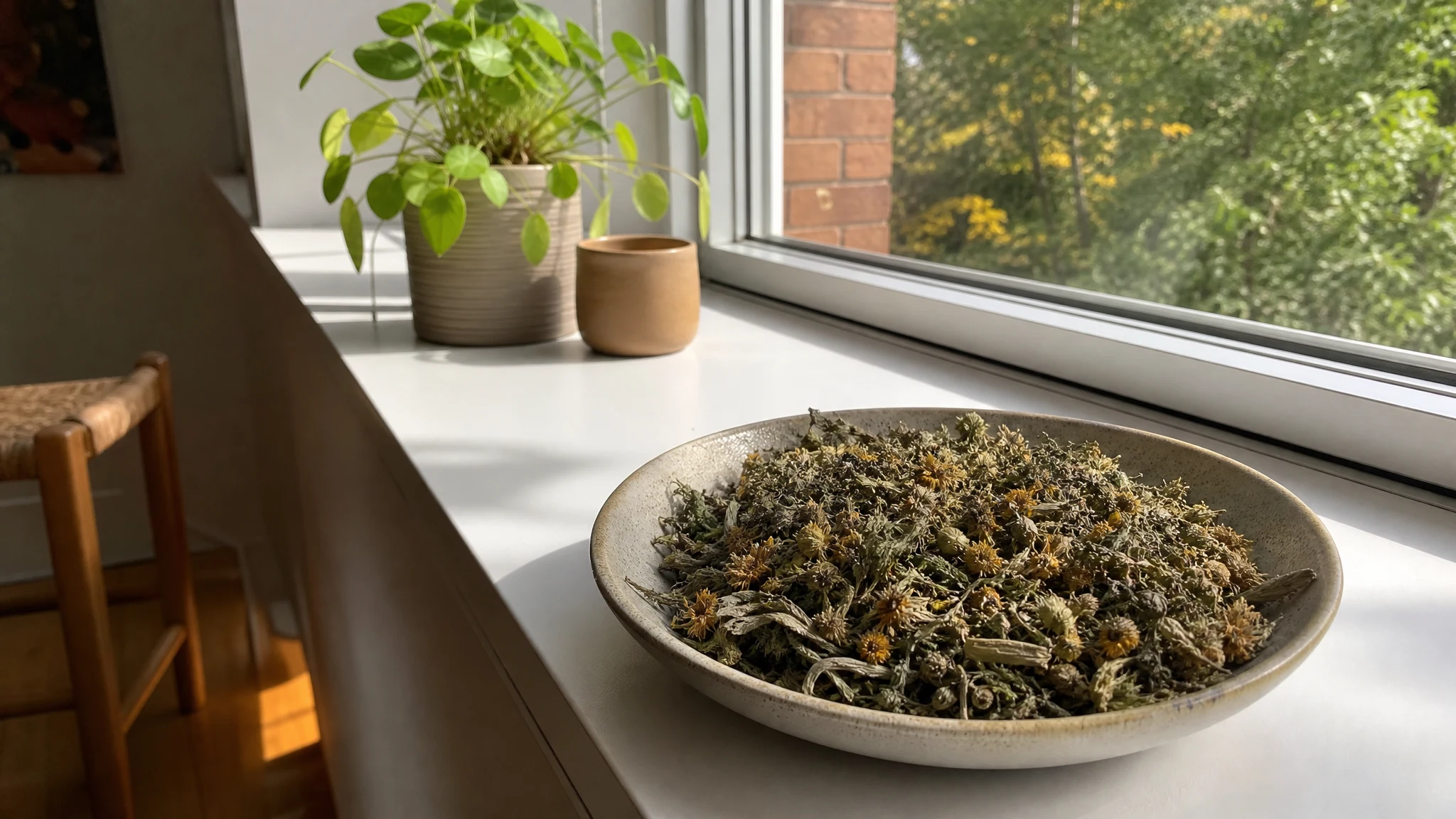
Dry everything completely first; the extension guide says this can take a few days to a few weeks. Weigh the botanicals and orris into a bowl, then add the oil by weight on a scale that reads to 0.01 g if you can. Droppers differ, and the oil is sold neat. Seal the mix in a tightly closed glass jar, since the guide warns plastic or metal may interact with essential oils. It says potpourri "needs to age for at least a month", with a daily shake, in a cool, dry place. Smell it at the end of that month before judging the dose, and change only one thing in the next batch.
Looking after the jar once it is ready
When the month is up, open the lid in a well-aired room and give the jar a gentle swirl. A good mix smells soft and layered, with the dried mugwort leaf green and silvery at the back and the cedar and juniper in front. If the scent seems faint later in the season, we would not pour oil straight onto the mix. Add a single drop to a dry corner, stir it in with a spoon, reseal the jar for a few days and note the change in your notebook.
Potpourri is pleasant to look at as well, so a clear jar on a shelf out of direct sun works nicely. Sunlight fades dried botanicals, and a cupboard keeps them closer to the colour they started with.
Who should skip it
This is for dry mixes only. Keep bowls and sachets out of reach of children and pets, and ask a veterinarian before scenting a home with animals; our pets article gathers what vets report. Our safety copy says to avoid mugwort oil in pregnancy and never to take it internally, so anyone pregnant or nursing should ask an obstetric clinician first. A sachet should stay closed and off the skin. For a pillow or sachet in more detail, see our dream pillow and sachet article.
If the first jar smells right after its month, write down the grams, not the drops, and make it again before changing anything.
Mugwort Essential Oil
Mugwort Essential Oil from our own shop, in sizes from 0.5 oz to bulk.
From $16.99
Shop Now →Sources & Further Reading
- Nebraska Extension in Lancaster County. Potpourri: Make Your Own. lancaster.unl.edu/potpourri
- IFRA. IFRA Standards, 51st Amendment (Thujone). IFRA Standards PDF