How to Judge Mugwort Oil Quality: What Paperwork Shows
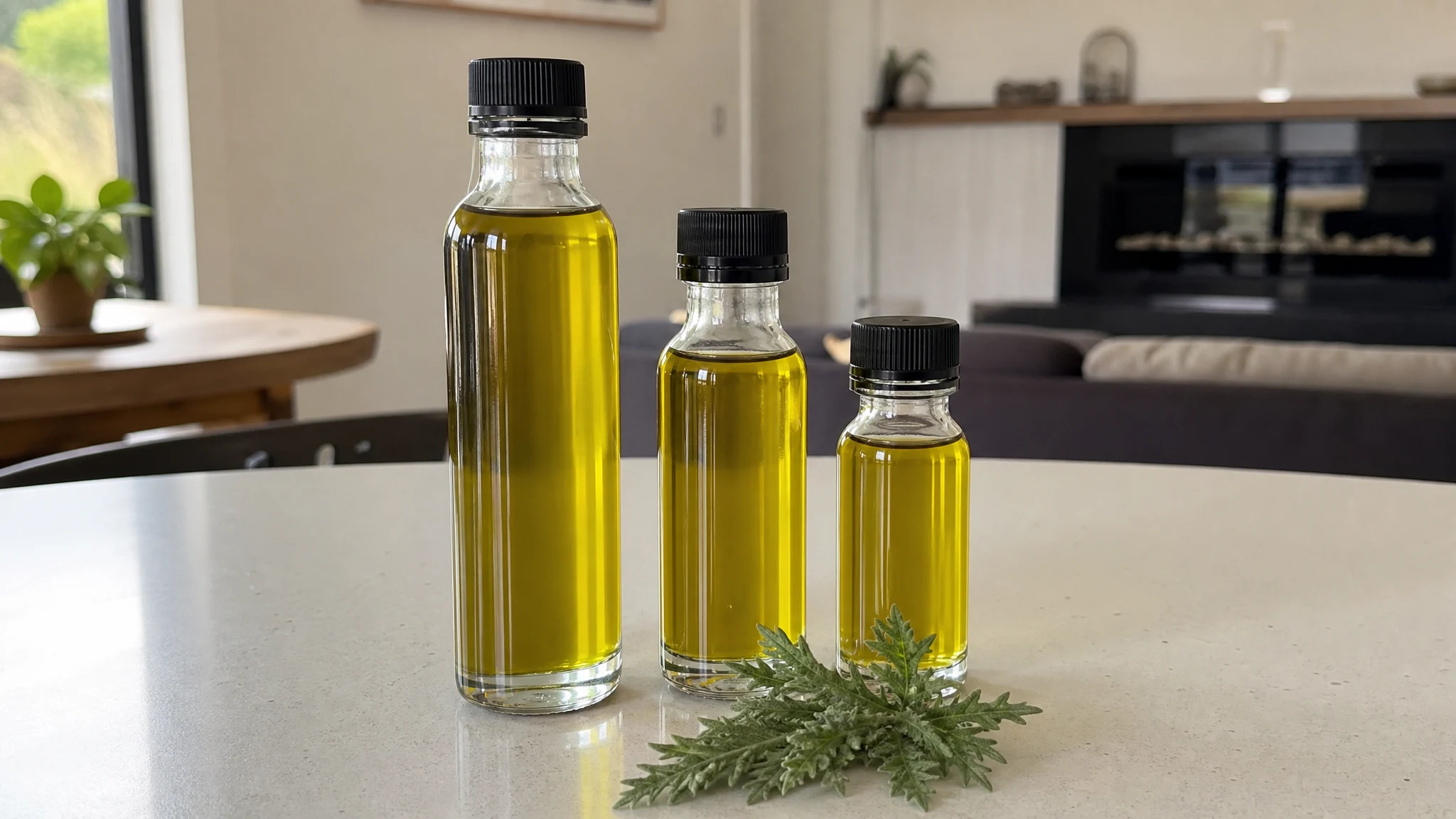
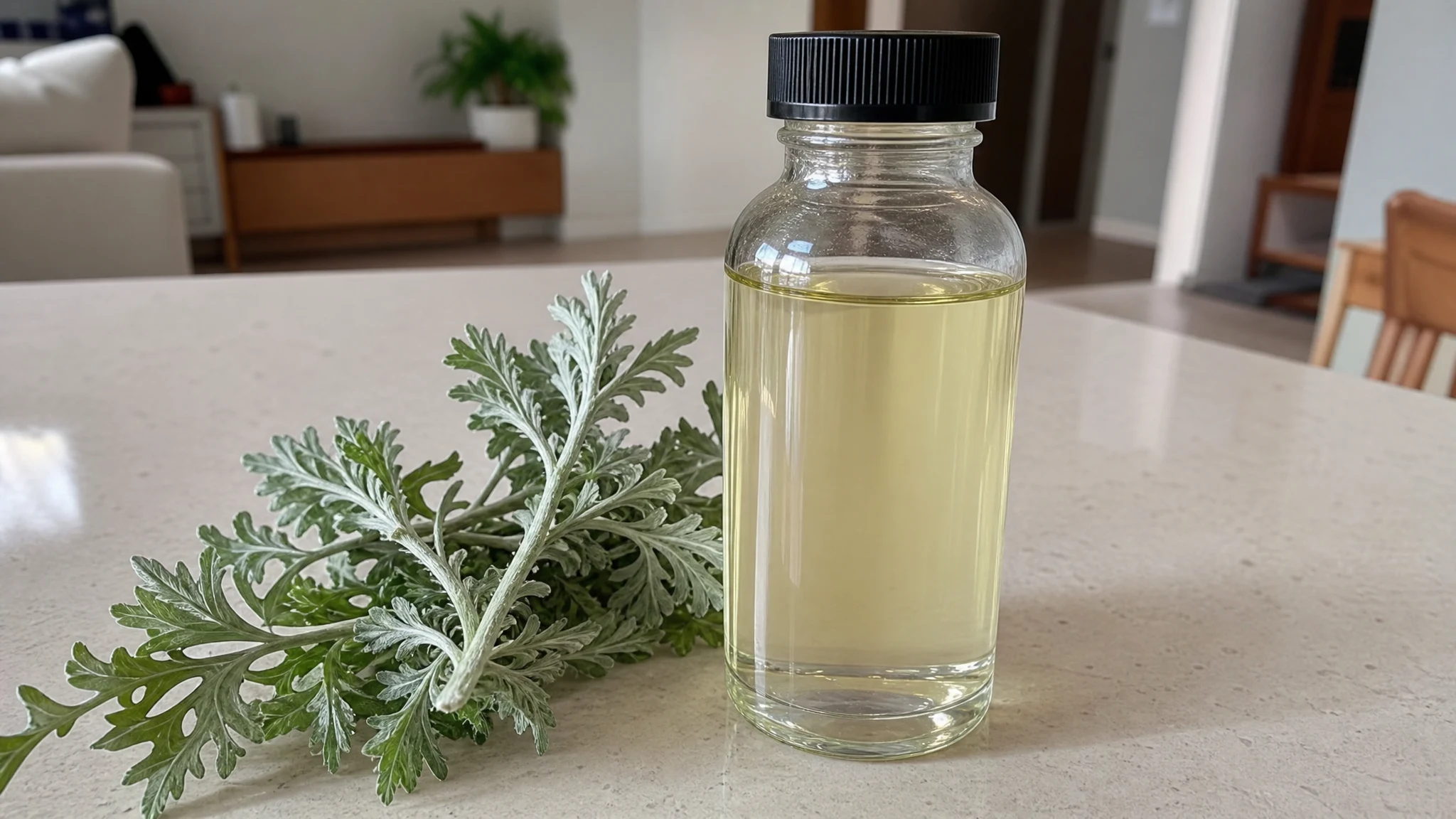
Pour three mugwort oils side by side and you could be looking at a dark green liquid, a yellow one and a pale yellow one, all honestly sold under the same name. Colour and nose are enjoyable ways to meet an oil, but they are poor ways to judge it, and that is worth knowing before you spend money.

Mugwort Essential Oil
Our own Mugwort Essential Oil, in sizes from 0.5 oz to bulk.
From $16.99
Shop Now →Why looking and sniffing only get you so far
A research team in China took leaves of Artemisia argyi from a single farm and extracted them three ways. Hydrodistillation gave a dark green oil, subcritical extraction gave a yellow one, and simultaneous distillation-extraction gave a pale yellow one. Same leaves, three colours, and the methods also changed the chemistry: the dark green oil carried more caryophyllene oxide, while the yellow one carried more beta-caryophyllene (Guan and colleagues, 2019). So a listing that says mugwort oil "should be green" has described a preference rather than a test.
Composition varies from plant to plant as well. A cultivated Artemisia vulgaris from Brazil was led by caryophyllene and germacrene D and listed no thujone at all (Malik and colleagues, 2019). Hydrodistilled Chinese A. argyi leaves in the first study contained alpha-thujone at just under 8% of the oil. Another A. argyi paper, steam-distilling leaves and stems from an Anhui plantation, led with cineole and did not mention thujone (Li and colleagues, 2024). All of these are described as mugwort oils. Our composition article goes through more of that variety.
The fair conclusion is that scent tells you whether you like an oil, and a trained nose cannot be expected to confirm it is the oil on the label. A 2024 review of authenticity methods groups the available tools into three families: sensory evaluation, physical and chemical properties, and full chemical composition analysis. The first two are the quick, inexpensive ones. The third, usually gas chromatography with mass spectrometry (GC-MS), is where questions of identity get settled (Yang and colleagues, 2024).
What paperwork can do for you
Each document answers one question, and knowing which saves a lot of confusion.
- The Latin name on the label tells you which plant the seller says it is. It is worth matching against the batch paperwork, and the two should name the same plant.
- Relative density and refractive index show the liquid falls within a plausible range for a light essential oil. Many oils overlap there, so they do not identify a particular plant.
- A GC-MS report lists constituents and their proportions for one sample. It is the document that can speak to composition, and it is most useful when it names the batch.
- A thujone figure is the input for working out how much oil a product category allows.
- A safety data sheet covers hazards, handling and storage in sixteen standard sections. US hazard communication rules expect manufacturers and importers to supply one to distributors and employers with the first shipment and on request, so a business buyer should simply ask.
- A batch number and best-by date tie the paperwork to the bottle in your hand.
What our published certificate shows
We publish a one-page Certificate of Analysis for one batch, at our COA page. It lists the batch number, appearance (a green, clear, transparent liquid), smell, a relative density of 0.895 at 20 C, a refractive index of 1.4750 at 20 C, the steam-distillation extraction method and a best-by date of 07/14/2028. It is a snapshot of that batch and we describe it that way. It does not carry a GC-MS profile or a thujone figure, so if you are formulating a product where those matter, please ask us in writing through the contact page and get the answer in writing before you rely on it. That simple step protects you with any supplier.
Thujone belongs on your list
If the oil is going into something that touches skin, thujone is the quality figure that does the most work, because it sets the ceiling. The IFRA Standards (51st Amendment) restrict thujone by product category: 1.4% of the finished product for fine fragrance (Category 4), 0.095% for body creams and oils (Category 5A), 0.016% for Category 5C and 9.5% for candles (Category 12). The maximum oil percentage is the cap divided by the oil's thujone share, so with an oil at 10% thujone, a Category 5A product could hold at most 0.95% oil. That is arithmetic to show how the sum works, not a figure for any oil we sell.
Our own dilution guidance for skin is 0.5% to 2% in a carrier oil with a patch test first, with minimal dilutions and the low end as the sensible place to begin. We also advise avoiding use during pregnancy, keeping the oil from children and pets, and never taking it internally. For skin products, a cosmetic safety assessor or a dermatologist is the right person to check a formulation.
A short list to carry into any purchase
- Is the Latin name stated, and does the batch paperwork name the same plant?
- Are plant part and extraction method stated?
- Does the batch number on the bottle match the one on the certificate?
- Is there a GC-MS report if you need composition?
- Will the seller put testing, origin or certification claims in writing?
One small habit helps more than any chart: keep a notebook page for each oil you buy. Write the date, the batch number, how the bottle looked when you opened it and what the first sniff reminded you of. Months later, when you wonder whether a bottle has changed or whether your nose has, that page is a kinder judge than memory.
Our label-reading guide goes field by field, and where to buy mugwort essential oil covers questions for each kind of seller. Asking good questions is a perfectly good way to get to know an oil, and a seller who answers them in writing is worth keeping.
A good oil is one you understand a little better each time you open it, and a few questions asked early make that easy.
Mugwort Essential Oil
Mugwort Essential Oil from our own shop, in sizes from 0.5 oz to bulk.
From $16.99
Shop Now →Sources & Further Reading
- Chemical Composition and Antimicrobial Activities of Artemisia argyi Lévl. et Vant Essential Oils Extracted by Simultaneous Distillation-Extraction, Subcritical Extraction and Hydrodistillation. Molecules 2019;24(3):483. PMC6384757
- Chemical Profile and Biological Activities of Essential Oil from Artemisia vulgaris L. Cultivated in Brazil. Pharmaceuticals 2019;12(2):49. PMC6631396
- The antimicrobial effect and mechanism of the Artemisia argyi essential oil against bacteria and fungus. Brazilian Journal of Microbiology 2024;55. PMC10920523
- Advanced analytical techniques for authenticity identification and quality evaluation in Essential oils: A review. Food Chemistry 2024;451:139340. Europe PMC
- 29 CFR § 1910.1200 - Hazard communication. Legal Information Institute, Cornell Law School. law.cornell.edu
- The complete IFRA Standards, up to and including the 51th Amendment (January 2024), Standard "Thujone" (Amendment 49). IFRA. IFRA Standards, 51st Amendment